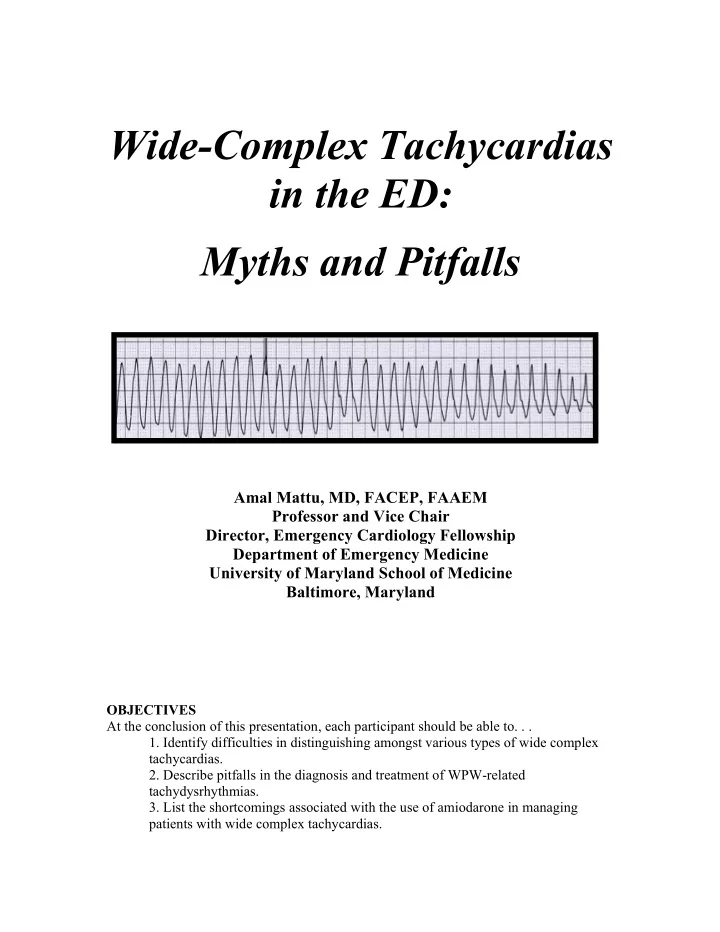
SLIDE 2 WCTs in the ED: Myths and Pitfalls Amal Mattu, MD
2
- I. ECG Diagnosis of Wide Complex Tachycardias
ACLS 2000 — Stable WCT, unknown type: “Attempt to establish a specific diagnosis”
- 12-lead ECG
- Esophageal lead
- Clinical information
Myth: The electrocardiogram can reliably distinguish between VT and SVT-AC. Classic teaching: “…assume WCT is VT until proven otherwise…” “…when in doubt, assume and treat WCT as VT…” ECG clues favoring VT: AV dissociation QRS > 140 ms. or RS > 100 ms. Captured beats Precordial concordance Fusion beats V1: taller left “rabbit ear” Leftward axis V1: “steeple sign Rightward axis V6: rS, QS, or QR complex Extreme rightward axis V6: S or QS > 15 mm deep Brugada Criteria (Circulation, 1991)
- 1. Absence of RS complex in all precordial leads?
- 2. RS interval > 100 ms. in one precordial lead?
- 3. AV dissociation?
- 4. Morphology criteria for VT present in precordial leads V1-2 and V6?
- Sensitivity 98.7%, specificity 96.5%
Herbert, et al (Ann Emerg Med, 1996)
- 27 ECGs with WCT from ED records
- Three emergency physicians
- Apply Brugada criteria
- 22% disagreement in distinguishing VT from SVT-AC
Isenhour, et al (Acad Emerg Med, 2000)
- 157 ECGs with WCT, final diagnosis confirmed electrophysiologically
- Two cardiologists, two emergency physicians
- Apply Brugada criteria
- Sensitivity at diagnosing VT
- Emergency physicians: 83% and 79% (interobserver agreement 82%)
- Cardiologist: 85% and 91% (interobserver agreement 81%)
Jastrzebski, et al. (Europace, 2013)
- 260 WCTs of which 159 were VT
- Sensitivities for detecting VT…