WINERY PRESENTATION ITALY Umbria Montefalco If you happen to visit - - PDF document

winery presentation italy umbria
SMART_READER_LITE
LIVE PREVIEW

WINERY PRESENTATION ITALY Umbria Montefalco If you happen to visit - - PDF document

WINERY PRESENTATION ITALY Umbria Montefalco If you happen to visit the region of Umbria you will notice that is a wide valley that has in the center a small mountain or better a big hill known since the Middle Age as the Hawks


slide-1
SLIDE 1

VinUS Inc. NAPOLINI PRESENTATION 1 WINERY PRESENTATION ITALY Umbria

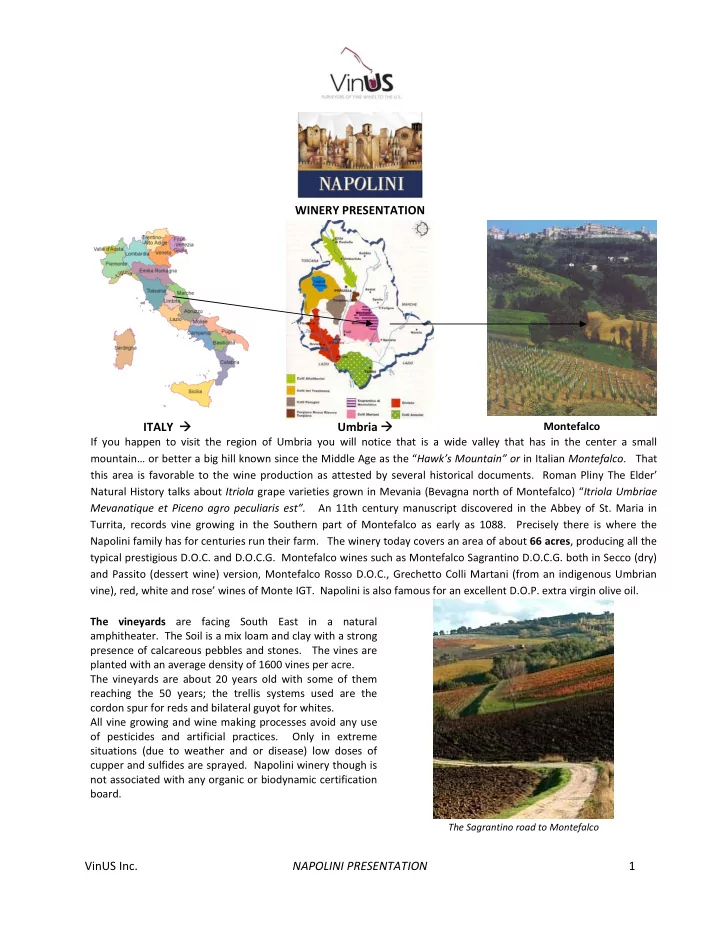
Montefalco If you happen to visit the region of Umbria you will notice that is a wide valley that has in the center a small mountain… or better a big hill known since the Middle Age as the “Hawk’s Mountain” or in Italian Montefalco. That this area is favorable to the wine production as attested by several historical documents. Roman Pliny The Elder’ Natural History talks about Itriola grape varieties grown in Mevania (Bevagna north of Montefalco) “Itriola Umbriae Mevanatique et Piceno agro peculiaris est”. An 11th century manuscript discovered in the Abbey of St. Maria in Turrita, records vine growing in the Southern part of Montefalco as early as 1088. Precisely there is where the Napolini family has for centuries run their farm. The winery today covers an area of about 66 acres, producing all the typical prestigious D.O.C. and D.O.C.G. Montefalco wines such as Montefalco Sagrantino D.O.C.G. both in Secco (dry) and Passito (dessert wine) version, Montefalco Rosso D.O.C., Grechetto Colli Martani (from an indigenous Umbrian vine), red, white and rose’ wines of Monte IGT. Napolini is also famous for an excellent D.O.P. extra virgin olive oil. The vineyards are facing South East in a natural

  • amphitheater. The Soil is a mix loam and clay with a strong

presence of calcareous pebbles and stones. The vines are planted with an average density of 1600 vines per acre. The vineyards are about 20 years old with some of them reaching the 50 years; the trellis systems used are the cordon spur for reds and bilateral guyot for whites. All vine growing and wine making processes avoid any use

  • f pesticides and artificial practices. Only in extreme

situations (due to weather and or disease) low doses of cupper and sulfides are sprayed. Napolini winery though is not associated with any organic or biodynamic certification board.

The Sagrantino road to Montefalco

slide-2
SLIDE 2

VinUS Inc. NAPOLINI PRESENTATION 2

Grechetto Colli Martani – Trebbiano Spoletino

Cultivars: Napolini’s main white varietal used is the Grechetto Colli Martani. This varietal is quite strong and has good production levels, ripens relatively early making wine of medium to high alcohol with full flavor and good acidity. When used in blends, it adds perfume, flavor and structure to the wines. Grechetto is used to make the Vigna di Clara and is one of the varietals used as well for the Bianco dei Monti together with Tocai Friulano and Chardonnay, Trebbiano Toscano and the Trebbiano Spoletino. The latter one is a genetic mutation of the trebbiano family, which is very late maturing yet, brings up a lot of structure in terms of acidity and sugar content. Reds: all the typical varieties of Umbria region like Sagrantino, Sangiovese, Montepulciano di Abruzzo and Ciliegiolo are grown. These are used to make the Rosso di

  • Montefalco. Same varietals with some merlot are used to

make their Rosso dei Monti. Of course Napolini makes as well a straight Sagrantino a very important varietal that is indigenous from Montefalco. Sagrantino vines at harvest time all leaves are red! Sagrantino The Sagrantino name comes from latin sacer (sacre). Since the Middle Age the wines made with this varietal were used as “the holy wine” by the Pope for masses. The bunch is made of big thick grapes that they fully ripen by mid October. The must from the grapes has a deep color good sugar content, therefore mid to high alcohol content wines will come out, with fairly high acidity and tannins. The proper late maturation in the vines and the characteristics of the grape make this wine fairly easy to vinify; but in order to get the complexity that the wine deserves it requires a long rest in casks in order to smooth down their characteristic tannin and spiciness. All wines at Napolini go thru alcoholic fermentation in stainless steel tanks and/or concrete vats. All of them are fermented on spontaneous yeast. Whites rest on fine lees for at least three months. Reds after the alcoholic fermentation is complete are put in oak casks where the malolactic and the ageing take place. Specifically the Sagrantino ages 9 months in barriques for the malolactic then 2 years in Slavonian casks 30HL and another year of fining in the bottle. That is true both for the dry version and the dessert one. The Rosso di Montefalco goes directly in Slavonian oak for one year, while the Rosso stays in concrete and stainless steel again for one year.

Mario Napolini in his cellar

slide-3
SLIDE 3

VinUS Inc. NAPOLINI PRESENTATION 3 White Wines

Bianco Dei Monti: this wine is made of 60% Trebbiano Toscano, 15% Trebbiano Spoletino,, 9% Grechetto, 8% Tocai Friulano and 8% Malvasia grapes that are harvested at the end of September and fermented together in stainless steel tanks with no malolactic induced. Wine is kept of fine lees for three months then bottled. Tasting profile: Bianco Dei Monti shows a deep yellow color a very floral nose and refreshing taste. It pairs well with fish and white meat dishes or cheeses of mild texture grilled veggies salads. Vigna di Clara: This wine is made of Grechetto dei Colli Martani with the grapes harvested the first two weeks of

  • September. The wine ferments in stainless steel tanks

with no malolactic and rests on fine lees for 5 months before being bottled. Tasting profile: The color is bright straw yellow. The nose is

  • f white flowers, peaches and apricots that are also found in

the mouth with but with a toasted almonds finish. Excellent as an aperitif or with delicate dishes such as appetizers, fish white meats grilled vegetables and soft cheeses.

Red Wines Vigna Rosa: This rose' is made of Sangiovese,

Sagrantino and Montepulciano varietals. The grapes are handpicked and left soaking for less than a day in the fermenting vat without pressing them.

Tasting profile: the result is a refreshing wine with cherry

notes that can be paired with medium cheeses and light first courses.

Rosso Dei Monti: a blend of Sangiovese, Sagrantino,

Ciliegiolo, Merlot and Montepulciano di Abruzzo. Grapes are harvested at the end of September first week of October and then fermented together with long maceration on skins for about 20 days and frequent pump over (remontage). The wine rest for one year in stainless steel and concrete tanks than are bottled and fines for 3 months at least before being released.

Tasting profile: A bright ruby red color welcomes a cherry

and flavors with spicy notes. It pairs well with hard cheeses and red meat particularly if barbecued.

Rosso Di Montefalco: it is made with 60% Sangiovese,

20% Sagrantino, 10% Montepulciano di Abruzzo, 10% Merlot grapes harvested by hand in the middle of

  • October. The must is left in contact with the skins for 20

days then the wine is put in cask of Slavonian oak for at least one year. After that the fining in bottle for 6 months takes place prior to release.

Tasting profile: Ripe cherry and black berries flavors with

some spicy notes and round tannins. It pairs well pork meat dishes, game dishes, rich pastas or risotto with truffles and mushrooms.

Sagrantino: Sagrantino grapes are handpicked at the

end of October. The wine has a long maceration period

  • f over a month during which the alcoholic fermentation

takes place. Then it is put in tonneaux and barriques for six months (where the malolactic process takes place); after that moment the ageing is being done for 18 months in Slavonian oak casks. The wine then is bottled and rest fining for 9 months before is being released.

Tasting profile: Ruby red with garnet hues the nose has

spicy notes with black and blue berries firm tannins but smooth and dry. It goes well with rich dishes like “ragu pasta” and game such as quail, braised wild boar meat or roasted lamb sharp hard cheeses.

Sagrantino Passito: the ripest grapes of sagrantino are

harvested at the end of October and left on vertical nets to dry for 75 days. After that time the grapes are very concentrated are then squeezed and fermented in barriques for 6 months and left for almost 2 years before bottling the wine.

Tasting profile: the wine is deep red almost purple in color

with intense notes of blackberries blue berries and currants. It is sweet but at the same time lively and can be paired with strong cheeses, some roasted meat and dry pastries.

slide-4
SLIDE 4

VinUS Inc. NAPOLINI PRESENTATION 4 Notes: _____________________________________________________________________________________ _____________________________________________________________________________________ _____________________________________________________________________________________ _____________________________________________________________________________________ _____________________________________________________________________________________ _____________________________________________________________________________________ _____________________________________________________________________________________ _____________________________________________________________________________________ _____________________________________________________________________________________ _____________________________________________________________________________________ _____________________________________________________________________________________ _____________________________________________________________________________________ _____________________________________________________________________________________ _____________________________________________________________________________________ _____________________________________________________________________________________ _____________________________________________________________________________________ _____________________________________________________________________________________ _____________________________________________________________________________________ _____________________________________________________________________________________ _____________________________________________________________________________________ _____________________________________________________________________________________ _____________________________________________________________________________________ _____________________________________________________________________________________ _____________________________________________________________________________________ _____________________________________________________________________________________ _____________________________________________________________________________________ _____________________________________________________________________________________ _____________________________________________________________________________________ _____________________________________________________________________________________ _____________________________________________________________________________________ _____________________________________________________________________________________ _____________________________________________________________________________________ _____________________________________________________________________________________ _____________________________________________________________________________________ _____________________________________________________________________________________ _____________________________________________________________________________________ _____________________________________________________________________________________