
SLIDE 1
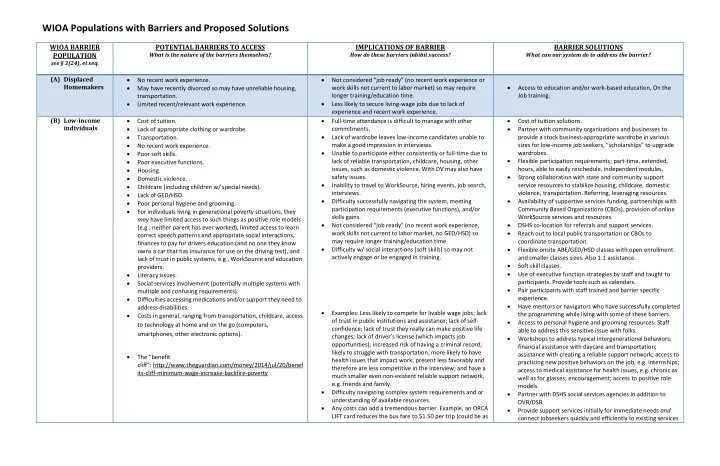
WIOA Populations with Barriers and Proposed Solutions
WIOA BARRIER POPULATION
see § 3(24), et seq.
POTENTIAL BARRIERS TO ACCESS
What is the nature of the barriers themselves?
IMPLICATIONS OF BARRIER
How do these barriers inhibit success?
BARRIER SOLUTIONS
What can our system do to address the barrier?
(A) Displaced Homemakers
- No recent work experience.
- May have recently divorced so may have unreliable housing,
transportation.
- Limited recent/relevant work experience.
- Not considered “job ready” (no recent work experience or
work skills not current to labor market) so may require longer training/education time.
- Less likely to secure living-wage jobs due to lack of
experience and recent work experience.
- Access to education and/or work-based education, On the
Job training. (B) Low-income individuals
- Cost of tuition.
- Lack of appropriate clothing or wardrobe.
- Transportation.
- No recent work experience.
- Poor soft skills.
- Poor executive functions.
- Housing.
- Domestic violence.
- Childcare (including children w/ special needs).
- Lack of GED/HSD.
- Poor personal hygiene and grooming.
- For individuals living in generational poverty situations, they
may have limited access to such things as positive role models (e.g., neither parent has ever worked), limited access to learn correct speech patterns and appropriate social interactions, finances to pay for drivers education (and no one they know
- wns a car that has insurance for use on the driving test), and
lack of trust in public systems, e.g., WorkSource and education providers.
- Literacy issues.
- Social services involvement (potentially multiple systems with
multiple and confusing requirements).
- Difficulties accessing medications and/or support they need to
address disabilities.
- Costs in general, ranging from transportation, childcare, access
to technology at home and on the go (computers, smartphones, other electronic options).
- The “benefit
cliff”: http://www.theguardian.com/money/2014/jul/20/benef its-cliff-minimum-wage-increase-backfire-poverty
- Full-time attendance is difficult to manage with other
commitments.
- Lack of wardrobe leaves low-income candidates unable to
make a good impression in interviews.
- Unable to participate either consistently or full-time due to
lack of reliable transportation, childcare, housing, other issues, such as domestic violence. With DV may also have safety issues.
- Inability to travel to WorkSource, hiring events, job search,
interviews.
- Difficulty successfully navigating the system, meeting
participation requirements (executive functions), and/or skills gains.
- Not considered “job ready” (no recent work experience,
work skills not current to labor market, no GED/HSD) so may require longer training/education time.
- Difficulty w/ social interactions (soft skills) so may not
actively engage or be engaged in training.
- Examples: Less likely to compete for livable wage jobs; lack
- f trust in public institutions and assistance; lack of self-
confidence; lack of trust they really can make positive life changes; lack of driver’s license (which impacts job
- pportunities); increased risk of having a criminal record;
likely to struggle with transportation; more likely to have health issues that impact work; present less favorably and therefore are less competitive in the interview; and have a much smaller even non-existent reliable support network, e.g. friends and family.
- Difficulty navigating complex system requirements and or
understanding of available resources.
- Any costs can add a tremendous barrier. Example, an ORCA
LIFT card reduces the bus fare to $1.50 per trip (could be as
- Cost of tuition solutions.
- Partner with community organizations and businesses to
provide a stock business-appropriate wardrobe in various sizes for low-income job seekers, “scholarships” to upgrade wardrobes.
- Flexible participation requirements; part-time, extended,
hours, able to easily reschedule, independent modules.
- Strong collaboration with state and community support
service resources to stabilize housing, childcare, domestic violence, transportation. Referring, leveraging resources.
- Availability of supportive services funding, partnerships with
Community Based Organizations (CBOs), provision of online WorkSource services and resources.
- DSHS co-location for referrals and support services.
- Reach out to local public transportation or CBOs to
coordinate transportation.
- Flexible onsite ABE/GED/HSD classes with open enrollment
and smaller classes sizes. Also 1:1 assistance.
- Soft skill classes.
- Use of executive function strategies by staff and taught to
- participants. Provide tools such as calendars.
- Pair participants with staff trained and barrier specific
experience.
- Have mentors or navigators who have successfully completed
the programming while living with some of these barriers.
- Access to personal hygiene and grooming resources. Staff
able to address this sensitive issue with folks.
- Workshops to address typical intergenerational behaviors;
financial assistance with daycare and transportation; assistance with creating a reliable support network; access to practicing new positive behaviors on the job, e.g. internships; access to medical assistance for health issues, e.g. chronic as well as for glasses; encouragement; access to positive role models.
- Partner with DSHS social services agencies in addition to
DVR/DSB.
- Provide support services initially for immediate needs and