Wisdom in Psychotherapy Deepening Mindfulness in Clinical Practice - - PDF document

wisdom in psychotherapy
SMART_READER_LITE
LIVE PREVIEW

Wisdom in Psychotherapy Deepening Mindfulness in Clinical Practice - - PDF document

Wisdom and Compassion in Psychotherapy: Wisdom in Psychotherapy Deepening Mindfulness in Clinical Practice Ronald D. Siegel Hard core pornography is hard to define If we are doomed to die [but] let us spend. I know it


slide-1
SLIDE 1

1

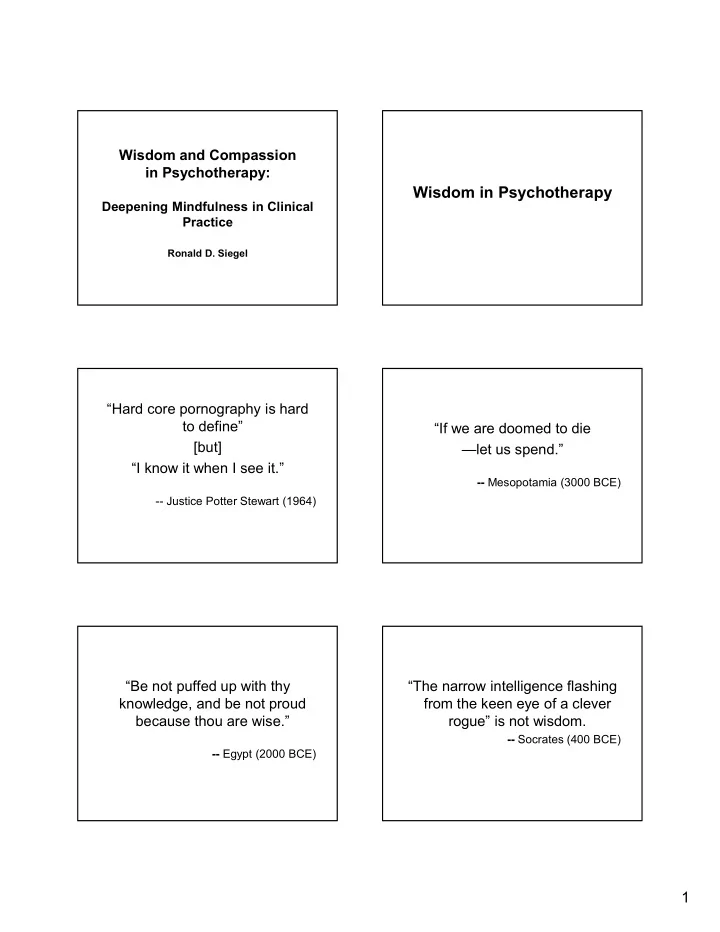
Wisdom and Compassion in Psychotherapy:

Deepening Mindfulness in Clinical Practice

Ronald D. Siegel

Wisdom in Psychotherapy

“Hard core pornography is hard to define” [but] “I know it when I see it.”

  • - Justice Potter Stewart (1964)

“If we are doomed to die —let us spend.”

  • - Mesopotamia (3000 BCE)

“Be not puffed up with thy knowledge, and be not proud because thou are wise.”

  • - Egypt (2000 BCE)

“The narrow intelligence flashing from the keen eye of a clever rogue” is not wisdom.

  • - Socrates (400 BCE)
slide-2
SLIDE 2

2

A 15 year old girl wants to get married right away. What should she do?

Paul Baltes – Berlin Group

  • 1. Factual knowledge
  • 2. Procedural knowledge
  • 3. Life-span contextualism
  • 4. Value relativism
  • 5. Awareness and management of

uncertainty

Monika Ardelt

“A fool can learn to say all the things a wise man says, and to say them

  • n the same occasions, but this

isn’t real wisdom.”

  • -John Kekes

Not Knowing Beginner’s Mind Buddhist Psychology

  • Compilation of insights derived largely

from mindfulness practice

  • Not a religion in Western sense, but the

results of a 2500 year old tradition of introspection

slide-3
SLIDE 3

3

Three Marks of Existence

  • Anicca

(impermanence)

  • Dukkha

(unsatisfactoriness)

  • Anatta (no enduring,

separate self)

Mindfulness How Mindfulness Fosters Wisdom I

  • Stepping Out Of the Thought Stream
  • Being With Discomfort
  • Disengaging From Automatic

Responses

How Mindfulness Fosters Wisdom II

  • Transpersonal Insight
  • Seeing How the Mind Creates Suffering
  • Embracing Opposites
  • Developing Compassion

Anatta The Western View of the Self

  • Emphasis on separateness vs.

connection to family, tribe, nature, etc.

  • Healthy (Western) development:
  • Individuated
  • Aware of Boundaries
  • Knowing one’s needs
  • Clear identity and sense of self
slide-4
SLIDE 4

4

Narcissism in Western Psychology

  • DSM
  • Character disorder
  • Behavior therapy
  • Self efficacy
  • Psychodynamic psychotherapy
  • Healthy narcissism or self esteem

Narcissism in Buddhist Psychology

  • We suffer when we don’t know who we

really are

  • Attempt to buttress self is central cause
  • f suffering
  • Our concept of “self” is based on a

fundamental misunderstanding

Therapeutic Benefits of Glimpsing Anatta

  • 1. Increased affect tolerance
  • 2. Radical acceptance of parts
  • 3. Freedom from self-esteem concerns
  • 4. Deeper connection to others

Thinking Homunculus? Default Mode Network

slide-5
SLIDE 5

5

Who Am I?

  • Two types of self-reference
  • Narrative focus (NF)
  • Enduring traits
  • Talking to ourselves about ourselves
  • Experiential focus (EF)
  • Moment-to-moment

experience

  • The mind-body in action

Medial Prefrontal Cortex (mPFC)

  • Links subjective

experiences across time

  • Holds memory of
  • Self traits
  • Traits of similar
  • thers
  • Reflected self-

knowledge

  • Future aspirations

1) Affect Tolerance

And I, Sir, Can Be Run Through with a Sword Selfing & Affect Tolerance

  • Not “my,” but “the”
  • Anger
  • Sadness
  • Fear
  • Joy
  • Lust

2) Acceptance of Parts

slide-6
SLIDE 6

6

Our Polytheistic Mind How Was Your Meditation?

  • Part trying to attend to

the breath

  • Part fantasizing about

the future

  • Part judging myself
  • Ask the committee!

Jung’s Shadow

  • We identify with some

parts while rejecting

  • thers
  • We become defensive

when shadow is illuminated

We’re all Bozos on this Bus

  • Dandelions in a field
  • Not a path to perfection, but a path to

wholeness

  • Boundary of what we can accept in
  • urselves is the boundary of our

freedom

– Zen Patriarch

3) Freedom from Self-Esteem Concerns

Self-Evaluation

slide-7
SLIDE 7

7

What Realms Define Me?

  • Skills & Talents
  • Accomplishments
  • Pedigree or Group

Membership

  • Moral Standing
  • Appearance

Lake Wobegon

Where all the women are strong, all the men are good looking, and all the children are above average.

The Failure of Success

  • The pain of I, me, me, mine
  • Narcissistic recalibration
  • Impossibility of winning consistently

Wrong Wall? It’s Getting Worse Narcissistic Personality Inventory

  • I just want to be reasonably happy
  • I want to amount to something in the eyes of the world
  • If I ruled the world it would be a better place
  • The thought of ruling the world scares the hell out of me
  • I am much like everybody else
  • I am an extraordinary person
  • I always know what I’m doing
  • Sometimes I’m not sure of what I’m doing
slide-8
SLIDE 8

8

Egos Inflating Over Time: A Cross‐Temporal Meta‐Analysis of the Narcissistic Personality Inventory

Journal of Personality, Volume 76, Issue 4

Self-Esteem Autobiography

I get my money from Mommy.

4) Connecting to Others

Love Self-Esteem

slide-9
SLIDE 9

9

“Do unto others as you would have them do unto you”

It’s not just a commandment, but a law of nature.

Judgments

Make a connection, not an impression.

It’s About Other People

Embracing Insignificance

slide-10
SLIDE 10

10

Wat Tham Sua

Tiger Cave Temple Krabi, Thailand

King of England, 1387 Loving-kindness for the Competition Self-Compassion

  • Self-kindness
  • Common Humanity
  • Mindfulness

Therapeutic Progress

“mine” about me Not about me “mine” about me Not about me

  • - Adapted from Engler & Fulton

Why Are You Unhappy? Because 99.9% of everything you think, and everything you do, is for yourself. And there isn’t one.

  • - Wei Wu Wei
slide-11
SLIDE 11

11

Compassion in Psychotherapy

Affect Regulation Systems .

Seeking pleasure Achieving and Activating Affiliative Soothing/safety Well-being Threat-focused Protection & Safety Seeking Activating/Inhibiting

Anger, anxiety, disgust Drive, excitement, vitality Contentment, safety, connection

Compassion

  • Latin: pati; Greek: pathein (“to suffer”)
  • Latin: com (“with”)
  • Compassion means to “suffer with”

another person.

Compassion’s Relatives

  • Empathy
  • Sympathy
  • Love
  • Pity
  • Altruism

Lovingkindness Practice

  • “Metta” practices
  • May I be happy,

peaceful, free from suffering

  • May my loved
  • nes be happy. . .
  • May all beings be
  • happy. . .
slide-12
SLIDE 12

12

Heart over Head

  • Conventional CBT
  • Modifies

expectations, beliefs,

  • r behaviors
  • Metta practice
  • Attempts to modify

emotional states directly

Research on LKM

  • Builds positive emotions and resources
  • Increases feelings of social connectedness.
  • Changes the brain, which correlates with

empathy and generosity.

  • Shifts away from fault-finding, self and other
  • Reduces back pain.

How Mindfulness Develops Compassion

  • Compassion for ourselves arises as we
  • pen to our own suffering
  • Compassion for others arises as we see

that everyone else also suffers

  • Compassion arises naturally as we see
  • ur interconnectedness

Condon, Desbordes, & Miller (2013)

Paradoxical Responses

  • Universality of ambivalence
  • Highlight one pole, energize the
  • ther
  • Negative emotions may arise
  • Cynicism, anger, sadism
  • Practice saying “Yes” to

these

slide-13
SLIDE 13

13

When Things Go Wrong

Unholy trinity of

  • Self-criticism
  • Self-isolation
  • Self-absorption

An Anidote: Self-Compassion

  • Self-kindness
  • Common Humanity
  • Mindfulness

First Noble Truth to the Rescue

The Story of the Mustard Seed

5 Paths to Self-Compassion

1. Physical: Soften the body 2. Mental: Allow thoughts to come and go 3. Emotional: Befriend feelings 4. Relational: Connect safely with others 5. Spiritual: Commit to something larger

  • -Chris Germer

The Big Picture

  • What helps you to identify with

something larger than yourself?

  • Nature
  • Friend, Family, or Community
  • Spiritual Teacher
  • Religious figure or image

Self-Compassionate Letter

  • Describe something that makes you feel

badly about yourself

  • Think of loving, accepting, imaginary

friend

  • Write a letter to yourself from your

friend’s perspective

  • --Kristen Neff
slide-14
SLIDE 14

14

Research On Self-compassion

  • Predicts psychological well-being
  • Different construct than self-esteem
  • Unrelated to narcissism
  • Adaptive response to academic failure
  • Alleviates shame and self-criticism
  • Helps to avoid unhealthy food

Greeting Exercise

  • Begin with breath
  • Visualize the person behind the door,

suffering human being, once a child, has hopes and dreams, vulnerable and afraid, believing you can help

  • Now open the door and say “hello.”

Equanimity Phrases

  • Everyone is on his or her own life

journey.

  • I am not the cause of my patient’s

suffering, nor is it entirely within my power to alleviate it.

  • Though moments like this are difficult to

bear, I may still try to help to the extent that I can.

Going Nowhere

For meditations & other resources: www.mindfulness-solution.com email: rsiegel@hms.harvard.edu