WisDOTs Traffic Incident Management Enhancement (TIME) Program How - - PowerPoint PPT Presentation

wisdot s traffic incident management enhancement time
SMART_READER_LITE
LIVE PREVIEW

WisDOTs Traffic Incident Management Enhancement (TIME) Program How - - PowerPoint PPT Presentation

WisDOTs Traffic Incident Management Enhancement (TIME) Program How does this Happen? What is Traffic Incident Management? Incident Management is defined as: The systematic, planned, and coordinated use of human, institutional,


slide-1
SLIDE 1

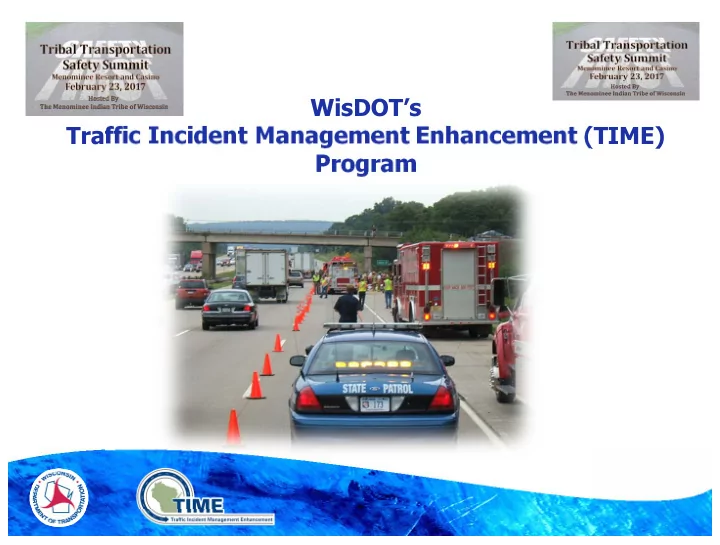
WisDOT’s Traffic Incident Management Enhancement (TIME) Program
slide-2
SLIDE 2

How does this Happen?

slide-3
SLIDE 3

What is Traffic Incident Management?

Incident Management is defined as:

“The systematic, planned, and coordinated use of human, institutional, mechanical, and technical resources to reduce the duration and impact of incidents, and improve the safety of motorist, crash victims, and incident responders.”

slide-4
SLIDE 4

What is it in reality?

First and foremost

Improve safety for ALL responders who respond to crash scenes

Law Enforcement Firefighters Emergency Medical Services WI Emergency Management personnel Department of Public Works personnel Highway Department personnel Dept of Natural Resources Towing and Removal Professionals Medical Examiner/Coroner Environmental contractors Funeral Home personnel Good Samaritans

slide-5
SLIDE 5

Crash Pyramid

slide-6
SLIDE 6

Why Employ TIM?

  • Every incident requires a response that impacts the roadway
  • A “simple” PI crash

– Law Enforcement – 1 to 2 LEOs (at a minimum) – Fire Service – 3 to 4 FF (at a minimum) – EMS – 2 to 3 (at a minimum) – Towing and Recovery (1 minimum) – Total (at a minimum 7 responders at every scene) » Others? (DPW/Highway Dept, Medical Examiner, DNR, DOT, Recon, Funeral Home, etc…)

slide-7
SLIDE 7

Impacts - Congestion and Delay

  • Non-recurring traffic

incidents account for one- fourth of congestion and delay.

  • 1 minute of Interstate lane

blockage translates into at least 4 minutes of delay.

  • Secondary incidents

(crashes).

  • Decreased quality of life.
  • Poor public image of “us”.

Traffic Incidents (25%) Bottlenecks (40%) Special Events/ Other (5%) Poor Signal Timing (5%) Bad Weather (15%) Work Zones (10%)

slide-8
SLIDE 8

Wisconsin’s TIME Program

(Traffic Incident Management Enhancement)

  • What is TIME?

– Comprehensive multi-agency, multi-discipline program enacted by WisDOT.

  • What is the Purpose of TIM?

– Effectively and efficiently manage the response to traffic incidents to improve responder and motorist safety. – Minimize traffic and community impacts.

slide-9
SLIDE 9

It’s all about Responder / Worker Safety

“D “drivers

The “D” Drivers Are Killing Us… – Drunk – Drugged – Drowsy – Distracted – Just plain… Dumb

slide-10
SLIDE 10

Are they really paying attention?

slide-11
SLIDE 11

Why does this Happen?

slide-12
SLIDE 12

You are never safe!

slide-13
SLIDE 13
slide-14
SLIDE 14
slide-15
SLIDE 15
  • Photo of Washburn County SD squad strike *** Add

narrative below slide.

slide-16
SLIDE 16
slide-17
SLIDE 17
slide-18
SLIDE 18
slide-19
SLIDE 19
slide-20
SLIDE 20

Add photo of tow truck struck from N&S Towing

slide-21
SLIDE 21
slide-22
SLIDE 22
slide-23
SLIDE 23

Three county highway workers and

  • ne FF were killed in either a WZ or

at an incident scene in 2015

  • April 27th - Calumet County – Driving a sweeper
  • May 27th – Shawano County – Flagging Operation
  • July 14th – Lincoln County - Flagging Operation
  • December 11th – Marquette County - Medical Emergency
slide-24
SLIDE 24

The Statewide Traffic Operations Center (STOC) Control Room

slide-25
SLIDE 25
  • POC for WisDOT RIMC, Electrician and Bridge Inspector.
  • Monitor traffic via CCTV (424 cameras)

– Message 151 Dynamic Messaging Sign (DMS) – Message 124 Portable Changeable Messaging Sign (PCMS) when needed. – Broadcast Amber, Silver and NWS Weather alerts.

  • Author Traffic Incident Alerts.
  • Author “Floodgate” messages.
  • Notify other states of traffic incidents in WI.
  • WITRACK Notifications.
  • Direct contact with WSP and numerous Sheriff’s Departments via

CAD.

Duties of the STOC Control Room

slide-26
SLIDE 26

WisDOT 511 Mobile App

  • Launched June 2015
  • Over 37,000 downloads
  • Features include: travel times,

winter road conditions, camera images and customizable alerts

  • Free download through Google

Play or Apple Store

slide-27
SLIDE 27

During fall flooding, STOC provided links to local county closures on 511wi.gov Information including: Incident and construction closures, cameras and DMS location, travel times and winter road conditions

slide-28
SLIDE 28
  • STOC will post incident information

to @511wi Twitter account

  • Tweets will generally include

images of scene and/or delays if available

  • Retweets by media / public help to

get word out

  • Will NEVER post injury / fatality

information

slide-29
SLIDE 29

DMS Safety Messaging

slide-30
SLIDE 30
slide-31
SLIDE 31

Adverse Weather Messaging

  • Supports the “Improve Incident

Management/ Safe Travel in Bad Weather” initiative of Wisconsin’s 2014-2016 Strategic Highway Safety Plan (SHSP)

  • Winter Storm and/or Blizzard

Warnings are now being signed for.

  • Alerts from the National Weather

Service will indicate when we initiate the messaging

  • Timely notification of changing

roadway conditions with the STOC allows for more accurate messaging during an event.

slide-32
SLIDE 32

34

DENSE FOG REDUCE SPEED WATER OVER ROAD USE ALT ROUTE LOW VISIBILITY REDUCE SPEED HIGH WINDS ON BRIDGE REDUCE SPEED FLOODING XX MILES AHEAD USE ALT ROUTE DENSE FOG ON BRIDGE

Adverse Weather Messaging

slide-33
SLIDE 33

SAFETY MESSAGING UPDATE

  • Oct. 1 - 3

Oct 18 - 21 Oct 29 - 31

slide-34
SLIDE 34

Some other recent messages

slide-35
SLIDE 35

PCMS Compromised Messaging

37

slide-36
SLIDE 36

38

PCMS MESSAGES

  • FHWA received reports of

DMS and PCMS signs ‘hacked’ in August in a number of states.

  • Unauthorized messages have

potential to create safety hazard for the public.

  • Please contact STOC if any

signs are observed displaying unauthorized messages.

  • Blank sign if possible
slide-37
SLIDE 37

Promote Wisconsin’s Move Over or Slow Down Law

slide-38
SLIDE 38

We want this!

slide-39
SLIDE 39

Not this!

slide-40
SLIDE 40
slide-41
SLIDE 41

Scene Management

Traffic Incident Management Area (TIMA) Establishment

slide-42
SLIDE 42

TRAFFIC INCIDENT MANAGEMENT AREA (TIMA)

Lane 1 Lane 2

  • Location where the incident has occurred and

emergency responders are working

  • Cones should continue alongside the incident space to

help define the boundary between the traffic space and the incident space

  • All vehicles should be located on the same side of the

roadway and in the same direction as the incident

  • The initial responding unit will set an example for others

to follow

slide-43
SLIDE 43
  • Blocking is the action of

positioning an apparatus or a vehicle in order to halt the flow

  • f moving traffic in one or

more lanes

  • A blocking vehicle should be

positioned at the upstream end of the buffer space

  • The blocking vehicle protects

the scene by creating a physical barrier between upstream traffic and the incident space

Blocking Vehicle

slide-44
SLIDE 44

Lane +1 Blocking

slide-45
SLIDE 45

This is why we use the FD to block

  • ur scenes.
slide-46
SLIDE 46

What else does the TIME Program do?

  • Host regional TIME Meetings twice a year.
  • Attend/Present @ responder conferences.
  • Conduct 4-Hour Responder Training courses.
  • Participate in After Action Reviews of Major

Incidents.

  • Work closely with the STOC Control Room.
  • Work closely with the TIME Coalition.
slide-47
SLIDE 47

Who Attends?

  • Law Enforcement
  • Fire
  • EMS
  • County Highway Departments
  • WisDOT
  • Towing and Recovery
  • Medical Examiner / Coroner

24 Meetings for 2016

2017 TIME Program Regional Meetings

Nor Region So Regio No Regio Southeas Northeas Region

**Looking to provide “region-specific” training in support of TIM.

North Central Region Southwest Region Northwest Region Southeast Region Northeast Region

slide-48
SLIDE 48

TIME Program Training

slide-49
SLIDE 49

TIM Responder Training

  • 4-hour course
  • 113 TIME Program “approved” instructors

–FHWA trained, multiple disciplines

  • No cost to the agency
  • Multiple responder disciplines
  • Two instructors from different disciplines
slide-50
SLIDE 50
slide-51
SLIDE 51
slide-52
SLIDE 52

We also like the Quick Clearance of Incidents

slide-53
SLIDE 53

This one was easy to clear!!

slide-54
SLIDE 54

Wisconsin TIME Coalition: Formation

  • Coalition officially formed August 28, 2012.
  • TIME Coalition established to formally recognize

partnerships that exist across jurisdictions and disciplines.

  • Currently, 19 member
  • associations. All with a

nexus to TIM.

  • Represents over 39,000

responders in Wisconsin.

slide-55
SLIDE 55

COALITION PARTNERS

  • 1. Wisconsin Department of Transportation 2. Wisconsin Chiefs of Police Association 3. Wisconsin County Highway Association 4. Wisconsin Sheriffs and Deputy

Sheriffs Association 5. Wisconsin Department of Justice, Division of Law Enforcement Services, Training and Standards Bureau 6. Federal Highway Administration

  • 7. Wisconsin Public Safety Communications 8. Wisconsin Air Medical Council 9. Wisconsin State Patrol 10. Wisconsin Towing Association 11. Wisconsin Law

Enforcement Training Officers Association of Wisconsin 12. Wisconsin State Fire Chiefs’ Association 13. Wisconsin Motor Carriers Association 14. Wisconsin Professional Police Association 15. Wisconsin EMS Association 16. Wisconsin State Firefighters’ Association 17. WI Coroners and Medical Examiners Association

  • 18. American Public Works Association - Wisconsin Chapter 19. Wisconsin Insurance Alliance
slide-56
SLIDE 56

Keep an Eye out for Dump Trucks

slide-57
SLIDE 57

If your agency needs any TIM-related assistance, i.e. training, newsletter submissions, handouts, etc… please contact:

TimeProgram@dot.wi.gov

  • r

TimeProgram@dot.wi.gov

  • r

60

David L. Spakowicz David.Spakowicz@dot.wi.gov 414-225-3729 (Desk) 414-406-0349 (Cell)