words in context

Words in Context Sense Examples (keyword in context) . . . used to - PowerPoint PPT Presentation

Words in Context Sense Examples (keyword in context) . . . used to strain microscopic plant life from the . . . 1 . . . too rapid growth of aquatic plant life in water . . . 1 . . . automated manufacturing plant in Fremont . . . 2 6.864 (Fall


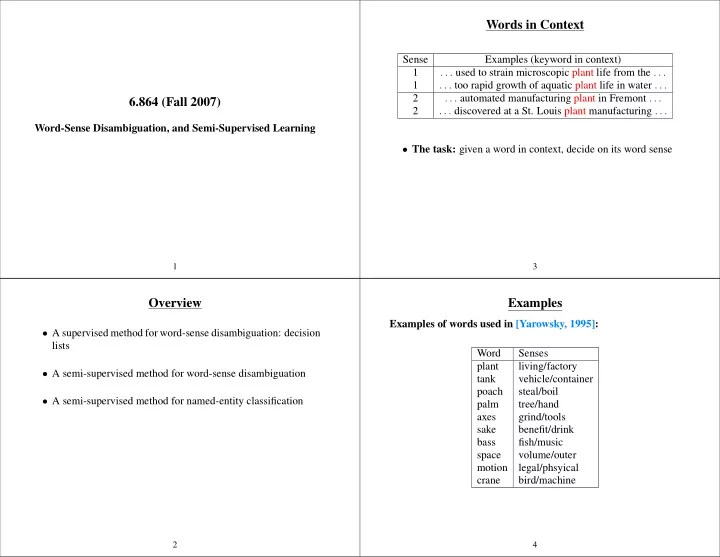
  1. Words in Context Sense Examples (keyword in context) . . . used to strain microscopic plant life from the . . . 1 . . . too rapid growth of aquatic plant life in water . . . 1 . . . automated manufacturing plant in Fremont . . . 2 6.864 (Fall 2007) . . . discovered at a St. Louis plant manufacturing . . . 2 Word-Sense Disambiguation, and Semi-Supervised Learning • The task: given a word in context, decide on its word sense 1 3 Overview Examples Examples of words used in [Yarowsky, 1995]: • A supervised method for word-sense disambiguation: decision lists Word Senses plant living/factory • A semi-supervised method for word-sense disambiguation tank vehicle/container poach steal/boil • A semi-supervised method for named-entity classification palm tree/hand axes grind/tools sake benefit/drink bass fish/music space volume/outer motion legal/phsyical crane bird/machine 2 4

  2. Features Used in the Model An Example The ocean reflects the color of the sky, but even on cloudless days • Word found in + / − k word window the color of the ocean is not a consistent blue. Phytoplankton, microscopic plant life that floats freely in the lighted surface waters, • Word immediately to the right (+1 W) may alter the color of the water. When a great number of organisms are concentrated in an area, the plankton changes the color of the • Word immediately to the left (-1 W) ocean surface. This is called a ’bloom.’ • Pair of words at offsets -2 and -1 ⇓ w − 1 = Phytoplankton t − 1 = JJ • Pair of words at offsets -1 and +1 w +1 = life t +1 = NN w − 2 , w − 1 = (Phytoplankton,microscopic) t − 2 , t − 1 = (NN,JJ) • Pair of words at offsets +1 and +2 w − 1 , w +1 = (microscopic,life) . . . w +1 , w +2 = (life,that) word-within-k = ocean word-within-k = reflects word-within-k = color . . . word-within-k = bloom 5 7 Features Used in the Model A Machine-Learning Method: Decision Lists • Also maps words to parts of speech, and general classes (e.g., • For each feature, we can get an estimate of conditional WEEKDAY, MONTH etc.) probability of sense 1 and sense 2 • Local features including word classes are added: • For example, take the feature w +1 = life – Pair of tags at offsets -2 and -1 • We might have – Tag at position -2, word at position -1 Count ( sense 1 of plant , w +1 = life ) = 100 – etc. Count ( sense 2 of plant , w +1 = life ) = 1 • Maximum-likelihood estimate P ( sense 1 of plant | w +1 = life ) = 100 101 6 8

  3. Smoothed Estimates Creating a Decision List • Usual problem: some counts are sparse • Create a list of rules sorted by strength Rule Weight • We might have w +1 = life → sense 1 0.99 w − 1 = manufacturing → sense 2 0.985 Count ( sense 1 of plant , w − 1 = Phytoplankton ) = 2 → word-within-k=life sense 1 0.98 Count ( sense 2 of plant , w − 1 = Phytoplankton ) = 0 → word-within-k=manufacturing sense 2 0.979 → word-within-k=animal sense 1 0.975 → word-within-k=equipment sense 2 0.97 • α smoothing (empirically, α ≈ 0 . 1 works well): → word-within-k=employee sense 2 0.968 w − 1 = assembly → sense 2 0.965 2 + α P ( sense 1 of plant | w − 1 = Phytoplankton ) = . . . 2 + 2 α 100 + α P ( sense 1 of plant | w +1 = life ) = 101 + 2 α • To apply the decision list: take the fi rst (strongest) rule in the list which with α = 0 . 1 , gives values of 0 . 95 and 0 . 99 (unsmoothed gives values of applies to an example 1 and 0 . 99 ) 9 11 The ocean refl ects the color of the sky, but even on cloudless days the color Creating a Decision List of the ocean is not a consistent blue. Phytoplankton, microscopic plant life that fl oats freely in the lighted surface waters, may alter the color of the water. When a great number of organisms are concentrated in an area, the • For each feature, find plankton changes the color of the ocean surface. This is called a ’bloom.’ Feature Sense Strength sense ( feature ) = argmax sense P ( sense | feature ) w − 1 = Phytoplankton 1 0.95 w +1 = life 1 0.99 e.g., sense ( w +1 = life ) = sense 1 w − 2 , w − 1 = (Phytoplankton,microscopic) N/A w − 1 , w +1 = (microscopic,life) N/A w +1 , w +2 = (life,that) 1 0.96 • Create a rule feature → sense ( feature ) with weight word-within-k = ocean 1 0.93 P ( sense ( feature ) | feature ) . e.g., word-within-k = reflects N/A word-within-k = color 2 0.65 Rule Weight t − 1 = JJ 2 0.56 w +1 = life → sense 1 0.99 t − 2 , t − 1 = (NN,JJ) 2 0.7 w − 1 = Phytoplankton → sense 1 0.95 t +1 = NN 1 0.64 . . . . . . • N/A ⇒ feature has not been seen in training data • w +1 = life → Sense 1 is chosen 10 12

  4. Experiments A Partially Supervised Method • [Yarowsky, 1994] applies the method to accent restoration in • Collecting labeled data can be expensive French, Spanish De-accented form Accented form Percentage • We’ll now describe an approach that uses a small amount of cesse cesse 53% labeled data, and a large amount of unlabeled data cess´ e 47% coute coˆ ute 53% coˆ ut´ e 47% cote cˆ ot´ e 69% cˆ ote 28% cote 3% < 1 % cot´ e • Task is to recover accents on words – Very easy to collect training/test data – Very similar task to word-sense disambiguation – Useful for restoring accents in de-accented text, or in automatic generation of accents while typing 13 15 Overview A Key Property: Redundancy The ocean reflects the color of the sky, but even on cloudless days • A supervised method for word-sense disambiguation: decision the color of the ocean is not a consistent blue. Phytoplankton, lists microscopic plant life that floats freely in the lighted surface waters, may alter the color of the water. When a great number of organisms are concentrated in an area, the plankton changes the color of the • A semi-supervised method for word-sense disambiguation ocean surface. This is called a ’bloom.’ • A semi-supervised method for named-entity classification ⇓ w − 1 = Phytoplankton word-within-k = ocean w +1 = life word-within-k = reflects w − 2 , w − 1 = (Phytoplankton,microscopic) word-within-k = bloom w − 1 , w +1 = (microscopic,life) word-within-k = color w +1 , w +2 = (life,that) . . . There are often many features which indicate the sense of the word 14 16

  5. Another Useful Property: “One Sense per Discourse” An example: for the “plant” sense distinction, • Yarowsky observes that if the same word appears more than initial seeds are and word-within-k=life once in a document, then it is very likely to have the same word-within-k=manufacturing sense every time Partitions the unlabeled data into three sets: • 82 examples labelled with “life” sense • 106 examples labelled with “manufacturing” sense • 7350 unlabeled examples 17 19 Step 1 of the Method: Collecting Seed Examples Training New Rules • Goal: start with a small subset of the training data being 1. From the seed data, learn a decision list of all rules with weight labeled above some threshold (e.g., all rules with weight > 0 . 97 ) • Various methods for achieving this: 2. Using the new rules, relabel the data (usually we will now end up with more data being labeled) – Label a number of training examples by hand – Pick a single feature for each class by hand 3. Induce a new set of rules with weight above the threshold from e.g., word-within-k=bird and the labeled data word-within-k=machinery for crane – Look through frequently occurring features, and label a few of them 4. If some examples are still not labeled, return to step 2 – Using words in dictionary defi nitions e.g., Pick words in the two defi nitions for “plant” A vegetable organism, or part of one, ready for planting or lately planted. equipment, machinery, apparatus, for an industrial activity 18 20

Recommend


More recommend


Explore More Topics

Stay informed with curated content and fresh updates.