Workshop: Hack Your Brain: Tools and Tips for Building Emotional - - PDF document

workshop hack your brain tools and tips for building
SMART_READER_LITE
LIVE PREVIEW

Workshop: Hack Your Brain: Tools and Tips for Building Emotional - - PDF document

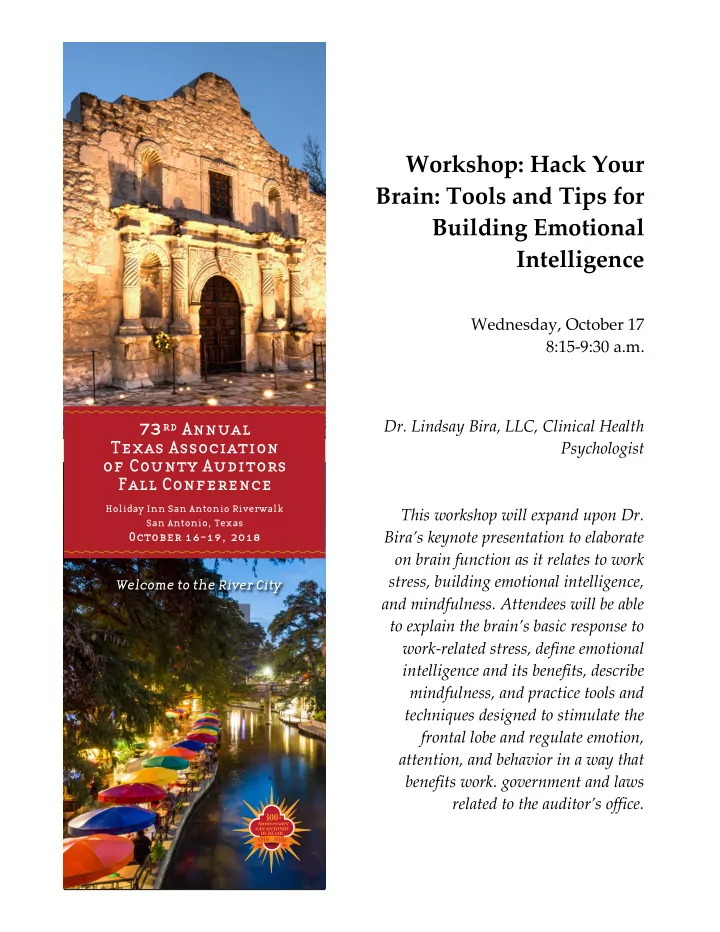
Workshop: Hack Your Brain: Tools and Tips for Building Emotional Intelligence Wednesday, October 17 8:15-9:30 a.m. 73 rd Annual Dr. Lindsay Bira, LLC, Clinical Health Texas Association Psychologist of County Auditors Fall Conference


slide-1
SLIDE 1

73rd Annual

Texas Association

  • f County Auditors

Fall Conference

Holiday Inn San Antonio Riverwalk San Antonio, Texas

October 16-19, 2018

Anniversary SAN ANTONIO

300

DE BÉJAR

th

Welcome to the River City

Workshop: Hack Your Brain: Tools and Tips for Building Emotional Intelligence

Wednesday, October 17 8:15-9:30 a.m.

  • Dr. Lindsay Bira, LLC, Clinical Health

Psychologist This workshop will expand upon Dr. Bira’s keynote presentation to elaborate

  • n brain function as it relates to work

stress, building emotional intelligence, and mindfulness. Attendees will be able to explain the brain’s basic response to work-related stress, define emotional intelligence and its benefits, describe mindfulness, and practice tools and techniques designed to stimulate the frontal lobe and regulate emotion, attention, and behavior in a way that benefits work. government and laws related to the auditor’s office.

slide-2
SLIDE 2
  • Dr. Lindsay Bira, LLC, Clinical

Health Psychologist, San Antonio

  • Dr. Bira is a clinical health psychologist,

TEDx speaker, and served as assistant professor of psychiatry at UT Health San

  • Antonio. She has clinical research

specialty in behavioral medicine and PTSD/trauma. She speaks often on the topic of mental health and wellbeing, serves as a consultant on projects that seek to incorporate mental health, and runs a private practice, treating adults and teens for a range of issues. She received her Ph.D. in clinical health psychology from University of Miami. She completed residency with Harvard Medical School and Boston University School of Medicine before completing an additional two-year fellowship in trauma

  • psychology. Dr. Bira has been featured

by TEDx, Texas Public Radio, Women’s Health Magazine, Headspace, Science, Nature Biotech, and more for her work in PTSD, mindfulness, brain health and personal growth. She is passionate about breaking stigma around mental health to improve wellbeing and works to bridge the gap between complex research and global understanding.

slide-3
SLIDE 3

1

slide-4
SLIDE 4

2

STRESS

slide-5
SLIDE 5

3

slide-6
SLIDE 6

4

slide-7
SLIDE 7

5

slide-8
SLIDE 8

6

slide-9
SLIDE 9

7

slide-10
SLIDE 10

8

slide-11
SLIDE 11

9

slide-12
SLIDE 12

10

slide-13
SLIDE 13

11

slide-14
SLIDE 14

12

slide-15
SLIDE 15

13

Resick et al. (2017) Resick et al. (2017)

slide-16
SLIDE 16

14

Resick et al. (2017) Resick et al. (2017)

slide-17
SLIDE 17

15

Resick et al. (2017) Resick et al. (2017)

slide-18
SLIDE 18

16

Resick et al. (2017)

slide-19
SLIDE 19

17

slide-20
SLIDE 20

18

slide-21
SLIDE 21

19

slide-22
SLIDE 22

20

slide-23
SLIDE 23

21

slide-24
SLIDE 24

22

slide-25
SLIDE 25

23

Diaphragmatic Breathing

slide-26
SLIDE 26

24

slide-27
SLIDE 27

25

slide-28
SLIDE 28

26 Diaphragmatic Breathing TACA18

slide-29
SLIDE 29

www . DrLindsayBira . com

COMPASSION MINDFULNESS EXERCISE

INFORMAL:

  • Begin with some diaphragmatic breathing.
  • Now, wherever you are, look around you.
  • Who do you see?
  • Notice your immediate judgments, negative and positive. Those are normal. But try to drop them.
  • Remind yourself that everyone is exactly how they are for a reason.
  • Remind yourself that everyone is trying the best they can.
  • All reactions make sense when considered in context: where a person came from, early experiences,

genetic makeup, recent events….

  • Think about each person and feel compassion toward their struggles. Focus on growing that feeling.
  • Wish them well in your head with the following words:

WISHING WELL DIALOGUE: I wish you happiness. I wish you health. I wish you ease in riding the waves of life.

FORMAL:

  • Close your eyes.
  • Imagine someone you love. Feel that love and compassion. Wish them well.
  • Now imagine an acquaintance you are fond of. Bring up the feelings of love. Wish them well.
  • Now imagine someone who grates on your nerves. Try to bring up those feelings of compassion

toward them. Wish them well.

  • Now maybe imagine someone who you really, really dislike. Try to bring up those feelings of

compassion toward them. Spend time on this. Remember what it feels like when it comes easy. Let it

  • grow. Wish them well.
  • Now, imagine yourself. Notice what you feel. Try to bring up feelings of compassion toward yourself.

Wish yourself well.

slide-30
SLIDE 30

Hack Your Brain: APOLOGIES

DON’T!

  • Say "I'm sorry but . . . " = justify / excuse
  • Blame the other person ("because you..." or "I'm sorry you...")
  • Minimize consequences ("it was a joke!")
  • Expect forgiveness or a certain reaction
  • Use non-verbals that conflict

DO!

  • Start with: "I'm sorry"
  • Focus on your role in the chaos - responsibility ("I'm sorry I...")
  • Express emotion & empathy to connect
  • Offer a fix or Give hope - promise better
  • Use matching non-verbals

5 Steps to a Good Apology

  • 1. A clear "I'm sorry" statement
  • 2. Express regret
  • 3. Acknowledge norms / expectations / values were violated
  • 4. Empathy statements to acknowledge full impact on other person
  • 5. Request forgiveness ; promise better trying

WAYS TO FACE THE MUSIC:

  • Get in touch with your values. It doesn’t matter what the other person did….how did you act that

doesn’t match the type of person you value being? Focus on that.

  • Make sure your emotion is appropriate.
  • Is it hard to face because you are feeling shame? Is it appropriate to feel bad about who you

are as a person or is guilt more appropriate – feeling bad for a way you acted?

  • If intention of harm wasn’t there…then it’s not even guilt. Maybe you acted out of line and

neglected a responsibility? Much different. Peel off unnecessary emotions.

  • Think about apologies as a way to build trust in a relationship of any kind. Or, if the relationship can’t

be saved or isn’t a healthy one, look at is as a way to grow as a person.

  • VULNERABILITY = GROWTH & POWER….the best leaders are ones who express empathy and

acknowledge their wrongdoings, no matter how small or seemingly justified.

slide-31
SLIDE 31

APOLOGIES: Plug it in

ADDRESS DIFFICULT SITUATIONS:

  • “I notice _____, I worry ______, I wonder”
  • “I notice this project is moving much slower than it needs to be. I worry we are not on the

same page and will keep having problems unless we get there. I wonder how we can all contribute more efficiently?”

  • State what you can do better to get people to be open to being better themselves
  • “I notice this project is moving much slower than it needs to be. I worry we are not on the

same page and will keep having problems unless we get there. I know I personally have been dragging my feet because of other demands but also because this just isn’t fun. That is not a good excuse though and I am going to be better. I wonder what your experience has been? Thoughts?”

APOLOGY EXAMPLE:

“I’m sorry for _________.” (focusing on your actions) “I wish I had said or done _____ instead.” (express regret and a better way) “Doing ____ was not ok because _____.” (what value/norm/expectation did it violate?) “I realize my actions caused you to _________.” (empathize with the impact) “I understand it may take a while, but I hope you can forgive me.” OR “I’m going to be better about keeping _____ in check. I promise it won’t be a problem again. Can I ____ to offset the wrong?” (request forgiveness, promise better trying, offer solution) Keep in mind that you CAN offer some explanation of why you acted the way you did, but be clear that it is NOT an excuse and does not justify your behavior. Use this only in a way that can promote empathy in the other person; not as a way to show you were right.

slide-32
SLIDE 32

Describe target situation: All factors involved:

Guilt Level (0-100%) (people, timing, weather, etc.)

What did you do and why? Why didn't you do something else? What was your intention? If responsible, for what or who?

LOOK AT THE FACTS: APPROPRIATE EMOTION:

www . DrLindsayBira . com

2018 - Lindsay Bira, PhD

slide-33
SLIDE 33

What can you say to yourself now about what happened?

Responsibility Pie

Guilt Level (0-100%)

Bothersome thoughts: Healthy Questions:

Who else neglected a responsibility? Why was the responsibility neglect by you, others? Were there conflicting roles and responsibilities? How does responsibility get distributed?

"I should / shouldn't have _____." "If I would have ____, then it wouldn't have happened / it would be better." "It's my / their fault it happened."

Why didn't I? What else was going on? What was the info I had then? How do I know this? What other factors were involved? What else could have happened? So, I / they intended the harm? What was the intention? Who, if anyone, intended the harm?

"Things like this should not happen."

What are the actual stats? Under what circumstances does this happen?

www . DrLindsayBira . com

slide-34
SLIDE 34

Free Lined Graph Paper from http://incompetech.com/graphpaper/lined/

slide-35
SLIDE 35

Free Lined Graph Paper from http://incompetech.com/graphpaper/lined/