
SLIDE 1
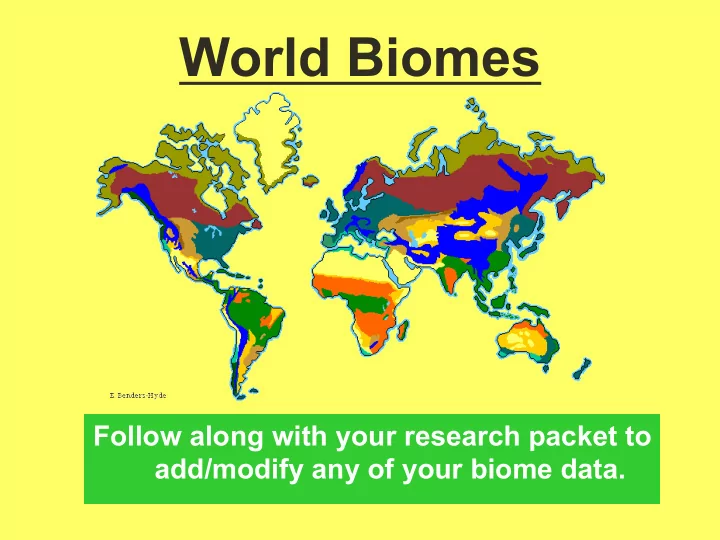
World Biomes Follow along with your research packet to add/modify - - PowerPoint PPT Presentation
World Biomes Follow along with your research packet to add/modify any of your biome data. Tropical Rainforest Location: Found near equatorlittle variation in temperatures. No distinct seasonal changes. Earth's most complex land biome
http://www.cotf.edu/ete/modules/msese/earthsysflr/
Location: Found near equator…little variation in temperatures. No distinct seasonal changes.
Tropical Rainforest Abiotic factors
ü
high biodiversity and biomass
ü
both hot and moist;
ü
ideal for bacteria and
they quickly decompose matter on the forest floor allowing nutrients to be recycled.
ü
<1 cm of topsoil
ü
About 100 in/yr of rainfall
http://www.cotf.edu/ete/modules/msese/earthsysfl
Bougainvillea
§
Sunlight is a major limiting factor
§
Plants grow in layers (canopy receives most light)
§
Shallow, wide roots since soil is so thin and poor in nutrients
§
Little sun reaches the floor
Bangul Bamboo
§
Many symbiotic relationships
§
Live in different levels of canopy
Wagler’s pit viper
Silvery Gibbon Slender Loris
http://www.blueplanetbiomes.org/rnfrst_animal_page.htm
Many animals are specialists and require special habitat components to survive Camouflage is common
http://www.blueplanetbiomes.org/rnfrst_animal_page.htm
§ Humans strip the rainforests for uses including logging and cattle ranching. § In addition to the plants and animals that are displaced by this destruction, entire civilizations of people are also without a home. § You can help by promoting sustainable use of the rainforests’ products
Temperate Deciduous Forests Location:
§
found in temperate zone (about 480 North lat)
§
http://www.runet.edu/~swoodwar/CLASSES/GEOG235/biomes/tbdf/tbdf.html
§
Characterized by an abundance of deciduous (leaf bearing) trees Characterized by 4 seasons § Soils: Deep soil layers, rich in nutrients § Precipitation: 30–100 in/yr in all forms (snow, rain, hail, fog, etc.)
http://www.cotf.edu/ete/modules/msese/earthsysflr/taiga.html
More diversity in the deciduous forest vs. the coniferous forest due to increased sunlight. Trees adapt to varied climate by becoming dormant in winter
White Birch
Birchhttp://www.blueplanetbiomes.org/ deciduous_plant_page.htm
Lady Fern Geulder Rose
Deciduous forests grow in layers More sunlight reaches the ground compared to a rainforest so you will find more ground dwelling plants.
§
Lose Winter Coat
§
Adapt to many seasons
§
Eat from different layers
Bald Eagle
Fat Dormouse Least Weasel
http://www.blueplanetbiomes.org/deciduous_animal_page.htm
http://www.runet.edu/~swoodwar/CLASSES/GEOG235/biomes/tbdf/tbdf.html
Many forests are cleared to provide housing for humans. Careful use of the resource can provide a renewable system if we don’t take too much habitat away.
Abiot biotic ic fact actor
§
Winters are long and cold
§
Averages 100 in/yr precipitation— mostly snow
§
Soil poor in nutrients and very acidic
§
Growing season is very short
http://www.uwsp.edu/geo/faculty/ritter/geog101/modules/ ecosystems_biomes/biomes_northern_forest.html
Balsam Fir
§
Coniferous (needle-bearing) trees are abundant
§
Roots long to anchor trees
§
Needles long, thin and waxy
§
Low sunlight and poor soil keeps plants from growing on forest floor
http://www.inchinapinch.com/hab_pgs/terres/coniferous/plants.htm
Fireweed
Moose §
Adapt for cold winters
§
Burrow, hibernate, warm coat, insulation, etc.
http://www.inchinapinch.com/hab_pgs/terres/coniferous/animals.htm
Great Grey Owl
Mining operations can irreparably damage this fragile ecosystem. Pollution left behind can also put animals and plants at risk.
http://www.blueplanetbiomes.org/ taiga.htm
http://www.blueplanetbiomes.org/grasslands.htm
Savannas annas (or
Gras asslands lands)
Contain the greatest number of grazing animals on Earth.
Location: Found in the tropics…near equator Amount of precipitation supports tall grasses but only occasional trees. The word savanna stems from an Amerind term for plains
http://www.runet.edu/~swoodwar/CLASSES/GEOG235/biomes/savanna/savanna.html Whistling Thorn Umbrella Thorn Acacia
§ Grows in Tufts § Resistance to Drought § Many plants have thorns and sharp leaves to protect against predation.
http://www.blueplanetbiomes.org/savanna_plant_page.htm Kangaroos Paws
Baobab
Adapt for short rainy season—migrate as necessary Limited food leads to vertical feeding
http://www.blueplanetbiomes.org/savanna_animal_page.htm
Zebras Chacma Baboon
http://www.blueplanetbiomes.org/savanna_animal_page.htm
§ Invasive species § Changes in fire management § Because of their low elevation, some savannas are threatened by minor rises in sea level associated with global climate change
Koala Elephant
§
§
http://www.blueplanetbiomes.org/steppe.htm
Fleabane
http://www.blueplanetbiomes.org/prairie_plants_page.htm
Buffalo Grass
Prairie dog Bobcat
http://www.blueplanetbiomes.org/ pampas_animal_page.htm
Geoffrey’s cat
Dry, cold, grasslands Location: Found in Russia and the Ukraine
http://www.blueplanetbiomes.org/steppe.htm
www.plasmacy.de www.wsu.edu
<50 in/year precipitation Mountains often play a role in climate characteristics
Tumbleweed
Sweet Vernal
http://www.blueplanetbiomes.org/steppe_plant_page.htm
§ Many migrate, hibernate or burrow during extremes in temp and precipitation
http://www.blueplanetbiomes.org/steppe_animal_page.htm
Mongolian Gerbil
Saiga Antelope
Gazelle herd
§ Overgrazing…nomadic tribes have started to spend more time in one location, § Infrastructure development (roads, buildings, etc) § Unmanaged hunting and poaching is destroying herds of animals Corsac fox Lynx Milk vetch
http://www.blueplanetbiomes.org/ steppe.htm
Location: Primarily in coastal areas with Mediterranean
N and S of the equator.
http://www.blueplanetbiomes.org/chaparral.htm
§ Climate: hot, dry summers, mild, wet
variations in seasonal temperatures…NICE!
California Chaparral Mediterranean Chaparral
http://www.blueplanetbiomes.org/ world_biomes.htm
Mostly low-lying shrubs and small trees. Many plants have leathery leaves to resist water loss Many plant species have
them resist fire…the fire will take out “weaker” plants that don’t belong.
Blue Oak
Fairy Duster
Camouflage—to avoid predation Many animals will change their diet as the season changes.
Puma Aardwolf
Human development— very desirable climate for humans to live.
Grey Fox King Protea Wild Goat
§ Location: Depending
desert, you will find them in various locations.
§
<10 in/yr of rain
§
Little to no topsoil due to high winds.
§
Minerals not deep in soil.
§
Too dry for decay
http://www.cotf.edu/ete/modules/msese/earthsysflr/ taiga.html
While there are many types of deserts, they all share one characteristic: They are the driest places on Earth!
Joshua Tree http://www.blueplanetbiomes.org/
desert_plant_page.htm
Desert Plant Adaptations:
§
§
§
§
Barrel Cactus § Ocotollio
Desert Animal Adaptations:
§ Get water from food § Thick outer coat § Burrow during day § Large ears § Smaller animals = less surface area http://www.blueplanetbiomes.org/desert_animal_page.htmJavelina Bob Cat Armadillo Lizard
Residential development Off road recreational activities destroy habitat for plants and animals. Some plants are removed by collectors, endangering the population.
Sonoran Desert Dry Desert
http://www.blueplanetbiomes.org/world_biomes.htm
Location: Found north of the Arctic Circle
§
§
§
§
http://www.cotf.edu/ete/modules/msese/earthsysflr/taiga.html
§ Growing close to the ground § Having shallow roots to absorb the limited water resources. § Trees grow less than 1 m high! cottongrass Reindeer lichen
Woody
hrubs ubs
http://www.runet.edu/~swoodwar/CLASSES/GEOG235/biomes/tundra/tundra.html
Hea Heaths hs Examples of Tundra Plants
Arctic fox snowy owl Grizzly Bear
Tufted Saxifrage Polar Bear
Fres eshw hwater er Ecos cosystems ems
×
Salinity <0.5 ppt.
×
Lake are the deepest of fresh water systems
×
Lakes are fed by underground aquifer or stream
×
Ponds are fed by rainfall and may be seasonal
http://mbgnet.mobot.org/fresh/
× Sun can reach bottom × Fed by rainfall × May be seasonal × Algae and plants
throughout
Microscopic Animals and Algae
nutrient rich area found close to shore
bottom of the lake where no sunlight can reach.
www.dnr.wi.gov
www.uwsp.edu
×
Plants are floating algae and plants along shoreline
×
Animals live in or near water
www.aquaticbiomes.gov
http://mbgnet.mobot.org/fresh/wetlands/
× Very shallow with
× Saturated soil × Low oxygen in water
× Emergent plants
http://www.blueplanetbiomes.org/world_biomes.htm Heron
Land soaked because of poor drainage Decay is slow - Soil is acidic
http://mbgnet.mobot.org/fresh/wetlands/
www.kathimitchell.com
http://www.ucmp.berkeley.edu/glossary/gloss5/ biome/aquatic.html
www.3d-screensaver- downloads.com www.cs.dartmouth.edu
www.nwk.usace.army.mil
http://mbgnet.mobot.org/salt/sandy/
×
Fresh and salt water meet
www.lookoutnow.com & www.visualparadox.com
Manatee and goose
www.davenewbould.co.uk
pers-erf.org
×
Close to equator
×
Consistent water temperature
×
Shallow water
×
Low in Nutrients
× Breeding area for
http://mbgnet.mobot.org/salt/coral/
Temperature is important, too hot or too cold and the animals can’t live there to create limestone Human intrusion (scuba diving) is damaging if you touch/ step on the reef Pollution is also a concern. www.calacademy.org
http://mbgnet.mobot.org/salt/sandy/
http://www.worldbiomes.com/ biomes_aquatic.htm
http://www.calstatela.edu/faculty/eviau/edit557/oceans/norma/
http://www.kidzworld.com/site/p1951.htm
Hammerhead
Lion fish
http://www.worldbiomes.com/biomes_aquatic.htm
www.defenders.org
www.awi-bremerhaven.de
nmml.afsc.noaa.gov
newt.phys.unsw.edu.a u