World History, October 12 Entry Task: 10 ?s - Guess - Middle ages OR - - PowerPoint PPT Presentation

world history october 12
SMART_READER_LITE
LIVE PREVIEW

World History, October 12 Entry Task: 10 ?s - Guess - Middle ages OR - - PowerPoint PPT Presentation

World History, October 12 Entry Task: 10 ?s - Guess - Middle ages OR Renaissance??? (You can put M or R) Announcements: - PHONE - my 2-year old daughter may have broken her nose this am, so Im keeping my phone on! - Did you turn in the chart


slide-1
SLIDE 1

World History, October 12

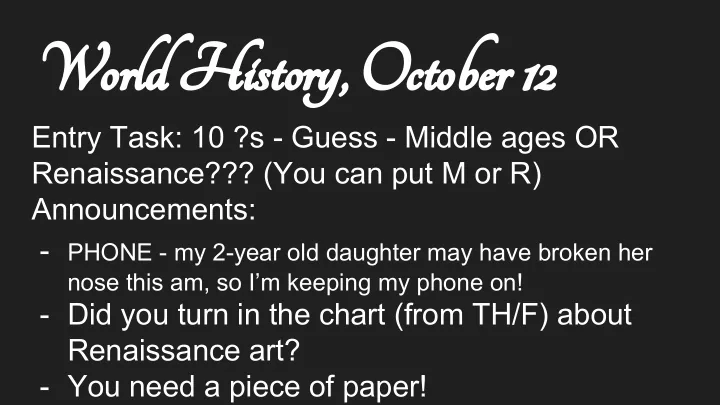
Entry Task: 10 ?s - Guess - Middle ages OR Renaissance??? (You can put M or R) Announcements:

  • PHONE - my 2-year old daughter may have broken her

nose this am, so I’m keeping my phone on!

  • Did you turn in the chart (from TH/F) about

Renaissance art?

  • You need a piece of paper!
slide-2
SLIDE 2

Review

slide-3
SLIDE 3

Review

slide-4
SLIDE 4

Review

slide-5
SLIDE 5

Review

slide-6
SLIDE 6

Review

slide-7
SLIDE 7

Review

slide-8
SLIDE 8

Review

slide-9
SLIDE 9

Review

slide-10
SLIDE 10

Review

slide-11
SLIDE 11
slide-12
SLIDE 12

Renaissance in Italy

The conditions that led to the Renaissance in Italy:

  • Crusades (trade routes) opened contact with more advanced

civilizations

  • The Church lost much of its power, and people began to doubt

its ultimate authority.

  • Due to trade, merchants = wealthy. The wealthy competed for

status (show offs!)

  • New philosophy of enjoying this life instead of simply waiting

for the next one.

slide-13
SLIDE 13

Humanism

  • Humanism consists of four essential aspects:
  • 1. Admiration of the Ancient Greeks and Romans.
  • 2. Philosophy of enjoying this life, instead of just waiting for

the next one.

  • 3. The glorification of humans and the belief that individuals

are can do anything.

  • 4. The belief that humans deserved to be the center of

attention.

slide-14
SLIDE 14

How were artists trained?

Apprentice ~ age 12

  • humble tasks

(sweeping, grinding/mixing pigments) - then drawing sketches, copying paintings, etc

slide-15
SLIDE 15

Fact: Leonardo da Vinci listed thirty-six services that he could perform for his patrons.

slide-16
SLIDE 16

Artists = Celebrities

Lives of the Most Excellent Painters, Sculptors, and Architects Giorgio Vasari 1550

slide-17
SLIDE 17

Renaissance Art

Artists gained prestige, no longer anonymous

  • became celebrities

Patrons (“mecenas”) - financed and protected

  • artists. Patrons commissioned artwork and decided

the themes

  • Kings & Popes
  • Medici Family in Florence were the most famous

and wealthy patrons in the Renaissance.

slide-18
SLIDE 18
slide-19
SLIDE 19

Patrons: King of Naples and Pope Benedict XI

  • Giotto di Bondone→

Called Father of the Renaissance (1267 – 1337) was a painter famous for the solid bodies, the expression

  • f human emotion, and

the suggestion of landscape in his paintings.

slide-20
SLIDE 20
  • - Masaccio → (1401

– 1428) was a painter who used the inspiration of the ancients to put a new emphasis on nature,

  • n three-dimensional

human bodies, and

  • n perspective. He

also was the first painter since the ancients to show nudes in his paintings.

slide-21
SLIDE 21

Trinity, Masaccio

slide-22
SLIDE 22
  • Donatello (Donato di

Niccolo di Betto Bardi) → (1386 – 1466) was mainly a sculptor whose focus was on the beauty of the human body. He made some of the first nude sculptures since the ancients.

slide-23
SLIDE 23

Florence Cathedral - east doors Gates of Paradise - Lorenzo Ghiberti 1425-52

slide-24
SLIDE 24
  • Filippo Brunelleschi →

(1377 – 1446) was an architect whose work was groundbreaking for its simplicity, symmetry, balance and harmony. Additionally, he created the largest dome built in Europe since the ancients in a cathedral in Florence.

slide-25
SLIDE 25
slide-26
SLIDE 26
slide-27
SLIDE 27
slide-28
SLIDE 28

Cathedral construction began in 1296...Dome construction was from 1420-1436 (Giotto designed the bell tower; Donatello assisted in modeling the dome; da Vinci engineered and designed the copper ball and cross at the top of the dome)

slide-29
SLIDE 29
  • Sandro Boticelli → (1445-

1510) new genre of art - inspired by poetry, fantasy (la Primavera) Patron - Lorenzo de’ Medici

slide-30
SLIDE 30

Birth of Venus - Botticelli - kept behind closed doors for 500 years! Religious fervor = destruction of art

slide-31
SLIDE 31
  • Leonardo da Vinci→

(1452 – 1519) was an unorthodox painter (and a scientist, writer, inventor, etc) whose paintings are remarkable for their technical perfection: use

  • f angles, perspective,

and a detailed background.

slide-32
SLIDE 32

Leonardo da Vinci

  • Artist
  • Sculptor
  • Architect
  • Scientist
  • Engineer
  • Inventor
slide-33
SLIDE 33

Quick biography and inventions of da Vinci

https://www.youtube.com/watch?v=PwOlIGGDVjE https://www.youtube.com/watch?v=nrV91kOn-ao

slide-34
SLIDE 34
slide-35
SLIDE 35
slide-36
SLIDE 36

World History, October 13

Entry Task: Uffizi Gallery (Florence)

https://www.youtube.com/watch?v=61uXUxmpKWg

Announcements:

  • Please take out your notes from yesterday! You can write notes from
  • ur reading and do your writing prompt here.
  • Questions answered! Let me know if you have more!
  • Common techniques: Fresco, egg tempera, and oil (after 1500) painting

(Middle Ages = -egg tempera paintings were done on carefully prepared wood panels, often with gold)

  • Valuable material = alum (mostly used in making wool) - Medicis had a

CARTEL - fixed prices, controlled good

  • Mona Lisa - stolen in 1911 - employee at the Louvre (Paris) 1956 - acid and a

rock damaged the painting!

slide-37
SLIDE 37

da Vinci’s Last Supper - fresco had tempera and oil mixed in to slow process which caused deterioration

  • f the piece

Mona Lisa - oil on wood Birth of Venus - egg tempera

  • n wood
slide-38
SLIDE 38
  • Raphael Raffaello Sanzio

da Urbino→ (1483 – 1520)

was a painter who used his mastery of perspective and ancient styles to produce works

  • f harmony, beauty, and

serenity and convey a sense of peace. Patron: Pope Julius II

slide-39
SLIDE 39

Review

The School of Athens, Raphael

  • Variety of

poses

  • No

Christian themes

  • Important Greek philosophers and thinkers

included (Michelangelo as Heraclitus- weeping)

slide-40
SLIDE 40

Review

  • Raphael’s

“selfie”

slide-41
SLIDE 41

Betrothal of the Virgin, Raphael 1504

slide-42
SLIDE 42
  • Michelangelo Buonarroti →

(1475 – 1564) was a painter who also experimented in poetry, architecture, and

  • sculpture. Most of his work

focuses on individuals who always give a sense of strength and ambition. Watch: Michelangelo, Sistine Chapel ceiling, 1508-12 Patron: Pope Julius II, Pope Leo X

https://www.youtube.com/watch?v=_u8LDXhFzPo

slide-43
SLIDE 43

Venus de Milo (GREEK) VS David (Michelangelo)

(RENAISSANCE)

  • 17 feet high!
slide-44
SLIDE 44

Pieta,

1498-99

slide-45
SLIDE 45

https://www.youtube.com/watch?v=PEE3B8Fsuc0

slide-46
SLIDE 46

Ceiling: 1508-1512

slide-47
SLIDE 47

1536-1541

Alter wall - Last Judgment Separation - Blessed from the Damned

slide-48
SLIDE 48
  • Titian (Tiziano Vecelli) →

(1479 – 1576) was a painter who painted scenes of luxury in such a vivid, immediate way that his paintings seem real to the viewer.

slide-49
SLIDE 49

Virgin and Child, Titian Patron: Phillip II (Spain)

slide-50
SLIDE 50

Portraits

Batista Sforza & Federico de Montefeltre: The Duke & Dutchess of Urbino Piero della Francesca, 1465-1466.

slide-51
SLIDE 51

Reading: The Book of the Courtier, Baldesar Castiglione

Courtier - a person who attends a royal court as a companion or adviser to the king or queen

According to Castiglione, what are the basic attributes of the Renaissance courtier? Make a LIST. How did the values of this courtier influence the development of a modern aristocratic class in Western Europe?

slide-52
SLIDE 52

Writing Prompt

In what ways did Renaissance art and philosophy reinforce each other? (AND/OR) How did the artists of the Italian Renaissance incorporate the new intellectual and cultural trends of their time into their art?

slide-53
SLIDE 53

The Northern Renaissance

  • 1. What were the characteristics of the art of the

Northern Renaissance? How did it reflect the societies of Northern Europe?

  • 2. How was the Northern Renaissance different

from that in Renaissance Italy?