Writing a 3-D Multiplayer Game with Kawa and JMonkeyEngine Per - - PDF document

writing a 3 d multiplayer game with kawa and jmonkeyengine
SMART_READER_LITE
LIVE PREVIEW

Writing a 3-D Multiplayer Game with Kawa and JMonkeyEngine Per - - PDF document

Writing a 3-D Multiplayer Game with Kawa and ... http://localhost/per/papers/JavaOne15/slides.html... Writing a 3-D Multiplayer Game with Kawa and JMonkeyEngine Per Bothner (Kawa) <per@bothner.com> mikel evins (the Fabric)


slide-1
SLIDE 1

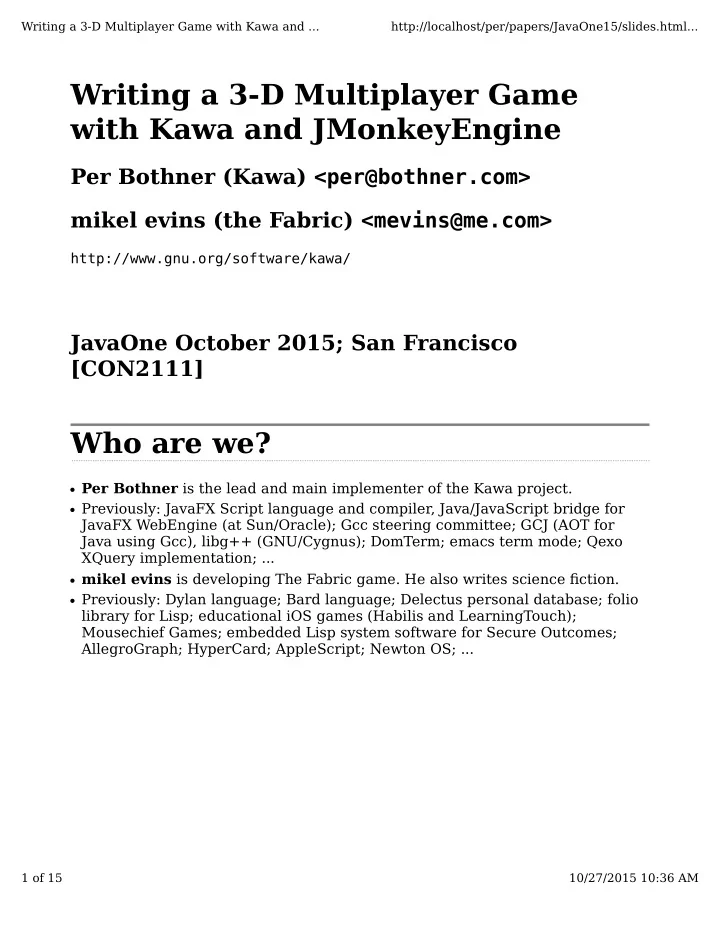
Writing a 3-D Multiplayer Game with Kawa and JMonkeyEngine

Per Bothner (Kawa) <per@bothner.com> mikel evins (the Fabric) <mevins@me.com>

http://www.gnu.org/software/kawa/

JavaOne October 2015; San Francisco [CON2111]

Who are we?

Per Bothner is the lead and main implementer of the Kawa project. Previously: JavaFX Script language and compiler, Java/JavaScript bridge for JavaFX WebEngine (at Sun/Oracle); Gcc steering committee; GCJ (AOT for Java using Gcc), libg++ (GNU/Cygnus); DomTerm; emacs term mode; Qexo XQuery implementation; ... mikel evins is developing The Fabric game. He also writes science fiction. Previously: Dylan language; Bard language; Delectus personal database; folio library for Lisp; educational iOS games (Habilis and LearningTouch); Mousechief Games; embedded Lisp system software for Secure Outcomes; AllegroGraph; HyperCard; AppleScript; Newton OS; ...

Writing a 3-D Multiplayer Game with Kawa and ... http://localhost/per/papers/JavaOne15/slides.html... 1 of 15 10/27/2015 10:36 AM

slide-2
SLIDE 2

Introduction

"The Fabric" is a far-future MMORPG [Massively multiplayer online role-playing game] A MMORPG is typically a major multi-million dollar project Typically developed using a traditional edit/compile/debug cycle. The Fabric is basically developed just by mikel It is written 100% in the Kawa dialect of Scheme Uses the JMonkeyEngine gaming engine, which is written in Java This talk looks at how this is possible, and experience gained

DEMO

Demo Fabric features

Factors in language choice and design

Interactive and incremental development Syntax: composability, extensibility, avoiding boiler-plate Language specification, standards, documentation Java integration Performance: execution speed, start-up, compilaton, memory use Pragmatics: tools, building, deployment

Writing a 3-D Multiplayer Game with Kawa and ... http://localhost/per/papers/JavaOne15/slides.html... 2 of 15 10/27/2015 10:36 AM

slide-3
SLIDE 3

Interactive and incremental program development

No explicit required compile step Avoid needless boilerplate; types not required While the program is running, new code can be added. Existing code can be replaced. dynamic: eval, repl, create functions/classes at run-time Values can be modified and functions called from a REPL. Seamless transition: exploration, prototyping, testing, development,

  • ptimization

The Lisp family of Languages

Includes Common Lisp, Scheme, Dylan, Clojure and variations Decades of history, experience, research (from 1958) Originally tied to AI and “symbolic processing” Pioneered REPLs, GC, lambda, more (now being “re-discovered” by others) Emphasized interactive development Progressively eliminate boilerplate - types optional; no main program Designed to make the programmer fast - easy to go from vague idea to running code

Expression languages

Expression-oriented: A statement is just an expression whose value is ignored. Where Java has statements (loops, if, switch, try) — Lisp uses expressions. Equivalent of Java's break takes a return value. Expressions can composed more easily. Can also be moved around more easily.

Writing a 3-D Multiplayer Game with Kawa and ... http://localhost/per/papers/JavaOne15/slides.html... 3 of 15 10/27/2015 10:36 AM

slide-4
SLIDE 4

Lisp prefix notation

Syntax consistently uses pathenthesised prefix notation: (OP ARG1 ARG2 ... ARGn) OP can be: a procedure (+, sqrt, length) an expression that evaluates to a procedure control structure (if, lambda, do, let) user-defined macro Kawa also allows OP to be: a class or type name (in a constructor expression) an array, list, vector, or string (indexing)

Benefits of Lisp syntax

Using expressions and a simple regular prefix syntax simplifies: Treating programs as data (I/O) Constructing, manipulating, and analyzing programs Macros and syntactic extension Language extensions (DSLs) No reserved identifiers If you notice repetitive code, abstract it out with macros

Lisps for the JVM

For Fabric, mikel tried out 3 Lisp-family languages for the JVM: Kawa (an implementation of Scheme, with extensions) ABCL (an implementation of Common Lisp) Clojure

Writing a 3-D Multiplayer Game with Kawa and ... http://localhost/per/papers/JavaOne15/slides.html... 4 of 15 10/27/2015 10:36 AM

slide-5
SLIDE 5

What is ABCL?

“Armed Bear Common Lisp” is a full implementation of Common Lisp on the JVM. Has both an interpreter and a compiler. The Common Lisp language was standardized by ANSI in 1994. Includes CLOS (CL Object System), a very flexible and dynamic object system.

What is Clojure?

Not compatible with other Lisp-like languages. Strong support for parallel and side-effect-free programming using immutable data structures. Strong eco-system and specialized tools. Was released in 2007.

What is Kawa?

An implementation of the Scheme language Implements the latest Scheme standard (R7RS from 2013) (- except for full continuations - which are in-progress) Many extensions and conveniences for JVM users The oldest still-active compiler-based language for JVM (beside Java): 1996 A toolkit for language implementation, including a compiler that produces efficient JVM bytecode. An interactive programming system

Some Kawa language features

the repl comprehensive Java interop JavaFX support separate compilation supports Android shell programming features implements many semi-standard extensions (SRFIs)

Writing a 3-D Multiplayer Game with Kawa and ... http://localhost/per/papers/JavaOne15/slides.html... 5 of 15 10/27/2015 10:36 AM

slide-6
SLIDE 6

Java/JVM integration

Any “serious” JVM-based language lets you define and access JVM classes, members, and plain-old-Java-objects. Though sometimes there are limitations, complications, or inefficiencies Example: JMonkeyEngine3 requires you to subclass its library classes. No straight-forward way to do this in either Clojure or ABCL. (There are work-arounds.) With Kawa, it's easy. ABCL's CLOS object system system is very powerful and dynamic Hence you can't directly map CLOS methods and fields to JVM members Clojure has multiple ways to define types and interfaces; most flexible is gen-class

Kawa class definition

A Kawa "simple" class compiles very directly to a plain Java class or interface. Syntax is based on Common Lisp. (define-simple-client FabricClient (SimpleApplication ActionListener) ;; super-types (@Serializable) ;; annotations are supported ;; fields (username::String init: #!null) ;; init method - calls init-client procedure ((simpleInitApp) (init-client (this))) ...) The non-simple define-class supports true multiple inheritance.

Writing a 3-D Multiplayer Game with Kawa and ... http://localhost/per/papers/JavaOne15/slides.html... 6 of 15 10/27/2015 10:36 AM

slide-7
SLIDE 7

Property and method references

Kawa doesn't distinguish Kawa object from Java objects. “colon operator” X:N gets property named N from object X. doc:buffer — get field ("abab":indexOf "ab" 1) — call method Color:GREEN — get static field (BigDecimal:valueOf 123456 2) — call static method Hides field vs getter method difference: uri:raw-authority — same as (uri:getRawAuthority) All of these can compile to same bytecode as Java, assuming types are known to compiler.

  • bject creation

Type name does double duty as constructor function: (T x y) ;; Java: new T(x, y) or T.valueOf(x, y) Keyword arguments are translated to setting of fields or set methods: (RadioButton screen "CannonButton" (compute-cannon-button-origin screen) (compute-cannon-button-size screen) text: "Cannon" fontSize: 20 textAlign: Align:Center textVAlign: VAlign:Bottom)

Writing a 3-D Multiplayer Game with Kawa and ... http://localhost/per/papers/JavaOne15/slides.html... 7 of 15 10/27/2015 10:36 AM

slide-8
SLIDE 8

arrays and objects with children

Arrays, lists, vectors are created with the pattern: (TYPE x1 x2 ... xN) For example: (int[] 3 4 5 6) (vector 3 4 5 6) (java.util.ArrayList 3 4 5 6) Generalized to tree nodes with "child" values: (WeaponButtonGroup screen "WeaponGroup" state: state (RadioButton screen "CannonButton" ...) (RadioButton screen "ImpulseButton" ...))) Calls add method (or in this case addButton)

Kawa Modules

Each source file defines a namespace aka a “module”. A module contains definitions (named classes, functions, macros, variables, aliases) and top-level actions. Some definitions are exported. Another module (or the REPL) can import a module. This creates aliases for the module's exported definitions. Imported definitions can be re-exported. A variable can only be assigned to in its defining module. Easy for compiler to map name to definition and assignments. Simplifies data-flow analysis, type inference, error checking.

Module implementation

Module name is a fully-qualified class name Importing a module searches for the class or a corresponding source file Can optionally specify a source file, or generated from module name Each exported definition gets a static field, possibly with annotations To import a module, the compiler scans the static fields No “module database” or “namespace database” needed Simple, powerful, and efficient

Writing a 3-D Multiplayer Game with Kawa and ... http://localhost/per/papers/JavaOne15/slides.html... 8 of 15 10/27/2015 10:36 AM

slide-9
SLIDE 9

DEMO - update in place Performance - execution speed

Kawa prioritizes run-time performance and low overhead Speed is similar to Java or Scala Performance helped by type inference, data-flow analysis, and optional type specifiers Kawa compiler does custom analysis and code generation for many builtin functions ABCL and Clojure are slower then Kawa, though faster than many other “dynamic” languages

multiple threads and side effects

Clojure provides sophisticated side-effect-free data structures (collections and more) Useful for multi-threaded programs; avoids synchronization and races Also avoids some bugs However, they do require more time and more space. Kawa and ABCL also encourage pure side-effect-free programs. But not enforced by language - or data structures In practice, easier to get good performance with Kawa. SIMD parallelism (Java 8 streams or APL-like arrays) may be an easier path to multi-threaded performance.

Performance - start-up speed

Clojure and ABCL have notorously bad start-up times. Starting Kawa and loading Fabric from jar 0.5s. Starting Kawa and loading Fabric from source 1.7s. Compiling source (7500 lines) to jar with ant 5s. Whole shebang (Fabric, Kawa, JMonkeyEngine, assets) is 35MB.

Writing a 3-D Multiplayer Game with Kawa and ... http://localhost/per/papers/JavaOne15/slides.html... 9 of 15 10/27/2015 10:36 AM

slide-10
SLIDE 10

Startup issue - number of classes

Kawa compiles each function to a separate method. (Except nested functions, which may require “frame” classes.) Closure compiles each function to a separate class. Extra classes means bigger jar files, slower startup.

Startup issue - loading each function at startup

Clojure initializes the data structure for each accessible function at load time. Kawa only enters a (classname, fieldname) entry in the initial symbol table. The actual function object and its class are loaded lazily as needed.

Performance - memory use

Lazy code loading: saves memory of unused classes and functions Clojure no-side-effect data structures have higher overhead. Side-effect-free vectors require more memory than plain arrays. Because CLOS classes don't map so directly to JVM classes, expect ABCL

  • bject and classes to have more overhead.

Re-loading code in Kawa

Kawa does a lot of type propagation and inlining. Great for performance, but inconsistencies possible when reloading a function

  • r a module.

Clojure is better in this respect; ABCL is very robust. Solution: define an “interactive mode”, where we do less inlining and more indirection. Future: tracking of dependencies and automatic recompilation. Hardest for class changes, but indirection can handle most changes (except extends or implements). (The reason it's hard: co-existing of new and old instances.) This is a work-in-progress.

Writing a 3-D Multiplayer Game with Kawa and ... http://localhost/per/papers/JavaOne15/slides.html... 10 of 15 10/27/2015 10:36 AM

slide-11
SLIDE 11

Building and tooling

Most Clojure projects use the Leiningen tool Leiningen can create, compile, test, run projects. It can fetch dependencies Other powerful tools also available Kawa lacks anything similar - but doesn't need it kawa commmand is a simple wrapper for java -jar kawa.jar For building use whatever tools you like: ant, make, gradle For deploying use jar, zip, tar Nothing new to learn

mikel on clojure and its ecosystem

“Clojure is embedded in a large and complex ecosystem, and choosing to use Clojure essentially means committing to that entire ecosystem. The majority of learning Clojure is not learning the language; it’s learning clojars and leiningen and nrepl and boot and ring and om and maven and datomic and ...”

The Fabric development environment

kawa.jar The JMonkeyEngine jars ant Emacs with the quack.el package

No main function

With Java or Clojure you create a separate main function. Kawa top-level actions are compiled to a run method. When a module is loaded, its run method is invoked. Compile option --main generates main method which calls run.

Writing a 3-D Multiplayer Game with Kawa and ... http://localhost/per/papers/JavaOne15/slides.html... 11 of 15 10/27/2015 10:36 AM

slide-12
SLIDE 12

Deployment

With Kawa it's simple: You ship the kawa.jar You ship your application, as either jars or source files Use same tools as Java - for example ant or JavaFX packager

Writing a 3-D Multiplayer Game with Kawa and ... http://localhost/per/papers/JavaOne15/slides.html... 12 of 15 10/27/2015 10:36 AM

slide-13
SLIDE 13

standards and specifications

A specification enables multiple implementations Encourages text-books, classes, research Encourages stabilty and compatibility over time Helps separate bug from feature :-) However, standards can be very political and committees can slow progress Clojure follows no separate standard ABCL implements the Common Lisp standard. Kawa implements the 2013 R7RS Scheme sepecification

mikel's summary of Scheme and Kawa

Kawa is a particularly convenient implementation of a particularly convenient standard. Scheme is a convenient standard because it’s small and mature. Its standards are well understood, flexible, and adaptable. It’s community, though small, is evergreen. Its partisans continue to contribute to the advancement of language design. Kawa is a convenient implementation because it makes the cost of using a non-Java language about as low as it possibly can be. A single jar on your classpath is all you need to incorporate Kawa into your project.

Bottom line - why mikel chose Kawa

Kawa's startup time was far better Kawa’s performance was generally better Kawa made it much easier to work with JMonkeyEngine than either Clojure or ABCL: Inheriting from Java classes is much simpler Working with a traditional imperative, object-oriented library is easy in Kawa

  • r ABCL, but more awkward in Clojure

Kawa toolchain is much simpler than Clojure’s

Writing a 3-D Multiplayer Game with Kawa and ... http://localhost/per/papers/JavaOne15/slides.html... 13 of 15 10/27/2015 10:36 AM

slide-14
SLIDE 14

Bottom line - other considerations

ABCL wins on interactivity, expressiveness, and a robust REPL Cjojure wins on size of community Cjojure wins on elegant side-effect-free programming ABCL and Kawa win in being standards-based Clojure wins in tool support

Questions and answers

(More slides about Kawa after, if there is time.)

Soon: patterns

Variable names generalized to patterns in parameter lists and definitions: (! [x y] (make-a-list)) Succeeds if (make-a-list) returns a list of size 2. Conditional patterns use '?': (if (? pattern value) action-if-match action-if-nonmatch) Common use case: (if (? x::T val) (use-as-T x) (not-a-T)) This simplifies instanceof tests.

process literals

Simple syntax for creating and running a process: (define p1 &`{date --utc}) When you convert a process to a string, you gets its standard output: (->string p1) ⇒ "Mon Oct 26 18:54:55 UTC 2015" Simple process substitution: &{echo The time is &`{date --utc}} The in: specifies standard input as a string (“here document”): &`[in: "Foo\n"]{tr a-zA-Z A-Za-z} ⇒ "fOO" A pipe is just a combination of these ideas: &`[in: &`{date --utc}]{tr a-zA-Z A-Za-z}

Writing a 3-D Multiplayer Game with Kawa and ... http://localhost/per/papers/JavaOne15/slides.html... 14 of 15 10/27/2015 10:36 AM

slide-15
SLIDE 15

xml literals

An “XML ” literal is a '#' followed by an XML element: #<p>The result is <b>final</b>!<p> This evaluates to a DOM Element value. You can substitue the value of an expression (a string or a Node): #<em>The result is &{result}.</em>

APL-style arrays

(define v1 [2 3 5 7 11 13]) (v1 2) ⇒ 5 (v1 [3 1]) ⇒ [7 3] (v1 [4 >=: 2]) ⇒ [11 7 5] Supports assign/replacment of slices. Can change the side (insert/delete) Working on generalizing this to APL-style multi-dimensional arrays.

splices

The syntax @lst is used in a call. It evaluates lst to a sequence (list or array). Each element of lst becomes a separate argument If lst is [3 4 5]: (+ @lst) ⇒ (+ 3 4 5) — i.e. reduction. Works well with array/list constructor: (int[] @lst 9 @lst) ⇒ [3 4 5 9 3 4 5]

Writing a 3-D Multiplayer Game with Kawa and ... http://localhost/per/papers/JavaOne15/slides.html... 15 of 15 10/27/2015 10:36 AM