WSTNet Web-Science Summer School 2016, U. of Koblenz-Landau Markus - - PowerPoint PPT Presentation

wstnet web science summer school 2016 u of koblenz landau
SMART_READER_LITE
LIVE PREVIEW

WSTNet Web-Science Summer School 2016, U. of Koblenz-Landau Markus - - PowerPoint PPT Presentation

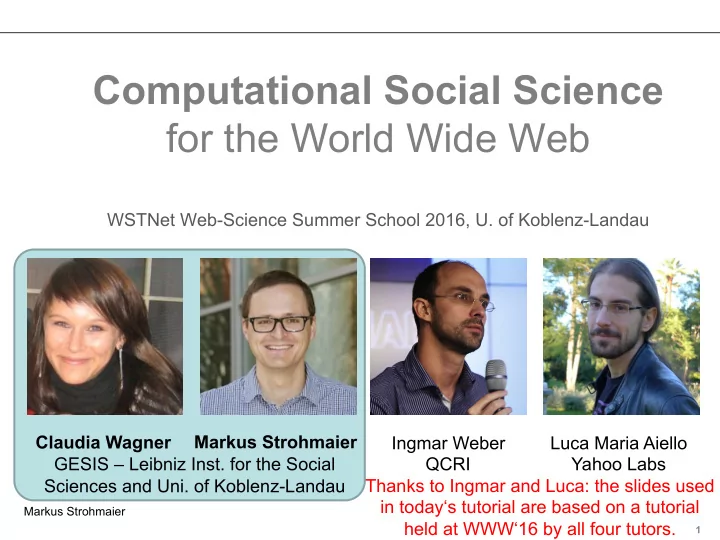
Computational Social Science for the World Wide Web WSTNet Web-Science Summer School 2016, U. of Koblenz-Landau Markus Strohmaier Claudia Wagner Ingmar Weber Luca Maria Aiello GESIS Leibniz Inst. for the Social QCRI Yahoo Labs Thanks to


slide-1
SLIDE 1

1

Markus Strohmaier

GESIS – Leibniz Inst. for the Social Sciences and Uni. of Koblenz-Landau

Computational Social Science for the World Wide Web

WSTNet Web-Science Summer School 2016, U. of Koblenz-Landau Claudia Wagner Markus Strohmaier Ingmar Weber QCRI Luca Maria Aiello Yahoo Labs Thanks to Ingmar and Luca: the slides used in today‘s tutorial are based on a tutorial held at WWW‘16 by all four tutors.

slide-2
SLIDE 2

2

Markus Strohmaier

Markus Strohmaier

I am a computer scientist in a social science institute.

  • Professor at the Dept. of Computer Science

University of Koblenz-Landau, Germany

  • Founder & Scientific Director,
  • Dept. of Computational Social Science

GESIS – Leibniz Institute for the Social Sciences Cologne, Germany

Post-Doc at U. of Toronto (2006/07) Visiting Researcher at (Xerox) Parc (2010/11), Visiting Assistant Professor at Stanford (2011/12), Assistant Professor at Graz University of Technology (2007-13)

Interested in understanding social phenomena via new kinds of data, from a methodological, empirical and theoretical perspective. Communities: WWW, ICWSM, Web-Science, ICCSS

http://markusstrohmaier.info @mstrohm

slide-3
SLIDE 3

3

Markus Strohmaier

WHO ARE YOU?

slide-4
SLIDE 4

4

Markus Strohmaier

Computational Social Science Tutorials

Last year (WWW‘15):

  • A great tutorial on Online Experiments for Computational Social

Science by Eytan Bakshy & Sean J. Taylor

  • Focus on “making your own data”, using PlanOut useful if you

have operational access to large online social platforms (eg. Wikipedia, Facebook) This year (WWW’16): Wagner, Strohmaier, Weber, Aiello

  • Focus on “found data” and social issues, useful if you don’t have
  • perational access to platforms, but access to web data
  • We will cover theory, data and methods / models
slide-5
SLIDE 5

5

Markus Strohmaier

Found data in the social sciences

There are two general types of found data: Accretion - a build-up of physical traces Erosion - the wearing away of material

slide-6
SLIDE 6

6

Markus Strohmaier

Polarization in Weblogs

during the US 2004 election

Polarization on Twitter

during the German 2013 election

6

Adamic, Lada A., and Natalie Glance. "The political blogosphere and the 2004 US election: divided they blog." Proceedings of the 3rd international workshop on Link discovery. ACM, 2005.

  • H. Lietz, C. Wagner, A. Bleier, and M. Strohmaier. When

politicians talk: Assessing online conversational practices of political parties on twitter. In International AAAI Conference on Weblogs and Social Media (ICWSM2014), Ann Arbor, MI, USA, June 2-4, 2014.

Found data on the web

slide-7
SLIDE 7

7

Markus Strohmaier

Social Issues on the Web: Growing Global Inequality

TBL: the Web has the potential to be a great equalizer, but only “if we hardwire the rights to privacy, freedom of expression, affordable access and net neutrality into the rules of the game.” http://thewebindex.org/ Equal access to information, knowledge, opportunity

slide-8
SLIDE 8

8

Markus Strohmaier

Stereotypes

Kay, Matthew, Cynthia Matuszek, and Sean A. Munson. "Unequal Representation and Gender Stereotypes in Image Search Results for Occupations." Proceedings of the 33rd Annual ACM Conference on Human Factors in Computing Systems. ACM, 2015.

Google image query: „Doctor“ Google image query: „Nurse“

„evidence for stereotype exaggeration and systematic underrepresentation of women”

slide-9
SLIDE 9

9

Markus Strohmaier

Discrimination

“non-black hosts are able to charge approximately 12% more than black hosts, holding location, rental characteristics, and quality constant.“

Edelman, Benjamin G. and Luca, Michael, Digital Discrimination: The Case of Airbnb.com (January 10, 2014). Harvard Business School NOM Unit Working Paper No. 14-054. http://dx.doi.org/10.2139/ssrn.2377353

slide-10
SLIDE 10

10

Markus Strohmaier

Racism

https://twitter.com/jackyalcine/status/615331869266157568

Photo app tagging black people as „gorillas“

slide-11
SLIDE 11

11

Markus Strohmaier

Inequality

  • C. Wagner, D. Garcia, J. Mohsen, and M. Strohmaier. It’s a man’s Wikipedia? assessing gender inequality

in an online encyclopedia. In International AAAI Conference on Web and Social Media (ICWSM2015), Oxford, UK, May 26-29, 2015.

“the way women are portrayed on Wikipedia starkly differs from the way men are portrayed.” “Women on Wikipedia tend to be more linked to men than vice versa”

slide-12
SLIDE 12

12

Markus Strohmaier

Price discrimination

we find evidence for price steering and price discrimination on four general retailers and five travel sites.

Measuring Price Discrimination and Steering on E-commerce Web Sites, Aniko Hannak, Gary Soeller, David Lazer, Alan Mislove, and Christo Wilson, In Proceedings of the 14th ACM/USENIX Internet Measurement Conference (IMC'14), Vancouver, Canada, November 2014.

slide-13
SLIDE 13

13

Markus Strohmaier

Map personalization

China's territory […] was shown to be about 21% larger by pixel count when it was depicted on Google Maps localized for mainland Chinese consumption.

MapWatch: Detecting and Monitoring International Border Personalization on Online MapsGary Soeller, Karrie Karahalios, Christian Sandvig, and Christo Wilson, Proceedings of the 25th International World Wide Web Conference (WWW 2016)Montreal, Quebec, Canada, April 2016

To be presented this week!

slide-14
SLIDE 14

14

Markus Strohmaier

Why our community should care about social issues on the Web

  • Inequality
  • Social Structures
  • Discrimination
  • Beliefs and Religions
  • Hate
  • Crime
  • Elections
  • Polarization
  • Views and Opinions
  • Radicalization
  • Personality
  • Perceptions

How do we describe them? How do we shape them?

The web reflects and helps shape:

slide-15
SLIDE 15

15

Markus Strohmaier

the Web has the potential to be a great equalizer, but

  • nly “if we hardwire the rights to privacy, freedom of

expression, affordable access and net neutrality into the rules of the game.”

equal access to information, knowledge, opportunity

http://webfoundation.org/2014/12/recognise-the-internet-as-a-human-right-says-sir-tim-berners-lee-as-he-launches-annual-web-index/

W h a t i s t h e w e b w e w a n t ? H

  • w

d

  • w

e m e a s u r e s

  • c

i a l p h e n

  • m

e n a ? H

  • w

d

  • w

e i m p r

  • v

e e x i s t i n g i n e q u a l i t i e s ?

slide-16
SLIDE 16

16

Markus Strohmaier

So when TBL asks: What kind of web do we want?

We (Web-researchers) need to lead the way in exploring and devising the web you want.

16

this means: build measurement instruments, understand social phenomena, devise policies, test and experiment with ideas, regulation and standardization, etc

https://webwewant.org/

slide-17
SLIDE 17

17

Markus Strohmaier

http://webwewant.org/

slide-18
SLIDE 18

18

Markus Strohmaier

Computational Social Science

CSSSA: http://computationalsocialscience.org/

Computational Social Science: “The science that investigates social phenomena through the medium of computing and algorithmic data processing.” [adapted from CSSSA]

18

  • Harvard iQS,
  • Stanford IRiSS,
  • CMU CASOS,
  • ESRC COSMOS
  • Web Observatories

So is this a new field for social scientists to engage in? The WWW community needs to join the effort to shape the WebWeWant!

slide-19
SLIDE 19

19

Markus Strohmaier

Where to go from here

To shape the WebWeWant, there is a need to learn about

  • Social issues
  • Social science theories
  • Social science hypotheses and methods
  • Social science data

Social science has a lot to contribute!

slide-20
SLIDE 20

20

Markus Strohmaier

Polarization

in the US Congress 1949-2011 1949 2011

sources: Andris, C. et al (2013) santa fe institute working paper (nov. 11, 2013) Andris, C. (2011) doctoral dissertation, mit, chapter 5

http://www.mamartino.com/projects/rise_of_partisanship/

slide-21
SLIDE 21

21

Markus Strohmaier

Gender inequality

Hausmann, Ricardo, Laura D. Tyson, and Saadia Zahidi. "The global gender gap index 2012." The Global Gender Gap Report (2012): 3-27.

World Economic Forum

slide-22
SLIDE 22

22

Markus Strohmaier

Social Science Data: US Census

rich in attributes:

  • Age and Sex
  • Race and Origin
  • Housing
  • Living Arrangements
  • Education
  • Health
  • Economy
  • Transportation
  • Income and Poverty
slide-23
SLIDE 23

23

Markus Strohmaier

Social Science Data: World Value Survey

slide-24
SLIDE 24

24

Markus Strohmaier

The Social Sciences*

*a simplified view

… are interested in understanding how people

  • think/feel/behave in social situations (social psychology),
  • relate to each other (sociology),
  • govern themselves (political science),
  • handle wealth (socioeconomics), and
  • create culture (anthropology).
  • M. Strohmaier, C. Wagner, Computational Social Science for the World Wide Web, IEEE Intelligent Systems

29(5): 84-88, 2014.

The web as a universal data source for social science questions?

slide-25
SLIDE 25

25

Markus Strohmaier

The value of Web data for social science research

Web data is often

  • not representative
  • population biases
  • poor in attributes
  • unknown demogr. attributes
  • dominated by a few
  • Power law phenomena
  • shaped by systems
  • algorithmically mediated
  • noisy
  • users != people

Web data is also

  • highly granular
  • high temporal resolution
  • rich in structure
  • multi-relational data
  • rich in sources
  • integration of diff. data types
  • complete
  • systems capture all

interactions

slide-26
SLIDE 26

26

Markus Strohmaier

Found Data vs. Designed Data

Found data:

  • Conservative estimate
  • Contextually dependent
  • Takes time to accumulate
  • Inferentially weak
  • Open privacy issues
  • cover lengthy periods of time
  • Ubiquitous
  • lower cost
  • less amenable to self-report bias
  • allows the exploration of trends

and temporal patterns

  • allows to observe rare events

Designed data:

  • Representative estimate
  • Problem dependent
  • Takes time to collect
  • Inferentially strong
  • Understood privacy issues
  • cover specific points in time
  • rare
  • high cost
  • amenable to self-report / social

desirability biases

  • allows precise assessments of

demographics

  • Difficult to observe rare events
slide-27
SLIDE 27

27

Markus Strohmaier

Why are Social Scientists excited about Computational Social Science?

Two main reasons:

  • Context of Justification: New kinds of data enable

to test social theories that we could not test previously

Verification, Falsification, Corroboration

  • Context of Discovery: New kinds of data enable to

come up with new social theories

Induction, Analogies, Abstraction

slide-28
SLIDE 28

28

Markus Strohmaier

Deductive Computational Social Science

  • Interested in testing (tentative) theories
  • Objective is to corroborate or falsify

We need theory, because we want to explain social issues.

(cf. The End of Theory: The Data Deluge Makes the Scientific Method Obsolete, Chris Anderson Wired Magazine, Date of Publication: 06.23.08)

Sociological Theory Hypothesis / Prediction Web Data Operationalization Methods Social Theories: Markus Testing Hypotheses: Claudia Validation Why do we need theory?

slide-29
SLIDE 29

29

Markus Strohmaier

Learning Goals

Understand

  • the web as a membrane for social issues
  • the web‘s research potential and limitations from a

social science perspective

  • the role of theory in social science
  • how sociological theories can be operationalized via

hypotheses

  • methods to test hypotheses via found data
  • Obtain an overview over datasets available
slide-30
SLIDE 30

30

Markus Strohmaier

What you can expect from this tutorial

  • Introduction and Motivation of the field of

Computational Social Science

  • Why it is relevant to the Web community
  • Limitations and opportunities of web data for social science research
  • Introduction to selected sociological theories
  • Examples of doing CSS with web data
  • Introduction to selected hypotheses testing methods
  • Methodological discussion of CSS
slide-31
SLIDE 31

31

Markus Strohmaier

Roadmap

Sociological Theory Hypothesis / Prediction Web Data Operationalization Methods Social Theories: Markus Testing Hypotheses: Claudia

slide-32
SLIDE 32

32

Markus Strohmaier

Theory vs. hypothesis

  • Hypothesis: a testable explanation of a fact
  • Theory: Well-substantiated explanation of a phenomenon

acquired through the scientific method and repeatedly tested and confirmed through observation and

  • experimentation. A theory can be used to make predictions

Theory Hypothesis Facts

The gap between the two can vary quite much Facts of social life can be difficult to measure. Hard to make reliable and valid measurements

slide-33
SLIDE 33

33

Markus Strohmaier

The nature of social structures

Theory review, operationalization (especially on WWW data), caveats

Stanley Milgram Mark Granovetter Robin Dunbar

Small-world hypothesis Tie strength and selection Social brain theory

slide-34
SLIDE 34

34

Markus Strohmaier

Small-world hypothesis

slide-35
SLIDE 35

35

Markus Strohmaier

A “common sense” intuition

We should select any person from the 1.5 billion inhabitants of the Earth. He bets us that, using no more than five individuals, one

  • f whom is a personal acquaintance, he could

contact the selected individual using nothing except the network of personal acquaintances.

Frigyes Karinthy – Chains, 1929

slide-36
SLIDE 36

36

Markus Strohmaier

The small-world problem

  • Formulated by social psychologist Stanley Milgram
  • Given any two people in the world (X and Y), how many

intermediate acquaintance links are needed before X and Y are connected?

Jeffrey & Milgram – An Experimental study of The Small World Problem, 1969

?

Theory Hypothesis Facts

slide-37
SLIDE 37

37

Markus Strohmaier

Milgram’s small-world experiment

  • Algorithmic formulation of the problem
  • Attempt to generate an acquaintance chain from a start

person to a target person

  • 1. A document is marked with information about the target

(name, address, occupation, company, hometown , etc.)

  • 2. The document is delivered to the start person
  • 3. The person with the document must:

a) Mark it with their name b) Deliver it to target if it’s a personal acquaintance c) Deliver to a personal acquaintance who might have a better chance to know the target d) Send a special tracer card to Harvard (for chain tracking)

slide-38
SLIDE 38

38

Markus Strohmaier

Experimental setup

  • 1 target person (a stockbrocker in Boston, MA)
  • 296 start people

– 100 stockholders in Nebraska – 96 random in Nebraska – 100 random in Boston

slide-39
SLIDE 39

39

Markus Strohmaier

Chain length

  • Mean number of

intermediaries = 5.2 (4.4 Boston, 6.1 Nebraska)

  • Mean number of hops

= 5 to 7

  • 64 chains reached the

target

slide-40
SLIDE 40

40

Markus Strohmaier

Length of incomplete chains

  • High dropout rate

– Hard task with only local knowledge – Lack of incentives

slide-41
SLIDE 41

41

Markus Strohmaier

Reliability and validity

  • Ecological validity

– The experiment well approximates a real-world situation (for the 60s) – Participants were not incentivized

  • Reliability

– Clear algorithmic rules, but… – 80% of chains are discarded, longer chains are under-represented: more likely that they will encounter an unwilling participant.

  • External validity

– Only 1 “special” target person (high social status) – Start people recruited with advertisement seeking for “well- connected” individuals

Less than 100 chains in US only cannot generalize

slide-42
SLIDE 42

42

Markus Strohmaier

From snail mail to email

  • Similar setup, using email, between 2001 and 2007
  • Experiment 1:

– 18 targets in 13 countries – 98,865 start people from 168 countries – 106,295 chains

  • Experiment 2:

– 21 targets in 13 countries – 85,621 start people from 163 countries – 56,033 chains Goel et al. – Social Search in “Small World” Experiments, 2009

slide-43
SLIDE 43

43

Markus Strohmaier

Results

  • Less than 1% of chains reached target, dropout rate

exponential with length

  • 4.05 steps on average
  • Dropout for lack of incentive
  • Estimating length in a no-attrition scenario
  • Median number of steps = 7

“if individuals searching for targets do not have sufficient incentives to proceed, the small-world hypothesis does not hold”

slide-44
SLIDE 44

44

Markus Strohmaier

Algorithmic vs. topological definition

  • Milgram and Watts explored the algorithmic definition
  • f the small-world problem

– Social search: shortest path that ordinary people can find given their local topological information about the underlying social graph

  • Large-scale web social data allowed for an

exploration of the topological definition of the same problem

– Shortest possible path between two individuals, with a global knowledge of the social network

  • J. Kleinberg. The small-world phenomenon: An algorithmic perspective, 2000
slide-45
SLIDE 45

45

Markus Strohmaier

Topological small-world (MSN)

  • Availability of large-scale online social network data made

direct topological measurement possible

  • MSN communication graph with 180M nodes and 1.3B

undirected edges

  • Topological distance between 1000 random nodes and all
  • thers. Measure number of hops

– Mode = 6 – Median = 7 – Average = 6.6 Leskovec & Horvitz – Planetary-scale view on instant messaging network, 2007

slide-46
SLIDE 46

46

Markus Strohmaier

Topological small-world (Facebook)

  • Facebook data 721M nodes 69B edges
  • Compute distance between all the pairs
  • Need a very efficient way to do it (HyperANF): http://

webgraph.dsi.unimi.it

  • Average of 4.74 hops
  • Recently repeated on 1.6B nodes
  • Average of 4.57 hops

Backstrom et al. – Four degrees of separation, 2012

slide-47
SLIDE 47

47

Markus Strohmaier

Open questions

  • Reliability

– Are all online social network ties good proxies for acquantiance?

  • External validity

– Does the result generalize across platforms? – Is the average path length shrinking in time?

  • Construct validity

– Is this results in line with expectations? What should we compare it to?

  • Ecological validity

– Is the actual graph distance meaningful for any social process?

slide-48
SLIDE 48

48

Markus Strohmaier

Tie strength

slide-49
SLIDE 49

49

Markus Strohmaier

Tie strength and social search

  • In Granovetter’s Small-World experiment, participants had to

report if the next step in the chain was a “friend” or “acquaintance”

  • Chain completion rate was 26% more likely if the first

interracial tie was an “acquaintance” (target person was black, start persons white)

  • Sparked the intuition that weak ties are more effective to

exchange information over a social network

slide-50
SLIDE 50

50

Markus Strohmaier

Granovetter’s tie strength

  • The degree of overlap of two individuals’ friendship

networks varies directly with the strength of their social tie. The strength of a tie is proportional to the similarity of its endpoints.

  • Strength of a tie is a combination of amount of time,

emotional intensity, intimacy, and reciprocal services which characterize a tie

Granovetter, Strength of weak ties, 1973 Subjective and hardly measurable concepts!

slide-51
SLIDE 51

51

Markus Strohmaier

Objective measure of tie strength

  • 2,184 rated Facebook

friendships

  • 85% prediction accuracy

using proxies of Granovetter’s indicators of strength

  • E. Gilbert & C. Karahalios. Predicting Tie Strength With Social Media 2009
slide-52
SLIDE 52

52

Markus Strohmaier

  • The stronger the tie between A and B

a) The higher the number of their shared social contacts b) The more similar they are Granovetter, Strength of weak ties, 1973 = =

Granovetter’s tie strength

slide-53
SLIDE 53

53

Markus Strohmaier

Hypothesis: Triangle closure

  • The more triangles the edge closes, the

higher the likelihood of its formation

  • Can be tested with predictive frameworks

– Target node A – Its distance-2 neighbors at time t: Γt

2(A)

– Predict the nodes in Γt

2 (A) that will be connected

with A at time t+Δ

  • Number of common neighbors (and

derivative measures) is highly predictive

A B C Kleinberg et al., The link prediction problem for social networks, 2003

slide-54
SLIDE 54

54

Markus Strohmaier

Theory à Hypothesis à Facts

Theory Hypothesis Facts

“Strength means time, intimacy…” People who declare to be close friends spend more time together and exchange more emotion words …as measured on social media exchange “The stronger a tie, the more similar its endpoints ” “… and the higher the number of their shared connections” Similarity (profile, behavioral) of people connecting is higher. Link that close triangles are more likely to form …as measured on online social graphs

Validity? Do more (and different) experiments

slide-55
SLIDE 55

55

Markus Strohmaier

Corollary: Weak ties and bridges

  • Bridges are always weak ties, never strong ties
  • Strong ties bring fragmentation: information has way more

pathways to stay within dense local clusters

  • Weak ties create reduce path length and create
  • pportunities to access new information

13

F G

slide-56
SLIDE 56

56

Markus Strohmaier

The Social Brain Theory

slide-57
SLIDE 57

57

Markus Strohmaier

Densification of social graph

  • Why the triangle closure process stops?

– Similarity – Incentives – Time and space constraints – Attention and cognitive boundaries

  • How big is a person’s ego network?
  • Is there a universal limit to human connectivity?
slide-58
SLIDE 58

58

Markus Strohmaier

The Social Brain Theory

  • Big brains evolved to solve the

problem of social life

– Cognitive effort – Time constraints (social grooming) – Face to face interaction – Emotional intensity

  • Correlation between neocortical

volume and typical social group size

  • Limits of human social network

size between 100 and 200 individuals (150 is the anecdotal number – Dunbar number)

  • R. Dunbar – Neocortex size as a constraint on group size in primates, 1992
slide-59
SLIDE 59

59

Markus Strohmaier

Exchange of Xmas cards

  • Sending Christmas cards individuals make an effort to contact

their network of acquaintances they value

  • 43 questionnaires from UK

households

  • 2,984 Christmas cards sent
  • Number of contacts =

– # family members + – # card recipients (household) + – # people seen on Christmas

  • Results

– Mean cards = 68.19 – Mean contacts = 153.5

Experimental limitations ?

Hill & Dunbar. Social Network Size in Humans, 2002

slide-60
SLIDE 60

60

Markus Strohmaier

Circles

  • 61 group datasets from literature
  • Expanding intimacy circles

– Support cliques (5) – Sympathy circle (15) – Close relationships (50) – Stable relationships (150) – Acquaintances (500) – People we can name (1500)

  • Scaling factor of ~3

Zhou et al. Discrete hierarchical organization of social group sizes, 2005

slide-61
SLIDE 61

61

Markus Strohmaier

Grooming in digital media?

  • SNSs may circumvented at least some of the real-life

constraints

  • Apparently no limit

Kwak et al. WWW 2010

slide-62
SLIDE 62

62

Markus Strohmaier

Probing digital barriers

  • Survey to 2000 UK Facebook users, stratified sample (age,

gender…)

  • How many Facebook…

– Friends [0,1000+] – Close friends [0,100+] – Support clique members (advice/sympathy in time of distress) [0,16+]

  • R. Dunbar. Do online social media cut through the constraints

that limit the size of offline social networks?, 2016

slide-63
SLIDE 63

63

Markus Strohmaier

SNSs do not circumvent real-life constraints

Mean=155 Mean=14 Mean=4

slide-64
SLIDE 64

64

Markus Strohmaier

  • Twitter dataset, 380M tweets, 1.7M users
  • Network of conversations
  • Direct measurement of the interaction strength:
  • Plot ω vs. kout
  • B. Gonçalves et al., Validation of Dunbar's number in Twitter conversations 2011

Dunbar number on Twitter

slide-65
SLIDE 65

65

Markus Strohmaier

Dunbar number on email

  • Email corpus of
  • Univ. Oslo

employees and students (35,600)

  • ~1M contacts in the
  • utside world

Haerter et al. Communication dynamics in finite capacity social networks, 2012

slide-66
SLIDE 66

66

Markus Strohmaier

SUMMARY From theory to hypotesis (and back) How to operationalize abstract concepts Reliability and validity of measurements Generalize across datasets Online vs. offline Explore from different angles

slide-67
SLIDE 67

67

Markus Strohmaier

Roadmap

Sociological Theory Hypothesis / Prediction Web Data Operationalization Methods Social Theories: Markus Testing Hypotheses: Claudia

slide-68
SLIDE 68

68

Markus Strohmaier

Any questions?

slide-69
SLIDE 69

69

Markus Strohmaier

Literature on found data

Eugene J. Webb, Lee Sechrest und Donald T. Campbell (1999), Unobtrusive Measures Raymond Lee (2000). Unobtrusive Methods In Social Research, Buckingham: Open University Press. Allan Kellehear (1993). The Unobtrusive Researcher - A guide to methods, St Leonards: Allen & Unwin. William G. Zikmund, Barry J. Babin, Jon C. Carr (2012). Business research methods. Cengage Learning (chapter 11) Yoram M Kalman. Unobtrusive Methods for Social Science Research - A Neglected Methodological Approach in the Social Sciences (slides) Christine Hine (2011). Internet Research and Unobtrusive Methods. Social Research Update, 61, 1-4. Michelle O’Brien (2010). Unobtrusive Research Methods – An Interpretative Essay.