(Wu 1995) Standard probabilistic context-free grammars: - - PowerPoint PPT Presentation

wu 1995
SMART_READER_LITE
LIVE PREVIEW

(Wu 1995) Standard probabilistic context-free grammars: - - PowerPoint PPT Presentation

(Wu 1995) Standard probabilistic context-free grammars: probabilities over rewrite rules define probabilities over trees, strings, in one language 6.864 (Fall 2007) Transduction grammars : Simultaneously generate strings in two languages


slide-1
SLIDE 1

6.864 (Fall 2007) Machine Translation Part IV

1

Overview

  • Syntax Based Model 1: (Wu 1995)

2

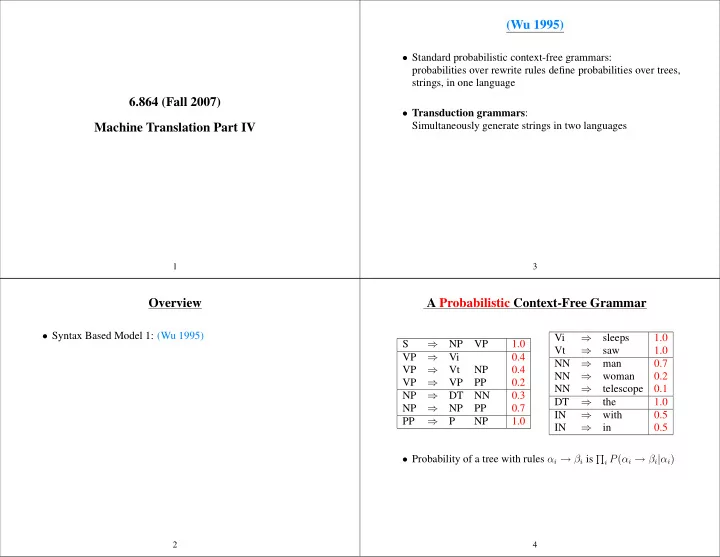
(Wu 1995)

  • Standard probabilistic context-free grammars:

probabilities over rewrite rules define probabilities over trees, strings, in one language

  • Transduction grammars:

Simultaneously generate strings in two languages

3

A Probabilistic Context-Free Grammar

S ⇒ NP VP 1.0 VP ⇒ Vi 0.4 VP ⇒ Vt NP 0.4 VP ⇒ VP PP 0.2 NP ⇒ DT NN 0.3 NP ⇒ NP PP 0.7 PP ⇒ P NP 1.0 Vi ⇒ sleeps 1.0 Vt ⇒ saw 1.0 NN ⇒ man 0.7 NN ⇒ woman 0.2 NN ⇒ telescope 0.1 DT ⇒ the 1.0 IN ⇒ with 0.5 IN ⇒ in 0.5

  • Probability of a tree with rules αi → βi is

i P(αi → βi|αi)

4

slide-2
SLIDE 2

Transduction PCFGs

  • First change to the rules: lexical rules generate a pair of words

Vi ⇒ sleeps/asleeps 1.0 Vt ⇒ saw/asaw 1.0 NN ⇒ man/aman 0.7 NN ⇒ woman/awoman 0.2 NN ⇒ telescope/atelescope 0.1 DT ⇒ the/athe 1.0 IN ⇒ with/awith 0.5 IN ⇒ in/ain 0.5

5

Transduction PCFGs

S NP D the/athe N man/aman VP Vi sleeps/asleeps

  • The modified PCFG gives a distribution over (f, e, T) triples,

where e is an English string, f is a French string, and T is a tree

6

Transduction PCFGs

  • Another change: allow empty string ǫ to be generated in either

language, e.g., DT ⇒ the/ǫ 1.0 IN ⇒ ǫ/awith 0.5

7

Transduction PCFGs

S NP D the/ǫ N man/aman VP Vi sleeps/asleeps

  • Allows strings in the two languages to have different lengths

the man sleeps ⇒ aman asleeps

8

slide-3
SLIDE 3

Transduction PCFGs

  • Final change: currently formalism does not allow different

word orders in the two languages

  • Modify the method to allow two types of rules, for example

S ⇒ [NP VP] 0.7 S ⇒ NP VP 0.3

9

  • Defi ne:

– EX is the English string under non-terminal X e.g., ENP is the English string under the NP – FX is the French string under non-terminal X

  • Then for S ⇒ [NP VP] we defi ne

ES = ENP .EV P FS = FNP .FV P where . is concatentation operation

  • For S ⇒ NP VP we defi ne

ES = ENP .EV P FS = FV P .FNP

In the second case, the string order in French is reversed

10

Transduction PCFGs

S NP [D the/ǫ N] man/aman VP Vi sleeps/asleeps

  • This tree represents the correspondance

the man sleeps ⇒ asleeps aman

11

A Transduction PCFG

S ⇒ [NP VP] 0.7 S ⇒ NP VP 0.3 VP ⇒ Vi 0.4 VP ⇒ [Vt NP] 0.01 VP ⇒ Vt NP 0.79 VP ⇒ [VP PP] 0.2 NP ⇒ [DT NN] 0.55 NP ⇒ DT NN 0.15 NP ⇒ [NP PP] 0.7 PP ⇒ P NP 1.0

12

slide-4
SLIDE 4

Vi ⇒ sleeps/ǫ 0.4 Vi ⇒ sleeps/asleeps 0.6 Vt ⇒ saw/asaw 1.0 NN ⇒ ǫ/aman 0.7 NN ⇒ woman/awoman 0.2 NN ⇒ telescope/atelescope 0.1 DT ⇒ the/athe 1.0 IN ⇒ with/awith 0.5 IN ⇒ in/ain 0.5

13

(Wu 1995)

  • Dynamic programming algorithms exist for “parsing” a pair
  • f English/French strings (finding most likely tree underlying

an English/French pair). Runs in O(|e|3|f|3) time.

  • Training the model: given (ek, fk) pairs in training data, the

model gives P(T, ek, fk | Θ) where T is a tree, Θ are the parameters. Also gives P(ek, fk | Θ) =

  • T

P(T, ek, fk | Θ) Likelihood function is then L(Θ) =

  • k

log P(fk, ek | Θ) =

  • k

log

  • T

P(T, fk, ek | Θ) Wu gives a dynamic programming implementation for EM

14

R: the current diffi culties should encourage us to redouble our efforts to promote cooperation in the euro-mediterranean framework. C: the current problems should spur us to intensify our efforts to promote cooperation within the framework of the europa-mittelmeerprozesses. B: the current problems should spur us, our efforts to promote cooperation within the framework of the europa-mittelmeerprozesses to be intensifi ed. R: propaganda of any sort will not get us anywhere. C: with any propaganda to lead to nothing. B: with any of the propaganda is nothing to do here. R: yet we would point out again that it is absolutely vital to guarantee independent fi nancial control. C: however, we would like once again refer to the absolute need for the independence of the fi nancial control. B: however, we would like to once again to the absolute need for the independence of the fi nancial control out. R: i cannot go along with the aims mr brok hopes to achieve via his report. C: i cannot agree with the intentions of mr brok in his report persecuted. B: i can intentions, mr brok in his report is not agree with. R:

  • n method, i think the nice perspectives, from that point of view, are very interesting.

C: what the method is concerned, i believe that the prospects of nice are on this point very interesting. B: what the method, i believe that the prospects of nice in this very interesting point.

15

R: secondly, without these guarantees, the fall in consumption will impact negatively upon the entire industry. C: and, secondly, the collapse of consumption without these guarantees will have a negative impact on the whole sector. B: and secondly, the collapse of the consumption of these guarantees without a negative impact

  • n the whole sector.

R: awarding a diploma in this way does not contravene uk legislation and can thus be deemed legal. C: since the award of a diploms is not in this form contrary to the legislation of the united kingdom, it can be recognised as legitimate. B: since the award of a diploms in this form not contrary to the legislation of the united kingdom is, it can be recognised as legitimate. R: i should like to comment briefly on the directive concerning undesirable substances in products and animal nutrition. C: i would now like to comment briefly on the directive on undesirable substances and products of animal feed. B: i would now like to briefly to the directive on undesirable substances and products in the nutrition of them.

16

slide-5
SLIDE 5

R: it was then clearly shown that we can in fact tackle enlargement successfully within the eu ’s budget. C: at that time was clear that we can cope with enlargement, in fact, within the framework drawn by the eu budget. B: at that time was clear that we actually enlargement within the framework able to cope with the eu budget, the drawn.

Figure 1: Examples where annotator 1 judged the reordered system to give an improved

translation when compared to the baseline system. Recall that annotator 1 judged 40 out

  • f 100 translations to fall into this category. These examples were chosen at random

from these 40 examples, and are presented in random order. R is the human (reference) translation; C is the translation from the system with reordering; B is the output from the baseline system.

17

R:

  • n the other hand non-british hauliers pay nothing when travelling in britain.

C:

  • n the other hand, foreign kraftverkehrsunternehmen fi gures anything if their lorries

travelling through the united kingdom. B:

  • n the other hand, fi gures foreign kraftverkehrsunternehmen nothing if their lorries travel

by the united kingdom. R: i think some of the observations made by the consumer organisations are included in the commission ’s proposal. C: i think some of these considerations, the social organisations will be addressed in the commission proposal. B: i think some of these considerations, the social organisations will be taken up in the commission ’s proposal. R: during the nineties the commission produced several recommendations on the issue but no practical solutions were found. C: in the nineties, there were a number of recommendations to the commission on this subject to achieve without, however, concrete results. B: in the 1990s, there were a number of recommendations to the commission on this subject without, however, to achieve concrete results. R: now, in a panic, you resign yourselves to action. C: in the current paniksituation they must react necessity. B: in the current paniksituation they must of necessity react. R: the human aspect of the whole issue is extremely important. C: the whole problem is also a not inconsiderable human side. B: the whole problem also has a not inconsiderable human side.

18

R: in this area we can indeed talk of a european public prosecutor. C: and we are talking here, in fact, a european public prosecutor. B: and here we can, in fact speak of a european public prosecutor. R: we have to make decisions in nice to avoid endangering enlargement, which is our main priority. C: we must take decisions in nice, enlargement to jeopardise our main priority. B: we must take decisions in nice, about enlargement be our priority, not to jeopardise. R: we will therefore vote for the amendments facilitating its use. C: in this sense, we will vote in favour of the amendments which, in order to increase the use

  • f.

B: in this sense we vote in favour of the amendments which seek to increase the use of. R: the fvo mission report mentioned refers specifi cally to transporters whose journeys

  • riginated in ireland.

C: the quoted report of the food and veterinary offi ce is here in particular to hauliers, whose rushed into shipments of ireland. B: the quoted report of the food and veterinary offi ce relates in particular, to hauliers, the transport of rushed from ireland.

Figure 2: Examples where annotator 1 judged the reordered system to give a worse

translation than the baseline system. Recall that annotator 1 judged 20 out of 100 translations to fall into this category. These examples were chosen at random from these 20 examples, and are presented in random order. R is the human (reference) translation; C is the translation from the system with reordering; B is the output from the baseline system.

19