wutsrponmlihgfedcbaTSPLFEDCB Dear Dr. Rigas; Please find attached - - PDF document

wutsrponmlihgfedcbatsplfedcb
SMART_READER_LITE
LIVE PREVIEW

wutsrponmlihgfedcbaTSPLFEDCB Dear Dr. Rigas; Please find attached - - PDF document

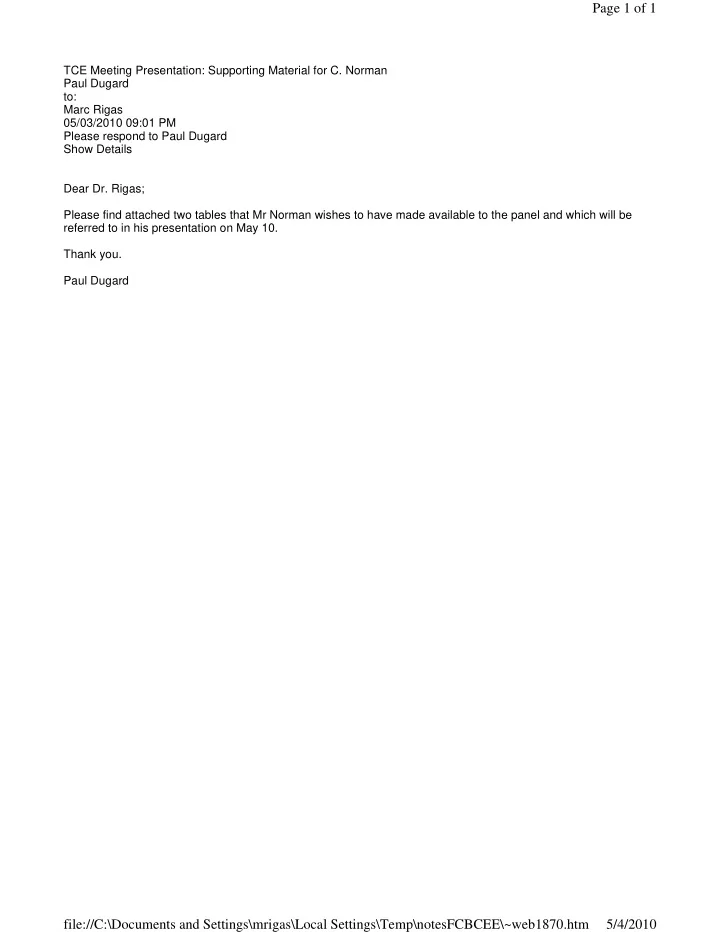
Page 1 of 1 TCE Meeting Presentation: Supporting Material for C. Norman Paul Dugard to: Marc Rigas 05/03/2010 09:01 PM Please respond to Paul Dugard Show Details wutsrponmlihgfedcbaTSPLFEDCB Dear Dr. Rigas; Please find attached two tables


slide-1
SLIDE 1

wutsrponmlihgfedcbaTSPLFEDCB

Page 1 of 1

TCE Meeting Presentation: Supporting Material for C. Norman Paul Dugard to: Marc Rigas 05/03/2010 09:01 PM Please respond to Paul Dugard Show Details Dear Dr. Rigas; Please find attached two tables that Mr Norman wishes to have made available to the panel and which will be referred to in his presentation on May 10. Thank you. Paul Dugard

file://C:\Documents and Settings\mrigas\Local Settings\Temp\notesFCBCEE\~web1870.htm 5/4/2010

slide-2
SLIDE 2

Contaminated Water Supplies at Camp Lejeune, Assessing Potential Health Effects National Research Council of the National Academy of Sciences (2009)

BOX 1 Five Categories Used by IOM to Classify Associations Sufficient Evidence of a Causal Relationship Evidence from available studies is sufficient to conclude that a causal relationship exists between exposure to a specific agent and a specific health

  • utcome in humans, and the evidence is supported by experimental data. The

evidence fulfills the guidelines for sufficient evidence of an association (below) and satisfies several of the guidelines used to assess causality: strength of association, dose-response relationship, consistency of association, biologic plausibility, and a temporal relationship. Sufficient Evidence of an Association Evidence from available studies is sufficient to conclude that there is a positive

  • association. A consistent positive association has been observed between

exposure to a specific agent and a specific health outcome in human studies in which chance and bias, including confounding, could be ruled out with reasonable confidence. For example, several high-quality studies report consistent positive associations, and the studies are sufficiently free of bias, including adequate control for confounding. Limited/Suggestive Evidence of an Association Evidence from available studies suggests an association between exposure to a specific agent and a specific health outcome in human studies, but the body of evidence is limited. . . . Inadequate/Insufficient Evidence to Determine Whether an Association Exists Evidence from available studies is of insufficient quantity, quality, or consistency to permit a conclusion regarding the existence of an association between exposure to a specific agent and a specific health outcome in humans. Limited/Suggestive Evidence of No Association Evidence from well-conducted studies is consistent in not showing a positive association between exposure to a specific agent and a specific health outcome after exposure of any magnitude. . . . Source: IOM (Institute of Medicine). 2003. Gulf War and Health, Vol. 2, Insecticides and Solvents. Washington, DC: National Academies Press.

slide-3
SLIDE 3

xwvutsrqponmlihgfedcaWTSRPONLIEDCA BOX 2 Categorization of Health Outcomesa Reviewed in Relation to TCE, PCE, or Solvent Mixtures Sufficient Evidence of a Causal Relationship

  • No outcomes

Sufficient Evidence of an Association

  • No outcomes

Limited/Suggestive Evidence of an Association

  • Kidney cancer
  • Adult leukemia (solvent mixtures)
  • Multiple myeloma (solvent mixtures)
  • Myleodysplasic syndromes (solvent

mixtures)

  • Scleroderma (solvent mixtures)
  • Neurobehavioral effects (solvent mixtures)

Inadequate/Insufficient Evidence to Determine Whether an Association Exists

  • Oral/pharyngeal cancer
  • Childhood leukemia
  • Nasal cancer
  • Childhood neuroblastoma
  • Laryngeal cancer
  • Childhood brain cancer
  • Esophageal cancer (TCE)
  • Aplastic anemia
  • Stomach cancer
  • Congenital malformations
  • Colon cancer
  • Male infertility
  • Rectal cancer
  • Female infertility (after exposure
  • Pancreatic cancer

cessation)

  • Hepatobiliary cancer
  • Lung cancer (TCE)
  • Bone cancer
  • Miscarriage, preterm birth, or fetal growth

restriction (from maternal preconception exposure or paternal exposure)

  • Soft tissue sarcoma
  • Melanoma
  • Preterm birth or fetal growth restriction

(from exposure during pregnancy)

  • Non-melanoma skin cancer
  • Cardiovascular effects
  • Breast cancer (TCE)
  • Liver function or risk of cirrhosis
  • Cervical cancer
  • Gastrointestinal effects
  • Ovarian/uterine cancer
  • Renal toxicity
  • Prostate cancer
  • Amyotrophic lateral sclerosis
  • Bladder cancer (TCE)
  • Parkinson disease
  • Cancer of the brain or central nervous

system

  • Multiple sclerosis
  • Alzheimer disease
  • Non-Hodgkin lymphoma
  • Long-term reduction in color discrimination
  • Hodgkin disease
  • Long-term hearing loss
  • Multiple myeloma
  • Long-term reduction in olfactory function
  • Adult leukemia
  • Myelodysplasic syndromes

Limited/Suggestive Evidence of No Association

  • No outcomes

aOutcomes for TCE and PCE unless otherwise specified*

* PCE-only outcomes omitted