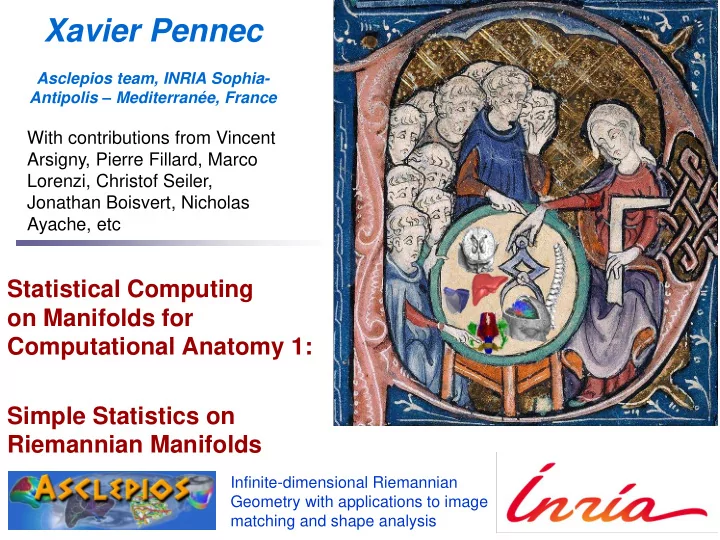
Xavier Pennec Asclepios team, INRIA Sophia- Antipolis Mediterrane, - - PowerPoint PPT Presentation

xavier pennec
SMART_READER_LITE
LIVE PREVIEW

Xavier Pennec Asclepios team, INRIA Sophia- Antipolis Mediterrane, - - PowerPoint PPT Presentation

Xavier Pennec Asclepios team, INRIA Sophia- Antipolis Mediterrane, France With contributions from Vincent Arsigny, Pierre Fillard, Marco Lorenzi, Christof Seiler, Jonathan Boisvert, Nicholas Ayache, etc Statistical Computing on


slide-1
SLIDE 1

Statistical Computing

  • n Manifolds for

Computational Anatomy 1: Simple Statistics on Riemannian Manifolds

Infinite-dimensional Riemannian Geometry with applications to image matching and shape analysis

Xavier Pennec

Asclepios team, INRIA Sophia- Antipolis – Mediterranée, France

With contributions from Vincent Arsigny, Pierre Fillard, Marco Lorenzi, Christof Seiler, Jonathan Boisvert, Nicholas Ayache, etc

slide-2
SLIDE 2
  • X. Pennec - ESI - Shapes, Feb 10-13 2015

2

Anatomy

Gall (1758-1828) : Phrenology Talairach (1911-2007)

Antiquity

  • Animal models
  • Philosophical physiology

Renaissance:

  • Dissection, surgery
  • Descriptive anatomy

Vésale (1514-1564) Paré (1509-1590)

1990-2000:

  • Explosion of imaging
  • Computer atlases
  • Brain decade

2007

Science that studies the structure and the relationship in space of different organs and tissues in living systems [Hachette Dictionary]

Revolution of observation means (1988-2007) :

From dissection to in-vivo in-situ imaging

From representative individual to population

From descriptive atlases to interactive and generative models (simulation)

Galien (131-201)

1st cerebral atlas, Vesale, 1543

17-20e century:

  • Anatomo-physiology
  • Microscopy, histology

Visible Human Project, NLM, 1996-2000 Voxel-Man, U. Hambourg, 2001 Talairach & Tournoux, 1988

Sylvius (1614-1672) Willis (1621-1675)

Paré, 1585

slide-3
SLIDE 3
  • X. Pennec - ESI - Shapes, Feb 10-13 2015

3

Design Mathematical Methods and Algorithms to Model and Analyze the Anatomy

 Statistics of organ shapes across species, populations, diseases…  Model organ development across time (heart-beat, growth, ageing, ages…)  To understand and to model how life is functioning

Classify structural deviations (taxonomy), Relate anatomy and function

 To detect, understand and correct dysfunctions

From generic (atlas-based) to patients-specific models

 Very active topic in medical image analysis

Keyword of Medic Image Computing and Computer Assisted Intervention (MICCAI)

Computational Anatomy

slide-4
SLIDE 4

Statistical Analysis of Geometric Features

Noisy Geometric Measures

 Tensors, covariance matrices  Curves, tracts  Surfaces  Transformations

 Rigid, affine, locally affine, diffeomorphisms

Goal:

 Deal with noise consistently on these non-Euclidean manifolds  A consistent statistical (and computing) framework

  • X. Pennec - ESI - Shapes, Feb 10-13 2015

5

slide-5
SLIDE 5

Morphometry through Deformations

6

  • X. Pennec - ESI - Shapes, Feb 10-13 2015

Measure of deformation [D’Arcy Thompson 1917, Grenander & Miller]

 Observation = “random” deformation of a reference template  Reference template = Mean (atlas)  Shape variability encoded by the deformations

Statistics on groups of transformations (Lie groups, diffeomorphism)? Consistency with group operations (non commutative)?

Patient 3 Atlas Patient 1 Patient 2 Patient 4 Patient 5 1 2 3 4 5

slide-6
SLIDE 6
  • X. Pennec - ESI - Shapes, Feb 10-13 2015

7

Shape of RV in 18 patients

Methods of computational anatomy

Remodeling of the right ventricle of the heart in tetralogy of Fallot

 Mean shape  Shape variability  Correlation with clinical variables  Predicting remodeling effect

slide-7
SLIDE 7

Longitudinal deformation analysis

8

time

Dynamic obervations

How to transport longitudinal deformation across subjects? What are the convenient mathematical settings?

  • X. Pennec - ESI - Shapes, Feb 10-13 2015

Patient A Patient B

? ?

Template

slide-8
SLIDE 8
  • X. Pennec - ESI - Shapes, Feb 10-13 2015

9

Statistical Computing on Manifolds for Computational Anatomy

Simple Statistics on Riemannian Manifolds Manifold-Valued Image Processing Metric and Affine Geometric Settings for Lie Groups Analysis of Longitudinal Deformations

slide-9
SLIDE 9
  • X. Pennec - ESI - Shapes, Feb 10-13 2015

10

Statistical Computing on Manifolds for Computational Anatomy

Simple Statistics on Riemannian Manifolds

 Introduction to computational anatomy  The Riemannian manifold computational structure  Simple statistics on Riemannian manifolds  Applications to the spine shape and registration accuracy

Manifold-Valued Image Processing Metric and Affine Geometric Settings for Lie Groups Analysis of Longitudinal Deformations

slide-10
SLIDE 10

Basic probabilities and statistics

Measure: random vector x of pdf Approximation:

  • Mean:
  • Covariance:

Propagation: Noise model: additive, Gaussian... Principal component analysis Statistical distance: Mahalanobis and

dz z p z ). ( . ) E( x

x

x

  ) x (

xx

Σ x , ~ ) (z px

 

T

) x ).( x ( E     x x

xx

 

             x . . x , x ) (

T

h h h ~ h

xx

Σ x y

 2

  • X. Pennec - ESI - Shapes, Feb 10-13 2015

11

slide-11
SLIDE 11

Differentiable manifolds

Définition:

 Locally Euclidean Topological space

which can be globally curved

 Same dimension + differential regularity

Simple Examples

 Sphere  Saddle (hyperbolic space)  Surface in 3D space

And less simple ones

 Projective spaces  Rotations of R3 : SO3 ~ P3  Rigid, affine Transformation  Diffeomorphisms

  • X. Pennec - ESI - Shapes, Feb 10-13 2015

12

slide-12
SLIDE 12

Differentiable manifolds

Computing in a a manifold

 Extrinsic

 Embedding in ℝ𝑜

 Intrinsic

 Coordinates : charts  Atlas = consistent set

  • f charts
  • X. Pennec - ESI - Shapes, Feb 10-13 2015

13  Measuring?

 Volumes (surfaces)  Lengths  Straight lines

slide-13
SLIDE 13

g(t)

dt t L

 || ) ( || ) ( g g 

  • Length of a curve

Measuring extrinsic distances

Basic tool: the scalar product

  • X. Pennec - ESI - Shapes, Feb 10-13 2015

14

w v w v

t

  ,

w

w v w v ) cos( ,   

  • Angle between vectors
  • Norm of a vector

   v v v ,

p v

slide-14
SLIDE 14

Bernhard Riemann 1826-1866

Measuring extrinsic distances

Basic tool: the scalar product

  • X. Pennec - ESI - Shapes, Feb 10-13 2015

15

w v w v

t

  ,

p p

w v w v ) cos( ,

p

   

  • Angle between vectors

dt t L

t

|| ) ( || ) (

) (

g

g g 

  • Length of a curve
  • Norm of a vector

p p

v v v    ,

Bernhard Riemann 1826-1866

w p G v w v

t p

) ( ,   

slide-15
SLIDE 15

w p G v w v

t p

) ( ,   

Bernhard Riemann 1826-1866

Riemannian manifolds

Basic tool: the scalar product

  • X. Pennec - ESI - Shapes, Feb 10-13 2015

16

dt t L

t

|| ) ( || ) (

) (

g

g g 

  • Length of a curve

Bernhard Riemann 1826-1866

  • Geodesic between 2 points
  • Shortest path
  • Calculus of variations (E.L.) :

2nd order differential equation (specifies acceleration)

  • Free parameters: initial speed

and starting point

slide-16
SLIDE 16

17

Bases of Algorithms in Riemannian Manifolds

Operation Euclidean space Riemannian Subtraction Addition Distance

Gradient descent ) (

t t t

x C x x   

) (y Log xy

x

 xy x y  

x y y x   ) , ( dist

x

xy y x  ) , ( dist ) (xy Exp y

x

)) ( (

t x t

x C Exp x

t

  

x y xy  

Reformulate algorithms with expx and logx

Vector -> Bi-point (no more equivalence classes)

  • X. Pennec - ESI - Shapes, Feb 10-13 2015

Exponential map (Normal coordinate system):

 Expx = geodesic shooting parameterized by the initial tangent  Logx = unfolding the manifold in the tangent space along geodesics

 Geodesics = straight lines with Euclidean distance  Local  global domain: star-shaped, limited by the cut-locus  Covers all the manifold if geodesically complete

slide-17
SLIDE 17
  • X. Pennec - ESI - Shapes, Feb 10-13 2015

21

Statistical Computing on Manifolds for Computational Anatomy

Simple Statistics on Riemannian Manifolds

 Introduction to computational anatomy  The Riemannian manifold computational structure  Simple statistics on Riemannian manifolds  Applications to the spine shape and registration accuracy

Manifold-Valued Image Processing Metric and Affine Geometric Settings for Lie Groups Analysis of Longitudinal Deformations

slide-18
SLIDE 18

Random variable in a Riemannian Manifold

Intrinsic pdf of x

 For every set H

𝑄 𝐲 ∈ 𝐼 = 𝑞 𝑧 𝑒𝑁(𝑧)

𝐼

 Lebesgue’s measure  Uniform Riemannian Mesure 𝑒𝑁 𝑧 =

det 𝐻 𝑧 𝑒𝑧

Expectation of an observable in M

 𝑭𝐲 𝜚 = 𝜚 𝑧 𝑞 𝑧 𝑒𝑁 𝑧 𝑁

 𝜚 = 𝑒𝑗𝑡𝑢2 (variance) : 𝑭𝐲 𝑒𝑗𝑡𝑢 . , 𝑧 2 = 𝑒𝑗𝑡𝑢 𝑧, 𝑨 2𝑞 𝑨 𝑒𝑁(𝑨)

𝑁

 𝜚 = log 𝑞 (information) : 𝑭𝐲 log 𝑞

= 𝑞 𝑧 log (𝑞 𝑧 )𝑒𝑁 𝑧

𝑁

 𝜚 = 𝑦 (mean) : 𝑭𝐲 𝐲 = 𝑧 𝑞 𝑧 𝑒𝑁 𝑧

𝑁

  • X. Pennec - ESI - Shapes, Feb 10-13 2015

22

slide-19
SLIDE 19

Fréchet expectation (1944)

Minimizing the variance Existence

 Finite variance at one point

Characterization as an exponential barycenter (P(C)=0) Uniqueness Karcher 77 / Kendall 90 / Afsari 10 / Le 10

 Unique Karcher mean (thus Fréchet) if distribution has support in a

regular geodesic ball with radius 𝑠 < 𝑠∗ =

1 2 min 𝑗𝑜𝑘 𝑁 , 𝜌/ 𝜆 (k upper

bound on sectional curvatures on M)

 Empirical mean: a.s. uniqueness [Arnaudon & Miclo 2013]

Other central primitives

 

 

 

) , dist( E argmin

2

x x y

y M 

 Ε

 

 

) ( ). ( . x x E ) ( grad

2

   

M

M z d z p y

x x

x x 

 

 

  

  1

) , dist( E argmin x x y

y M 

 Ε

  • X. Pennec - ESI - Shapes, Feb 10-13 2015

23

slide-20
SLIDE 20

24

Statistical tools: Moments

Frechet / Karcher mean minimize the variance Gauss-Newton Geodesic marching Covariance (PCA) [higher moments]

 

x y E with ) ( exp x

x 1

 

v v

t

t

  

 

  

  

M

M ) ( ). ( . x . x x . x E

T T

z d z p z z

x xx

x x  

 

 

 

 

) ( ) ( ). ( . x x E ) , dist( E argmin

2

    

C P z d z p y

y M M

M

x

x x x x Ε

  • X. Pennec - ESI - Shapes, Feb 10-13 2015

[Oller & Corcuera 95, Battacharya & Patrangenaru 2002, Pennec, JMIV06, NSIP’99 ]

slide-21
SLIDE 21

25

Example with 3D rotations

Principal chart: Distance: Frechet mean:

n r . : ector rotation v  

2 ) 1 ( 1 2 1

) , dist( r r R R 

Centered chart:

mean = barycenter

      

 i

) , dist( min arg

3

i SO R

R R R

  • X. Pennec - ESI - Shapes, Feb 10-13 2015
slide-22
SLIDE 22

Other definitions of the mean

Doss [1949] / Herer [1988]: Convex barycenters (Emery / Arnaudon)

 Convex functions in compact spaces are constant

Emery 1991:

 if the support of x is included in a strongly convex

  • pen set:

Picard 1994: Connector (->) Connection (->) metric

 Difference between barycenters is O()

     

) , dist( E ) , dist( x x y x y y    / M Ε

     

x x x

  • f

support

  • n the

convex for ) ( E ) (       y y / M Ε s Barycenter Convex s barycenter l Exponentia 

  • X. Pennec - ESI - Shapes, Feb 10-13 2015

26

slide-23
SLIDE 23

27

Distributions for parametric tests

Uniform density:

 maximal entropy knowing X

Generalization of the Gaussian density:

 Stochastic heat kernel p(x,y,t) [complex time dependency]  Wrapped Gaussian [Infinite series difficult to compute]  Maximal entropy knowing the mean and the covariance

Mahalanobis D2 distance / test:

 Any distribution:  Gaussian:

   

       2 / x . . x exp . ) (

T

x Γ x k y N

) Vol( / ) ( Ind ) ( X z z p

X

x

 

 

 

 

r O k

n

/ 1 . ) det( . 2

3 2 / 1 2 /

      

 

Σ

   

r O / Ric

3 1 ) 1 (

      

Σ Γ

y x . . y x ) y (

) 1 ( 2 

 

xx x t

 

n  ) ( E

2 x x

 

r O

n

/ ) ( ) (

3 2 2

        x

x

[ Pennec, JMIV06, NSIP’99 ]

  • X. Pennec - ESI - Shapes, Feb 10-13 2015
slide-24
SLIDE 24

28

Gaussian on the circle

Exponential chart: Gaussian: truncated standard Gaussian [ . ; . ] r r r x      

standard Gaussian (Ricci curvature → 0) uniform pdf with (compact manifolds) Dirac

:   r :   g :  g 3 / ) . (

2 2

r   

  • X. Pennec - ESI - Shapes, Feb 10-13 2015
slide-25
SLIDE 25

PCA vs PGA

PCA

 Generative model: Gaussian  Find the subspace that best explains the variance

 Maximize the squared distance to the mean

PGA (Fletcher 2004, Sommer 2014)

 Generative model:

 Implicit uniform distribution within the subspace  Gaussian distribution in the vertical space

 Find a low dimensional subspace (geodesic subspaces?) that

minimizes the error

 Minimize the squared Riemannian distance from the measurements to that sub-manifold (no closed form)

Different models in curved spaces (no Pythagore thm) Open problem and discussions

  • X. Pennec - ESI - Shapes, Feb 10-13 2015

29

slide-26
SLIDE 26
  • X. Pennec - ESI - Shapes, Feb 10-13 2015

30

Statistical Computing on Manifolds for Computational Anatomy

Simple Statistics on Riemannian Manifolds

 Introduction to computational anatomy  The Riemannian manifold computational structure  Simple statistics on Riemannian manifolds  Applications to the spine shape and registration accuracy

Manifold-Valued Image Processing Metric and Affine Geometric Settings for Lie Groups Analysis of Longitudinal Deformations

slide-27
SLIDE 27
  • X. Pennec - ESI - Shapes, Feb 10-13 2015

31

Statistical Analysis of the Scoliotic Spine

Database

307 Scoliotic patients from the Montreal’s Sainte-Justine Hospital.

3D Geometry from multi-planar X-rays

Mean

Main translation variability is axial (growth?)

Main rot. var. around anterior-posterior axis [ J. Boisvert et al. ISBI’06, AMDO’06 and IEEE TMI 27(4), 2008 ]

slide-28
SLIDE 28
  • X. Pennec - ESI - Shapes, Feb 10-13 2015

32

Statistical Analysis of the Scoliotic Spine

  • Mode 1: King’s class I or III
  • Mode 2: King’s class I, II, III
  • Mode 3: King’s class IV + V
  • Mode 4: King’s class V (+II)

PCA of the Covariance:

4 first variation modes have clinical meaning [ J. Boisvert et al. ISBI’06, AMDO’06 and IEEE TMI 27(4), 2008 ] AMDO’06 best paper award, Best French-Quebec joint PhD 2009

slide-29
SLIDE 29

Bronze Standard Rigid Registration Validation

Best explanation of the observations (ML) :

 LSQ criterion  Robust Fréchet mean  Robust initialization and Newton gradient descent

Result Derive tests on transformations for accuracy / consistency

  • X. Pennec - ESI - Shapes, Feb 10-13 2015

33

 

2 2 1 2 2 1 2

), , ( min ) , (   T T T T d 

trans rot j i

T   , ,

,

ij ij ij T

T d C ) ˆ , (

2

[ T. Glatard & al, MICCAI 2006,

  • Int. Journal of HPC Apps, 2006 ]
slide-30
SLIDE 30

Augmented reality guided radio-frequency tumor ablation

Current operative setup at IRCAD (Strasbourg, France)

 Per-operative CT “guidance”  Respiratory gating

Marker based 3D/2D rigid registration

  • S. Nicolau, X.Pennec, A. Garcia,L. Soler, N. Ayache
  • X. Pennec - ESI - Shapes, Feb 10-13 2015

35

slide-31
SLIDE 31

Liver puncture guidance using augmented reality

  • X. Pennec - ESI - Shapes, Feb 10-13 2015

36

slide-32
SLIDE 32

Liver puncture guidance using augmented reality

3D (CT) / 2D (Video) registration

 2D-3D EM-ICP on fiducial markers  Certified accuracy in real time

Validation

 Bronze standard (no gold-standard)  Phantom in the operating room (2 mm)  10 Patient (passive mode): < 5mm (apnea)

  • X. Pennec - ESI - Shapes, Feb 10-13 2015

37

[ S. Nicolau, et al. Comp. Anim. & Virtual World 2005, Medical Image Analysis, 13(3), 2009 ]

  • S. Nicolau, IRCAD / INRIA
slide-33
SLIDE 33

38

Data (per-operative US)

 2 pre-op MR (0.9 x 0.9 x 1.1 mm)  3 per-op US (0.63 and 0.95 mm)  3 loops

Robustness and precision Consistency of BCR

Results on per-operative patient images

Success var rot (deg) var trans (mm) MI 29% 0.53 0.25 CR 90% 0.45 0.17 BCR 85% 0.39 0.11

var rot (deg) var trans (mm) var test (mm) Multiple MR 0.06 0.06 0.10 Loop 2.22 0.82 2.33 MR/US 1.57 0.58 1.65 [Roche et al, TMI 20(10), 2001 ] [Pennec et al, Multi-Sensor Image Fusion, Chap. 4, CRC Press, 2005]

  • X. Pennec - ESI - Shapes, Feb 10-13 2015
slide-34
SLIDE 34

39

Mosaicing of Confocal Microscopic in Vivo Video Sequences.

Cellvizio: Fibered confocal fluorescence imaging

FOV 200x200 µm

Courtesy of Mike Booth, MGH, Boston, MA

FOV 2747x638 µm

Cellvizio

[ T. Vercauteren et al., MICCAI 2005, T.1, p.753-760 ]

  • X. Pennec - ESI - Shapes, Feb 10-13 2015
slide-35
SLIDE 35

40

Common coordinate system

 Multiple rigid registration  Refine with non rigid

Mosaic image creation

 Interpolation / approximation

with irregular sampling

Mosaic

Frame 6 Frame 1 Frame 2 Frame 3 Frame 4 Frame 5

Mosaicing of Confocal Microscopic in Vivo Video Sequences.

Courtesy of Mike Booth, MGH, Boston, MA

FOV 2747x638 µm

[ T. Vercauteren et al., MICCAI 2005, T.1, p.753-760 ]

  • X. Pennec - ESI - Shapes, Feb 10-13 2015
slide-36
SLIDE 36

Advertisement

Geometric Sciences of Information - GSI’2013

 Paris, August 28-30 2013, 2013

http://www.gsi2013.org

  • X. Pennec - ESI - Shapes, Feb 10-13 2015

41

  • Computational Information Geometry
  • Hessian/Symplectic Information Geometry
  • Optimization on Matrix Manifolds
  • Probability on Manifolds
  • Optimal Transport Geometry
  • Shape Spaces: Geometry and Statistic
  • Geometry of Shape Variability
  • ……….
  • Organizers: S. Bonnabel, J. Angulo, A. Cont, F.

Nielsen, F. Barbaresco

  • Scientific committee: F. Nielsen, M. Boyom P.

Byande, F. Barbaresco, S. Bonnabel, R. Sepulchre,

  • M. Arnaudon, G. Peyré, B. Maury, M. Broniatowski,
  • M. Basseville, M. Aupetit, F. Chazal, R. Nock, J.

Angulo, N. Le Bihan, J. Manton, A. Cont, A.Dessein, A.M. Djafari, H. Snoussi, A. Trouvé, S. Durrleman, X. Pennec, J.F. Marcotorchino, M. Petitjean, M. Deza

slide-37
SLIDE 37

Advertisement

Mathematical Foundations of Computational Anatomy Workshop at MICCAI 2013 (MFCA 2013)

 Nagoya, Japan, September 22 or 26, 2013

  • X. Pennec - ESI - Shapes, Feb 10-13 2015

42

  • Organizers: S. Bonnabel, J. Angulo, A. Cont, F.

Nielsen, F. Barbaresco

  • Scientific committee: F. Nielsen, M. Boyom P.

Byande, F. Barbaresco, S. Bonnabel, R. Sepulchre,

  • M. Arnaudon, G. Peyré, B. Maury, M. Broniatowski,
  • M. Basseville, M. Aupetit, F. Chazal, R. Nock, J.

Angulo, N. Le Bihan, J. Manton, A. Cont, A.Dessein, A.M. Djafari, H. Snoussi, A. Trouvé, S. Durrleman, X. Pennec, J.F. Marcotorchino, M. Petitjean, M. Deza

Proceedings of previous editions: http://hal.inria.fr/MFCA/

http://www-sop.inria.fr/asclepios/events/MFCA11/ http://www-sop.inria.fr/asclepios/events/MFCA08/ http://www-sop.inria.fr/asclepios/events/MFCA06/

slide-38
SLIDE 38
  • X. Pennec - ESI - Shapes, Feb 10-13 2015

43

Publications: http://www.inria.fr/sophia/asclepios/biblio Software: http://www.inria.fr/sophia/asclepios/software/MedINRIA.

Thank You!