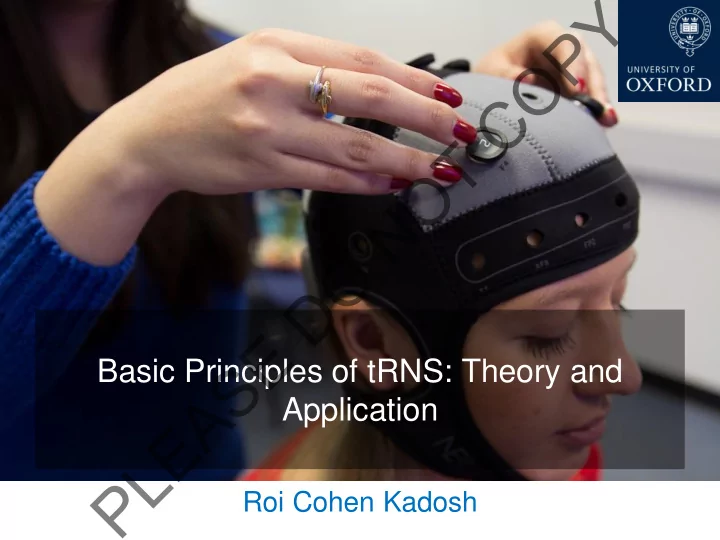
SLIDE 1
Basic Principles of tRNS: Theory and Application
Roi Cohen Kadosh
P L E A S E D O N O T C O P Y
SLIDE 2 Declaration of competing interests
- Scientific Advisory Board, Neuroelectrics Inc.
- Scientific Advisory Board, InnoSphere Inc.
- Consultancy, InnoSphere Inc.
P L E A S E D O N O T C O P Y
SLIDE 3
P L E A S E D O N O T C O P Y
SLIDE 4
Noise
If everything else is ideal, then noise is the enemy
P L E A S E D O N O T C O P Y
SLIDE 5
Noise
Can we consider our brain as an ideal system?
P L E A S E D O N O T C O P Y
SLIDE 6 Noise
Benefits have been reported in diverse systems, including:
- Climate models
- Electronic circuits
- Differential equations
- Lasers
- Neural models
- Physiological neural populations and networks
- Chemical reactions
- Ion channels
- SQUIDs (superconducting quantum interference devices)
- Ecological models
- Cell biology
- Financial models
- Psychophysics
- Nanomechanical oscillators
- Organic semiconductor chemistry
- Social systems
McDonnell & Abbott, 2009, PLoS Comp Biol
P L E A S E D O N O T C O P Y
SLIDE 7
Noise
Nonlinearity: presence of noise in a nonlinear system is better for output signal quality than its absence. Noise cannot be beneficial in a linear system
Performance (noise + nonlinearity) > Performance (nonlinearity)
Stochastic facilitation: Random noise enhances the detection of weak stimuli and/or the information content of a signal
(Moss et al., 2004, Clin Neurophysiol; McDonnell & Ward, 2011, Nat Rev Neurosci)
P L E A S E D O N O T C O P Y
SLIDE 8
Noise
Nonlinearity: presence of noise in a nonlinear system is better for output signal quality than its absence. Noise cannot be beneficial in a linear system
Performance (noise + nonlinearity) > Performance (nonlinearity)
McDonnell & Abbott, 2009, PLoS Comp Biol
P L E A S E D O N O T C O P Y
SLIDE 9
P L E A S E D O N O T C O P Y
SLIDE 10 Random Noise Stimulation
2005, Ann Neurol
- Used noisy galvanic vestibular stimulation (GVS) to influence
neuronal circuits including the basal ganglia and the limbic system
- 19 Patients with multi system atrophy and/or Parkinson’s disease.
- Noisy GVS boosted the neurodegenerative brains of patients,
including those unresponsive to standard levodopa therapy
- It is also effective in improving autonomic and motor responsiveness
P L E A S E D O N O T C O P Y
SLIDE 11 Transcranial Random Noise Stimulation (tRNS)
Alternating current at random frequencies (Terney et al.,
2008, J Neurosci)
P L E A S E D O N O T C O P Y
SLIDE 12
Terney et al., 2008, J Neurosci
10 min tRNS on MEP
P L E A S E D O N O T C O P Y
SLIDE 13 Advantages over tDCS
- Polarity-independent
- Less sensitive to cortex folding
- Compared to tDCS, it is more comfortable,
which make it potentially advantageous for setting and blinding studies (Ambrus et al., 2010;
Moliadze et al., 2010)
- The 50% perception threshold for both tDCS
conditions was at 0.4mA while this threshold was at 1.2mA in the case of tRNS.
P L E A S E D O N O T C O P Y
SLIDE 14
Chaieb et al., 2015, Front Neurosci
The effect of carbamazepine (CBZ): A sodium channel blocker
A more pronounced effect of voltage-gated sodium channels on tRNS aftereffects
P L E A S E D O N O T C O P Y
SLIDE 15
Perceptual learning
Fertonani et al. 2011, J Neurosci
P L E A S E D O N O T C O P Y
SLIDE 16
Perceptual task
Van der Groen and Wenderoth 2016, J Neurosci
P L E A S E D O N O T C O P Y
SLIDE 17 Snowball et al., 2013, Curr Biol
tRNS over the dlPFC improves cognitive training
D ay M e a n C a lc u la tio n R T s (m s)
1000 2000 3000 4000 5000
tR N S S ham
D ay M e a n D rill R T s (m s )
400 600 800 1000
S ham tR N S
Calculation Training Drill Training
1 2 3 4 5 1 2 3 4 5
P L E A S E D O N O T C O P Y
SLIDE 18
Near Infrared Spectroscopy (NIRS)
An optical imaging technique used to observe: ▪ HbO2 (oxygenated haemoglobin) ▪ HHb (deoxygenated haemoglobin) ▪ HbT (total haemoglobin)
P L E A S E D O N O T C O P Y
SLIDE 19 4 5 6 7 8 P e a k t i m e ( s e c
d s ) H b O
2
S h a m t R N S H H b H b T
F(1, 20)=6.67, p=.018
tRNS improves brain efficiency
Faster Slower
P L E A S E D O N O T C O P Y
SLIDE 20 Snowball et al., 2013, Curr Biol
Long-lasting effect
M e d i a n R T ( m s ) 2 5 3 3 5 4 4 5 5 5 5 6 O l d P r o b l e m s N e w P r o b l e m s S h a m t R N S
P L E A S E D O N O T C O P Y
SLIDE 21 No lasting improvement for drill
M e d i a n R T ( m s )
1 5 2 2 5 3 3 5 4 4 5
S h a m t R N S
p=0.78
Faster Slower
P L E A S E D O N O T C O P Y
SLIDE 22 C a l c u l a t i o n D r i l l 4 6 8 1 1 2 P e a k t i m e ( s e c
d s ) S h a m t R N S
F(1,10)=.49, p=.5 F(1,10)=11.58, p=.007
Long-lasting effect at the physiological level
Faster Slower
P L E A S E D O N O T C O P Y
SLIDE 23
Results
Cappelletti et al. 2013, J Neurosci
P L E A S E D O N O T C O P Y
SLIDE 24 Atypical development
tRNS cap
Looi et al., 2017, Sci Rep
P L E A S E D O N O T C O P Y
SLIDE 25 S e s s io n L e v e l c o m p le te d 1 2 3 4 5 6 7 8 9 6 8 1 0 1 2 1 4 1 6 1 8 2 0 S h a m
tR N S
tRNS affects the learning slopes
F(1,10)=5.9, p<.01 Better Snowball et al., 2013, Curr Biol; Cappelletti et al., 2013, J Neurosci; Popescu et al., 2016, Neuropsychologia; Fertonani et al., 2011, J Neurosci; Terney et al., 2008, J Neurosci
P L E A S E D O N O T C O P Y
SLIDE 26 Online effect: temporary fluctuations in behaviour
- r knowledge that can be observed and measured
during the acquisition process
The Subcomponents of Cognitive Training
Soderstrom & Bjork (2015, Perspect Psychol Sci)
Performance
P L E A S E D O N O T C O P Y
SLIDE 27 Offline effect: relatively permanent changes in behaviour/knowledge
The Subcomponents of Cognitive Training
Soderstrom & Bjork (2015, Perspect Psychol Sci)
Learning
P L E A S E D O N O T C O P Y
SLIDE 28 Experiment 1
d l P F C P P C
5 1 O n l i n e ( B )
n=72 Better
P L E A S E D O N O T C O P Y
SLIDE 29 Experiment 1
d l P F C P P C
5 1 O f f l i n e ( B )
*
n=72 Better
P L E A S E D O N O T C O P Y
SLIDE 30 Experiment 2
d l P F C P P C
5 1 O n l i n e ( B )
n=51 Better
P L E A S E D O N O T C O P Y
SLIDE 31 Experiment 2
d l P F C P P C
5 1 O f f l i n e ( B )
* * *
n=51 Better
P L E A S E D O N O T C O P Y
SLIDE 32 The effect is offline-related!
d l P F C P P C
5 1 O f f l i n e ( B )
*
d l P F C P P C
5 1 O n l i n e ( B ) d l P F C P P C
5 1 O n l i n e ( B ) d l P F C P P C
5 1 O f f l i n e ( B )
* * *
n=123, Stimulation x Area: p=.00004, dlPFC: p=0.0008, PPC: p=0.01 Better
P L E A S E D O N O T C O P Y
SLIDE 33
Dose effect and potential mediators
P L E A S E D O N O T C O P Y
SLIDE 34
We aimed to target the top-down cortical attention system; a predominantly right lateralised frontoparietal network
The neural basis of sustained attention
P L E A S E D O N O T C O P Y
SLIDE 35 Sustained attention
1270 1280 1290 1300 1310 1320 1330 1340
0.5 1 1.5 2 2.5 3 3.5 4 4.5 5 5.5 6 6.5 7 7.5 8 8.5 9 9.5
65 35 000
- 400
- 400
- 800
- 1200
- 1600
- 2000
- 2400
- Target
Onset
the s mulus begins to decrease from the baseline level (65%)
decrease Contrast
the s mulus reaches the lowest
(35%)
to Baseline Contrast
the s mulus returns to the baseline level (65%)
(ms) Contrast
S mulus (%)
P L E A S E D O N O T C O P Y
SLIDE 36 Experiment design
Within-subjects design (n=72) Each subject received 3 different stimulation
conditions over 3 consecutive days
Order of stimulation fully randomized tRNS electrodes placed over F4 and P4 to
target right DLPFC and right IPL
Harty & Cohen Kadosh (Submitted)
P L E A S E D O N O T C O P Y
SLIDE 37 F(4,284) = 3.08, p = .017
P L E A S E D O N O T C O P Y
SLIDE 38
Variability in the response 1mA tRNS
P L E A S E D O N O T C O P Y
SLIDE 39 1mA tRNS reduced TBR
F(2,136) = 5.93, p = .003
P L E A S E D O N O T C O P Y
SLIDE 40
The benefit from tRNS depended on TBR
P L E A S E D O N O T C O P Y
SLIDE 41 Short Quiz
What are the advantages of tRNS over tDCS?
- Polarity-independent
- Less sensitive to cortex folding
- It is more comfortable, which make it potentially
advantageous for setting and blinding studies
- The 50% perception threshold for both tDCS
conditions was at 0.4mA while this threshold was at 1.2mA in the case of tRNS.
P L E A S E D O N O T C O P Y
SLIDE 42
Short Quiz
tRNS seems to interact with: 1) The GABAergic system 2) The dopaminergic system 3) The glutamatergic system 4) 1 and 3 are correct 5) All the answers are correct
P L E A S E D O N O T C O P Y
SLIDE 43
Short Quiz
Based on the material covered here, who would you think be most likely to benefit from tRNS 1) The average person 2) Those who are cognitive below the average 3) Those who are cognitively above the average 4) 1 and 2 5) 1 and 3 as the effect is non-linear
P L E A S E D O N O T C O P Y
SLIDE 44
Short Quiz
The effect of tRNS is: 1) Online-base 2) Offline-base 3) Can be both 4) Neither (you should use tDCS)
P L E A S E D O N O T C O P Y
SLIDE 45 What have we learned
- Noise can be beneficial in nonlinear systems
- Applying noise to the brain improves performance
- The effect can be long-lasting
- tRNS has some advantages over tDCS
- tRNS interacts with voltage-gated sodium channels,
the gultamateric system, and hemodynamic response.
- The effect can be moderated by neurophysiological
trait
P L E A S E D O N O T C O P Y
SLIDE 46 Thanks to
Current and previous lab members Dr Siobhan Harty Dr Beatrix Krause Dr Chung Yen Looi Thomas Page Dr Tudor Popescu Gal Raz Albert Snowball Dr Devin Terhune Olivia Towse Dr George Zacharopoulos Collaborators Dr Jessamy Almquist (Honeywell) Dr Mihaela Duta (Oxford) Prof Margarete Delazer (Innsbruck)
- Prof. Glyn Humphreys (Oxford)
Jenny Lim (Fairely House School) Dr Simon Lolliot (McGill) Dr Ilias Tachtsidis (UCL) Dr Laura Zamarian (Innsbruck) Dr Tingting Zhu (UCL) Prof Glyn Humphreys (Oxford) Staff, parents and children, Fairely House School
P L E A S E D O N O T C O P Y
SLIDE 47
Thank you for your attention
E-mail: roi.cohenkadosh@psy.ox.ac.uk Web: www.psy.ox.ac.uk/research/cohen-kadosh-laboratory
“It is not science fiction, it is already real and it will be a critical part of our future.”
Stephen Hawking, discussing our research TEDx Talk: https://www.youtube.com/watch?v=QoHZ5b-aaX4
P L E A S E D O N O T C O P Y