
SLIDE 1
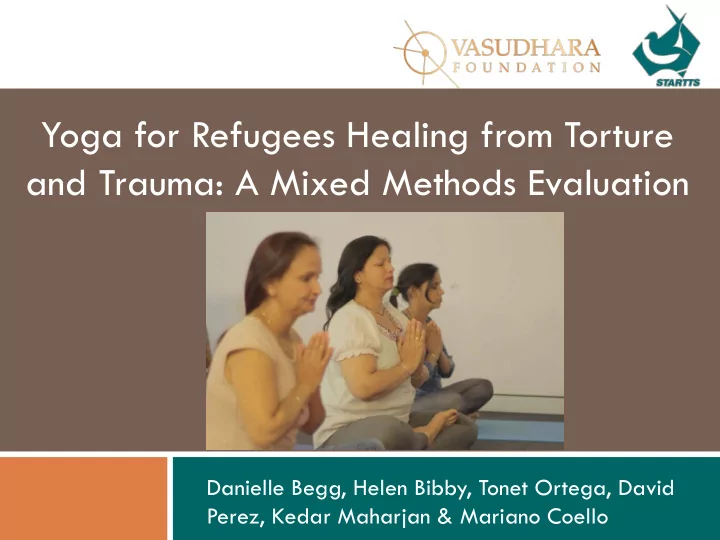
Yoga for Refugees Healing from Torture and Trauma: A Mixed Methods - - PowerPoint PPT Presentation
Yoga for Refugees Healing from Torture and Trauma: A Mixed Methods Evaluation Danielle Begg, Helen Bibby, Tonet Ortega, David Perez, Kedar Maharjan & Mariano Coello Background Refugees at risk of psychological complications due to high
Refugees at risk of psychological complications due to high
PTSD & depression among the most common mental health
Increasing recognition of the importance of brain & body in
(van der Kolk et al., 2014)
Increasing interest in mind-body therapies
(Metcalf et al, 2016)
Little published research on the use of yoga with refugees Promising findings in other traumatised populations:
Reduced PTSD symptoms in US women
(Mitchell et al, 2014; van der Kolk et al., 2014)
Reduced PTSD symptoms & depression in male Vietnam veterans
(Carter & Byrne, 2004; Johnston et al., 2015)
Other suggested benefits for trauma survivors:
Physical symptoms & general health Sleep Stress Resilience
(Brown & Gerbarg, 2005; Jindani, 2015; Jindani & Khalsa, 2015; Staples, Hamilton & Uddo, 2013)
Mechanisms of effect yet to be determined. Hypotheses
Reduced hyperarousal via nervous system regulation (Johnston et al.,
2015; Pradhan et al., 2016; Staples et al., 2013)
Increased psychological flexibility (Dick et al.,2014) Improved body awareness and tolerance of physical sensations
(van der Kolk et al., 2014)
Hackney Yoga Project (UK):
Good acceptability of yoga to refugee participants Anecdotal reports of reduced anxiety, improved physical health
& well-being, increased confidence & resilience (Ourmala, 2016)
Two month pilot conducted with 64 refugees & asylum seekers
Attendance records
Qualitative feedback
Relaxation Improved mood Reduced pain STARTTS SydWest Multicultural Services Settlement Services
International
Asylum Seekers Centre Villawood Immigration
Detention Centre
Weekly one hour yoga classes offered to groups of refugees Referrals come from STARTTS & affiliated organisations Classes held in Western & South Western Sydney Groups conducted by a qualified yoga instructor and STARTTS
Classes consist of
Breathing exercises Gentle yoga poses Guided relaxation
Each class tailored to the needs
Blacktown SydWest Men* 19 Adult Nepali Bhutanese Blacktown SydWest Women 27 Adult Nepali Bhutanese Carramar STARTTS 40 Adult Arabic Chaldean Liverpool Mandaean Centre 22 Adult Arabic Mandaean Liverpool Refugee Health 16 Adult Arabic Mandaean Mt Druitt Com. Health* 10 Adult Arabic Mixed Toongabbie Com. Centre 35 Adult Tamil Tamil
* Shorter group: Data was only collected at two time-points
Inspire psychological calm through focus on breath Improve physical well-being, body awareness & relaxation
Improve mind-body connection by providing a safe place for
Further assess feasibility & acceptability for refugee
Identify any physiological, psychological or interpersonal
Explore counsellor & participant attitudes & opinions
Process measures (weekly)
Attendance records Satisfaction ratings
Psychological questionnaires
Harvard Trauma Questionnaire: Part IV (HTQ) (Mollica et al., 1992) Hopkins Symptom Checklist (HSCL) (Parloff et al., 1954) Freiburg Mindfulness Inventory* (FMI) (Walach et al., 2006)
* Selected groups only
Physiological measures
Fitness Assessment Hand grip (Roberts et al., 2011) Reaction time (Eckner et al., 2009) Standing balance (Springer et al.,
2007)
Heart Rate Variability (HRV)
(emWave)
Qualitative evaluation
Counsellor interviews Participant focus groups
Differences between groups
Demographics Symptom severity Evaluation methodology
Missing data
Large, noisy groups Non-literate participants Mid-point data collection done in school holidays Variable attendance
Gender Female 90% Age (years) M (SD) 47.1 (16.2) Country of birth Iraq Bhutan Sri Lanka Other* 49% 27% 19.5% 4.5% Years in Australia M (SD) 5.8 (4.2) Residential status Permanent resident or citizen Asylum seeker or TPV holder 80.5% 19.5% Clinical levels of mental health symptoms PTSD Depression Anxiety 46% 49% 58%
* Other countries of birth: Indonesia, Iran, Morroco, Pakistan, Syria
20 40 60 80 100
1 3 5 7 9 11 13 15 17 19 21
Average number of sessions attended by
Mid-point: 4.7 (SD= 2.6)
Range = 0-11
End-point: 6.2 (SD=4.1)
Range = 0-17
1 2 3 4 5
A B C D E F G H I
Satisfaction was predicted by
Gender (t=-2.599, p<0.05) Poorer balance at baseline (r=0.52, p<0.05)
It was not associated with baseline psychological results or
Number of yoga sessions attended was a significant predictor of
Model: F3,13= 17.819, p <0.001
Adjusted R square = 0.759
Predictor: Unstandardised ß = -0.11, p<0.01
* Controlling for baseline HTQ score & age 1 2 3 4
2 4 6 8 10 12 14 16 18
HTQ NUMBER OF SESSIONS
Number of yoga sessions attended was a significant predictor of
Model: F3,19= 10.143, p <0.001
Adjusted R square = 0.555
Predictor: Unstandardised ß = -0.08, p<0.05
* Controlling for baseline HSCL Depression & age 1 2 3 4
2 4 6 8 10 12 14 16 18
HSCL DEPRESSION NUMBER OF SESSIONS
Number of yoga sessions attended did not appear to predict
However, there was some evidence of a relationship between
No evidence of a relationship between number of sessions
Unable to examine the impact of home practice
Physical Improved ability to perform poses/flexibility Reduced pain/pain management Improved sleep Psychological Feeling calm & relaxed Able to cope with stress/anxiety Anger management Increased insight/awarenss Social Enhanced confidence/self-concept Sense of pride & belonging in group Having fun/enjoyment
“The pain hasn’t disappeared completely but definitely it has gone better and with the flexibility of the body, we are more active.”
(Bhutanese women’s group)
“In the past, I used to be very anxious all the time and very nervous. I used to not be able to breathe as I do now. And now I am much better. Like, when I go to sleep, I practice breathing in and out. I am practicing my breathing every single night… and it helps me relax and calm down.”
(Mandean group)
“After coming to this group… poses that looked impossible for us before … seems like nothing is impossible, and we can do that as a group”
(Bhutanese men’s group)
“Yoga helped to improve communication, relationship, improvement in memory… We built a close relationship, we are like a family now. Through this program, relationship became stronger. Yoga helps us with all aspects…”
(Mandaean group)
Attending more yoga sessions predicts lower PTSD and
Not attributable to age or baseline symptoms No evidence for mindfulness as mechanism of effect Baseline CNS regulation may play a role
High satisfaction levels despite variable attendance
Participants and counsellors
Physical Psychological Social
Tailoring intervention to different ages & ability levels Importance of suitable venue & consistent interpreter Unanswered questions
More rigorous evidence needed for effectiveness Active components of treatment Predictors of outcome
Methodological improvements for research
Comparison group (e.g. exercise/lifestyle) Individual assessment sessions Record home practice Find ways to facilitate attendance
Jorge Aroche Mariano Coello Jasmina Bajrakterevic-Hayward David Perez Kedar Maharjan Tonet Ortega Kat Mikhailouskaya Demiana Mangaryos Adriana Seifertova Marcel Abdelmasieh Pearl Fernandes Harini Mayuran Katherine Theodor Yvette Aielllo Hee Zee Lu Sanja Stefanovic Rocio Martinez Winnie Kamakil Tanya Nelson Carnegie Lucy Barkl Matt Singmin Nik Dawson
Yoga program at STARTTS was funded by the Vasudhara
The Foundation supports early-stage, innovative and creative
Broad range of interests including:
Yoga Meditation Projects that support refugees in Australia
http://www.vasudharafoundation.org/
Brown, R. P., & Gerbarg, P. L. (2005). Sudarshan Kriya Yogic breathing in the treatment of stress, anxiety, and depression. Part II--clinical applications and guidelines. J Altern Complement Med, 11(4), 711-717.
Carter, J., & Byrne, G. (2004). A two year study of the use of yoga in a series of pilot studies as an adjunct to ordinary psychiatric treatment in a group of Vietnam War veterans suffering from post traumatic stress disorder. Retrieved from www.Therapywithyoga.com.
Dick, A. M., Niles, B. L., Street, A. E., DiMartino, D. M., & Mitchell, K. S. (2014). Examining mechanisms
and emotion regulation on PTSD symptoms. Journal of Clinical Psychology, 70(12), 1170-1182.
Eckner, J. T., Whitacre, R. D., Kirsch, N. L., & Richardson, J. K. (2009). Evaluating a clinical measure of reaction time: an observational study. Percept Mot Skills, 108(3), 717-720.
Fazel, M., & Stein, A. (2002). The mental health of refugee children. Archives of Disease in Childhood, 87(5), 366-370.
Fazel, M., Wheeler, J., & Danesh, J. (2005). Prevalence of serious mental disorder in 7000 refugees resettled in western countries: a systematic review. The Lancet, 365(9467), 1309-1314.
Jindani, F. (2015). Explorations of wellness and resilience: A yoga intervention for post-traumatic
Jindani, F., & Khalsa, G. (2015). A yoga intervention program for patients suffering from symptoms
Complementary Medicine, 21(7), 401-408.
Johnston, J. M., Minami, T., Greenwald, D., Li, C., Reinhardt, K., & Khalsa, S. B. S. (2015). Yoga for military service personnel with PTSD: A single arm study. Psychological Trauma: Theory, Research, Practice, and Policy, 7(6), 555-562.
Metcalf, O., Varker, T., Forbes, D., Phelps, A., Dell, L., et al. (2016). Efficacy of fifteen emerging interventions for the treatment of posttraumatic stress disorder: A systematic review. Journal of Traumatic Stress, 88-92.
Mitchell, K. S., Dick, A. M., DiMartino, D. M., Smith, B. N., Niles, B., Koenen, K. C., & Street, A. (2014). A pilot study of a randomized controlled trial of yoga as an intervention for PTSD symptoms in
Mollica, R. F., Caspi-Yavin, Y., Bollini, P., Truong, T., Tor, S., & Lavelle, J. (1992). The Harvard Trauma
stress disorder in Indochinese refugees. J Nerv Ment Dis, 180(2), 111-116.
http://www.ourmala.com/yogaforrefugees/
Parloff, M. B., Kelman, H. C., & Frank, J. D. (1954). Comfort, effectiveness, and self-awareness as criteria of improvement in psychotherapy. Am J Psychiatry, 111(5), 343-352.
Pradhan, B., D'Amico, J. K., Makani, R., & Parikh, T. (2016). Nonconventional interventions for chronic post-traumatic stress disorder: Ketamine, repetitive trans-cranial magnetic stimulation (rTMS), and alternative approaches. Journal of Trauma & Dissociation, 17(1), 35-54.
Roberts, H. C., Denison, H. J., Martin, H. J., Patel, H. P., Syddall, H., Cooper, C., & Sayer, A. A. (2011). A review of the measurement of grip strength in clinical and epidemiological studies: towards a standardised approach. Age Ageing, 40(4), 423-429.
Springer, B. A., Marin, R., Cyhan, T., Roberts, H., & Gill, N. W. (2007). Normative values for the unipedal stance test with eyes open and closed. J Geriatr Phys Ther, 30(1), 8-15.
Staples, J. K., Hamilton, M. F., & Uddo, M. (2013). A yoga program for the symptoms of post- traumatic stress disorder in veterans. Military Medicine, 178(8), 854-860.
Steel, Z., Chey, T., Silove, D., Marnane, C., Bryant, R. A., & van Ommeren, M. (2009). Association of torture and other potentially traumatic events with mental health outcomes among populations exposed to mass conflict and displacement: a systematic review and meta-analysis. Jama, 302(5), 537-549.
van der Kolk, B. A., Stone, L., West, J., Rhodes, A., Emerson, D., Suvak, M., & Spinazzola, J. (2014). Yoga as an adjunctive treatment for posttraumatic stress disorder: A randomized controlled trial. Journal of Clinical Psychiatry, 75(6), e559-e565.
Walach, H., Buchheld, N., Buttenmüller, V., Kleinknecht, N., & Schmidt, S. (2006). Measuring mindfulness—the Freiburg Mindfulness Inventory (FMI). Personality and Individual Differences, 40(8), 1543-1555.