1 2 3 Illustrate how the NH MTSS-B framework can be used to - - PDF document

1 2 3
SMART_READER_LITE
LIVE PREVIEW

1 2 3 Illustrate how the NH MTSS-B framework can be used to - - PDF document

11/13/17 Collaborators Building Systems with Community Partners for Student Success Presentation for 13 th Annual New England PBIS Forum November 14, 2017 Kathy Francoeur, M.Ed Stacey Lazaar, M.A Assessing Current Status of School


slide-1
SLIDE 1

11/13/17 1

Building Systems with Community Partners for Student Success

Presentation for 13th Annual New England PBIS Forum November 14, 2017 Kathy Francoeur, M.Ed Stacey Lazaar, M.A

Collaborators Objectives

  • Describe ISF & NH MTSS-B framework
  • Illustrate how the NH MTSS-B framework

can be used to support collaboration and efficient implementation

  • Example of how MTSS-B is being

implemented. Assessing “Current Status” of School Building PBIS Implementation

Just getting started with installing PBIS?

1

Implementing PBIS, need to boost fidelity?

2

Implementing PBIS with fidelity, want to enhance with Mental Health Integration (ISF)?

3

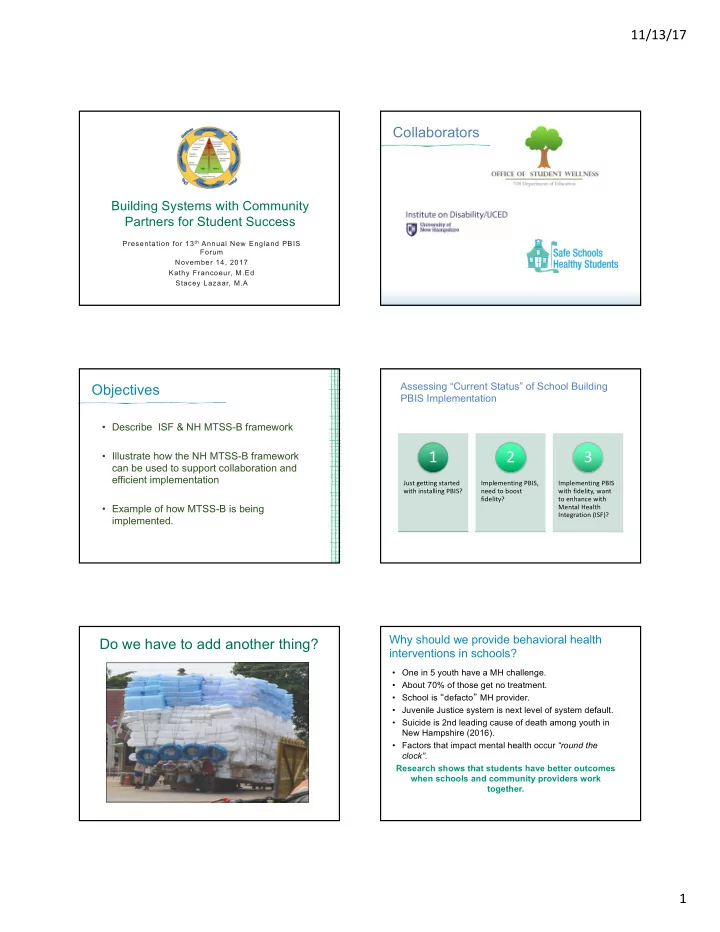
Do we have to add another thing?

Why should we provide behavioral health interventions in schools?

  • One in 5 youth have a MH challenge.
  • About 70% of those get no treatment.
  • School is “defacto” MH provider.
  • Juvenile Justice system is next level of system default.
  • Suicide is 2nd leading cause of death among youth in

New Hampshire (2016).

  • Factors that impact mental health occur “round the

clock”. Research shows that students have better outcomes when schools and community providers work together.

slide-2
SLIDE 2

11/13/17 2

Multi-Tiered System of Support for Behavior (MTSS-B) is a

Framework for enhancing adoption & implementation of Continuum of evidence-based interventions to achieve Academically & behaviorally important outcomes for All students

PBIS Provides a Solid Foundation…. but More is Needed…

  • Many schools implementing PBIS struggle to

implement effective interventions at Tiers 2 and 3

  • Youth with “internalizing” issues may go undetected
  • PBIS systems often do not address broader

community data and mental health prevention.

An Interconnected Systems Framework

– A Structure and process for education and mental health systems to interact in most effective and efficient way. – Guided by key stakeholders in education and mental health/community systems – Who have the authority to reallocate resources, change role and function of staff, and change policy. Need for Interconnected Systems: Challenges

Ad hoc and weak connections of community mental health providers to schools – Need for community partners to be integrated into school teams; – Need funding/support for partners – Need for systematic MOUs to clarify roles and functions of integrated teams/’work’

Establish a Structure for Integrated Work

Establish a “way of work”. Move away from “more is better”. Utilize a formal process for selection and implementation (data/practices/systems) New emphasis on “sustainability” and “efficiency” have heightened attention on the need for effective systems of alignment.

Greenwald, Poulos, & Horner, 2015)

Establish a Structure for Integrated Work

Establish a team of stakeholders who have the authority to reallocate people, funding, resources

Establish

Include an integrated professional development plan for both school and community employed staff

Include

Focus on cross-system teams that hold themselves accountable with data-based decisions

Focus on

slide-3
SLIDE 3

11/13/17 3

Moving away from “students receives counseling “ to “student receives 10 coping skill group sessions quire Skills acquired during sessions are supported by ALL staff

Demystify Interventions

MH/PBIS: An Expanded Tier Two & Tier 3

  • Mental health/community professionals part of

secondary systems and problem solving teams

  • Groups co-facilitated by school staff and

community partner

  • Opportunity to expand the continuum of

interventions based on data (i.e. trauma informed interventions)

  • Out-reach to families for support/interventions

Tier 3 – Intensive mental health supports designed to meet the unique needs of students who already display a concern or problem. Tier 2 – Targeted mental health supports provided for groups of students identified as at risk for a concern or problem. Tier 1 – Universal supports that all students receive. Promoting wellness & positive life skills can prevent or reduce mental health concerns or problems from developing.

Which Tier? Depends on your Data

Where do specific “MH” Interventions Fit?

That depends on the data of the school and community

Examples of Expanded View

  • f data:
  • Child welfare contacts,
  • Violence rates
  • Incarceration rates
  • Deployed families,
  • Homeless families,
  • Unemployment spikes

PBIS Core Features Partnership & Collaboration Implementation Science

What is MTSS-B?

NH’s Multi-Tiered Systems of Support for Behavior Framework… “…is a “way of doing business” that puts into place proven school- and community-based behavioral health practices so that every student can achieve health and wellness and be successful in school. MTSS-B employs a systemic, continuous- improvement framework integrating school behavioral health practices across all levels of the educational system for supporting every student.”

NH Office of Student Wellness State Management Team, 2016

slide-4
SLIDE 4

11/13/17 4

Evolution of MTSS-B in Concord

  • In 2013, the New Hampshire Department of Education (NHDOE),

Bureau of Special Education was awarded an $8.6 million grant from the Substance Abuse and Mental Health Administration (SAMHSA) to implement a four-year Safe Schools/Healthy Students State Planning Project.

  • Concord School District was chosen as a local partner, along with

Laconia and Rochester School Districts, and received $2.1 million in federal funding to carry out the grant activities over 4 years.

Key Questions

  • Can we expand the effectiveness of the

school-based continuum if we include a broader group of school/community mental health providers?

  • Can we enhance the continuum with a

greater array of EBP’s to meet the needs

  • f more students with greater

effectiveness ?

Safe Schools/Healthy Students Project Elements

Element 1: Promoting Early Childhood Social Emotional Learning and Development Element 2: Promoting Mental, Emotional, and Behavioral Health Element 3: Connecting Families, Schools, and Communities Element 4: Preventing and Reducing Alcohol, Tobacco, and Other Drug Use Element 5: Creating Safe and Violence-Free Schools

For more information on SS/HS see: Realizing the Promise of the Whole-School Approach to Children’s Mental Health: A Practical Guide for Schools, , (2011). SAMHSA, US Department of health and Human services)

Quick Reflection

Does your District have a current district-level leadership team that has responsibility for

  • verseeing/supporting

MTSS in all schools?

1

Are there community/family representatives on this team?

2

Guiding Planning And Implementation: The Community Management Team

Concord Schools Riverbend Community Mental Health Ascentria Care Alliance Child and Family Services of NH Second Start Concord Police Department Division of Children, Youth and Families Department of Juvenile Justice Services Community Bridges Granite United Way Concord Head Start Concord Housing Authority City of Concord Parks and Recreation Department Boys and Girls Club of Central New Hampshire 21st Century After School Programs Granite State Federation of Families UNH Institute on Disability NH Center for Effective Behavioral Interventions and Supports

Outcomes of Our Needs Assessment and Environmental Scan

  • Schools are defacto mental health system for children
  • Schools are an effective location for screening and

intervention

  • Existing systems can support school-based mental

health

  • Providing services in schools can:

– Reduce barriers – Reduce stigma – Catch problems before they become severe – Allow for universal prevention and intervention activities

slide-5
SLIDE 5

11/13/17 5

Outcomes of Our Needs Assessment and Environmental Scan

  • Providers were seeing students in school in

isolation

  • No reciprocal system of communication place
  • Resources were spent on addressing the most

pressing needs of struggling students

  • There was no service integration between the

school and the mental health center

Consumer Guide to Selecting Evidenced Based Mental Health Services within a SWPBS model

Robert Putnam, Susan Barrett, Lucille Eber, Tim Lewis & George Sugai

Advancing Education Effectiveness: Interconnecting School Mental Health & School-wide Positive Behavior Support, Appendix F, pages 148-9 https://www.pbis.org/common/cms/files/Current%20Topics/Final- Monograph.pdf Take an inventory (and examine effectiveness and fidelity) of current practices before investing in new interventions or programs. When data indicates a need for a new initiative, consider using this guide

New Expanded Partnership: Riverbend Community Mental Health and Concord School District Strengths – Shared vision about what school-based mental health should look like—integrated, accessible and flexible – Clear definition of roles and expectations – Developed contract as a partnership – Communication! – Relationships! – Blending of two different cultures yields mutual understanding and respect Challenges/Current Status – Need for consistent and open communication about what’s working and what’s not – Problem-solving as a partnership – Continue to define and redefine roles as needs develop Memorandum of Understanding Between Riverbend Community Mental Health Center and Concord School District

  • Designed to create and solidify collaborative relationships

between community-based clinicians and school staff

  • Features of the MOU:

– Clinicians are supported by the district to sit on Tier 1, Tier 2, and Tertiary Implementation Teams* (community mental health reimbursement is client-specific) – Clinicians are supported by the district to help plan and provide school-wide and small group (Tier 2) evidence- based interventions such as….

  • Education for faculty of trauma-informed care.
  • Co-lead Coping Cat groups with school staff.
  • Develop functional behavioral support plans for non-

mental health eligible students.

  • Design a facilitated referral process and promote

student screening and assessments.

Features of the MOU, continued:

  • Clinicians provide consultation, mental health education

and prevention information for school personnel

  • Clinicians have the opportunity to expand knowledge base
  • f evidence-based practices by:

– Conducting research into relevant EBPs – Obtaining any necessary training in EBPs – Creating implementation plan for use of EBPs in schools

  • Clinicians develop a “library” of ‘canned’ trainings for

teachers/staff which can be used by any clinicians to provide additional training throughout the current school year and beyond

  • Clinicians facilitate parent education

Elements of a Strong MOU

  • Specific, explicit, detailed description of the roles of school

personnel and community mental health personnel.

  • Agreement to use a multi-tiered system and what that

means for the community provider.

  • Agreement on the procedures and tools for the selection

and utilization of evidence-based, evidence informed practices.

  • Hours (limits), billing rates, billing procedures.
  • Reporting and evaluation procedures- confidentiality

agreements (what can be shared by whom, how, and when).

  • Outcomes and how they will be assessed.

11/13/17 30
slide-6
SLIDE 6

11/13/17 6

Partnership Highlights

  • Clinicians have dedicated time in 5 elementary schools

and middle school

  • Ongoing Professional Development Offerings:

Mindful Classrooms, Supporting Students with Anxiety, Trauma-Informed Care, Child Mental Health and De- escalation Techniques, Compassion Fatigue

  • Development of Facilitated Referral Process (with webinar)

and Systematic Screening Protocol

  • Evidence-Based Practice Implementation: Coping Cat,

Zones of Regulation, Social Thinking, Mindful Schools

  • Showcased partnership at Local, Regional and National

Conferences

Individualization and Intensity of Interventions Increases A Few Students >5% ALL Students 100% Some Students >15%

Tier 1 Interventions & Supports- Structured Behavior Interventions for ALL students

  • BMS Expectation Matrix
  • Classroom Expectations & Classroom Lessons
  • Guidance Services
  • Remind, Redirect, Reteach & Reinforce
  • Family Contact
  • Plan and Process
  • Buddy Classroom
  • Loss of Privilege
  • Student/Parent Conferences
  • After School Programs
  • Mindfulness

Tier 2: Behavioral Interventions & Supports- Supports for some students who struggle with meeting the expectations

  • Targeted Counseling
  • Zones of Regulation
  • Coping CAT
  • Check In/Check Out
  • Social Thinking Groups

Tier 3: Individualized Supports -Structured Interventions for the few students with the greatest need

  • Complex Functional Behavioral Assessment (FBA) and Behavior Support
  • 3 R (Respectful, Relevant, Realistic) Plan(s)
  • Individualized Mental Health Counseling (Riverbend)

Beaver Meadow School Continuum of Supports

Coping Cat – Who is it for?

  • Internalizers
  • Anxiety
  • Avoidant behavior
  • Low self-esteem
  • Struggles with peer relationships
  • Isolates or withdraws
  • Sadness
  • Frequent nurse visits
  • Difficulty accepting mistakes/critique
  • Easily upset over seemingly small

problems

COPING CAT – What do they learn?

THE FEAR PLAN F – Feeling Frightened (Groups 1-3)

  • Identifying body reactions and physical

symptoms that are connected to feelings of anxiety and stress.

  • Learning tools: Six-sides of breathing,

4x4x4x4 breathing, mindful breathing, visualization, tin-man spaghetti, relaxation How you can help: Ask your student about their stressors! Prompt your students to use mindful breathing or take a relaxation break

Zones of Regulation – Who’s it for?

  • Externalizers
  • Mood dysregulation
  • Difficulties regulating body or emotions
  • Trauma, activating same fight, flight, freeze

response

  • Impulsive behaviors
  • High reactivity
  • Frequent office or SSR visits
  • Difficulties returning to baseline
  • Executive functioning difficulties (ADHD,

PTSD, etc).

  • Full curriculum 2nd grade or up, though basic

intro to colors can start as early as K (if at age-level cognitively).

The Zones – What do they learn?

  • Expected verse Unexpected Behavior for various scenarios
  • When is it expected to be in the green zone during the school

day?

  • The yellow?
  • Blue?
  • How about the red?

How you can help: We have to work really hard to not vilify the red and yellow zones! The point is not to punish when in the red zone but to identify we are feeling more intense feelings.

slide-7
SLIDE 7

11/13/17 7

How many served in the Tier 2 interventions?

20 19 18 8 65

10 20 30 40 50 60 70

CICO Coping Cat Zones of regualtion Social Thinking Total BMS Tier 2 Interventions: Number of Students Enrolled

Other Classroom Supports Provided by Riverbend:

7 160

20 40 60 80 100 120 140 160 180

# of Classroom # of students impacted Mindfulness in the Class

How to Get Started and Keep Moving Forward

Applying Implementation Science Engaging community partners Engaging families and youth Selecting EBP Using data to monitor fidelity and outcomes Increasing staff competence and confidence Communication with district level staff

Thank You Contact Us!

Kathy Francoeur, M.Ed.

MTSS-B Coach /RENEW Trainer Institute on Disability University of New Hampshire 10 West Edge Drive Durham, NH 03824 (603)862-0318 kathryn.Francoeur@unh.edu

Stacey Lazzar, MA

Safe Schools/Healthy Students Project Manager Concord School District 38 Liberty Street Concord, NH 03301 603-225-0811, ext. 7065

slazzar@sau8.org