1 BP treatment for up to 5 years: Treatment Beyond 5 Years the - - PDF document

1 bp treatment for up to 5 years treatment beyond 5 years
SMART_READER_LITE
LIVE PREVIEW

1 BP treatment for up to 5 years: Treatment Beyond 5 Years the - - PDF document

Financial Disclosures Controversies in Long Term Osteoporosis Treatment - Advisory Boards or consulting: Radius , Amgen, Merck Dennis M. Black, PhD Dept. of Epidemiology and Biostatistics - Research Grants UCSF Alexion, Asahi-Kasei 2 *


slide-1
SLIDE 1

1 Controversies in Long Term Osteoporosis Treatment

Dennis M. Black, PhD

  • Dept. of Epidemiology and Biostatistics

UCSF

2

Financial Disclosures

*

  • Advisory Boards or consulting:

Radius , Amgen, Merck

  • Research Grants

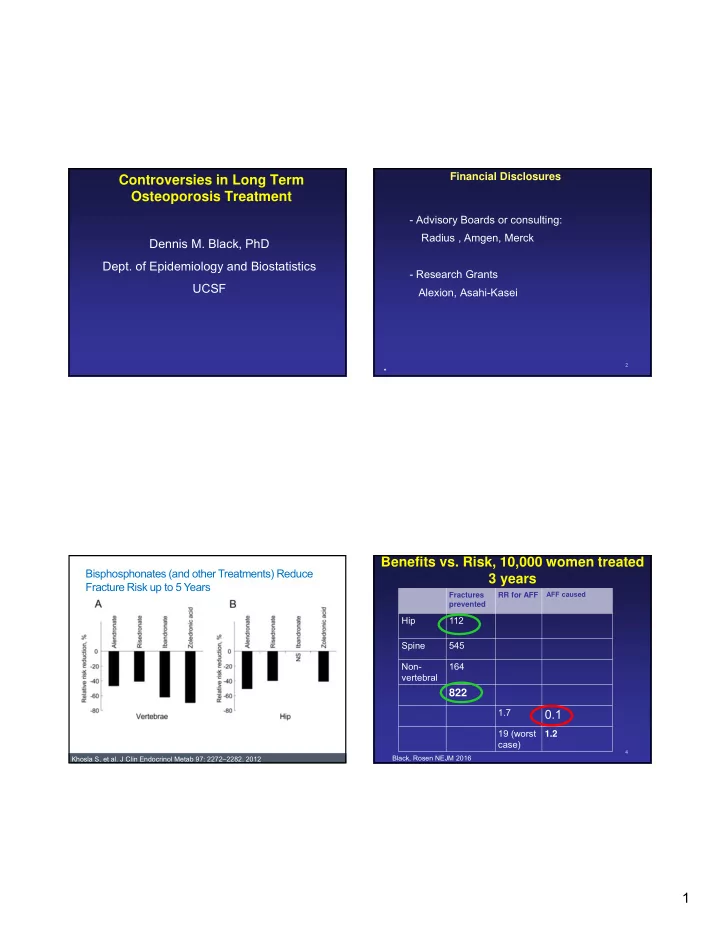
Alexion, Asahi-Kasei Bisphosphonates (and other Treatments) Reduce Fracture Risk up to 5 Years

Khosla S, et al. J Clin Endocrinol Metab 97: 2272–2282, 2012

4

Benefits vs. Risk, 10,000 women treated 3 years

Fractures prevented RR for AFF

AFF caused

Hip 112 Spine 545 Non- vertebral 164

822

1.7

0.1

19 (worst case) 1.2

Black, Rosen NEJM 2016

slide-2
SLIDE 2

2

5

Benefits for BP treatment (for 3-5 years) far outweigh any risks, even allowing for some risk of AFF.

What about treatment beyond 5 years?

BP treatment for up to 5 years: the Bottom Line

6

Bisphosphonates Alendronate and Zol Other BPs Denosumab

Treatment Beyond 5 Years

Osteoporosis Treatment Long-term Randomized Extension Studies for Alendronate and ZOL

2 4 6 8 10 Risedronate Alendronate Zoledronic acid

ALN = alendronate; DB = double-blind; EXT 1= extension 1; EXT 2= extension 2; FIT = Fracture Intervention Trial; FLEX = FIT Long-term EXtension; HORIZON-PFT = Health Outcomes and Reduced Incidence with Zoledronic acid Once Yearly Pivotal Fracture Trial; OL, Open-label; PBO = placebo; RCT = randomized controlled trial; RIS = risedronate; VERT-MN = Vertebral Efficacy with Risedronate Therapy MultiNational; Z3P3 = zoledronic acid treatment for 3 years followed by placebo for 3 years; Z6 = zoledronic acid treatment for 6 years; ZOL = zoledronic acid.

  • 1. Black DM, et al. N Engl J Med. 2007; 356: 1809-1822. 2. Black DM, et al. J Bone Miner Res. 2012; 27: 243-254. 3. The Effect of 6 versus 9 Years of Zoledronic Acid Treatment in Osteoporosis:

A Randomized Extension to the HORIZON-Pivotal Fracture Trial (PFT).Presented at ASBMR 2013 (abstract no. SA0389). 4. Black DM, et al. Lancet. 1996; 348: 1535-1541. 5. Cummings SR, et al. JAMA. 1998; 280: 2077–2082.

  • 6. Black DM, et al. JAMA. 2006; 296: 2927-2938. 7. Reginster J-Y, et al. Osteoporos Int. 2000; 11: 83–91. 8. Sorensen OH, et al. Bone. 2003; 32: 120-126. 9. Mellström DD, et al. Calif Tissue Int. 2004; 75: 462-468.

Time (Years)

FIT4,5

ALN (n = 3236) PBO (n = 3223)

RCT – FLEX6

ALN 5 mg (n = 329) or 10 mg (n = 333) PBO (n = 437)

HORIZON-PFT1

ZOL (n = 3889) PBO (n = 3876)

RCT – EXT1 2

Z6 (n = 616) Z3P3 (n = 617)

VERT- MN 7

RIS 2.5 mg (n = 408) 5 mg (n = 407) PBO (n = 407)

RCT – EXT8

RIS (n= 135) PBO (n= 130)

OL- EXT9

RI S 7 yrs (n = 83) PBO 5 yrs/ RI S 2yrs (n = 81)

RCT – EXT2 3

Z9 (n = 95) Z6P3 (n = 95)

Design of the FIT Long-Term Extension (to 10 years) of Alendronate (FLEX)*

FIT N = 6,459 Placebo N = 3,223 Alendronate N = 3,236 Randomized in FLEX N = 1,099 Alendronate, 5 or 10 mg N = 662 Placebo N = 437

Mean ALN use: 5 years FLEX (5 yrs)

* Black, et al, JAMA 12/2006

40% 60% BMD: Primary endpoint Fractures: Exploratory endpoint
slide-3
SLIDE 3

3

FLEX: Alendronate

Randomized, Double-blind Treatment 5 years of ALN followed by 5 more years or PBO

Fractures Placebo, No. ( % ) ( n= 4 3 7 ) Pooled Alendronate,

  • No. ( % )

( n= 6 6 2 ) Relative Risk ( 9 5 % Confidence I nterval) *

Vertebral Clinical . Morphom etric 2 3 ( 5 .3 ) 4 6 ( 1 1 .3 ) 1 6 ( 2 .4 ) 6 0 ( 9 .8 ) 0 .4 5 ( 0 .2 4 – 0 .8 5 ) 0 .8 6 ( 0 .6 0 – 1 .2 2 ) Clinical Nonspine Hip 8 3 ( 1 9 .0 ) 1 3 ( 3 .0 ) 1 2 5 ( 1 8 .9 ) 2 0 ( 3 .0 ) 1 .0 0 ( 0 .7 6 – 1 .3 2 ) 1 .0 2 ( 0 .5 1 – 2 .1 0 )

FLEX: Incidence of Fracture by Treatment Group

Black DM, et al. JAMA. 2 0 0 6 ;2 9 6 :2 9 2 7 – 2 9 3 8 .

0.1 1 10 Vertebral FX (clinical) Clinical Fracture Alendronate (FLEX: 5 yrs/5 yrs

1.00 (0.8, 1.3) 0.45 (0.2, 0.85) 0.99 (0.7, 1.5) 0.48 (0.3, 0.9)

Vertebral FX (morphometric) Clinical Fracture Zoledronic acid: HORIZON: 3yrs/3 yrs

Reductions (RR) for fractures for continuing bisphosphonates: Alendronate and ZOL

3 Relative Hazard (± 95% CI) Favors Bisphosphonate Favors Placebo

Black JAMA 2006;Black et a. JBMR 2012

Fracture reductions with long-term continuation

  • f bisphosphonates (2 RCTs)
  • Fracture results for Alendronate and Zol
  • Continuing lowers vertebral fractures risk vs discontinuing
  • Continuing vs. discontinuing  no effect on non-vertebral

− Confidence intervals are wide and allow for possible benefit

  • What about long term safety? Does AFF risk increase with

longer duration of treatment?

Black JAMA 2006; Black et a. JBMR 2012

What about long term safety? Does AFF risk increase with longer duration of treatment?

  • Very controversial question
  • 2012 Kaiser SC case series of AFF
  • Influential but methodologic flaws
  • 2016 Danish cohort study
  • Used subtrochanteric/femoral shaft fractures (not adjudicated AFF)
  • Suggests benefits vs. risks strongly favorable for long term

treatment

Dell JBMR 2012; Abrahamsen BMJ 2016

slide-4
SLIDE 4

4

13

Do Atypical Femur Fractures Increase with Duration of Treatment? AFF cases from Kaiser S. Calif*

Dell et. al. JBMR 12/12 Incidence of AFF Years of use of bisphosphonates

14

Do Atypical Femur Fractures Increase with Duration of Treatment? Recent Danish Cohort (81,000 users)*

Abrahamsen, et al BMJ 6-16 ST/FS: Subtrochanteric/Fem Shaft fracture

15

Is AFF incidence increased with longer duration of use?

Risks of long term osteo therapy

16

Is AFF incidence increased with longer duration of use?

  • Results are mixed, not certain
  • Most prudent belief: AFF risk increases with

treatment duration

  • Therefore, best to minimize length of treatment

And continue to treat only those who will most benefit from longer term treatment

slide-5
SLIDE 5

5

Which patients benefit most from continuation of ALN (or ZOL) and should therefore be continued?

  • Primary benefit is in reduction of vertebral fractures
  • Therefore, logical to continue those at highest risk of

vertebral fractures

  • NEJM; 5/2012

− Perspective from FDA together with an analysis from FLEX

  • Consider femoral neck BMD and vertebral fracture status

at the end of the initial treatment period

Black, et al. NEJM 2012 May 31;366(22):2051-3

Which patients benefit most from long term ALN (up to 10 years) and should therefore be continued?

  • Our recommendations from FLEX* (5 years previous ALN).

Continue alendronate in:

  • Women with femoral neck BMD T-score <-2.5
  • In women with existing vertebral fractures, continue treatment in those

with fn BMD T-score <-2.0

  • Others can discontinue with retention of some benefits for up to 5

years

*Black, et al. NEJM 5/12

19

FLEX vertebral fracture benefit: Who to continue?

Femoral Neck BMD T- Score (start FLEX) 5 Yr risk (%) Clinical Vert.

  • Fx. In PBO

Number Needed to Treat

All women in study

All BMD values 5.5 34 ≤ -2.5 9.3 21

  • 2.5 to -2

5.8 33 ≥ -2 2.3 81 No prevalent vert. fracture (start of FLEX) ≤ -2.5 8.0 24

  • 2.5 to -2

3.0 63 ≥ -2 1.8 102 Prevalent vertebral fracture (start of FLEX) ≤ -2.5 11.1 17

  • 2.5 to -2

11.1 17 ≥ -2 3.7 51 Black, et al. NEJM. 2012 May 31;366(22):2051-3

Other factors relevant to deciding to discontinue after 5 years

  • BMD and vertebral fracture status at time on

discontinuation

  • *Bone markers not useful
  • Perhaps other factors such as age and fracture on

treatment

*Bauer, et al. JAMA IM (5/14)

slide-6
SLIDE 6

6

Overview for long-term use of alendronate and ZOL

  • Some residual benefits after stopping for

alendronate and zoledronic acid

  • Reductions in spine fractures
  • Benefits of long-term use are smaller than benefits

for short-term use

  • On the other hand, risks might be increasing over

time

  • Risk benefit ratio for long term continuation not as

favorable as for short-term use Summary of benefits vs. risks for ALN or ZOL treatment as a function of time

Benefits Hip, non- vertebral and spine reductions Risks Treatment 3-5 years Benefits: Only spine reductions Risks Treatment Beyond 5 yrs Benefits unproven Risks uncertain Treatment Beyond 10 years with ALN (6 years with ZOL)

Long-term use of other bisphosphonates

  • Limited data for Risedronate and Ibandronate on

long term use

  • Long term continuation seems to continue

lowered fracture risk (similar to ALN and ZOL)

  • BUT discontinuation likely results in faster loss of

benefits of therapy

  • Different pharmacologic characteristics
  • For Risedronate and Ibandronate , after

discontinuation, cannot assume same on-going benefits as seen with ALN and ZOL

Long-term use of non-bisphosphonate therapies

  • For Teriperatide, Denosumab, Raloxifene, HRT,

benefits are rapidly lost after discontinuation

  • Very different from Alendronate and Zoledronic

acid

  • Need to be continued long-term or switched to

another therapy after discontinuation

slide-7
SLIDE 7

7

Long-term treatment: Controversies and unresolved questions..

  • Does longer term treatment ...
  • Increase risks?
  • Decrease Benefits?
  • Value of drug holidays to reduce risks
  • Can we identify those at higher risks? If yes, then

use shorter term therapy

  • Promising leads..
  • Asians (RR=5-10)
  • Femoral geometry (more bowed femurs)

26

Thanks!