1 Bilinear Patch Bicubic Bezier Patch Editing Bicubic Bezier - - PDF document

1
SMART_READER_LITE
LIVE PREVIEW

1 Bilinear Patch Bicubic Bezier Patch Editing Bicubic Bezier - - PDF document

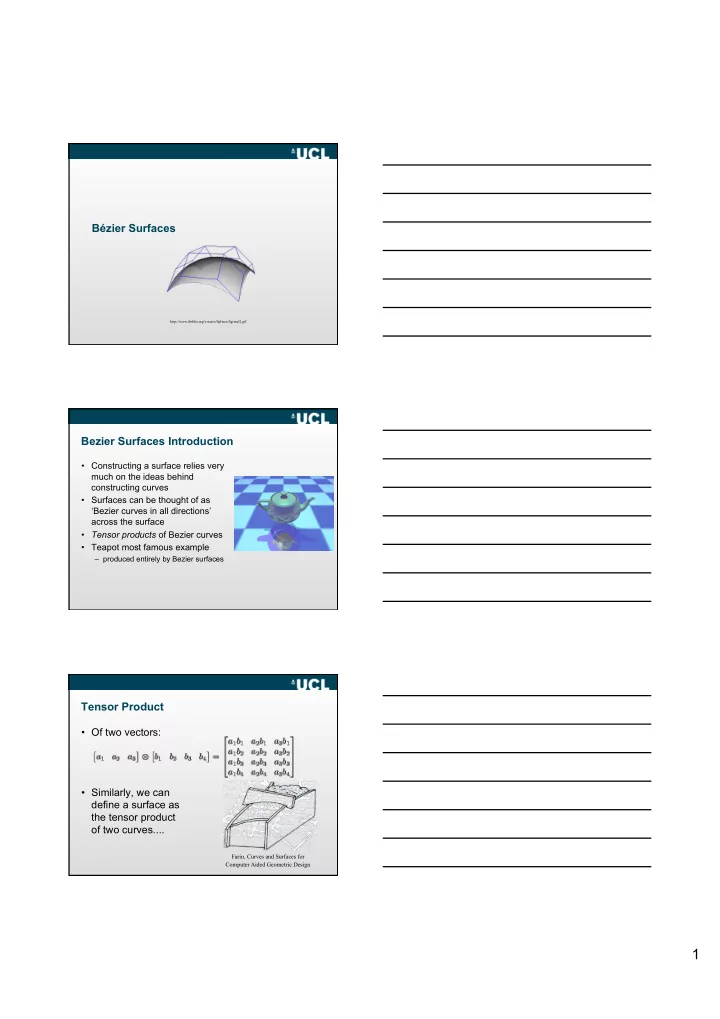
Bzier Surfaces http://www.ibiblio.org/e-notes/Splines/fig/surf2.gif Bezier Surfaces Introduction Constructing a surface relies very much on the ideas behind constructing curves Surfaces can be thought of as Bezier curves in all


slide-1
SLIDE 1

1

Bézier Surfaces

http://www.ibiblio.org/e-notes/Splines/fig/surf2.gif

Bezier Surfaces Introduction

  • Constructing a surface relies very

much on the ideas behind constructing curves

  • Surfaces can be thought of as

‘Bezier curves in all directions’ across the surface

  • Tensor products of Bezier curves
  • Teapot most famous example

– produced entirely by Bezier surfaces

  • Of two vectors:
  • Similarly, we can

define a surface as the tensor product

  • f two curves....

Tensor Product

Farin, Curves and Surfaces for Computer Aided Geometric Design

slide-2
SLIDE 2

2

Bilinear Patch Bicubic Bezier Patch Editing Bicubic Bezier Patches

Curve Basis Functions Surface Basis Functions

slide-3
SLIDE 3

3

Control Points

  • Consider the (m+1)*(n+1) array of 3D

control points

  • This array can be used to define a

Bezier of surface of degree m and n.

  • If m=n=3 this is called ‘bi-cubic’.
  • The same relation between surface and

control points holds as in curves

– If the points are on a plane the surface is a plane – If the edges are straight the Bezier surface edges are straight – The entire surface lies inside the convex hull

  • f the control points.

Rendering – de Casteljau

  • Use de Casteljau to subdivide each row.
  • Then use de Casteljau to subdivide each of the 7

resulting columns.

  • This will result in 4 sets of (m+1)*(n+1) array with
  • ne common row and one common column.
  • If all points are on a plane and the edges are

straight line then we get a polygon with 4 vertices.

  • So the recursive algorithm is as follows:

Subdivision 4*4 Cubic Case

pppp pppp pppp pppp pppmqqq pppmqqq pppmqqq pppmqqq pppmqqq pppmqqq pppmqqq pppmqqq pppmqqq pppmqqq pppmqqq split along rows split down columns This gives 4 sets of 4*4 arrays of control points. In each case the middle values are shared by the two adjacent sets.

slide-4
SLIDE 4

4

Rendering 3D de Casteljau Testing Colinearity

  • This is where the computational work of the algorithm is located.
  • If the equation of the plane is ax+by+cz=d and (x,y,z) is a point then its

distance from the plane is:

  • So we have an analogy to the curve case, except also we should

check that the edges are straight, and that adjacent regions have been split to the same level.

  • A simple approach is to just run the recursion to the same level

irrespective of testing whether the final pieces are really flat.

Modeling with Bicubic Bezier Patches

  • Original Teapot specified with Bezier Patches
slide-5
SLIDE 5

5

Bernstein Basis Representation

  • Mathematically the surface can be represented as:
  • Note that it is easy to see that this is simple a

‘Bezier curve of Bezier curves’.

B-Spline Surfaces

  • These can be constructed in exactly the same

way, except that there will be a knot sequence for the rows and for the colums.

  • The simplest approach is on a row by row and

column by column basis convert the B-Spline control points to Bezier control points and then render the Bezier surfaces.

Conclusions

  • Surfaces are a simple extension to curves
  • Really just a tensor-product between two curves

– One curve gets extruded along the other