Sentential complement structures Within the framework of GB, it is - - PowerPoint PPT Presentation

sentential complement structures
SMART_READER_LITE
LIVE PREVIEW

Sentential complement structures Within the framework of GB, it is - - PowerPoint PPT Presentation

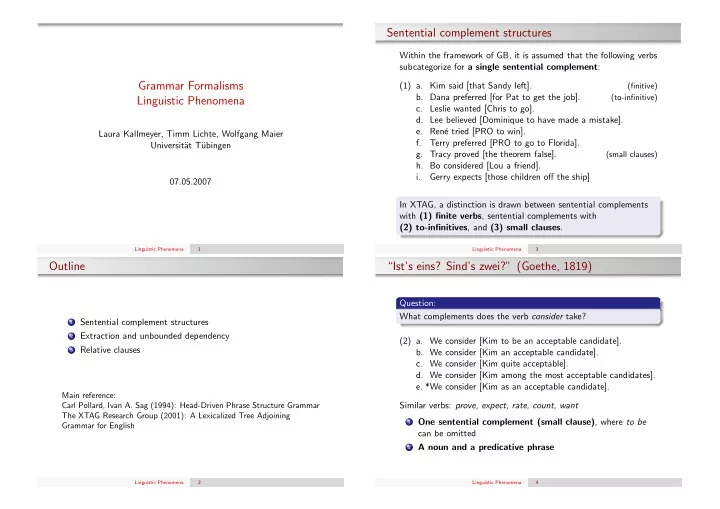
Sentential complement structures Within the framework of GB, it is assumed that the following verbs subcategorize for a single sentential complement : Grammar Formalisms (1) a. Kim said [that Sandy left]. (finitive) b. Dana preferred [for Pat


slide-1
SLIDE 1

Grammar Formalisms Linguistic Phenomena

Laura Kallmeyer, Timm Lichte, Wolfgang Maier Universit¨ at T¨ ubingen 07.05.2007

Linguistic Phenomena 1

Outline

1

Sentential complement structures

2

Extraction and unbounded dependency

3

Relative clauses

Main reference: Carl Pollard, Ivan A. Sag (1994): Head-Driven Phrase Structure Grammar The XTAG Research Group (2001): A Lexicalized Tree Adjoining Grammar for English

Linguistic Phenomena 2

Sentential complement structures

Within the framework of GB, it is assumed that the following verbs subcategorize for a single sentential complement: (1) a. Kim said [that Sandy left].

(finitive)

  • b. Dana preferred [for Pat to get the job].

(to-infinitive)

  • c. Leslie wanted [Chris to go].
  • d. Lee believed [Dominique to have made a mistake].
  • e. Ren´

e tried [PRO to win]. f. Terry preferred [PRO to go to Florida].

  • g. Tracy proved [the theorem false].

(small clauses)

  • h. Bo considered [Lou a friend].

i. Gerry expects [those children off the ship] In XTAG, a distinction is drawn between sentential complements with (1) finite verbs, sentential complements with (2) to-infinitives, and (3) small clauses.

Linguistic Phenomena 3

“Ist’s eins? Sind’s zwei?” (Goethe, 1819)

Question: What complements does the verb consider take? (2) a. We consider [Kim to be an acceptable candidate].

  • b. We consider [Kim an acceptable candidate].
  • c. We consider [Kim quite acceptable].
  • d. We consider [Kim among the most acceptable candidates].
  • e. *We consider [Kim as an acceptable candidate].

Similar verbs: prove, expect, rate, count, want

1

One sentential complement (small clause), where to be can be omitted

2

A noun and a predicative phrase

Linguistic Phenomena 4

slide-2
SLIDE 2

Small clauses - Pro and contra (1)

Pro: Homomorphism between argument structure and complement structure (in GB: “Projection Principle”; in TAG: Elementary Tree Minimality) Uniformity of the subcategorized constituents: Instead of NP, AP, PP, IP/S, ... as possible categories of the complements, there is only one complement category.

Linguistic Phenomena 5

Small clauses - Pro and contra (2)

Contra: Passivization (object-to-subject shift) (3) We considered [Kim quite acceptable]. Kim was considered [ quite acceptable]. Idiosyncratic restrictions on the predicative phrase (4) a. I consider/*expect [this Island a good vacation spot].

  • b. I consider/*expect [this man stupid].

I expect [that man to be stupid].

  • c. We rate/*consider [Kim as quite acceptable]

⇒ The verb should be indifferent to the categorial status of the small clause predicate!

Linguistic Phenomena 6

Small clauses - XTAG-Analysis (1)

S NP↓ VP V NP ǫ N⋄ S NP↓ VP V AP ǫ A⋄ S NP↓ VP V PP ǫ P⋄ NP↓ XTAG uses a uniform analysis of copula, raising verbs and consider verbs.

Linguistic Phenomena 7

Small clauses - XTAG-Analysis (2)

(5) We consider Kim acceptable.

S

ˆmode ind˜ ˆ ˜

NP↓ VP V S*

2 4 assign-case acc comp nil mode nom/prep 3 5 ˆ ˜

NP consider We S

ˆ ˜ 2 4 assign-case

1

comp nil mode nom 3 5

NP↓

h case

1

i

VP V AP NP ǫ A Kim acceptable

Exceptional Case Marking (ECM): The case of the subject of the sentential complement is assigned from the superordinate subcategorizing verb. For ECM, XTAG uses the feature assign-case.

Linguistic Phenomena 8

slide-3
SLIDE 3

Small clauses - XTAG-Analysis (3)

seems adjoins to VP ECM for nominative case (6) Kim seems acceptable.

VP

ˆmode ind˜ ˆ ˜

V VP*

2 6 6 4 assign-case nom agr 3sg comp nil mode nom 3 7 7 5 ˆ ˜

seems S NP↓

" case

1

agr

2

#

VP

ˆ ˜ 2 6 6 4 assign-case

1

agr

2

comp nil mode nom 3 7 7 5

V AP NP ǫ A Kim acceptable

Linguistic Phenomena 9

To-infinitives: Controlling and Raising its subject

Verbs that subcategorize for to-infinitives show differing properties with respect to their semantic and syntactic influence on the subject of the to-infinitives. Control verbs / Equi verbs (try, persuade) Raising verbs (seem, expect)

Linguistic Phenomena 10

Control verbs

Control verbs establish the coreference between their subject/object and the unexpressed subject (PRO) of their sentential complement. (PRO control) (7) a. John tried [PRO to leave]. (subject control) b. John persuaded him [PRO to leave]. (object control)

  • c. *There tries [PRO to be disorder after a revolution].

⇒ Control verbs assign semantic role to the controller!

Linguistic Phenomena 11

Control verbs - XTAG-Analysis

control feature for coindexation PRO tree Object control does not involve ECM

S

ˆmode ind˜

NP↓ VP V NP↓

h ctrl

1

i

S*

» ctrl

1

mode to-inf – ˆ ˜

persuaded S

ˆ ˜ » ctrl

1

mode to-inf –

NP↓

h ctrl

1

i

VP V NP to leave PRO

Linguistic Phenomena 12

slide-4
SLIDE 4

Raising verbs

Raising verbs determine case and agreement properties of the subject of the (non-finite) sentential complement. Semantically, however, the “raised” constituent is no immediate part of the argument structure of the raising verb. (8) a. [John] seems [to leave]. (subject raising) b. John expects [her to leave]. (object raising) c. [There] seems [to be disorder after a revolution]. d. John expected [it to rain]. ⇒ assign no semantic role to the raised constituent (raising of expletive it/there) (9) John seems unhappy. *John tries unhappy. ⇒ allow for small clauses

Linguistic Phenomena 13

Raising verbs - XTAG-Analysis (1)

no PRO The “raised” constituent is still part of the to-infinitive! ECM via assign-case feature Example for subject raising:

VP

ˆ ˜ ˆmode ind˜

V VP*

ˆ ˜ 2 4 assign-case nom agr 3sg mode to-inf 3 5

seems S NP↓

" case

1

agr

2

#

VP

ˆ ˜ 2 4 assign-case

1

agr

2

mode to-inf 3 5

V to leave

Linguistic Phenomena 14

Raising verbs - XTAG-Analysis (2)

Example for object raising: (10) We expect him to leave.

S

ˆmode ind˜ ˆ ˜

NP↓ VP V S*

2 4 assign-case acc comp nil mode to-inf 3 5 ˆ ˜

NP expect We S

ˆ ˜ » assign-case

1

mode to-inf –

NP↓

" case

1

agr

2

#

VP V to leave

Linguistic Phenomena 15

Raise or control - The big GB-picture

!!! Handle with care, I am not an expert on this !!! Forschungsobjekt: to-infinitives Background assumption: argument → complement (Projection Principle) Findings: the subject of to-infinitives (1) can have several cases or (2) is not realized phonologically. Hypothesis: (1) to-infinitives cannot assign case to its subject; (2) incomplete to-infinitives have a phonologically empty PRO in subject position. What does the case marking, then? nothing something (but not the to-infinitive) PRO ECM no need for case subject is raised to another verb semantic content is controlled by coreference that has a free case marking slot CONTROLLING RAISING

Linguistic Phenomena 16

slide-5
SLIDE 5

Raise or control?

Summary: control verbs raising verbs PRO no PRO (incomplete to-infinitives) (complete to-infinitives) no ECM ECM assign semantic role assign no semantic role (to the controlled constituent) (to the raised constituent) no small clauses small clauses XTAG: adjoin to S XTAG: adjoin to S or VP Classfication game:

(11) a. They asked Jan to leave. (object control) b. Bo turns out to be obnoxious. (subject raising) c. Sandy is willing to go to the movies. (subject control) d. Terry was expected to win the prize. (subject raising) e. Kim believed a unicorn to be approaching. (object control)

Linguistic Phenomena 17

Raise or control?

Summary: control verbs raising verbs PRO no PRO (incomplete to-infinitives) (complete to-infinitives) no ECM ECM assign semantic role assign no semantic role (to the controlled constituent) (to the raised constituent) no small clauses small clauses XTAG: adjoin to S XTAG: adjoin to S or VP Classfication game:

(12) a. It is important for Bill to dance. b. Christy left the party early to go to the airport. c. Peter kept standing in the doorway.

Linguistic Phenomena 18

Extraction and unbounded dependency

Topicalization/Extraction Wh-extraction

Linguistic Phenomena 19

Topicalization - Basics

Topicalization/Extraction: Placing a post-verbal constituent into a sentence-initial position. (13) a. Sandy loves Kim. (base configuration) b. Kim, Sandy loves . (NP-topicalization)

  • c. On Kim, Sandy depends

. (PP-topicalization)

Linguistic Phenomena 20

slide-6
SLIDE 6

Topicalization - Unbounded dependency

Unbounded dependency: The dependency between an extracted constituent and its trace may extend across arbitrarily many clause boundaries. (14) a. Kimi, Sandy loves

i .

  • b. Kimi, [Chris knows] Sandy loves

i .

  • c. Kimi, [Dana believes Chris knows] Sandy loves

i .

Linguistic Phenomena 21

Topicalization - XTAG-analysis (outline)

extra tree for topicalization

S NPs↓ VP V NP loves NPo↓ = ⇒ S NPo↓ S NPs↓ VP V NP loves t

Example:

S NPnom↓ VP V S* knows S NPnom↓ VP V S* blieves S NPo S Kim NPs VP Sandy V NP loves t

⇒ extended domain of locality and factoring of recursion

Linguistic Phenomena 22

Wh-extraction - Basics

Wh-Extraction: Placing a post-verbal constituent as wh-phrase into a clause-initial position. (15) a. I wonder whoi Sandy loves

i .

(indirect question)

  • b. Whoi does Sandy love

i .

(direct question)

  • c. Sandy loves Kimi whoi Irmgard hates

i.

(relative clause) wh-phrase: phrase that contains a wh-pronoun. wh-pronoun: who, which, what, whom, whose, that, when,... (16) Here’s the ministeri [in the middle of whosei sermon] the dog barked.

Linguistic Phenomena 23

Wh-extraction - More basics

Pied piping: Additional material along with wh-pronouns is fronted. (The fronted wh-phrase may be larger than the wh-pronoun.) (17) This is the book [the covers of which]i I have designed

i.

Preposition stranding: Material from the wh-phrase is left in base position. (18) This is the book [which]i I have designed [the covers of

i].

Linguistic Phenomena 24

slide-7
SLIDE 7

Wh-extraction - Unbounded dependency

Unbounded dependency: The dependency between an extracted wh-phrase and its trace may extend across arbitrarily many clause boundaries. (19) a. I wonder whoi Sandy loves

i .

  • b. I wonder whoi [Chris knows] Sandy loves

i .

  • c. I wonder whoi [Dana believes Chris knows] Sandy loves

i.

Linguistic Phenomena 25

Wh-extraction - Islands for extraction

Adjuncts: (20) *[Which movie]i did Gorgette fall asleep after watching

i.

Finite sentences with complementizer (that, whether) (21) *Whoi did the elephant whisper that the emu saw

i ?

Whoi did the elephant say that the emu saw

i ?

Subjects from finite sentences with complementizer (→ In GB: Empty Category Principle/Subjacency): (22) *Whoi did Alice say that

i left.

Whoi did Alice say

i left.

Coordination (23) *I wonder whoi Sandy loves

i and Kim.

Linguistic Phenomena 26

Wh-extraction - Multiple traces

Parasitic gaps: (24) That was the rebel leader whoi rivals of

i shot i.

*That was the rebel leader whoi rivals of

i shot the British consul.

That was the rebel leader whoi agents of foreign powers shot

i.

tough movement: (25) Kimi would be easy to bribe

i .

Kimi would be easy to prove Sandy bribed

i .

This is a problem which1 John2 is difficult to talk to

2 about 1.

Multiple wh-extraction is forbidden in English: (26) *Whoi do you wonder whoj

j loves i.

Linguistic Phenomena 27

Wh-extraction - TAG-analysis from XTAG (1)

Basic trees for topicalization and wh-extraction: S NP↓ S NPS VP ǫ V⋄ S NP↓ S NPS ↓ VP V⋄ NPO ǫ S NP↓ S NPS ↓ VP V⋄ PP PP⋄ NP ǫ S AP↓ S NPS ↓ VP V⋄ AP ǫ

Linguistic Phenomena 28

slide-8
SLIDE 8

Wh-extraction - TAG-analysis from XTAG (2)

Tree for topicalization and wh-extraction

  • f an accusative object:

S

ˆ ˜ 2 4 inv

5

extracted + wh

4

3 5

NP↓

" case

2

wh

4

#

S

" inv

5

agr

1

# 2 4 inv

  • comp

nil agr

6

3 5

NPnom↓

h agr

1

i

VP V NP

ˆcase acc˜ h case

2

i

love t

Linguistic Phenomena 29

Wh-extraction - TAG-analysis from XTAG (3)

Direct questions: In the root node: inv = + (27) Whoi does Sandy love

i.

NP

ˆ ˜ » case

6

wh + –

who S

ˆ ˜ 2 4 inv

5

extracted + wh

4

3 5

NP↓

" case

2

wh

4

#

S

" inv

5

agr

1

# ˆinv

  • ˜

NPnom↓

h agr

1

i

VP NPnom V NP

ˆcase acc˜ h case

2

i

Sandy love t S

»inv + agr 3sg – ˆ ˜

V S*

ˆ ˜ ˆinv

  • ˜

does

Linguistic Phenomena 30

Wh-extraction - TAG-analysis from XTAG (4)

Indirect questions: wonder selects a sentential complement with wh = +, inv = -. (28) I wonder [whoi Sandy loves

i].

NP

ˆ ˜ » case

6

wh + –

who S

ˆ ˜ 2 4 inv

  • extracted

+ wh

4

3 5

NP↓

" case

2

wh

4

#

S

ˆinv

  • ˜

ˆinv

  • ˜

NPnom↓ VP NPnom V NP

ˆcase acc˜ h case

2

i

Sandy loves t

Linguistic Phenomena 31

Wh-extraction - TAG-analysis from XTAG (5)

Unbounded dependency: (29) I wonder whoi [Chris believes] Sandy loves

i.

S

ˆ ˜ 2 4 inv

  • extracted

+ wh

2

3 5

NP↓ S

ˆinv

  • ˜

ˆinv

  • ˜

NP VP Sandy V NP loves t S

» inv

6

comp nil – ˆ ˜

NPnom↓ VP V S*

ˆ ˜ »inv

  • comp

nil –

believes

Linguistic Phenomena 32

slide-9
SLIDE 9

Wh-extraction - TAG-analysis from XTAG (6)

Unbounded dependency: (30) I wonder whoi [Irmgard said Chris believes] Sandy loves

i.

S

ˆ ˜ 2 4 inv

  • extracted

+ wh

2

3 5

NP↓ S

ˆinv

  • ˜

ˆinv

  • ˜

NP VP Sandy V NP loves t S

» inv

6

comp nil – ˆ ˜

NPnom↓ VP V S*

ˆ ˜ »inv

  • comp

nil –

believes S

» inv

7

comp nil – ˆ ˜

NPnom↓ VP V S*

ˆ ˜ »inv

  • comp

nil –

said

Linguistic Phenomena 33

Wh-extraction - TAG-analysis from XTAG (9)

Extraction islands in XTAG:

⇒ Constraints for extraction and unbounded dependencies follow from the elementary trees, i.e., can be stated locally. Adjuncts: Adjuncts are not present in elementary trees of the projections they modify (minimality of elementary trees). Finite sentences with complementizer: comp = nil, where non-bride verbs attach (whisper) comp = nil/that, where bridge verbs attach (say) Subjects from finite sentences with complementizer: Corresponding elementary tree is not given. Coordination: Coordinated NPs are realized as one initial NP-tree that cannot split during derivation.

Linguistic Phenomena 34

Relative clauses - Basics

“Relative clauses are NP modifiers involving extraction of an argument or an adjunct” (XTAG manual)

(31) a. the dog [that ate the cake] (wh-relatives) b. the export exhibition [Muriel planned] (wh-less relatives) c. [Whati Sandy loves

i] is Kimi.

(free wh-relatives) d. the girl [reading the magazine] (gerunds ???) (32) Somebody lives nearby [who has a CD-burner]. (extraposition) ⇒ internal vs. external syntax

Linguistic Phenomena 35

Wh/that-relatives

(33) a. The dogi [thati ate the cake] (subject relative) b. The personi [whoi I talked to

i].

(non-subject relative) internal syntax: same as wh-extraction external syntax: adjunction at a NP-node NP NP* S NPwh↓ ate NPacc↓ Note: in XTAG, adjunction to a PRO-NP is not possible due to colliding case features.

Linguistic Phenomena 36

slide-10
SLIDE 10

That-less relatives

(34) a. the export exhibition [Muriel planned/is planning] (35) a. the export exhibition [planned by Muriel]

  • b. *the export exhibition [is being planned by Muriel]

c. the export exhibition [taking place in October]

  • d. *the export exhibition [takes place in October]

internal syntax: same as wh-extraction, but missing wh-pronoun external syntax: adjunction at a NP-node NP NP* S NPnom↓ VP V planned

Linguistic Phenomena 37

Free wh-relatives

Also known as Pseudoclefts ! (36) [Whati Sandy loves

i] is Kimi.

internal syntax: same as wh-extraction external syntax: counts as an NP NP what NP NP* S NPnom↓ VP V loves

  • r:

NP S NPwh↓ NPnom↓ loves

Linguistic Phenomena 38

Extraposed relatives

(37) a. Somebodyi lives nearby [whoi has a CD-burner]. b. Karl hat mir [von der Kopie [einer F¨ alschung [eines Bildes [einer Frau

i]]]] erz¨

ahlt, [die schon lange tot ist]i. internal syntax: same as wh-extraction external syntax: no adjunction at a NP-node, but to the right periphery

  • f the sentence

TAG-analysis ??? “movement” anchor structures Kroch,Joshi(1987) Kiss(2005) for HPSG multicomponent TAG

Linguistic Phenomena 39

Summary

Topicalization and wh-extraction obtain a uniform analysis. Account for unbounded dependency via extended domain of locality + factoring of recursion Island constraints can be modelled rather naturally (wrt. TAG). Relative clauses are realized as auxiliary trees. Their internal structure is analysed as ordinary wh-extraction. Extraposed relative clauses: Which way to go? ⇒ more details in later sessions ...

Linguistic Phenomena 40