Bottom up Parsing Bottom up parsing trys to transform the input - - PowerPoint PPT Presentation

bottom up parsing
SMART_READER_LITE
LIVE PREVIEW

Bottom up Parsing Bottom up parsing trys to transform the input - - PowerPoint PPT Presentation

Bottom up Parsing Bottom up parsing trys to transform the input string into the start symbol. Moves through a sequence of sentential forms (sequence of Nonterminal or terminals). Trys to identify some substring of the sentential form that


slide-1
SLIDE 1

Bottom up Parsing

  • Bottom up parsing trys to transform the input string into

the start symbol.

  • Moves through a sequence of sentential forms (sequence
  • f Nonterminal or terminals). Trys to identify some

substring of the sentential form that is the rhs of some production.

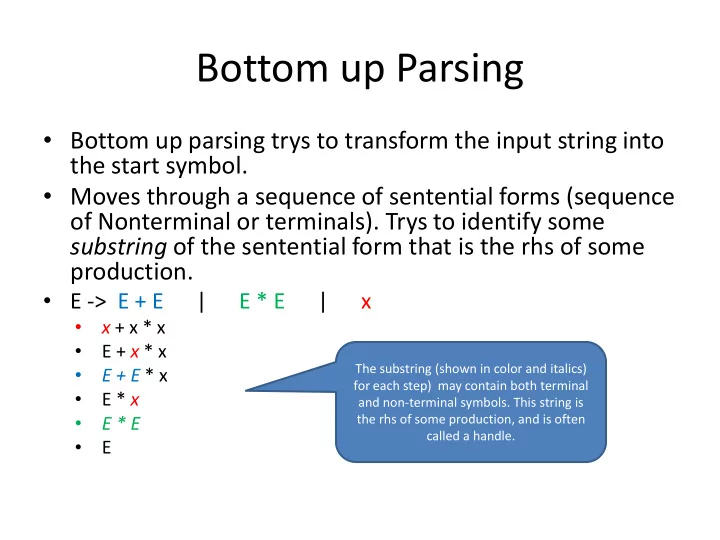
  • E -> E + E | E * E | x
  • x + x * x
  • E + x * x
  • E + E * x
  • E * x
  • E * E
  • E

The substring (shown in color and italics) for each step) may contain both terminal and non-terminal symbols. This string is the rhs of some production, and is often called a handle.

slide-2
SLIDE 2

Bottom Up Parsing

Implemented by Shift-Reduce parsing

  • data structures: input-string and stack.
  • look at symbols on top of stack, and the input-string and decide:

– shift (move first input to stack) – reduce (replace top n symbols on stack by a non-terminal) – accept (declare victory) – error (be gracious in defeat)

slide-3
SLIDE 3

Example Bottom up Parse

Consider the grammar: (note: left recursion is NOT a problem,

but the grammar is still layered to prevent ambiguity)

  • 1. E ::= E + T
  • 2. E ::= T
  • 3. T ::= T * F
  • 4. T ::= F
  • 5. F ::= ( E )
  • 6. F ::= id

stack Input Action x + y shift x + y reduce 6 F + y reduce 4 T + y reduce 2 E + y shift E + y shift E + y reduce 6 E + F reduce 4 E + T reduce 1 E accept The concatenation of the stack and the input is a sentential form. The input is all terminal symbols, the stack is a combination of terminal and non- terminal symbols

slide-4
SLIDE 4

LR(k)

  • Grammars which can decide whether to shift
  • r reduce by looking at only k symbols of the

input are called LR(k).

– Note the symbols on the stack don’t count when calculating k

  • L is for a Left-to-Right scan of the input
  • R is for the Reverse of a Rightmost derivation
slide-5
SLIDE 5

Problems (ambiguous grammars)

1) shift reduce conflicts: stack Input Action x + y + z ? stack Input Action if x t if y t s2 e s3 ? 2) reduce reduce conflicts:

suppose both procedure call and array reference have similar syntax:

– x(2) := 6 – f(x)

stack Input Action id ( id ) id ?

Should id reduce to a parameter or an expression. Depends on whether the bottom most id is an array or a procedure.

slide-6
SLIDE 6

Using ambiguity to your advantage

  • Shift-Reduce and Reduce-Reduce errors are caused by ambiguous

grammars.

  • We can use resolution mechanisms to our advantage. Use an

ambiguous grammar (smaller more concise, more natural parse trees) but resolve ambiguity using rules.

  • Operator Precedence

– Every operator is given a precedence – Precedence of the operator closest to the top of the stack and the precedence of operator next on the input decide shift or reduce. – Sometimes the precedence is the same. Need more information: Associativity information.

slide-7
SLIDE 7

Example Precedence Parser

+

*

( ) id $ +

*

( ) id $

< : < : < : < : < : < : < : < : < : < : < : < : < : < : : > : > : > : > : > : > : > : > : > : > : > : > : > : >

= input : x * x + y stack Input Action $ E * E + y $ reduce!

topmost terminal next input

accept

slide-8
SLIDE 8

Precedence parsers

  • Precedence parsers have limitations
  • No production can have two consecutive non-terminals
  • Parse only a small subset of the Context Free Grammars
  • Need a more robust version of shift- reduce parsing.
  • LR - parsers

– State based - finite state automatons (w / stack) – Accept the widest range of grammars – Easily constructed (by a machine) – Can be modified to accept ambiguous grammars by using precedence and associativity information.

slide-9
SLIDE 9

LR Parsers

  • Table Driven Parsers
  • Table is indexed by state and symbols (both term and non-term)
  • Table has two components.

– ACTION part – GOTO part

state terminals non-terminals 1 2 id + * ( ) $ E T F shift (state = 5) reduce(prod = 12) goto(state = 2)

ACTION GOTO

slide-10
SLIDE 10

LR Table encodes FSA

1 2 3 4 5 6 7 8 9 10 11 ( T E ) F

*

id ( * + ( F id id F F id

E

( T

+

T

E -> E + T | T T -> T * F | F F -> ( E ) | id transition on terminal is a shift in action table, on nonterminal is a goto entry

slide-11
SLIDE 11

Table vs FSA

  • The Table encodes the FSA
  • The action part encodes

– Transitions on terminal symbols (shift) – Finding the end of a production (reduce)

  • The goto part encodes

– Tracing backwards the symbols on the RHS – Transition on non-terminal, the LHS

  • Tables can be quite compact
slide-12
SLIDE 12

LR Table

state terminals non-terminals 1 2 3 4 5 6 7 8 9 10 11 id + * ( ) $ E T F s5 s4 1 2 3 s6 acc r2 s7 r2 r2 r4 r4 r4 r4 s5 s4 8 2 3 r6 r6 r6 r6 s5 s4 9 3 s5 s4 10 s6 s11 r1 s7 r1 r1 r3 r3 r3 r3 r5 r5 r5 r5

slide-13
SLIDE 13

Reduce Action

  • If the top of the stack is the rhs for some production n
  • And the current action is “reduce n”
  • We pop the rhs, then look at the state on the top of the stack, and index

the goto-table with this state and the LHS non-terminal.

  • Then push the lhs onto the stack in the new s found in the goto-table.

(?,0)(id,5) * id + id $ Where: Action(5,*) = reduce 6 Production 6 is: F ::= id And: GOTO(0,F) = 3 (?,0)(F,3) * id + id $

slide-14
SLIDE 14

Example Parse

Stack Input (?,0) id * id + id $ (?,0)(id,5) * id + id $ (?,0)(F,3) * id + id $ (?,0)(T,2) * id + id $ (?,0)(T,2)(*,7) id + id $ (?,0)(T,2)(*,7)(id,5) + id $ (?,0)(T,2)(*,7)(F,10) + id $ (?,0)(T,2) + id $ (?,0)(E,1) + id $ (?,0)(E,1)(+,6) id $ (?,0)(E,1)(+,6)(id,5) $ (?,0)(E,1)(+,6)(F,3) $ (?,0)(E,1)(+,6)(T,9) $ (?,0)(E,1) $ 1) E -> E + T 2) E -> T 3) T -> T * F 4) T -> F 5) F -> ( E ) 6) F -> id

slide-15
SLIDE 15

Review

  • Bottom up parsing transforms the input into the

start symbol.

  • Bottom up parsing looks for the rhs of some

production in the partially transformed intermediate result

  • Bottom up parsing is OK with left recursive

grammars

  • Ambiguity can be used to your advantage in

bottom up partsing.

  • The LR(k) languages = LR(1) languages = CFL