14:1 Walt Boynton and Many Colleagues Chesapeake Biological Lab, - - PowerPoint PPT Presentation

14 1
SMART_READER_LITE
LIVE PREVIEW

14:1 Walt Boynton and Many Colleagues Chesapeake Biological Lab, - - PowerPoint PPT Presentation

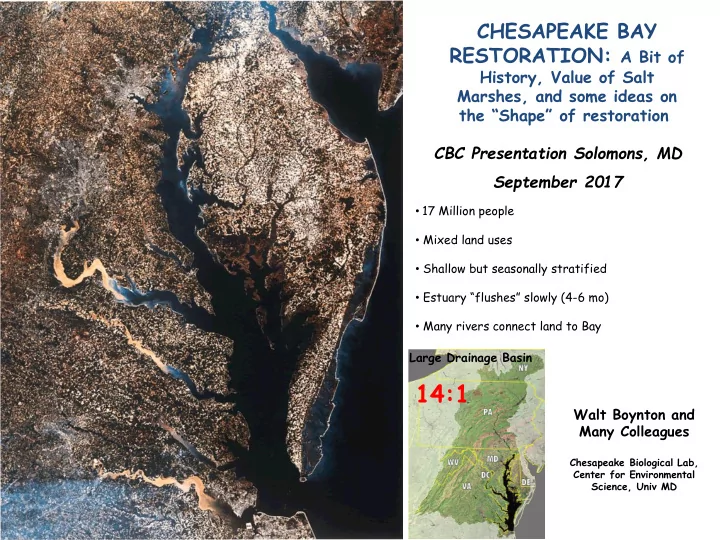
CHESAPEAKE BAY RESTORATION: A Bit of History, Value of Salt Marshes, and some ideas on the Shape of restoration CBC Presentation Solomons, MD September 2017 17 Million people Mixed land uses Shallow but seasonally stratified


slide-1
SLIDE 1

CBC Presentation Solomons, MD September 2017

14:1

  • 17 Million people
  • Mixed land uses
  • Shallow but seasonally stratified
  • Estuary “flushes” slowly (4-6 mo)
  • Many rivers connect land to Bay

Large Drainage Basin

Walt Boynton and Many Colleagues

Chesapeake Biological Lab, Center for Environmental Science, Univ MD

CHESAPEAKE BAY RESTORATION: A Bit of

History, Value of Salt Marshes, and some ideas on the “Shape” of restoration

slide-2
SLIDE 2

A Famous Chesapeake Bay Painting…1588

  • Clearly, fish were important
  • Emphasis on shallow waters…and

there are lots of these everywhere

  • CLEAR WATER and SAV…a clear

water benthic dominated painting and likely a benthic dominated ecosystem

From T. De Bry in Hariot 1588

slide-3
SLIDE 3

A John Smith Diet

  • Traded with natives for corn, venison, fish, oysters,

nuts, beans, pumpkins…traded swords for turkeys (a 1 for 1 deal…probably not a good deal for the English)

  • Tobacco…”it purges the superfluous phlegm and other gross humours and
  • peneth all the pores and passages of the body” from Harriot who died of a nasal

tumor in 1621…the 400 year tobacco wars are still with us.

  • Jamestowners preferred a seaman’s diet of pork,

beefe, fish, wheat and barley (even with the ever present worms)…not too adaptive even when hungry

  • Sturgeon (dried and pounded)
  • The Starving Time (winter 1609-1610)…cats, dogs,

horses and people…this was a very tough life indeed!

Hoobler 2006

slide-4
SLIDE 4

Patuxent River Estuary Circa 1832

“So transparent are its waters that far out from shore you may see, in the openings of the sea- weed forest, on its bottom the flashing sides

  • f the finny tribe as

they glide over the pearly sands.” The Old

Plantation by Hungerford (1859) Water Quality and Habitat Conditions can be much improved…not to the 1832 condition and that may not be the

  • ptimal status
slide-5
SLIDE 5

Major Events in Chesapeake Bay History: Science, Management and Politics

1950-60s: Pollution not possible in estuaries because of tidal flushing. The Bay is just fine and productive. Almost no “Estuarine Science” literature available 1960s: There is nothing …and we mean nothing…wrong with Chesapeake Bay. Reports of pollution are false and unpatriotic. You can be fired for this sort of loose talk 1960-70s: The more nutrients we can pour into the Bay the better…farmers know that fertilization is good so lets get on with fertilizing the Bay. About 90% of SAV are gone and the causes are unclear 1970-80s: So, OK estuaries can be polluted…big deal. The only thing needed for restoration is control of PHOSPHORUS and that’s easy. Restoration efforts need to focus on POINT SOURCES 1980-90s: Both NITROGEN and PHOSPHORUS from MANY SOURCES are killing Bay habitats …the bay is nutrient obese and needs a nutrient diet…big

  • time. DIFFUSE SOURCES clearly a major player

2000-17: Restoration is hard and expensive. Fears that all aspects of the Bay have long memories proven false…Bay is responsive. However, pathways to restored conditions are not simple….expect some surprises

slide-6
SLIDE 6

Pocomoke River Marshes

Lets look at Tidal Wetlands for a moment

We know a good bit about some marsh functions

  • wildlife habitat
  • nursery functions
  • storm protection

What about tidal marshes as important NUTRIENT SINKS…A kidney in the landscape helping us achieve the TMDL?

slide-7
SLIDE 7

Naticoke River Marshes

slide-8
SLIDE 8

Poplar Island: Salt Marsh Creation from Dredge Spoil

slide-9
SLIDE 9

Patuxent River and Bay Tidal Marshes

slide-10
SLIDE 10

Tidal Wetlands: Nutrient Loss

Hotspots in the Landscape

Units = Kg N/day

5400 2600 2800

Patuxent Tidal Marshes

1.5 % of basin landscape removes 48% of N inputs to the upper estuary

Inputs from all sources Export of N to lower estuary N losses via burial and denitrification

slide-11
SLIDE 11

Nitrogen Export: For these estuaries, the percent of TN input exported was

inversely related to water residence time

Nixon et al., 1996 Potomac

  • “Give the bugs

enough time and they will get rid of it”

Scott Nixon

  • N losses were via

denitrification and long-term N burial…fisheries losses were small More nitrogen exported How long water stays in the estuary (months)

slide-12
SLIDE 12

Synthesis Revised?

Nitrogen Export: Results from the Patuxent strongly diverged

from other sites not characterized by extensive wetlands

Nixon et al., 1996 Boynton et al. 2008

Potomac

Patuxent

Narragansett Bay

(dry) (wet)

slide-13
SLIDE 13

Synthesis Revised

Nitrogen Export: And then aother Chesapeake system

diverged, also having extensive wetlands at the land-sea margin

Nixon et al., 1996 Boynton et al. 2008 Fisher and Cornwell, pers comm

Potomac

Patuxent Choptank

Narragansett Bay

(dry) (wet)

slide-14
SLIDE 14

Synthesis Revised

Nitrogen Export: And then more systems diverged, all with

extensive wetlands

Nixon et al., 1996 Boynton et al. 2008 Fisher and Cornwell, pers comm Justic and Day, pers comm Perez et al (2001); Lane et al (2004)

Potomac

Patuxent Choptank

Narragansett Bay

Fourleague Bay, LA (dry) (wet)

slide-15
SLIDE 15

Synthesis Revised,,,might be something here

Nitrogen Export: And then more systems diverged, all with

extensive wetlands at the land-sea margin

Nixon et al., 1996 Boynton et al. 2008 Fisher and Cornwell, pers comm Justic and Day, pers comm Perez et al (2001); Lane et al (2004)

Potomac

Patuxent Choptank

Narragansett Bay

Fourleague Bay, LA Breton Sound, LA Davis Pd, LA (dry) (wet)

slide-16
SLIDE 16

Synthesis Revised,,,might be something here

Nitrogen Export: And then more systems diverged, all with

extensive wetlands at the land-sea margin

Nixon et al., 1996 Boynton et al. 2008 Fisher and Cornwell, pers comm Justic and Day, pers comm Perez et al (2001); Lane et al (2004)

Potomac

Patuxent

Narragansett Bay

(dry) (wet)

slide-17
SLIDE 17
slide-18
SLIDE 18
slide-19
SLIDE 19

Ecosystem Responses to Nutrient Degradation and Remediation

Increased algae, hypoxia, turbidity

slide-20
SLIDE 20

A “Simple” Response to Nutrient Load Reduction

  • Waste water treatment plants reduced P-loads

by >90% in 30 years

  • Algal blooms and bottom O2 responded rapidly
  • Underwater grasses also responded in a

favorable fashion

Algal Blooms Bottom Oxygen P-Loading

Year

Photo of upper potomac

Upper Potomac River and Washington, DC

(Kemp et al. 2005)

slide-21
SLIDE 21

Complex Response to P-Load Reduction

  • Potomac River tributary
  • Time-series of P-loading index

includes periods of brief increase and gradual decline

  • Phytoplankton chl-a shows

response to P-load reduction after decade delay, probably due to slow purging of sediment DIP pools (hysteretic response pattern?)

  • Reductions in phytoplankton

chl-a improved water clarity until a light threshold was reached allowing growth and survival of submersed plants

Phosphorus-Load Time-Series P-Load Index (g/l) Year SAV Response to Phytoplankton Phytoplankton Response to P- Load Reduction P-Load Index (g/l) SAV Cover (ha) Algal Chl-a (g/l) Chl-a (g/l) Hysteresis? Threshold?

Chris Jones, GMU

slide-22
SLIDE 22

X X X X

Model of O2 Interactions with P-Cycle

slide-23
SLIDE 23
  • Basic ideas of enrichment and restoration are scientifically solid
  • Substantial reductions of N and P result in improved water quality and

better habitat conditions…the Bay is RESPONSIVE to load changes

  • The pathways estuaries follow during degradation and restoration often

involve time delays (lags), abrupt changes (thresholds) and other things not yet known or fully understood – or predictable!

  • Restoration trends (and hints of trends) have been observed in both

small and large Chesapeake systems…very good signs!

  • Climate change and variability, continued and adaptive monitoring and

analysis, control of diffuse sources all remain major challenges

Take-Home Points