14:332:231 DIGITAL LOGIC DESIGN Ivan Marsic, Rutgers University - - PDF document

14 332 231 digital logic design
SMART_READER_LITE
LIVE PREVIEW

14:332:231 DIGITAL LOGIC DESIGN Ivan Marsic, Rutgers University - - PDF document

14:332:231 DIGITAL LOGIC DESIGN Ivan Marsic, Rutgers University Electrical & Computer Engineering Fall 2013 Lecture #3: Addition, Subtraction, Multiplication, and Division 2s-Complement Representation RECALL FROM THE LAST LECTURE: [D]


slide-1
SLIDE 1

1

14:332:231 DIGITAL LOGIC DESIGN

Ivan Marsic, Rutgers University Electrical & Computer Engineering Fall 2013

Lecture #3: Addition, Subtraction, Multiplication, and Division

2 of 15

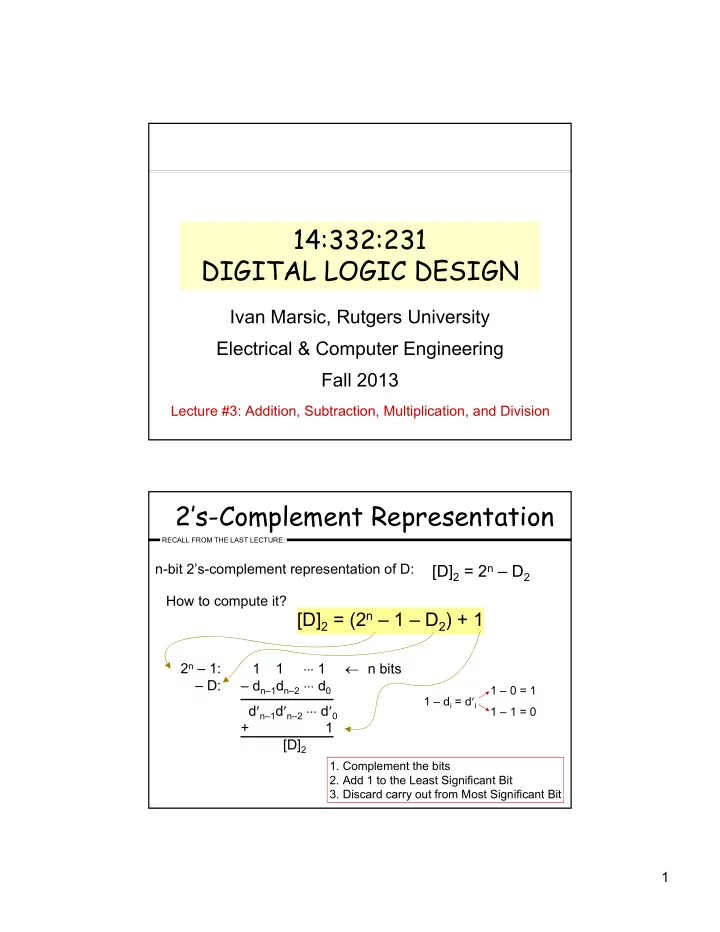
2’s-Complement Representation

n-bit 2’s-complement representation of D: How to compute it?

[D]2 = 2n – D2

  • 1. Complement the bits
  • 2. Add 1 to the Least Significant Bit
  • 3. Discard carry out from Most Significant Bit

[D]2 = (2n – 1 – D2) + 1

2n – 1: – D: 1 1  1  n bits – dn–1dn–2  d0 dn–1dn–2  d0 + 1 [D]2

1 – di = di 1 – 0 = 1 1 – 1 = 0

RECALL FROM THE LAST LECTURE:

slide-2
SLIDE 2

2

3 of 15

Addition with 2’s Complement

 Added by ordinary binary addition, ignoring any carries beyond the MSB  The result must be inside the range of the numbers represented by n-bits. Otherwise overflow occurs, and the result is not correct.

Example, number of bits limited to n = 5 Then, the range is –25–1 = –16  25–1 – 1 = +15 ~ 32 numbers

negative number resulted from adding 2 positive numbers  overflow

+510

00101 + +710 00111

+1210

01100

+9

01001 + –8 11000

+1 1|00001

2’s complement of +8: 810 = 01000  10111 1 11000 = –810

ignore carries beyond MSB

+12

01100 + +7 00111

+19

10011

4 of 15

Carries and Overflow

  • We ignore carries beyond MSB because

we are adding two’s complement numbers as if they were unsigned numbers

  • A carry beyond MSB is an artifact of

adding the sign bits and does not indicate overflow

  • For example, every time we add two negative

numbers, a carry beyond MSB occurs, but not necessarily an overflow

  • On the other hand, in a previous-slide example,
  • verflow occurred without a carry beyond MSB
slide-3
SLIDE 3

3

5 of 15

Overflow Detection Rule (1)

Overflow: If the sign of the addends is the same but different from the sign of the result.

If n = 6 bits, no overflow, range of numbers –32  +31 :

1410 = 01110  10001 ; –710 = 11001 1 10010 = –1410

–14 –7 –21 < –16

(2’s complement) Detect overflow because signs of addends and sum are different!

 10010 11001 1|01011

n = 5 bits

110010 + 111001 1|101011  verify result: 010100 + 1 010101 = 2110 magnitude

(2’s complement)

ignore carries beyond MSB 6 of 15

Overflow Detection Rule (2)

  • Overflow occurs when the value affects the sign bit:

– adding two positives yields a negative – adding two negatives gives a positive – subtract a negative from a positive and get a negative – subtract a positive from a negative and get a positive

  • No overflow when adding a positive and a negative

number

  • No overflow when subtracting two numbers of same sign
  • Consider the operations A + B, and A – B

– Can overflow occur if B is 0 ? – Can overflow occur if A is 0 ? cannot occur ! can occur ! (for A – B if B = –2n–1) [ e.g., for n=5: 0 – (–16) = +16 ]

slide-4
SLIDE 4

4

7 of 15

Subtraction with 2’s Complement

 A – B = A + (–B) = A + [B]2

 Subtraction identical to addition, the sign absorbed by the representation

 Again, the result must be inside the range of the numbers represented by n-bits. Otherwise overflow occurs, and the result is not correct.

Example, n = 5, the range is –25–1 = –16  25–1 – 1 = 15

positive number  overflow +5

00101 – +8 11000

–3

11101

+9

01001 – +9 10111 0 1|00000 = 010

2’s complement of +9: 910 = 01001  10110 1 10111 = –910

ignore carries beyond MSB

–8

11000 – +9 10111

–17 1|01111

810 = 01000  10111 1 11000 = –810

8 of 15

Multiplication in Decimal

 An example in decimal:  We do 214 × 5 = 1070 and then add to it the result of 214 × 4 = 856 right-shifted by one column.

214 × 45 1070 + 8560 = 9630

zzz × aaaa bbbb + cccc0 + dddd00 + eeee000

  • etc. …

multiplicand × multiplier = product

(1) For each digit of Multiplier, multiply Multiplicand by it. (2) Multiply the product by the order of the digit (×10i), i.e., shift it by one to the left:

214 × 45 5 × 214 ×100 + 4 × 214 ×101 21410 × 4510

slide-5
SLIDE 5

5

9 of 15

Multiplication in Binary

 Multiplying in binary follows the same form as in decimal:  Product P is composed purely of selecting, shifting and adding multiplicand A. The ith bit of multiplier B indicates whether a shifted version of A is to be selected in the ith row of the sum.

11010110 × 00101101 0000000011010110 0000000000000000 0000001101011000 0000011010110000 0000000000000000 0001101011000000 0000000000000000 + 0000000000000000 = 0010010110011110  A7 … A0  B7 … B0  P15 … P0 11010110 × 00101101 1 × 11010110 × 20 0 × 11010110 × 21 1 × 11010110 × 22 1 × 11010110 × 23 0 × 11010110 × 24 1 × 11010110 × 25 0 × 11010110 × 26 + + 0 × 11010110 × 27 multiplicand × multiplier shifted multiplicands = product 214 × 45 = 9630

multiplier’s LSB: multiplier’s MSB:

10 of 15

Multiplication in Binary

  • Because there are only two digits in

binary (0 and 1). The multiplication algorithm becomes only:

  • 1. Shift Multiplicand
  • 2. Multiply Shifted Multiplicand by 1 or 0
  • 3. Add the Shifted Multiplicands
  • So we can perform multiplication using

just full adders and a little logic for selection, in a layout which performs the shifting.

slide-6
SLIDE 6

6

11 of 15

Multiplication with Partial Products

 In digital systems, more convenient to work with partial products, instead of listing all shifted multiplicands and then adding them

1010 × 1011 00000000 + 1010 00001010 + 10100 00011110 + 000000 00011110 + 1010000 = 01101110 1 1 1 1010 × 1110 = 11010 mult multipl iplican icand mult multipl iplier ier partial product shifted multiplicand partial product shifted multiplicand partial product shifted multiplicand partial product shifted multiplicand pr produc uct

multiplier’s LSB: multiplier’s MSB:

12 of 15

Multiplication with 2’s Complement (1)

 Two’s complement multiplication works the same as unsigned multiplication:

shifted multiplicand is weighted by the multiplier bit, except for the MSB which, when “1” (i.e., negative multiplier), has a negative weight

1010 × 1011 00000 + 11010 111010 + 110100 1101110 + 0000000 11101110 + 00110000 = 00011110 1 1 1 –6 × –5 = 30 mult multipl iplican icand mult multipl iplier ier partial product shifted multiplicand partial product shifted multiplicand partial product shifted multiplicand partial product shifted and negated multiplicand pr produc uct

[1010]2 = 0101 1 0110

slide-7
SLIDE 7

7

13 of 15

Multiplication with 2’s Complement (2)

 Two’s complement multiplication works the same as unsigned multiplication:

when multiplier is positive, its MSB has zero weight:

1010 × 0101 00000 + 11010 111010 + 000000 1111010 + 1101000 11100010 + 00000000 = 11100010 1 1 –6 × +5 = –30 mult multipl iplican icand mult multipl iplier ier partial product shifted multiplicand partial product shifted multiplicand partial product shifted multiplicand partial product shifted multiplicand, zero weighted pr produc uct

[11100010]2 = 00011101 1 00011110 = 3010

verify the result:

14 of 15

Decimal Division

827 21 8 < 21 82 > 21

82 > 21×1 = 21 82 > 21×2 = 42 82 > 21×3 = 63 82 < 21× 4 = 84  use 3 = (4–1)

  • 1. Select most-significant digit

from Dividend to compare to Divisor

  • 2. It’s smaller than Divisor;

so, consider two digits

827 21

  • 3. Find greatest d (from 1 to 9)

that satisfies:

82 ≥ 21 × d 827 –63 19 197 –189 8 21

  • 4. Determine d using:

 Intuition (guessing) when done by human  Algorithm that increases d until

  • either d × 21 > 82; use (d–1)
  • or d = 9

39

197 > 21×1 … 197 > 21×8 197 > 21×9 = 189  use 9

 quotient  remainder

82710  2110 = 3910 810 dividend dividend divisor divisor quotient quotient remainder remainder

slide-8
SLIDE 8

8

15 of 15

Binary Division

001100111011 000000010101 Many steps before finding a number > Divisor. Presence of leading 0s disturbs the conventional algorithm. 000000011001 Extract digits from Dividend and shift them to align them with Divisor. Every step the Extracted Digits are compared to the Divisor: If Divisor × 1 > Extracted Digits  Shift in 0 in the Quotient If Divisor × 1 ≤ Extracted Digits  Shift in 1 in the Quotient – 000000010101 000000000100 000000100110 000001000111 – 000000010101 000000010001 000000100011 – 000000010101 000000001110 000000011101 – 000000010101 000000001000 In binary, d can only take the value 0 or 1. Means: Divisor × d ≤ Extracted Digits from Dividend  d = 1 Quotient: Shift left serial input from LSB.

82710  2110 = 3910 810 dividend dividend divisor divisor quotient quotient remainder remainder 0011001110112  0000000101012 = 0000010001112 0000000010002