2/29/16 Adaptive Immune Responses to Ranaviruses and Immune Evasion - - PDF document

2 29 16
SMART_READER_LITE
LIVE PREVIEW

2/29/16 Adaptive Immune Responses to Ranaviruses and Immune Evasion - - PDF document

2/29/16 Adaptive Immune Responses to Ranaviruses and Immune Evasion Strategies of Ranaviruses http://www.urmc.rochester.edu/smd/mbi/xenopus What is adaptive immunity anyway? An adaptive Immune System is present in all jawed vertebrates


slide-1
SLIDE 1

2/29/16 1

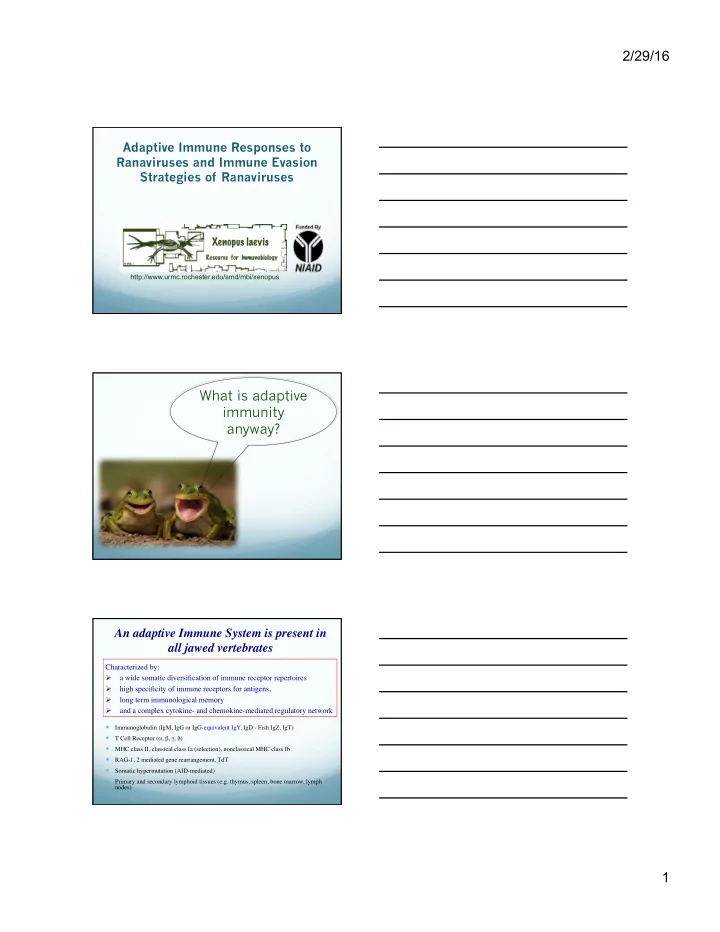
Adaptive Immune Responses to Ranaviruses and Immune Evasion Strategies of Ranaviruses

http://www.urmc.rochester.edu/smd/mbi/xenopus

What is adaptive immunity anyway?

An adaptive Immune System is present in all jawed vertebrates

— Immunoglobulin (IgM, IgG or IgG-equivalent IgY, IgD - Fish IgZ, IgT) — T Cell Receptor (α, β, γ, δ) — MHC class II, classical class Ia (selection), nonclassical MHC class Ib — RAG-1, 2 mediated gene rearrangement, TdT — Somatic hypermutation (AID-mediated) — Primary and secondary lymphoid tissues (e.g. thymus, spleen, bone marrow, lymph

nodes)

Characterized by: Ø a wide somatic diversification of immune receptor repertoires Ø high specificity of immune receptors for antigens, Ø long term immunological memory Ø and a complex cytokine- and chemokine-mediated regulatory network

slide-2
SLIDE 2

2/29/16 2

B cell receptors and Abs recognize (bind) epitopes on whole proteins in solution T cell receptors recognize only peptides bound to MHC molecules Nature Rev. Immunoloy Antigen presenting cell (APC)

Peptide

Somatic lymphocyte gene rearrangement

Some amphibian species have only 1 MHC class I gene per genome (Xenopus). Other have 2 or 3 genes per genomes (Ranidae)

MHC haplotypes

Allelic polymorphism

slide-3
SLIDE 3

2/29/16 3

Spleen Lymph node

Liver Kidney spleen

Organization of the immune system

General hematopoietic tissues

Boehm et al., (2012) Special focus: Structure and function of lymphoid tissues. Trends Immunol. 33:315

Evolutionary trajectory of lymphoid tissues in vertebrates

Features of an Adaptive Immune System

  • Ig, TCR, MHC
  • RAG 1, 2 expression
  • Lymphoid

Compartments

Flajnik, Nature Rev. Immunology 2, 688-698 (2002)

slide-4
SLIDE 4

2/29/16 4

Immunoglobulin Evolution

Flajnik, Nature Reviews Immunology 2, 688-698 (2002)

IgD

IgZ, IgT

Chamel, llama Ab IgH only (no IgL chain)

IgMgi (no TM)

No IgL chain

APC CD8 CD4

Class I Class II

Activation CTL Effector phase Kill class I+ targets

Memory

CD8

Apoptosis

Memory Expansion Maturation Cytokine release B Th

Memory CD4 Apoptosis

Plasma cells Cytokine release

Co-stim (B7, CD40)

Ags + “danger” signals

TLRs

Inflam- masome

Antiviral immune responses

Robert and Ohta, 2009. Dev. Dyn. 238:1249

Metamorphosis ¡

Ø External development , absence of maternal influences on embryos Ø Tadpoles are immunocompetent but immature Ø Immune system develop early (10 days of age) Ø Only about 20,000 T cells, mainly innate T cells, in tadpoles Ø No classical MHC class I protein expression until metamorphosis Ø No NK cells, weaker T cell responses than adults Ø Drastic remodeling of the immune system during metamorphosis Ø Thymocytes degenerate, new thymic education from new progenitors

slide-5
SLIDE 5

2/29/16 5

Urodelean adaptive immunity

  • Relatively poor adaptive immunity compared to anurans
  • Low IgM antibody heterogeneity (no specific IgY is

produced

  • Expanded MHC class I repertoire (~100 genes) that

may include classical and nonclassical MHC class I as well as a non-polymorphic MHC class II

  • Based on chronic rejection of allografts and xenografts,

weak immune responses appear to characterize most species of salamanders

  • High susceptibility to ranavirus infection
  • But still able to survive in pathogen-rich environments

Importance of B cells and antibodies in host response to ranavirus

Humoral (antibody) response

IgY IgY

slide-6
SLIDE 6

2/29/16 6

Humoral (antibody) response

Enzyme-Linked Immunosorbant Assay (ELISA)

FV3 Ag + Antiserum Denatured (boiled) FV3 + Antiserum Coated Ag + Pre- immune serum

FV3

— Xenopus and mammals have similar organization and

usage of their Ig genes (RAG-dependent VDJ rearrangements)

— Thymus-dependent switch IgM to IgY (IgG functional

equivalent), T-B collaboration

— But Xenopus antibodies are limited in heterogeneity,

mature poorly in affinity (less than 10 fold) and their serum titer increase only slightly during a secondary response

— How important is the humoral response in the resistance

against natural pathogens such as FV3 infection?

Humoral response

slide-7
SLIDE 7

2/29/16 7

Anti-FV3 IgY antibody response

Adjusted absorbance

.03 .05 .08 .1 .13 .15 .17 .2 .23

Native Denatured

* * * *

Naïve d-28 0 3 7 10 14 17 21 24 28

Days

d42 d28 d0 Naive

d-28

Priming Boost 1 Boost 2 2 wks 4 wks d0 d3 d7 d10 d14 d17 d21 d24 d28

Xenopus anti-FV3 IgY (1:200 dilution, O.D. = 0.4) Rabbit anti-FV3 IgG (1:20,000 dil, Oution.D. = 1.1) Maniero et al., Dev Comp Immunol 2006, 30:649 Immunization by infection without adjuvant

Long lasting B cell memory

(Re-infection 15 months after primary infection)

0.0 0.2 0.4 0.6 1 2 3 4 5 6

Weeks

  • O. D.

Anti-FV3 IgY (1:100 dil.) Rabbit serum anti-FV3 1:20,000 dilution O.D. = 1.1

Xenopus adult produce neutralizing anti-FV3 antibodies

  • Neg. Control (no FV3)

Positive Control (FV3, no serum) Immune serum 1:1 Immune serum 10:1 Naïve serum 1:1 Naïve serum 10:1

≈100µ

slide-8
SLIDE 8

2/29/16 8

1.E+03 1.E+04 1.E+05 1.E+06

1/10 1/10 1/100 1/1000 1/10000

Neutralization capacity of Xenopus anti-FV3 serum by TCID50

Initial titer: 3x10⁵ pfu/ml

Pfu/ml FV3 antiserum NXS

  • Nb. of surviving larvae

Maniero et al., Dev Comp Immunol 2006, 30:649 20 40 60 80 100 2 4 6 8 10 Percent survival Days

Unimmun. Immunized

Immunization FV3 Heat inactivated + alum

1,000 pfu/animal ~ 10 ug of protein

2 4 6 8 10 5 10 15 20 25 30

anti-FV3 serum APBS pre-immune serum anti-FV3 serum +1d

Days post-infection

Passive protection of anti-FV3 antiserum in susceptible larvae

1,000 pfu

p < 0.012

Tadpole exhibit poor anti-ranavirus antibody responses % survival

Summary I

  • Anuran amphibians like Xenopus are capable to generate effective

antibodies (IgM and IgY) against ranaviruses

  • More efficient, IgY

, antibody response is elicited during a secondary infection (No anti-FV3 Ab detected in adult sera during a primary infection in absence of adjuvant in Xenopus)

  • FV3-specific IgY antibodies (thymus-dependent IgG equivalent)

detected from 10 up to 24 days after re-infection (no adjuvent)

  • B cell memory lasting at least 15 months after a first infection
  • Serum of immunized frogs contain antibodies that can neutralize

ranavirus (Xenopus adults can generate potent neutralizing anti- FV3 antibodies, that are able to provide passive protection to susceptible tadpoles

  • Compared to adult frogs, tadpoles exhibit poor anti-ranavirus

antibody response

slide-9
SLIDE 9

2/29/16 9

Importance of T cells in host response to ranavirus Assessing T function by sublethal γ-irradiation

² T cell differentiation in the thymus is dependent on cell division, which is very sensitive to γ-irradiation ² Whole body γ-irradiation 5 to 10 Gray depletes mostly thymocytes and T cells ² This impairs adaptive immunity for 1 to 2 week (e.g., Skin graft rejection) ² Resistant adult Xenopus become susceptible and die from FV3 infection following sublethal γ-irradiation ² Infected γ-irradiated frogs also release more virus into the environment

More specific assessment of CD8 T cells by Ab treatment

v In vivo CD8 depletion by anti-CD8 mAb-treatment increases susceptibility to FV3 in adults

slide-10
SLIDE 10

2/29/16 10

T cell memory

Flow cytometry Detecting in vivo cell proliferation upon FV3 infection, primary response

Bromo deoxyUridine (BrdU)

Synthetic nucleoside analog

  • f thymidine

BrdU Cell proliferation

FV3 infection and BrdU incubation (added in water in obscurity)

Flow cytometry

+ BrdU

FV3 (106 pfu)

6 days 2 days

αCD8 αCD5 αClass II

Surface labeling followed by intracellular + BrdU

CD8

slide-11
SLIDE 11

2/29/16 11

100 101 102 103 104 BrdU FITC D6CD8.015 100 101 102 103 104 BrdU FITC D3CD8.014 100 101 102 103 104 BrdU FITC NCD8.013

0.51% 1.1% 2.4%

Brd U CD8 Flow Cytometry Output C D3 D6

0 3 6 9 - 1 month - 0 3 6 9

Primary

FV3 + BrdU 2d before harvest

Spleen

2-color flow cytometry αCD8 or class II (surface) αBrdU (intracellul)

Kidney

Immuno-histo (αCD8 or class II ) PCR, RT-PCR, TCID50

Secondary

FV3 + BrdU 2d before harvest

CD8 T cell proliferative response

Total splenic CD8 T cells Proliferating splenic CD8 T cells

*** *

0.001 0.01 0.1 1 10 100

* P < 0.05 ** P < 0.01 *** P < 0.001

Log cell nb

0.001 0.01 0.1 1 10 100

| | | | C 3 6 9

0.001 0.01 0.1 1 10 100

0.001 0.01 0.1 1 10 100

| | | | C 3 6 9 | | | | C 3 6 9 | | | | C 3 6 9

Log cell nb

** ** **

Morales & Robert, J. Virol. 2007

Primary Secondary

Detection of FV3 and CD8 T cells in the kidney of infected adult frogs

d3 d10 d35 d0

Anti-FV3 antibody d0 d6 Anti-CD8 antibody

50 µm

Robert ¡et ¡al. ¡(2005). ¡Virology; ¡332: ¡667 ¡ ¡

slide-12
SLIDE 12

2/29/16 12

Lymphocyte infiltrates in the kidney infected frogs

Nb of CD8 T cells

10 20 30

CD8 Class 2

*** ***

C D3 D6 D9 D15

  • Ave. Nb of cells

*** P< 0.001 ** P< 0.01

5 10

CD8 Class 2

*** ** **

C D3 D6 D9 D15 β2M MCP 3 6 9 C 3 6 9 15 C β2M MCP

Primary Secondary

PCR

Morales & Robert, J. Virol. 2007

Adult

Conventional cytotoxic

  • r killer T cells

Tadpoles

Innate T cells 6 Dominant

Invariant T cell Receptors

5 millions total T cells 20 thousand T cells

15 days old 1-2 year old

Conventional broad TCRα repertoire

Robert & Edholm, Immunogenetics (2014) 66:513.

slide-13
SLIDE 13

2/29/16 13

% survival Days post-FV3 infection FV3 i.p 10,000 pfu

Increased susceptibility to FV3 infection of XNC10 - deficient Tg tadpoles lacking XNC10- iT cells

20 40 60 80 100 2 7 12 17 22 27 OB XNC10 Tg screen+ Median survival time of Tg significantly shorter than controls (12.5 versus 36.5 days, P > 0.001).

Edholm et al., PNAS. 2013, 110:14342

Summary II

Ø CD8 T cells play a major role during a primary ranaviral

infection Ø γ-irradiated adults are more susceptible to FV3 infection Ø In vivo CD8 depletion with anti-CD8 mAb-treatment

increases susceptibility to FV3 in adults

Ø CD8 T cell infiltrate infected tissues then contract during

viral clearance

Ø Critical involvement of CD8 T cells during a ranaviral

secondary infection and immunological memory Ø Faster recovery of Infected adults Ø Faster infiltration of CD8 T cells and class II+ cell in kidneys Ø Faster viral clearance

Ø Critical involvement of XNC10-restricted innate T cells

Re-infection

FV3 load

1 3 6 9 1 3 6 9

Days post infection

  • 10
  • 2

5-

Number cells x 102

Effective Ab response

PFU [x102]

First infection

Innate Immune cells (macrophages)

1-

Infiltrating CD8 T cells

Xenopus ¡adult ¡immune ¡response ¡ kine1cs ¡in ¡infected ¡kidneys ¡ ¡

Chen ¡& ¡Robert, ¡2011, ¡Viruses, ¡3:2065

slide-14
SLIDE 14

2/29/16 14

How ranavirus can

  • vercome host

immune defenses? Virulence

Ability of a virus to cause disease in the infected host animal Virulence genes encode molecules that contribute to the pathogenicity

  • f the organism and enable them to achieve the following:

Ø Viral replication Ø Invasiveness (colonization of a niche in the host, attachment to cells) Ø Tropism Ø Enable the virus to spread in the host Ø Intrinsic cell killing effects Ø Obtain nutrition from the host Ø Immune evasion, immune suppression (avoiding immune recognition, modification and inhibition of immune response) Immune modulators:

  • Apoptosis
  • Cytokine or immune receptor mimics (Virokines, viroreceptors)
  • Complement binding proteins
  • Modifiers of MHC class I and class II pathways

Immune evasion strategies of ranaviruses

Ranaviruses can:

  • Cross species barriers of many ectothermic vertebrates,

suggesting potent immune evasion strategies

  • Persist quiescently in resistant host species, which may

serve as asymptomatic carriers for viral dissemination

  • Disseminate to immune privileged and distal end-organs

and tissues and immune

  • Persist quiescent in cells such as macrophages
  • Likely to use an arsenal of virulence and immune evasion

viral genes (function of only 1/3 of the 98-105 ORFs known or inferred based on sequence homology)

slide-15
SLIDE 15

2/29/16 15

Putative ranavirus virulence and immune evasion genes

q Some virulence genes identified by sequence homology q Characterization of immune evasion genes by site- specific viral gene deletion or knockout

  • 1. vIF2α homologue: Antagonist of protein kinase R (PKR)
  • 2. Caspase activation and recruitment domain-containing (CARD)

protein: Interfere with CARD domains containing pro-apoptotic, pro-inflammatory and/or interferon responsive

  • 3. β-hydroxysteroid dehydrogenase homolog: may play a role in

dampening host immune responses

  • 4. 18K immediate-early protein: unknown function but conserved

among ranaviruses

De Jesús Andino et al., 2015; Virology 485:162 CD8 ¡ T ¡cell ¡

  • AnIgen ¡processing ¡

¡and ¡presentaIon ¡

  • Co-­‑sImulaIon ¡
  • AcIvaIon ¡of ¡CD8 ¡ ¡

¡& ¡CD4 ¡T ¡cells ¡

Mø ¡ Adap(ve ¡Immune ¡cell ¡ effector ¡ Innate ¡Immune ¡cell ¡ effector ¡ Involved ¡in ¡viral ¡dissemina(on ¡ and ¡persistence ¡

  • Virus ¡transcripIonally ¡inacIve ¡ ¡

ApoptoIc ¡ cells ¡ MHC ¡class ¡I ¡ MHC ¡class ¡II ¡

  • Phagocytosis ¡
  • Pinocytosis ¡

¡ ¡ Release ¡of: ¡

  • Cytokines ¡(TNFα, ¡IL-­‑1β) ¡
  • Type ¡I ¡interferon ¡
  • Chemokines ¡(IL-­‑8) ¡
  • Toxins ¡(NO) ¡

InfecIon ¡

Complex role of macrophages in Xenopus host defenses against RV

Chen ¡& ¡Robert, ¡2011, ¡Viruses, ¡3:2065

1.E+01 1.E+03 1.E+05 1.E+07 1.E+09 1.E+11 1.E+01 1.E+02 1.E+03 1.E+04

*** *** FV3 copy number PFU/ml ¡

FV3 disseminate into the brain of tadpoles but not adult frogs

Adults

EF-1α (56oC / 40 cycles) vDNA pol II (56oC / 40 cycles)

1 2 1 2 1 2 1 2

C 1 3 6

1 2 1 2 1 2 1 2

C 1 3 6 Brain Kidney

Tadpoles

B K B K

20 40 60 80 100

TNF-α IL-1β Type I IFN

** ** ***

RQ (Fold change in expression)

Brain inflammation

De Jesús Andino et al., 2016; Scientific Report (in press)
slide-16
SLIDE 16

2/29/16 16

Ml Ml PLs Ml Ml

De Jesús Andino et al., 2016; Scientific Report (in press)

Mø infected in vitro for 2 days with FV3

1 µm 1 µm 100 µm 100 µm

Morales ¡et ¡al., ¡ 2010, ¡J. ¡Virol. ¡ 84:4912 ¡

Experimental Method

FV3 ¡infecIon ¡ ¡ 0 ¡ ¡ 30 ¡ Collect ¡macrophages ¡ RNA ¡and ¡DNA ¡isola(on ¡ Virus ¡load, ¡viral ¡transcrip(on ¡ Bacterial ¡ sImulaIon ¡ (InflammaIon) ¡ 32 ¡ 35 ¡ days ¡

slide-17
SLIDE 17

2/29/16 17

10 µm A B C D

HAM56 53R (FV3)

Robert et al., PLOS One, 2014; 9(11):e112904

Survival curve in adult frogs after FV3 infection, followed by bacterial stimulation

Robert et al., PLOS One, 2014; 9(11):e112904

v Adults: Resistant, clear FV3 within 2 weeks Ø Early innate immune response Ø Critical involvement of cytotoxic T cells and antibodies Ø FV3 persists quiescent in some asymptomatic adults Ø Immunological memory. Upon secondary infection: faster recovery, viral clearance & T cell response; and protective antibodies v Tadpoles: More susceptible, most succumb infection Ø Less efficient B and T cell responses (mainly innate T cells) Ø delayed and/or inadequate innate anti-FV3 response Ø Inefficient viral clearance & wider tissue dissemination Ø Ranaviruses may be more pathogenic in tadpoles

Host immunity to ranavirus