
SLIDE 1
Two Random Variables 19
2 Two Random Variables
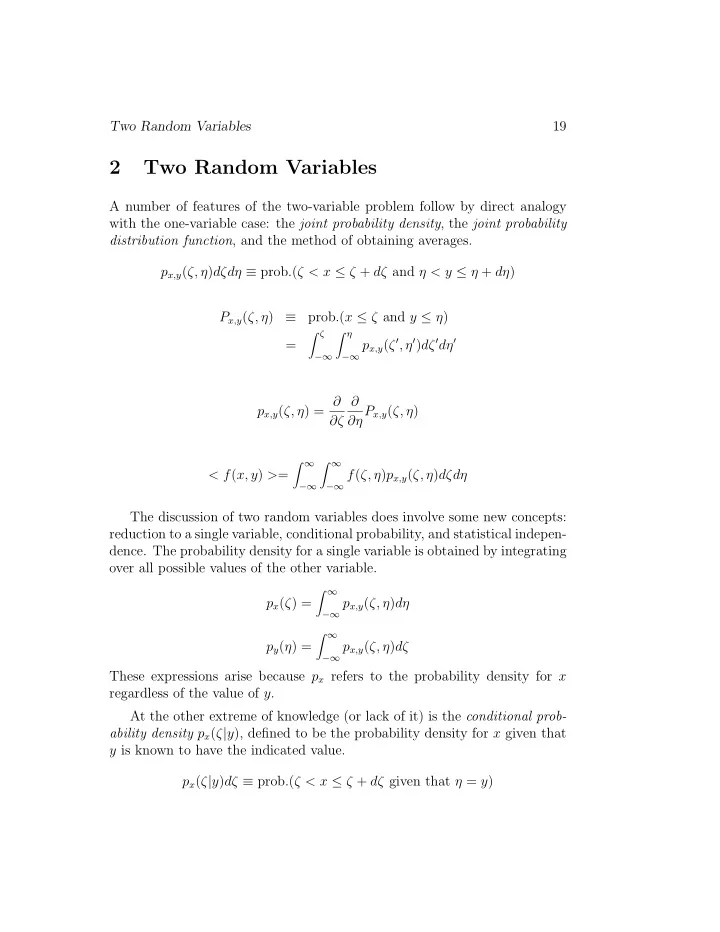
A number of features of the two-variable problem follow by direct analogy with the one-variable case: the joint probability density, the joint probability distribution function, and the method of obtaining averages. px,y(ζ, η)dζdη ≡ prob.(ζ < x ≤ ζ + dζ and η < y ≤ η + dη) Px,y(ζ, η) ≡ prob.(x ≤ ζ and y ≤ η) =
ζ η
px,y(ζ′, η′)dζ′dη′
−∞ −∞
∂ ∂ px,y(ζ, η) = Px,y(ζ, η) ∂ζ ∂η
∞
< f(x, y) >=
- ∞
f(ζ, η)px,y(ζ, η)dζdη
−∞ −∞
The discussion of two random variables does involve some new concepts: reduction to a single variable, conditional probability, and statistical indepen-
- dence. The probability density for a single variable is obtained by integrating
- ver all possible values of the other variable.
px(ζ) =
∞
px,y(ζ, η)dη
−∞
py(η) =
∞
px,y(ζ, η)dζ
−∞