
SLIDE 1
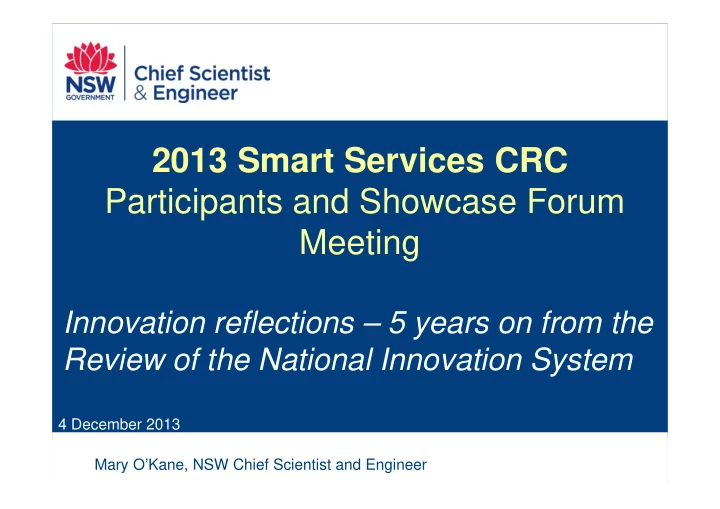
2013 Smart Services CRC Participants and Showcase Forum Meeting
Innovation reflections – 5 years on from the Review of the National Innovation System
4 December 2013 Mary O’Kane, NSW Chief Scientist and Engineer
2013 Smart Services CRC Participants and Showcase Forum Meeting - - PowerPoint PPT Presentation
2013 Smart Services CRC Participants and Showcase Forum Meeting Innovation reflections 5 years on from the Review of the National Innovation System 4 December 2013 Mary OKane, NSW Chief Scientist and Engineer 5 years on from Review of
4 December 2013 Mary O’Kane, NSW Chief Scientist and Engineer
Rationale: We are a wealthy country – 10th highest average income per capita – and yet worrying factors associated with innovation including:
R&D compared to OECD peers
innovation
Australia currently experiencing productivity growth decline Overall growth 1% per annum from 1998/99 to 2003/04 Negative growth -0.6% per annum from 2003/04 to 2010/11 [but note capital issues]
Source: ABS Australian System of National Accounts, 2010-11 (cat.no.5204.0)
75.0 80.0 85.0 90.0 95.0 100.0 105.0 Index Year
Multifactor Productivity
Source: ABS 5260.0.55.002 Experimental Estimates of Industry Multifactor Productivity, Australia: Detailed Productivity
Year GCI Rank (WEF) GII Rank (INSEAD) 2004-5 14 2005-6 10 2006-7 16 2007-8 19 17 (2007) 2008-9 18 22 (2008-9) 2009-10 15 18 (2009-10) 2010-11 16 2011-12 20 21 (2011) 2012-13 20 23 (2012) 2013-14 21 19 (2013)
Facebook)
Unconventional gas in North America & consequential energy security & export Germany drops nuclear & invests massively in renewables Japan has a tsunami Australia has White Papers
Most grow to an eventual size of 20-99
Specific manifestations of entrepreneurial giftedness include (from Shavinina, 2011) Constantly generate ideas on how to make money Love to generate and implement real-life projects with at least a minimal financial reward Love doing real business plans with predicted financial outcomes Work passionately and hard on executing their plans Wish to do ‘real’ things that bring money and try to do whatever possible to cut unnecessary steps
General manifestations of entrepreneurial giftedness include:
perseverance to succeed
early exposure to challenges competitiveness, excellence and perfection neglect of academic subjects & a rule-breaking attitude developing their own creative methods ability to implement ideas having a unique point of view practical intuition
The Australian 14/5/12
Country 2013/14 2012/13 2011/12 2010/11
Switzerland 1 1 1 1 Singapore 2 2 2 3 Sweden 6 4 3 4 Finland 3 3 4 7 USA 5 7 5 4 Germany 4 6 6 5 UK 10 8 10 12 Canada 14 14 12 10 Australia 21 20 20 16 China 29 29 26 27
Global Competitiveness Index (GCI)
Country 2013 2012 2011
Switzerland 1 1 1 Sweden 2 2 2 Singapore 8 3 3 Finland 6 4 5 USA 5 10 7 Canada 11 12 8 Germany 15 15 12 UK 3 5 10 Australia 19 23 21 China 35 34 29
Global Innovation Index (GII)
Country Rank (GCI) Singapore 1 Finland 2 Switzerland 5 Canada 17 Germany 21 Australia 37 Sweden 41 China 48 USA 49 UK 50
Quality of maths and science education
Country Rank (GCI) Switzerland 1 Finland 2 Singapore 3 Canada 10 Germany 14 Sweden 17 Australia 23 USA 25 UK 26 China 54
Quality of education system
Country Rank (GCI) Finland 2 USA 3 Australia 11 Sweden 18 Singapore 20 UK 36 Canada 38 Switzerland 45 China 83 Germany
enrolment rate
Country Rank (GII) Sweden 10 China 20 USA 27 Canada 29 Germany 31 Finland 34 UK 36 Australia 47 Switzerland 56 Singapore 61
Education
assess the quality of maths and science education in your country’s schools?
educational system in your country meet the needs of a competitive economy?
education enrolment rate
student
maths and science
(secondary)
Graduates in Science and Engineering
Country Rank (GII) Finland 9 Germany 19 Sweden 21 UK 35 Switzerland 50 Australia (2009) 65 USA 77 Canada
University/industry research collaboration (GII) University-industry collaboration in R&D (GCI)
Country Rank (GII) Switzerland 1 UK 2 USA 3 Finland 4 Singapore 5 Sweden 7 Germany 11 Australia 12 Canada 14 China 33 Country Rank (GCI) Switzerland 1 Finland 2 USA 2 Singapore 4 UK 5 Germany 9 Sweden 10 Australia 15 Canada 18 China 33
do companies obtain technology? by conducting formal research and pioneering their own from products – or from licensing and imitation
patents
through Patent Cooperation Treaty
applications filed at the national office
articles
worker
1000 population
spending
fees
communication service exports
investment net
Country Rank (GCI) Switzerland 1 Finland 2 Germany 3 USA 5 Sweden 7 UK 8 Singapore 18 Australia 23 Canada 27 China 30
Capacity for Innovation Knowledge Creation Knowledge Impact Knowledge diffusion
Country Rank (GII) Switzerland 1 Sweden 2 China 3 Germany 6 USA 7 UK 8 Finland 10 Canada 16 Australia 28 Singapore 30 Country Rank (GII) China 2 Singapore 6 Switzerland 10 USA 11 UK 12 Sweden 23 Germany 24 Canada 25 Finland 32 Australia 66 Country Rank (GII) Switzerland 5 Finland 6 Sweden 9 Singapore 14 USA 15 UK 18 Germany 20 China 21 Canada 24 Australia 63
Country Basic Requirements Efficiency Enhancers Innovation and sophistication factors Switzerland 3 5 1 Singapore 1 2 13 Sweden 8 7 5 Finland 7 9 2 USA 36 1 6 Germany 9 8 4 UK 24 4 10 Canada 15 6 25 Australia 17 13 26 China 31 31 34 Country Input Output Singapore 1 18 USA 3 12 UK 4 4 Sweden 5 3 Finland 6 8 Switzerland 7 1 Canada 9 13 Australia 11 32 Germany 20 10 China 46 25
Global Competitiveness Index (GCI) Global Innovation Index (GII)
Country Input Output
Switzerland 7 1 Sweden 5 3 Singapore 1 18 Finland 6 8 USA 3 12 Canada 9 13 Germany 20 10 UK 4 4 Australia 11 32 China 46 25
Global Innovation Index (GII)
Australia is fairly strong on innovation inputs …and weak on leveraging that into innovation
It’s easy to suggest things but hard to get traction & results. But we could …
values
regulations, …
energy, minerals, big coastline, new infrastructure …