2015 Inpatient Prospective Payment Services (IPPS) and Insights on - - PDF document

2015 inpatient prospective payment services ipps and
SMART_READER_LITE
LIVE PREVIEW

2015 Inpatient Prospective Payment Services (IPPS) and Insights on - - PDF document

2015 Inpatient Prospective Payment Services (IPPS) and Insights on Best Practices Marc Tucker,DO,FACOS,MBA Senior Medical Director Executive Health Resources Agenda 2014/2015 IPPS Final Rule 2015 proposed OPPS Transmittal


slide-1
SLIDE 1

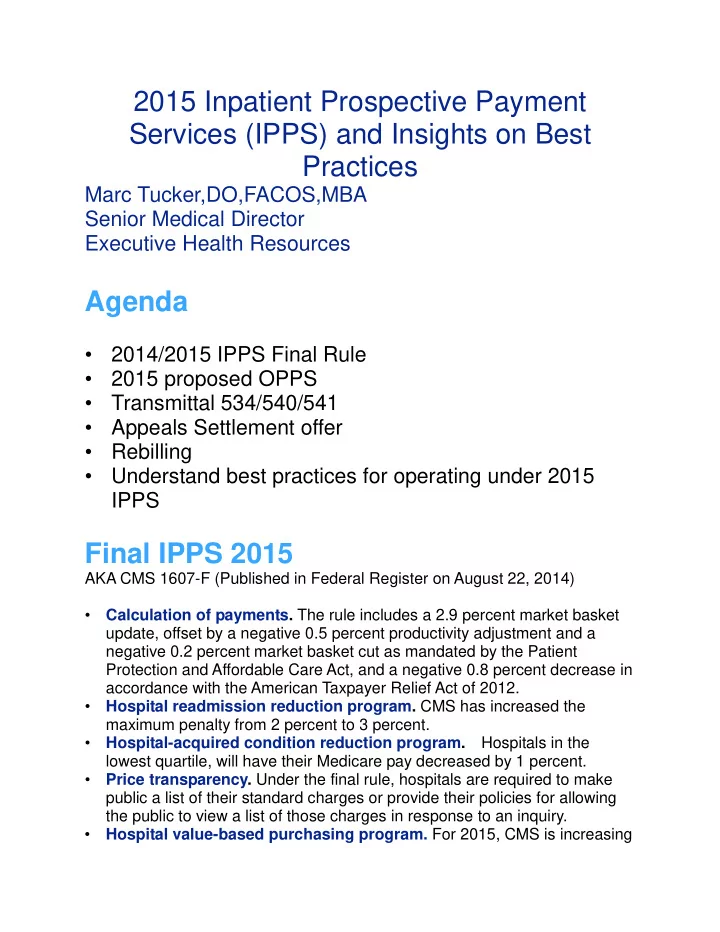
2015 Inpatient Prospective Payment Services (IPPS) and Insights on Best Practices

Marc Tucker,DO,FACOS,MBA Senior Medical Director Executive Health Resources

Agenda

  • 2014/2015 IPPS Final Rule
  • 2015 proposed OPPS
  • Transmittal 534/540/541
  • Appeals Settlement offer
  • Rebilling
  • Understand best practices for operating under 2015

IPPS

Final IPPS 2015

AKA CMS 1607-F (Published in Federal Register on August 22, 2014)

  • Calculation of payments. The rule includes a 2.9 percent market basket

update, offset by a negative 0.5 percent productivity adjustment and a negative 0.2 percent market basket cut as mandated by the Patient Protection and Affordable Care Act, and a negative 0.8 percent decrease in accordance with the American Taxpayer Relief Act of 2012.

  • Hospital readmission reduction program. CMS has increased the

maximum penalty from 2 percent to 3 percent.

  • Hospital-acquired condition reduction program. Hospitals in the

lowest quartile, will have their Medicare pay decreased by 1 percent.

  • Price transparency. Under the final rule, hospitals are required to make

public a list of their standard charges or provide their policies for allowing the public to view a list of those charges in response to an inquiry.

  • Hospital value-based purchasing program. For 2015, CMS is increasing
slide-2
SLIDE 2

the applicable percent reduction, the portion of Medicare payments available to fund the value-based incentive payments under the program, to 1.5 percent of Medicare reimbursements, resulting in about $1.4 billion in value-based incentives.

  • Medicare disproportionate share hospitals payments. As part of the

PPACA, Medicare DSH payments will be reduced 75 percent by 2019, or $49.9 billion. The final rule cuts overall Medicare DSH payments by 1.3 percent in fiscal year 2015, compared with fiscal year 2014.

Final IPPS 2015

Two Midnight rule remains intact Little to no changes Pages 50146 – 50148 pertain to the 2 midnight rule Several comments regarding defining short or low cost inpatient hospital stays No additional clinical exceptions added. However, still taking feedback: email to: SuggestedExceptions@cms.hhs.gov Although the FY 2015 IPPS/LTCH PPS proposed rule did not include any proposed regulatory changes relating to the 2-midnight benchmark, we nonetheless received a number of public comments regarding the current regulation. CAH: finalize a policy that a CAH is required to complete all physician certification requirements no later than 1 day before the date on which the claim for the inpatient service is submitted (pg. 50165)

2015 OPPS

CMS 1613-P

slide-3
SLIDE 3

The 2015 Outpatient Prospective Payment System (OPPS) Final Rule was released on November 10, 2014 Comments found on www.regulations.gov Highlights include:

  • Refinements to Comprehensive APC Policy
  • Significant Packaging of Ancillary Services
  • Changes to Inpatient Certification Requirements

The Final Rule and Elements of Certification

Documentation is Key:

  • There is an expectation that the elements of

certification (i.e. the reason for hospitalization, the estimated time the patient will need to remain in the hospital, and the plan of post-hospital care), generally can be satisfied by elements routinely found in a patient’s medical record, such as progress notes (CMS-1613-P at 41057).

  • “[I]n most cases, the admission order, medical record,

and progress notes will contain sufficient information to support the medical necessity of an inpatient admission without a separate requirement of an additional, formal, physician certification” (CMS-1613-P at 41057).

  • “[W]e believe that evidence of additional review and

documentation by a treating physician beyond the admission order is necessary to substantiate the

slide-4
SLIDE 4

continued medical necessity of long or costly inpatient stays” (CMS-1613-P at 41057).

Changes to Physician Certification Requirements

  • A separately signed Physician Certification statement

would no longer be required to be submitted with each and every Inpatient Hospital claim. – Only required for long-stay (20 days or more) and

  • utlier cases
  • The Inpatient Admission Order will continue to be

required as a condition of payment, but is no longer considered an element of certification.

Changes to Physician Certification Requirements

REMINDER, the 2015 OPPS Proposed Rules if finalized as written, would not take effect, until the implementation date of January 1, 2015. Until that time, providers should continue to adhere to current guidelines and regulations pertaining to the Two-Midnight Rule and Physician Certification Requirements

“Doc Fix” – HR 4302 Extension of the Probe & Educate

slide-5
SLIDE 5

CMS has extended the Inpatient Hospital Prepayment Review “Probe & Educate” review process through March 2015. This means that:

  • Medicare Administrative Contractors (MACs) will

continue to select claims for review and deny claims found not in compliance with CMS-1599-F (commonly known as the “2-Midnight Rule”).

  • MACs will continue to hold educational sessions with

hospitals as described below in “Selecting Hospitals for Review” through March, 2015.

  • Generally, Recovery Auditors will not conduct

post-payment patient status reviews of inpatient hospital claims with dates of admission on or after October 1, 2013 through March 2015.

Probe & Educate Process Probe & Educate Status Update

As of February 7, 2014: As of February 24, 2014:

  • CMS is requesting that the Medicare Administrative

Contractors (MACs) re-review all claim denials under the Probe & Educate process to ensure the claim decision and subsequent

slide-6
SLIDE 6

education is consistent with the most recent clarifications.

Examples

  • Example 3 - Short stays for medical conditions: The

beneficiary presented to the ED with recent onset of dizziness and denied any additional complaints. The beneficiary reported a recent adjustment to his blood pressure medication. The physician’s notes stated that the beneficiary was stable and that his blood pressure medication was to be held and dosage adjusted. The notes also indicated that the physician intended to

  • bserve the beneficiary overnight. The beneficiary was

discharged the next day. The hospital submitted a claim for a 1-day inpatient stay. Upon review of the claim, the MAC denied Medicare Part A payment because the medical record failed to support an expectation of a 2-midnight stay.

Examples

  • Example 4 - Physician attestation statements

without supporting medical record documentation: The physician’s order contained a checkbox with

slide-7
SLIDE 7

pre-printed text stating “The beneficiary is expected to require 2 or more midnights of hospital care.” The physician’s plan of care, however, stated that the beneficiary was to have diagnostics performed post-operatively, with a plan to discharge in the morning if stable. The beneficiary was discharged the following day as planned, after a 1-midnight stay. Upon review of the claim, the MAC denied Medicare Part A payment because the medical record failed to support an expectation of a 2-midnight stay when the order was written.

  • CMS reminds providers that attestation statements

indicating the beneficiary’s hospital stay is “expected to span 2 or more midnights” are not required under the inpatient admissions policy, nor are they adequate by themselves to support the expectation of a 2-midnight stay. Rather, the expectation must be supported by the entirety of the medical record.

Transmittal 541, CR 8802

  • Earlier versions of Transmittal 541 have previously

been introduced as Transmittals 505, 534 and 540; however those versions were rescinded.

  • Issued on September 12, 2014, but Implemented and

Effective on September 8, 2014 (date of service)

  • Provided the MAC, Recovery Auditor, and ZPIC the

discretion to deny other related claims submitted before or after the claim in question.

  • The Recovery Auditors will be allowed to also auto
slide-8
SLIDE 8

deny if approved by the New Issues Review Board.

  • CHANGE FROM Transmittal 534 - Allowed as one

approved example: now only a surgeon’s claim could be automatically denied, but NOT recoded to an appropriate outpatient evaluation and management service following the denial of a hospital’s inpatient admission.

  • CHANGE FROM Transmittal 540 – Paragraph in

Policy section was changed to be consistent with paragraph in Manual, with respect to the surgeon’s claim as outlined above.

Source: http://www.cms.gov/Regulations-and-Guidance/Guidance/Transmittals/2014-Transmittal s-Items/R541PI.html

The CMS Administrative Agreement Appeals Backlog

  • The average processing time for appeals decided in

fiscal year 2014 is 398.1 days.

  • For comparison, the average processing time for a

case in 2009 was 94.9 days.

  • There are currently 480,000 appeals awaiting

assignment to an ALJ

  • In early 2014, OMHA received 15,000 appeal requests

per week, up from 1250 appeals per week 2 years ago.

  • OMHA received a total of 320,000 claims in FY 2012,

and over 600,000 claims in FY 2013.

  • OMHA is currently anticipating the backlog to grow to

1,000,000 appeals by end of FY 2014.

  • OMHA projects that its FY 2015 caseload will increase
slide-9
SLIDE 9

to approximately 850,000 total claims.

Processing Backlogs

  • 15 weeks from receipt to open mail (though mail is

stamped received as of the date it was physically received, not the date it is opened)

  • 20-24 weeks from the date mail is received until it is

entered into OMHA’s database (this is the point at which the case becomes searchable in response to inquiries)

  • Up to 28 months from receipt until case is assigned to

a judge

  • 6 months for a hearing date after a case is assigned to

a judge

Source: http://www.hhs.gov/omha/important_notice_regarding_adjudication_timeframes.html

OMHA Statistical Sampling

In July, 2014, OMHA announced pilot programs to address the high-volume backlog at the Administrative Law Judge level of appeal.

slide-10
SLIDE 10

What is OMHA Statistical Sampling?:

  • A statistical expert develops

an appropriate sampling methodology in accordance with Medicare guidelines

  • Sample units are then

randomly selected from a universe of claims based on that methodology

  • An Administrative Law Judge

then reviews the sample units and makes findings and a decision on those sample

slide-11
SLIDE 11

units in a single appeal

  • The results of the sample are

then extrapolated to the entire universe

Source: http://www.hhs.gov/omha/statistical_samplin g_initiative.html (last visited September 10, 2014)

OMHA Statistical Sampling

To be eligible for OMHA statistical sampling:

  • A request for hearing must appeal a Medicare Qualified

Independent Contractor (QIC) reconsideration decision.

  • The appellant must be a single Medicare provider or

supplier.

  • All jurisdictional requirements for a hearing before an

Administrative Law Judge must be met for the request

slide-12
SLIDE 12

for hearing and all appealed claims.

  • The claims must be currently assigned to one or more

Administrative Law Judges or have been filed during the time period currently being assigned by OMHA Central Operations – at this time, that includes appeals that were filed between April 1, 2013, and June 30, 2013. To be eligible for OMHA statistical sampling:

  • No hearing on the claim has been scheduled or

conducted

  • There must be a minimum of 250 claims and all claims

must fall into only one of the following categories: – Pre-payment claim denials; – Post-payment (overpayment) non-Recovery Audit Contractor (RAC) claim denials; or – Post-payment (overpayment) RAC claim denials from one RAC.

Source: http://www.hhs.gov/omha/statistical_sampling_initiative.html (last visited September 10, 2014)

Administrative Agreement

  • CMS is offering an Administrative Agreement

(Settlement) to: – Any acute care hospital

  • Those paid via Prospective Payment System

(PPS), Periodic Interim Payments (PIP), and

slide-13
SLIDE 13

Maryland waiver – Critical access hospital (CAH) – Willing to resolve their pending appeals (or waive their right to request an appeal) – In exchange for timely partial payment (68% of the net payable amount).

Source: http://www.cms.gov/Research-Statistics-Data-and-Systems/Monitoring-Programs/Medic are-FFS-Compliance-Programs/Medical-Review/InpatientHospitalReviews.html

Eligible Claims

Claims meeting all of the criteria are eligible and ALL eligible claims must be included in the request for Administrative Agreement. Cannot Pick & Choose Claims Eligible claims must be included in a spreadsheet that the hospital is required to complete and submitted along with the Administrative Agreement request.

Eligible Claims (con’t)

  • The claim was denied by any entity that
slide-14
SLIDE 14

conducted a review on behalf of CMS;

  • The claim was not for items or services furnished

to a Medicare Part C enrollee;

  • The claim was denied based upon a Patient

Status Determination - The claim was denied based on an inappropriate setting determination, that is, on the basis that the service might have been reasonable and necessary, but treatment on an inpatient basis was not;

  • The first day of the admission was before

October 1, 2013;

Eligible Claims (con’t)

  • The Hospital timely appealed the denial;
  • As of the date of an executed Agreement

submitted to CMS by the Hospital: – The appeal decision was still pending at the MAC, QIC, ALJ, or DAB levels of review, or – The Hospital had not yet exhausted its appeal rights at the MAC, QIC, ALJ, or DAB level; and

  • The Hospital did not receive payment for the

service as a Part B claim (re-bill).

slide-15
SLIDE 15

Source: http://www.cms.gov/Research-Statistics-Data-and-Systems/Monitoring-Programs/Me dicare-FFS-Compliance-Programs/Medical-Review/InpatientHospitalReviews.html

Payment by CMS

CMS agrees to pay the Hospital sixty-eight (68) percent (‘the percentage”) of the net paid amount of each denied inpatient claim.

  • “Net paid amount” means the payment
  • n the original inpatient claim net paid

amount;

– Net Paid amount excludes the

  • ut-of-pocket obligations that are

included in the “gross” or “allowable” amounts.

  • This payment will be made in one

payment per hospital provider number,

  • r per owner or operator of multiple

settling hospitals.

  • CMS will refund to the Hospital all
slide-16
SLIDE 16

interest on any claim included in any appeal covered by the Agreement that CMS has collected from the Hospital as

  • f the effective date of the Agreement

– If CMS fails to make payment within the allotted sixty (60) days, CMS will pay interest to the Hospital for the period beginning on day sixty-one (61) through the date of payment. – The interest rate shall be the Current Value of Funds Rate (“CVFR”) as promulgated by the United States Department of the Treasury.

Source: http://www.cms.gov/Research-Statistics-Data-and-Systems/Monit

  • ring-Programs/Medicare-FFS-Compliance-Programs/Medical-R

eview/Downloads/External-FAQs8-cleared-909-v2_508.pdf

Miscellaneous Provisions

  • If the Hospital has not

fully repaid the originally denied amount on a claim included in an appeal

slide-17
SLIDE 17

listed on the spreadsheet

  • f eligible claims, the

Hospital will receive for that claim payment the percentage value applied less the outstanding

  • verpayment balance.
  • If the Hospital has not yet

repaid any of the

  • riginally denied amounts
  • n a claim included in an

appeal, or where the amount retained by the

slide-18
SLIDE 18

Hospital exceeds sixty-eight (68) percent of the net paid amount, the Hospital will owe CMS a refund for that claim. – CMS will calculate the refund amount as the difference between the retained amount and sixty-eight (68) percent

  • f the net paid amount.

– Any refund owed CMS

slide-19
SLIDE 19

will be subtracted from the total payment due under this Agreement

  • r from future

Medicare payments to the Hospital.

Source: http://www.cms.gov/Research-Statistics-D ata-and-Systems/Monitoring-Programs/M edicare-FFS-Compliance-Programs/Medi cal-Review/Downloads/AdminstrativeAgre ement.pdf

Miscellaneous Provisions

  • The Hospital agrees it will not commence any further
slide-20
SLIDE 20

appeals or actions of any kind challenging the Medicare contractor’s determination(s) regarding the claims included in the appeals – The Hospital will not attempt to rebill any of those services under Part B.

  • CMS retains the right to recoup any duplicate or

incorrect payments made for claims that were, but should not have been, included under this Agreement – Payments that may have been made in the appeals process or secondary to Part B billing inadvertently included among the payment made under this Agreement.

  • The Agreement does not include a release of liability of

any claims the United States may have under the False Claims Act, (31 U.S.C. section 3729 et seq.), the Civil Monetary Penalties Law, (42 U.S.C. section 1320a-7a),

  • r the common law theories of payment by mistake,

unjust enrichment, or fraud.

Source:http://www.cms.gov/Research-Statistics-Data-and-Systems/Monitoring-Program s/Medicare-FFS-Compliance-Programs/MedicalReview/Downloads/AdminstrativeAgree ment.pdf

CMS Settlement Process

Basic Settlement Process:

  • Decision must be made and process started Oct 31,

2014

  • Provider submits eligible claims spreadsheet
  • CMS reviews and provides feedback allowing provider

time to abandon/proceed with settlement

  • Medicare signs initial Administrative Agreement and
slide-21
SLIDE 21

pays provider for those claims agreed upon

  • A repeat of the process occurs with respect to any

discrepancies concerning the eligibility of claims

  • CMS employs a final reconciliation process and makes

additional adjustments as warranted

  • Continue to check the CMS website for updates…

Patient Deductible Responsibilities

The providers refund responsibility is as follows:

  • If the Beneficiary co-insurance has been collected at

the time the INITIAL administrative agreement is signed by the provider, no refund is required.

  • If the Beneficiary co-insurance has not been collected

at the time the INITIAL Administrative Agreement is signed by the provider, the provider must cease collections.

  • If a Beneficiary repayment plan has been executed at

the time the INITIAL Administrative Agreement is signed by the provider, the provider may continue to collect the co-insurance in accordance with the repayment plan.

slide-22
SLIDE 22

Source: http://www.cms.gov/Research-Statistics-Data-and-Systems/Monitoring-Programs/Medic are-FFS-Compliance-Programs/Medical-Review/Downloads/External-FAQs8-cleared-90 9-v2_508.pdf

Key Considerations

Every Hospital Should be Asking These Questions…

  • Is my hospital an eligible facility?
  • How do I determine which claims are eligible?
  • How many eligible claims do I have?
  • What is the total value of the eligible claims?
  • What is the value of those claims if I rebill under Part

B?

  • What is the administrative burden to engage in the

settlement?

  • How long have my appeals been in the appeals

process?

  • What has been my appeals success rate?

Key Considerations

Every Hospital Should be Asking These Questions…

  • What is my hospital’s financial situation with respect to

the settlement?

  • How much reserve did we assign to denied claims (i.e.,
slide-23
SLIDE 23

was it more or less than 68%)?

  • What is the impact of denied days on the calculation of

GME, IME, and DSH payments?

  • What percent, if any, of the patient deductible has been

paid?

Finally

  • No right answer for every hospital
  • Every hospital should evaluate the offer
  • Expect some facilities will accept the offer and others

will reject the offer

Rebilling

  • If a case has a physician inpatient order, yet fails

“expectation 2 midnight stay” or medical necessity: – If patient is still in the hospital, hospital may use Condition Code 44 to reclassify patient as in the past – If patient has been discharged, hospital may use Self Audit/Rebilling if within timely filing requirements

  • Rebilling:

– Submit provider-liable Part A claim – Summit an inpatient claim for payment under Part B and outpatient claim for Part B appropriate services – Status does not change – remains IP

slide-24
SLIDE 24

– Beneficiary responsible for Part B copayments

Rebilling Evolution Does Rebilling Make Cents?

  • Where are you most likely to miss revenue in the UR

process?

  • Without concurrent reviews hospitals risk losing

dollars on observation/outpatient cases!

  • Consider:
  • INPT DRG

– > CC44 with 8 hours obs (APC)

  • > CC 44 with less than 8 hours of obs (No

APC) – > Post discharge rebill 12x » > Claimed denied after 1 year

Best Practices to Comply With Current IPPS Conditions of Participations Have Not Changed

Conditions of Participations (CoPs) must be followed

  • “We did not propose and are not finalizing a policy that

would allow hospitals to bill Part B following an inpatient reasonable and necessary self-audit determination that does not conform to the requirements for utilization review under the CoPs.”

slide-25
SLIDE 25

– Page 50913, 2014 IPPS

  • 482.30 (c)(1) The UR plan must provide for review for

Medicare and Medicaid patients with respect to the medical necessity of: – Admissions to the institution – Duration of stays – Professional services furnished, including drugs and biologicals

Concurrent UM Still Matters

  • “Use of Condition Code 44 or Part B inpatient billing

pursuant to hospital self-audit is not intended to serve as a substitute for adequate staffing of utilization management personnel or for continued education of physicians and hospital staff about each hospital’s existing policies and admission protocols.”

– Page 50914, 2014 IPPS

Components Required for an IP Claim

  • Expectation/completion of a 2-midnight stay

⁻ UR review must ensure expectation of 2 midnights is “reasonable”

  • Medical Necessity

⁻ UR review must establish hospital level of care is needed to care for the patient

  • Physician certification/documentation signed by the

physician prior to DC ⁻ Order, reason for inpatient services, expectation

slide-26
SLIDE 26

and plan for post-hospital care

What is Medical Necessity?

  • Is the physician's expectation of 2 midnights

reasonable? – Achieved with criteria? PA evidence based determination? Other?

  • Is hospital level of care needed to care for the patient?

– Ensure no care for convenience, no delays in treatment/testing or custodial

Admission Review – Key Considerations

Initial review for expectation of Length of Stay (LOS)

  • Physician documentation of an expectation of

2-midnight stay generally falls into three categories: – Supports expectation of 2-midnight stay

  • “I expect this patient to remain in the hospital for

longer than…”

  • Expected LOS > 2 midnights (in document

signed by physician) – No documentation/conflicting documentation – Clearly conflicts with or fails to support expectation of 2-midnight stay

  • Order – “Discharge in am” (when care has not

already crossed at least one midnight)

  • Progress note – “anticipate d/c in am” (when care
slide-27
SLIDE 27

has not already crossed at least one midnight)

Recommended Hospital Work Flow Recommended Hospital Work Flow Considerations Regarding the Time of UR Review

  • Review at admission:

– IP

  • 2+ midnight expectation AND medical necessity

established AND physician certification complete – Observation/Outpatient

  • Expectation of <2 midnight stay and medical

necessity established – NOTA

  • Review for documentation of care for convenience, a

delay in treatment/testing or custodial care

  • Review after 1+ midnight:

– IP

  • 2+ midnights completed or expected AND medical

necessity established AND physician certification complete – Observation status should be rare after 2 midnights – NOTA

  • Review for documentation of care for convenience, a

delay in treatment/testing or custodial care

Summary

  • “Get It Right” while the patient is in the hospital and as
slide-28
SLIDE 28

early in the stay as possible

  • Implications for hospital, patient and physician
  • Admission review – key considerations:
  • Order
  • Expectation
  • Medical Necessity
  • Documentation and Certification
  • Rebill when appropriate
  • While the time requirement has evolved, the science at

the core of medical necessity remains the same

Marc Tucker,DO,FACOS,MBA Senior Medical Director mtucker@ehrdocs.com 610-446-6100

2 Midnight Example 1