2016 ICEH Alumni Workshop - Presentation Summary Summary of alumni - - PowerPoint PPT Presentation

2016 iceh alumni workshop presentation summary
SMART_READER_LITE
LIVE PREVIEW

2016 ICEH Alumni Workshop - Presentation Summary Summary of alumni - - PowerPoint PPT Presentation

2016 ICEH Alumni Workshop - Presentation Summary Summary of alumni Goals for the next 2-3 Name Challenges Positive outcomes presentation years Desiree Murray Caribbean has highest prevalence of Translating research Influencing the


slide-1
SLIDE 1

2016 ICEH Alumni Workshop - Presentation Summary

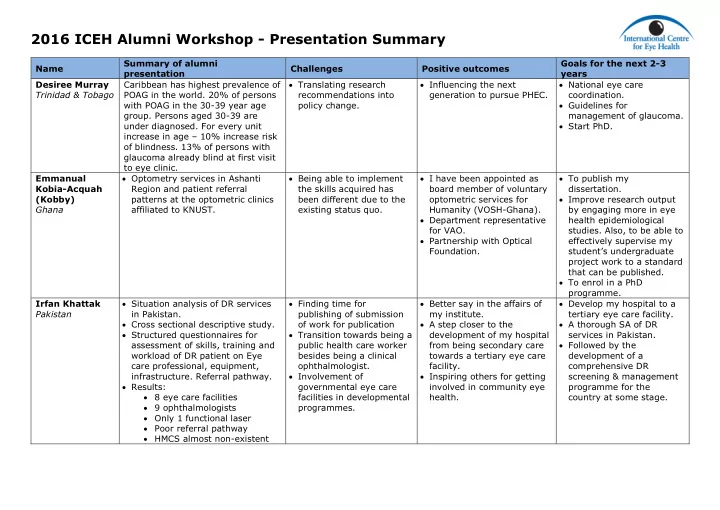
Name Summary of alumni presentation Challenges Positive outcomes Goals for the next 2-3 years Desiree Murray Trinidad & Tobago Caribbean has highest prevalence of POAG in the world. 20% of persons with POAG in the 30-39 year age

  • group. Persons aged 30-39 are

under diagnosed. For every unit increase in age – 10% increase risk

  • f blindness. 13% of persons with

glaucoma already blind at first visit to eye clinic.  Translating research recommendations into policy change.  Influencing the next generation to pursue PHEC.  National eye care coordination.  Guidelines for management of glaucoma.  Start PhD. Emmanual Kobia-Acquah (Kobby) Ghana  Optometry services in Ashanti Region and patient referral patterns at the optometric clinics affiliated to KNUST.  Being able to implement the skills acquired has been different due to the existing status quo.  I have been appointed as board member of voluntary

  • ptometric services for

Humanity (VOSH-Ghana).  Department representative for VAO.  Partnership with Optical Foundation.  To publish my dissertation.  Improve research output by engaging more in eye health epidemiological

  • studies. Also, to be able to

effectively supervise my student’s undergraduate project work to a standard that can be published.  To enrol in a PhD programme. Irfan Khattak Pakistan  Situation analysis of DR services in Pakistan.  Cross sectional descriptive study.  Structured questionnaires for assessment of skills, training and workload of DR patient on Eye care professional, equipment,

  • infrastructure. Referral pathway.

 Results:  8 eye care facilities  9 ophthalmologists  Only 1 functional laser  Poor referral pathway  HMCS almost non-existent  Finding time for publishing of submission

  • f work for publication

 Transition towards being a public health care worker besides being a clinical

  • phthalmologist.

 Involvement of governmental eye care facilities in developmental programmes.  Better say in the affairs of my institute.  A step closer to the development of my hospital from being secondary care towards a tertiary eye care facility.  Inspiring others for getting involved in community eye health.  Develop my hospital to a tertiary eye care facility.  A thorough SA of DR services in Pakistan.  Followed by the development of a comprehensive DR screening & management programme for the country at some stage.

slide-2
SLIDE 2

2016 ICEH Alumni Workshop - Presentation Summary

Selben Penzin Nigeria  The learning process at LSHTM, epidemiology, biostatistics and computer skills.  Rationale and aims of my dissertations.  Results from my dissertation  Recommendations for a positive change.  Writing up summaries with poor internet connection.  Working with an already established institution with set regulations – being able to sell new ideas.  Transitioning from paperwork / classroom to actual implementation of lessons learned.  Being able to teach resident doctors on academic writing especially the aspects of correct referencing and plagiarism.  Being able to put together a proposal for cost- containment measures in my hospital.  Enrol in a PhD or Drph programme.  Become a full-time lecturer and researchers.  Establish a pathway of collaboration with traditional eye practitioners.  Strengthen eye care services – encourage surgeons to improve on surgical outcomes and boost the confidence of the communities in hospital care. Dorothy Mutie Kenya  Life before PHEC – clinician, surgeon, trainer.  Life during PHEC & lessons learnt – networking, critiquing research, exposure to eye programmes  Life after PHEC – transition into teaching middle level eye health workers.  Acknowledgement of support – financial, institutional, social, academic, divine.  Disappointment with my marks: qualitative portion not well done.  Apathy in getting round to summarising my dissertation in preparation for publication.  Opportunity to use learning and teaching methods in my training job.  Drafted into the committee spearheading the eye health systems assessment for Kenya.  Involved in partnership talks at my new place of work.  Published article in CEHJournal.  Enhanced e-learning among my students.  Publish my dissertation and findings of EHSA Kenya, present at COECSA, OSK (Ophthalmological Society

  • f Kenya).

Islam Elbieh Egypt  Presenting my dissertation’s methodology and results: “Evaluation of performance of cataract services in Egypt”  Presenting my experience in LSHTM.  Presenting the impact of my degree and dissertation.  Restoring my life & job.  Commencing policy makers with my progress findings.  Raise the awareness of public health and research value in national eye centre (NEC)  MoH changes its priority list concerning outreach, HR, equipment.  Establishing protocol of cooperation between “NEC” and university for supporting research.  Starting department of community ophthalmology in NEC.  Publish my dissertation.  Career shift towards public health.  Achieving VISION 2020 and GAP in my country.

slide-3
SLIDE 3

2016 ICEH Alumni Workshop - Presentation Summary

Jacquelyn O’Banion USA Validation of screening parameters for URE in children in Swaziland.  Balancing clinical & public health work.  Being overwhelmed by the number of breadth of projects with ICEH support.  Implementation of my findings by the partner NGO.  Establishment of global

  • phthalmology fellowship

with a strong focus on public health.  Carry out & publish a quality research project.  Develop an impactful DR screening programme for Georgia. Nnenne Onu Nigeria  There is a great need for policies that will encourage redistribution

  • f optometrists and refraction to

rural areas in Nigeria. This will reduce the rate of migration across borders. By engaging with policy makers and the government, this can be achieved. The quality of training provided to

  • ptometrists need to improve on

the practical based aspect too.  Having the right approach to making decisions.  Difficulties with getting partnerships & funding.  Writing up publication and getting funding for it.  Getting funding for 10GA conference.  Different perspective to work and improve teaching method.  Effective advocacy for eye health.  Gained more confidence and skills which I am using positively.  Better engagement with senior colleagues (though it’s still a work in progress).  Help improve the quality

  • f graduates passing

through my institution.  Forming meaningful partnerships and links with organisations on eye health.  Presenting my work at a conference and getting it published.  Liaising with stakeholders

  • n placements for

students.  Effectively starting up externships/placements

  • utside while training

students.