
SLIDE 1
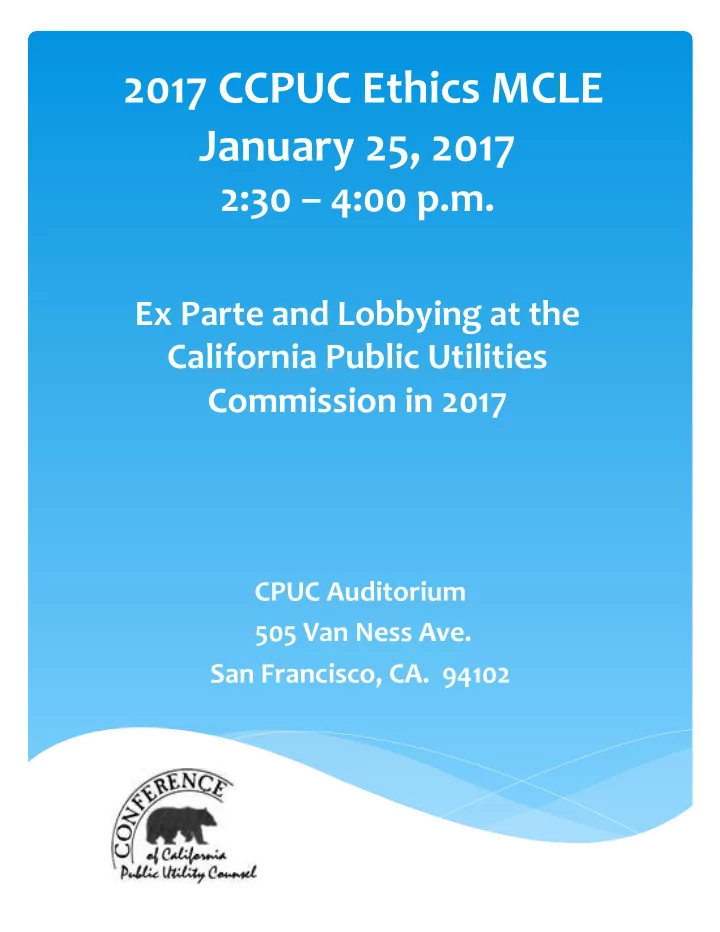
2017 CCPUC Ethics MCLE January 25, 2017 2:30 4:00 p.m. Ex Parte and - - PDF document
2017 CCPUC Ethics MCLE January 25, 2017 2:30 4:00 p.m. Ex Parte and Lobbying at the California Public Utilities Commission in 2017 CPUC Auditorium 505 Van Ness Ave. San Francisco, CA. 94102 Seminar Purpose This special seminar will
This special seminar will examine the changing perspectives on Ex Parte Communications and Lobbying the Commission by providing an overview of the new and existing law, rules and governing ex parte communications and lobbying at the Commission.
Program Schedule Opening Remarks Warm Up & Introductions SB 215 Genesis & Overview Lobbying Rules and the CPUC SB 215 and the New CPUC Ex Parte Rules (plus Q&A) Final Remarks
2:30-2:40 2:40-2:45 2:45-3:00 3:00-3:15 3:15-3:55 3:55-4:00
30min. 10 min.
Michael B. Day joined the Goodin MacBride firm in January 1998, from the firm of Wright & Talisman, whose San Francisco office he had opened in 1991. Mr. Day represents a wide variety of clients before the Commission in electric transmission, natural gas, telecommunications, rail safety, and water matters. From 1980-91, he held several positions in the Legal Division at the CPUC, including lead counsel in natural gas matters before the Federal Energy Regulatory Commission; Deputy General Counsel supervising all appellate and advisory matters before the commission; and Acting General Counsel to the CPUC. Prior to joining the Legal Division he was a trial attorney with Thornton, Taylor & Downs in San Francisco, specializing in property insurance litigation.
from the University of California, Hastings College of the Law in
Court and the District of Columbia and Fifth Circuits of the U.S. Court of Appeals
Tom rejoined TURN in 2010 after previously serving as TURN’s Senior Telecommunications Attorney from 1990 through 1999. Since returning to TURN, Tom has been TURN’s lead representative in many energy and safety-related proceedings at the Commission, including the enforcement cases against PG&E following the San Bruno gas pipeline explosion. In between his former and current stints at TURN, Tom served as the Legal and Telecommunications Advisor to CPUC Commissioner Loretta Lynch and as a Deputy City Attorney for the City and County of San Francisco. Prior to joining TURN in 1990, Tom was a Litigation Associate for the law firm of Morrison and Foerster in San Francisco and a law clerk for a federal district court judge in San Diego. As a 1998-99 Atlantic Fellow in Public Policy at the University of Glasgow School of Law, Tom researched telecommunications competition in the United Kingdom. He has also taught English in Shanghai, China. Tom has a law degree with Honors from NYU School of Law and an undergraduate degree with High Honors from Swarthmore College.
Sempra’s 13,000 domestic employees, including the company’s two California utilities – SDG&E and Southern California Gas Co. As part of Sempra Energy’s compliance program, Ms. Mains leads training and education, conducting regular sessions that cover topics such as lobbying for federal, state, and local jurisdictions; gifts; fundraising; campaign finance; and conflict of interest laws for hundreds of jurisdictions in 16 states. Mains’ 23 years of professional experience include corporate and project finance, real estate development and political law. She has worked in a variety of roles promoting financial, environmental, and political compliance and integrity. She received her BA in International Business from San Diego State University and her MBA from the University of San Diego and resides in San Diego with her husband and two daughters.
Jerry Brown was a relatively new Governor when I started working at the Commission in 1976. I worked in the Legal Division for about 15 years involved in virtually every subject area, primarily large/ complex energy projects, although I did handle the Commissions’ last commercial aviation matter (yes, we used to have them). While I worked in several units, I was among the group representing the predecessor organization of the Office of Ratepayer Advocates, originally called the Public Staff Division. Around 1991 I was appointed Assistant Chief of the Administrative Law Judge Division, initially handling all telecommunications matters and then adding energy ratemaking and other matters as needed. I retired in 2009 and have been brought back periodically to fill in, such assignments including the liaison between Legal Division and the Commission’s Office of Government Affairs, interim Chief of Staff to Commissioner Catherine Sandoval, reprisal of my role as Assistant Chief ALJ, ORA Counsel assisting on the Comcast/Time Warner merger proceeding and, for some time now, partnering with Mary McKenzie as acting Chief Counsel of ORA.
Zeb enjoys solving complex legal and regulatory problems in innovation sectors. Zeb currently work as a telecommunications attorney, representing wireless, CLEC, VoIP, and internet service providers in state utility regulatory proceedings. Zeb is an AmeriCorps alumnus, received a B.A. from Wesleyan University and a J.D. from Santa Clara University School of Law.
Thomas Long Legal Director
2
11
12
13
14
15
16
17
18
CCPUC Ex Parte Seminar January 25, 2017
Betsy Mains Political Compliance and Reporting Manager Sempra Energy
1 9
} Law: Poli=cal Reform Act of 1974 –
} Purpose: Regulates campaign
} Enforcement: Governed by the Fair
2
LOBBYIST: A lobbyist is a person who has met a threshold with regard to lobbying ac1vity and is required to register in that jurisdic=on.
month engaged in direct communica=on
LOBBYING ACTIVITY: Broadly defined as a communica1on with a qualifying
ac=on LOBBYIST EMPLOYER: A company who employs a lobbyist – oZen subject to addi=onal repor=ng requirements and/or restric=ons
2 1
Certain CPUC ma[ers must be reported. To know if an ac=on is reportable, there are 3 steps: 1) Determine if the proceeding is a covered proceeding There is NO repor+ng if it is not a ratemaking or quasi- legisla+ve proceeding – check with your counsel if unsure 2) Determine if the ac=vity rela1ng to that proceeding is reportable Direct communica+on Administra+ve tes+mony 3) If direct communica=on, understand if the person you are interac=ng with is a “qualifying official” ALJ Commissioners GCs and other advisors to ALJs and Commissioners
2 2
} Rate-making proceeding: any
Note: This is defined by the statute and is not necessarily the same as the CPUC’s categoriza=on of “rate-making”.
} Quasi-legisla+ve proceeding: means
2 3
} Any communica=on made at a public
} Time spent on oral tes=mony or preparing
} Time spent serving as counsel or preparing
2 4
} Engaging directly with a qualifying official (ALJs,
} Time spent encouraging the public to contact
2 5
2 6
1 LOBBYING AT THE CPUC AND REGISTRATION UNDER THE POLITICAL REFORM ACT January 25, 2017 Michael B. Day Goodin, MacBride, Squeri & Day, LLP SB 215 does not change existing law re lobbying the CPUC.
there will be greater emphasis on enforcing the existing law related to lobbying of the CPUC.
current rules by not registering as lobbyists.
monitor who is contacting Commissioners and advisors, thereby obtaining some information as to who might be having sufficient contacts to require registration. IMPORTANT DISCLAIMER
complex and this MCLE presentation is only a summary designed to give you an idea if your or your firm’s activity may require registration.
if you believe you may need to register as a Lobbyist or Lobbying Firm, you should consult a law firm that specializes in political law and lobbying registration and reporting.
What Activity Qualifies as Lobbying?
state agency; and
2
recommendations to any appointed, elected, or statutory member
authority concerning such recommendations. (2 CCR §18239(d)(5))
Directors, ALJs, Hearing Officers, and possibly other higher-level staff.
influencing, modifying, opposing, delaying, or advancing any legislative or administrative action. (2 CCR §18239(d)(4))
amendment, enactment, or defeat by any state agency of any rule or regulation. It also includes actions in certain ratemaking proceedings and quasi-legislative
government action (above a specified amount). An Important Exemption to the Lobbying Definition
not a direct communication that makes the individual a “lobbyist”.
When are you Required to Register as a Lobbyist or Lobbyist Employer? For Lobbyists:
is spent in direct communication with California qualifying officials.
month for direct communications with qualifying officials (Note: this is not $2000 per client, but $2000 for all direct communication activity).
3 Lobbying Firms:
partner, owner or officer is a lobbyist, or
employee, partner, owner or officer is registered as a lobbyist. Lobbyist Employers and Lobbying Coalitions Lobbyist Employers:
action, or
legislative or administrative action. Lobbying Coalitions:
legislative or administrative action whose members contribute to share the expenses of lobbying.
But Don’t Forget $5000 Filers!
payments of $5000 or more in any calendar quarter to influence legislative or administrative action. What are the paperwork requirements for a Registered Lobbyist?
with the Secretary of State (SOS) within 10 days after qualifying as a lobbyist, etc.
month following each calendar quarter.
4
all lobbying activity during a legislative session).
Special Reporting for Payments for PUC Administrative Testimony
Administrative Testimony at the CPUC.
for time spent appearing as counsel and preparing testimony. It must also include compensation to all witnesses for preparing to testify and for time spent testifying.
Other Requirements
Senate Ethics Committees) within 12 months of registration for the first time, and must take the course again if they have not taken the course within 12 months of renewing the certification.
make or act as an agent to give a gift, or “arrange” to give a gift in excess of $10 in a calendar month, nor make gifts aggregating more than $460 per calendar year.
including items such as tickets to events, meals, or attendance at functions. Educational tours and informational material are not considered gifts.
5 Resources for Complying with the Fair Political Practices Act The website of the Fair Political Practices Commission is a key resource for entities that are considering lobbying or registering to do so. You can find it at: http://www.fppc.ca.gov/ On the site under the tab “The Law” you can find links to the current version of the Fair Political Practices Act. See http://www.fppc.ca.gov/content/dam/fppc/NS- Documents/LegalDiv/The%20Political%20Reform%20Act/2016-act-final-highlighted.pdf You can also obtain the FPPC’s Regulations and decisions implementing the Act. See http://www.fppc.ca.gov/the-law/fppc-regulations/regulations-index.html Under the tab “Learn” you can find a useful Lobbying Disclosure Manual, which contains the rules regarding lobbying, plus links to all the key forms necessary to commence lobbying and to file the necessary reports. See http://www.fppc.ca.gov/learn/lobbyist-rules/lobbying-manual-and-forms.html The FPPC will also accept written or electronic requests for advice or explanations about the statutes and regulations affecting lobbying. See http://www.fppc.ca.gov/advice.html
Michael B. Day
tel 415.392.7900 | fax 415.398.4321
505 Sansome Street, Suite 900 | San Francisco, CA 94111 mday@goodinmacbride.com www.goodinmacbride.com
MBD/FIRM/X187977.v1
1 SB 215 AND THE NEW EX PARTE RULES AT THE CPUC REFERENCE MATERIALS FOR MCLE PRESENTATION FOR CCPUC January 25, 2017 Michael B. Day Goodin, MacBride, Squeri & Day, LLP
the changes in the law, study them carefully!
including details of the ex parte rules. You should consider participating in the rulemaking process, this will be initiated by the Governance Committee on Feb. 8th, and you should certainly closely follow its results.
govern the disqualification of Commissioners or ALJs for bias or prejudice, including actions taken outside the record of a proceeding.
an ex parte communication as “any oral or written communication between a decisionmaker and an interested party concerning any matter before the commission that the commission has not specified in its rules….as being a procedural matter, and does not occur in a public hearing, workshop or…on the official record….”
interest in a matter before the commission, including someone involved with a financial rating agency, or anyone else the Commission may define by rule as an interested person in its newly adopted rules.
General Counsel and the Executive Director are not included by statute, although the Commission is free to modify the decision when it adopts its new rules.
2
The Commission’s new rulemaking will also address the full scope of the rules for reporting ex parte communications and sanctions for non-compliance with the statute and the rules.
interested parties are to be banned. Parties are banned from communications as to the assignment of commissioners or ALJs to specific proceedings at the Commission.
for reporting ex parte communications in ratesetting cases (and reporting prohibited communications in adjudicatory cases if they occur) are set forth:
communication, whether it was written, oral or both, and the medium used;
communication, and the names of all persons present, as well as the topic of the communication, including all proceeding numbers applicable;
communication and its content;
Commission a notice that includes essentially the same information, but just a “brief description of the communication.”
notice after a Decisionmaker files his or her log of an ex parte contact, it will be referred to the General Counsel to order the interested party to file a notice. Failure to comply subjects the party to sanctions for continuing violations of the statutory provisions of SB 215.
three days’ notice of the meeting and invited to attend.
voted on a matter, parties not involved in the communication may file a petition to rescind or modify the decision.
governed by the requirements of the ex parte disclosure requirements, and the Commission shall develop rules that apply specifically to conferences. Such communications include contacts that take place at meals, informal events, tours, or entertainment.
3
defined by the Commission (and relates to the management committee structure adopted by the Commission).
proceeding, but are not “evidence” and parties may have an opportunity to respond to the written public comments.
influence action of CPUC. This is not a change in existing law.
makers permitted, even about procedural matters, except procedural matters may be discussed with the ALJ. Other than that, few changes.
chooses to do so;
including meetings with advisors as well as commissioners;
(presumably one related to the subject of the meeting- this needs clarification in the CPUC rulemaking) NOTE: This prohibits last minute contacts about revisions to Commission decisions except in writing with service to all parties!
decisionmakers, but not to meetings at which only advisors are present.
as under present practice at the Commission;
session (Ratesetting Deliberative Meeting).
proceedings or require reporting of such communications in specific cases if it chooses to do so.
such cases.
stricter, including civil penalties that can go as high as $50,000 per day for a continuing
4 violation of the rules, with each day of non-compliance constituting a separate violation. In addition, the Attorney General can enforce the provisions of the code against a Commissioner or employee of the Commission for violation of the rules.
Michael B. Day
tel 415.392.7900 | fax 415.398.4321
505 Sansome Street, Suite 900 | San Francisco, CA 94111 mday@goodinmacbride.com www.goodinmacbride.com
MBD/FIRM/X187936.v1
CCPUC 2017 Ethics MCLE Certificate and Eval - MCLE– Ex Parte and Lobbyibg– 1-25-17.docx
CERTIFICATE OF ATTENDANCE FOR CALIFORNIA MCLE
PROVIDER Conference of California Public Utility Counsel (“CCPUC”) - #1321_____ SUBJECT MATTER/TITLE
“Ex Parte and Lobbying at the California Public Utilities
Commission in 2017”
Panelists: Michael Day (Goodin, MacBride, et al.), Phil Weismehl (ORA), Tom Long (TURN), Betsy Mains (Sempra Energy), and Panel Moderator, Zeb Zankel (Davis Wright Tremaine, LLP) DATE/TIME OF ACTIVITY January 25, 2017 LOCATION CPUC Auditorium 505 Van Ness Ave., San Francisco LENGTH OF ACTIVITY 1.5 hours (2:30 – 4:00 p.m.)____________________ ELIGIBLE CALIFORNIA MCLE CREDIT TOTAL HOURS: 1.5 PREVENTION, DETECTION LEGAL ETHICS: ___1.5____ AND TREATMENT OF SUBSTANCE ABUSE: ________ ELIMINATION OF BIAS: IN THE LEGAL PROFESSION _______ GENERAL: _______ ______
To Be Completed By Attorney After Participation In Activity
By signing below, I certify that I participated in the activity described above and am entitled to claim the following California MCLE hours, including: TOTAL HOURS: 1.5
PREVENTION, DETECTION
AND TREATMENT OF LEGAL ETHICS: ___1.5___ SUBSTANCE ABUSE: ________ ELIMINATION OF BIAS: IN THE LEGAL PROFESSION ______ GENERAL: __________
__________________________________________ Signature Date January 25, 2017
REMINDER: Keep this record of attendance for 4 years. In the event that you are audited by the State Bar, you may be required to submit this record of attendance to the State Bar. Send to the State Bar only if you are audited. You must sign in
California MCLE credit. Provided as a courtesy by the State Bar Committee on Minimum Continuing Legal Education.
CCPUC 2017 Ethics MCLE Certificate and Eval - MCLE– Ex Parte and Lobbyibg– 1-25-17.docx
ACTIVITY EVALUATION FORM FOR CALIFORNIA MCLE
Please complete and return to Provider Please Print
Provider Name
Conference of California Public Utility Counsel (“CCPUC”)
Provider Address
2244 Walnut Grove Avenue, Rosemead, CA 91770_________
Title of Activity
“Ex Parte and Lobbying at the California Public Utilities
Commission in 2017”
Panelists: : Michael Day (Goodin, MacBride, et al.), Phil Weismehl (ORA), Tom Long (TURN), Betsy Mains (Sempra Energy), and Panel Moderator, Zeb Zankel (Davis Wright Tremaine)
Date of Offering: 1/25/2017 Site: CPUC Auditorium 505 Van Ness Avenue, San Francisco Name of Participant (optional) _____________________________________________________________________________________ First Last
Directions: On a scale of 1-5 (5 being the highest, best or most and 1 being the least, lowest or worst) rate by circling the number reflecting your opinion. To what extent were your personal objectives satisfied 5 4 3 2 1 Comments: ___________________________________________________________________________________________ _____________________________________________________________________________________________ _____________________________________________________________________________________________ ____________________ To what extent did the environment contribute to the learning experience? 5 4 3 2 1 Comments: ___________________________________________________________________________________________ _____________________________________________________________________________________________ _____________________________________________________________________________________________
To what extent did the written materials contribute to the learning experience? 5 4 3 2 1
Comments: ___________________________________________________________________________________________
CCPUC 2017 Ethics MCLE Certificate and Eval - MCLE– Ex Parte and Lobbyibg– 1-25-17.docx
_____________________________________________________________________________________________ _____________________________________________________________________________________________ ____________________ To what extent were the objectives stated in the promotional literature or those stated at the beginning of the activity satisfied? 5 4 3 2 1 Comments: ___________________________________________________________________________________________ _____________________________________________________________________________________________ _____________________________________________________________________________________________ ____________________ To what extent did the activity contain significant current intellectual
5 4 3 2 1 Comments: ___________________________________________________________________________________________ _____________________________________________________________________________________________ _____________________________________________________________________________________________ __________________________________________________________________________________________ Please rate the faculty on the same scale. Overall Teaching Effectiveness Effectiveness of Teaching Methods Significant Current Intellectual or Practical Content Instructor's Name: Michael Day 5 4 3 2 1 5 4 3 2 1 5 4 3 2 1 Subj/Topic ________________________________________ Comments: _________________________________________ ___________ _____________ _______________ _____________________________________________________ _____________________________________________________
CCPUC 2017 Ethics MCLE Certificate and Eval - MCLE– Ex Parte and Lobbyibg– 1-25-17.docx
Overall Teaching Effectiveness Effectiveness of Teaching Methods Significant Current Intellectual or Practical Content Instructor's Name: Phil Weismehl 5 4 3 2 1 5 4 3 2 1 5 4 3 2 1 Subj/Topic ________________________________________ Comments: _________________________________________ ___________ _____________ _______________ _____________________________________________________ _____________________________________________________ Overall Teaching Effectiveness Effectiveness of Teaching Methods Significant Current Intellectual or Practical Content Instructor's Name: Tom Long 5 4 3 2 1 5 4 3 2 1 5 4 3 2 1 Subj/Topic ________________________________________ Comments: _________________________________________ ___________ _____________ _______________ _____________________________________________________ _____________________________________________________
CCPUC 2017 Ethics MCLE Certificate and Eval - MCLE– Ex Parte and Lobbyibg– 1-25-17.docx
Overall Teaching Effectiveness Effectiveness of Teaching Methods Significant Current Intellectual or Practical Content Instructor's Name: Betsy Mains 5 4 3 2 1 5 4 3 2 1 5 4 3 2 1 Subj/Topic ________________________________________ Comments: _________________________________________ ___________ _____________ _______________ _____________________________________________________ _____________________________________________________ Overall Teaching Effectiveness Effectiveness of Teaching Methods Significant Current Intellectual or Practical Content Instructor's Name: Zeb Zankel (Moderator) 5 4 3 2 1 5 4 3 2 1 5 4 3 2 1 Subj/Topic ________________________________________ Comments: _________________________________________ ___________ _____________ _______________ _____________________________________________________ _____________________________________________________