3/7/2018 18 th Multidisciplinary Management of Cancers: A Casebased - - PDF document

3 7 2018
SMART_READER_LITE
LIVE PREVIEW

3/7/2018 18 th Multidisciplinary Management of Cancers: A Casebased - - PDF document

3/7/2018 18 th Multidisciplinary Management of Cancers: A Casebased Approach 18 th Multidisciplinary Management of Cancers: A Casebased Approach Panel Members Lymphoma Tumor Board Ranjana Advani, MDSaul A. Rosenberg, Professor of


slide-1
SLIDE 1

3/7/2018 1

18th Multidisciplinary Management of Cancers: A Case‐based Approach

Lymphoma Tumor Board 2018

Chair: Lawrence Kaplan, MD UC San Francisco

18th Multidisciplinary Management of Cancers: A Case‐based Approach

Panel Members

  • Ranjana Advani, MD‐Saul A. Rosenberg, Professor of Lymphoma, Stanford
  • Richard Hoppe, Henry S Kaplan‐Harry Lebeson, Professor of Cancer Biology, Stanford
  • Lawrence Kaplan, MD‐ Clinical Professor of Medicine, UCSF
  • Joseph Tuscano, MD‐ Professor Hematology‐Oncology, UCD
  • Charalambos Andreadis, MD‐ Associate Clinical Professor of Medicine, UCSF
  • Vu Nguyen, MD‐ Kaiser Permanente, TPMG
  • Leena Rahmat, MD‐UCSF

18th Multidisciplinary Management of Cancers: A Case‐based Approach

Case 1

  • 46 yo female presents with subacute progressively worsening shortness of breath,

left‐sided chest pain, cough, and low‐grade fevers.

  • Examination revealed a marked left‐sided external JVD.
  • Labs revealed WBC 12.1 x 10⁹/L, Hb 12 g/dL, platelet 560x 109/L, ANC 10.19 x

109/L and LDH 196 U/L.

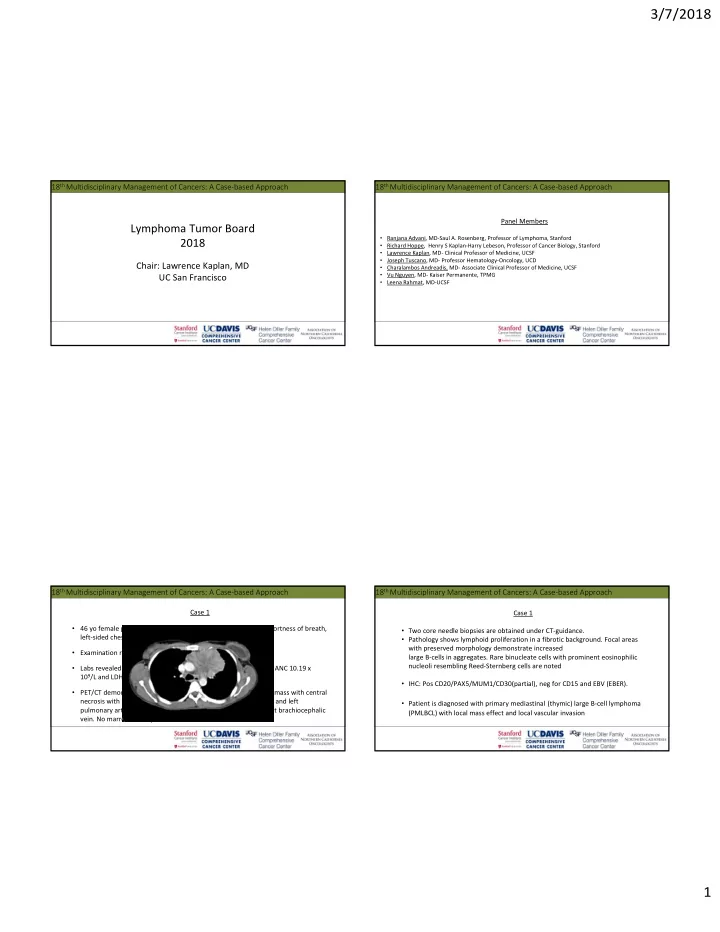
  • PET/CT demonstrated a 6.0 x 8.3 cm heterogeneous mediastinal mass with central

necrosis with SUV max of 16.2 causing a mass effect on the main and left pulmonary arteries with invasion & complete occlusion of the left brachiocephalic

  • vein. No marrow FDG‐uptake.

18th Multidisciplinary Management of Cancers: A Case‐based Approach

Case 1

  • Two core needle biopsies are obtained under CT‐guidance.
  • Pathology shows lymphoid proliferation in a fibrotic background. Focal areas

with preserved morphology demonstrate increased large B‐cells in aggregates. Rare binucleate cells with prominent eosinophilic nucleoli resembling Reed‐Sternberg cells are noted

  • IHC: Pos CD20/PAX5/MUM1/CD30(partial), neg for CD15 and EBV (EBER).
  • Patient is diagnosed with primary mediastinal (thymic) large B‐cell lymphoma

(PMLBCL) with local mass effect and local vascular invasion

slide-2
SLIDE 2

3/7/2018 2

18th Multidisciplinary Management of Cancers: A Case‐based Approach

Case 1 What treatment options should be considered for this patient?

  • A. R‐CHOP
  • B. R‐CHOP followed by involved field radiotherapy (RTX)
  • C. daEPOCH‐R
  • D. daEPOCH‐R followed by involved field RTX
  • E. ABVD

18th Multidisciplinary Management of Cancers: A Case‐based Approach

Case 1

  • Patient achieved a complete metabolic response after cycle 4 of DA‐R‐EPOCH

& completed a total of 6 cycles.

  • Patient feels well and has no respiratory or B‐symptoms
  • PET/CT 6 weeks post‐treatment: Anterior mediastinal mass unchanged in size.

There were new punctate foci of hypermetabolism within this mass with SUV

  • f 7.4 and 5.0. These hypermetabolic nodules are within the margin of the

known tumor in the anterior mediastinum (Deauville 4)

18th Multidisciplinary Management of Cancers: A Case‐based Approach

Case 1 How would you now proceed?

  • A. Salvage chemotherapy with R‐ICE
  • B. Biopsy of mediastinal mass
  • C. No action now. Repeat PET‐CT in 6 weeks
  • D. Radiotherapy

18th Multidisciplinary Management of Cancers: A Case‐based Approach

Case 1

  • Patient has no intervening treatment
  • A PET/CT is repeated 6 weeks later: Size of mediastinal mass unchanged.

Interval increase in hypermetabolism of two previously seen punctate areas of nodular hypermetabolism with SUVs of 16.1, and 10.5. Both of these also appear to have an increased soft tissue component. New focus of hypermetabolism at superior aspect of the mass with SUV 4.0

slide-3
SLIDE 3

3/7/2018 3

18th Multidisciplinary Management of Cancers: A Case‐based Approach

Case 1 You now:

  • A. Repeat scan in 6 weeks
  • B. Salvage R‐ICE followed by consolidation auto‐HCT
  • C. Mediastinal radiotherapy only
  • D. Nivolumab
  • E. Biopsy of mediastinal mass

18th Multidisciplinary Management of Cancers: A Case‐based Approach

Case 1

  • Patient received radiotherapy 40 Gy in 20 fractions (initial IMRT 3600 cGy in 18

daily fractions followed by a boost IMRT 400 cGy in 2 daily fractions) to the mediastinum.

  • Follow up PET/CT shows complete metabolic response (Deauville 2)

18th Multidisciplinary Management of Cancers: A Case‐based Approach

Case 1

  • Therapy with DA‐EPOCH‐R obviated the requirement for XRT. 5‐year f/u, EFS 93%, OS 97% (NEJM 2013;368:1408‐

16).

  • Response to salvage chemotherapy for R/R PMLBCL poor (ORR 25% in Kuruvilla et al Leukemia Lymphoma 2008;49: 1329‐1336)

18th Multidisciplinary Management of Cancers: A Case‐based Approach

END OF CASE 1

slide-4
SLIDE 4

3/7/2018 4

18th Multidisciplinary Management of Cancers: A Case‐based Approach

Case 2

  • 67 yo female who presented with cervical adenopathy and fatigue.
  • Physical Exam: bilateral palpable cervical lymphadenopathy
  • Labs: LDH 360 U/L, WBC 19 x 109/L, ANC 9.4 x 10⁹/L , Hgb 10.2 g/dL, Plts 148 x

109/L, acid 3.2 mg/dL.

  • Bone marrow biopsy negative.

18th Multidisciplinary Management of Cancers: A Case‐based Approach

Case 2

  • Core biopsy level 2 node revealed a diagnosis of diffuse large B‐cell lymphoma

(DLBCL) 80% Ki67, CD10‐, BCL6/Mum‐1+ (non‐GCB subtype). FISH was negative for BCL2, BCL6 or c‐Myc translocation. IHC positive for BCL‐2 (>50%) & Myc (> 40%).

  • PET showed mediastinal LAD, bilateral lung nodules, and cervical adenopathy.

No involvement below diaphragm.

  • Bone marrow biopsy negative.

18th Multidisciplinary Management of Cancers: A Case‐based Approach

Case 2 What is the recommended treatment? A. R‐CHOP B. R‐CHOP‐lenalidomide C. R‐CHOP‐Ibrutinib D. daEPOCH‐R E. R‐CHOP‐bortezomib

18th Multidisciplinary Management of Cancers: A Case‐based Approach

Case 2 Is intra‐thecal prophylactic chemotherapy warranted?

  • A. Yes
  • B. No
slide-5
SLIDE 5

3/7/2018 5

18th Multidisciplinary Management of Cancers: A Case‐based Approach

Case 2

  • She received 6 cycles of R‐CHOP
  • Post‐treatment PET/CT demonstrated improvement however residual bilateral

hypermetabolic pulmonary nodules & right supraclavicular nodes were noted.

  • CT‐guided core biopsy of a lung lesion on which revealed largely necrotic tissue

containing degenerating large cells consistent with residual/recurrent non‐ Hodgkin’s lymphoma.

18th Multidisciplinary Management of Cancers: A Case‐based Approach

Case 2 What salvage treatment do you consider now? A. R‐ICE followed by autologous stem cell transplant B. R‐ICE no transplant due to patient age C. R‐DHAP followed by an autologous stem cell transplant D. Ibrutinib

18th Multidisciplinary Management of Cancers: A Case‐based Approach

Case 2

  • Started C1 R‐ICE & had significant mental status changes attributed to ifosfamide
  • Treatment changed to GVD, completed 3 cycles
  • Repeat PET/CT demonstrated refractory disease
  • Treatment switched to R‐DHAP x 3 cycles
  • Restaging PET‐CT shows mixed response

18th Multidisciplinary Management of Cancers: A Case‐based Approach

Case 2 What would you recommend now?

  • A. BEAM + autoSCT
  • B. Referral for CAR‐T therapy
  • C. Blinatumumab

E. Hospice

slide-6
SLIDE 6

3/7/2018 6

18th Multidisciplinary Management of Cancers: A Case‐based Approach

Case 2

  • The patient is enrolled in a CD19 CAR-T cell clinical trial
  • However, patient developed progression and is in need of disease control before

proceeding to CART.

  • Options offered: R-Bendamustine-carfilzomib; lenalidomide-blinatumumab, R- or

G-Bendamustine

18th Multidisciplinary Management of Cancers: A Case‐based Approach

Case 2

  • Double expressor DLBCLs have unfavorable outcome, higher CNS relapse risk (Savage

et al JCO.2016;127: 2182) no clear benefit from DA EPOCH‐R. (CALGB 50303 data pending).

  • Addition of bortezomib to R‐CHOP failed to show benefit in non‐GCB DLBCL in two

trials (Leonard JM. Blood. 2015;126(23):811 / Davies AJ. Ann Oncol. 2017;35(Suppl 2):130‐131)

  • Randomized trial of R‐CHOP +/‐ ibrutinib (PHOENIX) for non‐GCB fully enrolled.
  • R2‐CHOP active but not clearly better. (J Clin Oncol. 2015;33(3):251, Lancet Oncol

2014;15:730‐37. Randomized trial in progress (ECOG E1412)

  • Patients who fail to respond to a first salvage regimen outcomes very poor (Elstrom R et

al Clin Lymphoma Myeloma Leuk. 2010;10:192-196.)

  • Commercial CART (axicabtagene) eligibility: falure to respond to two lines of therapy

18th Multidisciplinary Management of Cancers: A Case‐based Approach 18th Multidisciplinary Management of Cancers: A Case‐based Approach

Response Rate, % Best Overall Response Rate (N = 81) Response at 3 Months (N = 81) Response at 6 Months (n = 46) ORR (CR + PR) 53a 38 37 CR 40 32 30 PR 14 6 7

JULIET: Primary Endpoint

* P < .0001 (95% CI, 42%-64%). Null hypothesis of ORR ≤ 20%. CR, complete response; ORR, overall response rate; PR, partial response.

slide-7
SLIDE 7

3/7/2018 7

18th Multidisciplinary Management of Cancers: A Case‐based Approach

END OF CASE 2

18th Multidisciplinary Management of Cancers: A Case‐based Approach

Case 3

  • 27 yo F presented with fevers and a cough
  • CXR revealed a mediastinal mass. CT chest demonstrated a left‐sided

mediastinal mass with mediastinal & bilateral hilar lymphadenopathy

  • EBUS & biopsy of the mass was non‐diagnostic
  • ET/CT on demonstrated 6.8 x 2.2 x 6.9 cm mediastinal mass with SUV 6.9,

reduced size of mediastinal & hilar LAD. Prior LUL & LLL consolidation were improved, favoring infection. Extensive hypermetabolic para‐aortic LAD

18th Multidisciplinary Management of Cancers: A Case‐based Approach

Case 3

  • left VATS biopsy of the mediastinal mass confirmed cHL, nodular sclerosis type,

Reed‐Sternberg cells, CD30+, CD15+, pax5+, CD20‐, CD3‐, CD45‐

  • Bone marrow biopsy negative
  • Stage 3B disease, IPS 3

18th Multidisciplinary Management of Cancers: A Case‐based Approach

Case 3 What do you recommend for front‐line therapy?

  • A. ABVD x 6 cycles
  • B. ABVD X 6 followed by XRT to mediastinal disease
  • C. Brentuximab vedotin + AVD
slide-8
SLIDE 8

3/7/2018 8

18th Multidisciplinary Management of Cancers: A Case‐based Approach

Case 3

  • Patient receives 2 cycles ABVD
  • Re‐staging PET/CT after cycle 2 demonstrated a CMR, Deauville 2
  • She goes on to receive 4 additional cycles of ABVD
  • Re‐staging PET/CT demonstrated increased size of the mediastinal mass ,now

extending across the midline measuring 4.4 x 8.0 cm, SUV 8.4, confluent subcarinal, pretracheal, paraesophageal, & hilar LAD all increased, multiple new pulmonary nodules, a lingular mass 4.4 x 4 cm SUV 13.1 and new bilateral pleural effusions. Repeat bx + recurrent cHL

18th Multidisciplinary Management of Cancers: A Case‐based Approach

Case 3 What do you recommend?

  • A. ICE followed by consolidation with autoHCT
  • B. BEACOPP
  • C. Bendamustine & brentuximab vedotin
  • D. Nivolumab + brentuximab vedotin

18th Multidisciplinary Management of Cancers: A Case‐based Approach

Case 3

  • Received 2 cycles of ICE
  • Re‐staging PET/CT demonstrated minimal reduction of hypermetabolism and

size of the mass showed little change, Deauville 4

18th Multidisciplinary Management of Cancers: A Case‐based Approach

Case 3

  • Received two cycles bendamustine & brentuximab vedotin
  • Re‐staging PET/CT showed a slight decrease in size of the mediastinal mass

from 4.4 x 5.5 cm to 3.7 x 4.3 cm, SUV 5.3, increased nodular hypermetabolic components in other mediastinal nodes and new widespread hypermetabolic skeletal lesions.

slide-9
SLIDE 9

3/7/2018 9

18th Multidisciplinary Management of Cancers: A Case‐based Approach

Case 3 You now recommend:

  • A. Lenalidomide
  • B. Gemcitabine‐based chemotherapy (GVD)
  • C. Nivolumab
  • D. Nivolumab followed by allo HCT

18th Multidisciplinary Management of Cancers: A Case‐based Approach

Case 3

  • Received 3 cycles of nivolumab
  • PET/CT (after cycle 3) showed progression of skeletal disease Deauville 5.

Mediastinal mass had decreased in size and demonstrated CMR. Other nodal disease also reduced. Patient feels well. Bone pain resolved.

18th Multidisciplinary Management of Cancers: A Case‐based Approach

Case 3 What do you recommend?

  • A. Continue nivolumab
  • B. Autologous transplant
  • C. Clinical trial

18th Multidisciplinary Management of Cancers: A Case‐based Approach

Case 3

  • Went on to receive total 7 cycles of nivolumab
  • PET/CT demonstrated a mixed response and new carinal, hilar LAD, increased

periportal LAD, all hypermetabolic, deauville 5

  • Receives 2 cycles GVD
  • PET/CT 3/23/16 demonstrated a CMR in mediastinum and significant decrease

in retroperitoneal LAD and skeletal lesions.

  • Receives BEAM‐auto HCT but relapses 4 months post‐auto. Elects hospice care
slide-10
SLIDE 10

3/7/2018 10

18th Multidisciplinary Management of Cancers: A Case‐based Approach

  • A+AVD had superior efficacy to ABVD in the treatment of patients with advanced‐stage HL; combined risk of

progression, death, or noncomplete response was 4.9 percentage‐point lower combined risk of progression, death, or noncomplete response (NEJM, 2017. DOI: 10.1056/NEJMoa1708984) Common salvage regimens include:

  • ICE: Blood. 2001;97:616
  • GVD: Ann Oncol. 2007;18:1071
  • Brentuximab vedotin: Blood. 2016 Sep;128:1562‐6
  • BV‐bendamustine. Blood 2015; 126: 3982.
  • BV‐nivolumab: ORR 82%, CR 61%. (Blood 1st Ed, Dec 11,2017)
  • Phase I trial of nivolumab reported OR & CR rates of 87% & 17%, respectively, among 23 patients with rel/ref HL,

most had received ≥3 prior treatment regimens, including BV (78%) & autoHCT (78%) (NEJM. 2015;372(4):311)

  • Sustained remissions after autoHCT can be achieved in more than half of patients with rel/ref (JCO 2000;18(2):332)

Case 3

  • Blood. 2001;97(3):616.

18th Multidisciplinary Management of Cancers: A Case‐based Approach

END OF CASE 3

18th Multidisciplinary Management of Cancers: A Case‐based Approach

Case 4

  • A 45 yo M p/w fever, lymphadenopathy, headaches, & pancytopenia in early

2011

  • BMBx & left inguinal LN excisional biopsy demonstrated CD3+, CD4+, CD30+

ALK‐1‐negative anaplastic large cell lymphoma

  • PET scan demonstrates extensive hypermetabolic LAD, splenomegaly, liver

lesions, marrow uptake. CSF negative. IPI 3.

  • Labs: LDH 1067 U/L, WBC 2.4 x 10⁹/L, Hgb 15.5 g/dL, Plat 32 x 109/L, ANC .69 x

109/L, T bili 6.4 mg/dL, Cr .75 mg/dL, ferritin 2750 ug/L, TG 572 mg/dL.

18th Multidisciplinary Management of Cancers: A Case‐based Approach

Case 4 What do you recommend?

  • A. R‐EPOCH
  • B. CHOP
  • C. Cyclophosphamide / prednisone
  • D. CHOEP
  • E. Dexamethasone / etoposide
slide-11
SLIDE 11

3/7/2018 11

18th Multidisciplinary Management of Cancers: A Case‐based Approach

Case 4

  • Patient initially receives cyclophosphamide 1Gm/m2 + prednisone
  • TB reduced to 1.5, 3 days later.
  • Patient enrolled on clinical trial: GVD x 2 cycles, Augmented CHOP‐M x 2 cycles
  • CR following GVD and at end of induction

18th Multidisciplinary Management of Cancers: A Case‐based Approach

Case 4 Is referral for consolidation with an auto HCT indicated?

  • A. Yes
  • B. No

18th Multidisciplinary Management of Cancers: A Case‐based Approach

Case 4

  • Patient receives aggressive EA‐denileukin diftitox SC mobilization

Followed by CBV auto HCT (on clinical trial)

  • Remained in CR 20 months
  • New left cervical LAD, excisional biopsy confirmed relapsed CD30+ ALCL

18th Multidisciplinary Management of Cancers: A Case‐based Approach

Case 4 What do you recommend now?

  • A. Allogeneic transplant
  • B. DA‐EPOCH
  • C. Brentuximab vedotin
  • D. ICE followed by allogeneic transplant if he responds
slide-12
SLIDE 12

3/7/2018 12

18th Multidisciplinary Management of Cancers: A Case‐based Approach

Case 4

  • Brentuximab vedotin x 10 cycles administered with CMR after cycle 4
  • Further doses held due to severe peripheral neuropathy
  • Patient is not considered candidate for allotransplant and is observed.
  • Three years later: develops new inguinal LAD biopsy + for recurrence, CD30+.
  • PET‐CT reveals widespread hypermetabolic LAD

18th Multidisciplinary Management of Cancers: A Case‐based Approach

Case 4 What do you recommend now?

  • A. Refer for a clinical trial
  • B. brentuximab vedotin
  • C. romidepsin followed by allo HCT
  • D. Pralatrexate

18th Multidisciplinary Management of Cancers: A Case‐based Approach

Case 4

  • Patient receives 4 cycles brentuximab and PET-CT reveals CMR
  • Dose reduced for neuropathy and he receives 9 additional cycles
  • Three weeks later has widespread erythematous plaques on trunk.
  • Biopsy positive for recurrent ALCL (Still CD30+). PET-CT with LAD

18th Multidisciplinary Management of Cancers: A Case‐based Approach

Case 4 Your treatment choice is:

  • A. Pralatrexate
  • B. Romidepsin
  • C. Clinical trial
slide-13
SLIDE 13

3/7/2018 13

18th Multidisciplinary Management of Cancers: A Case‐based Approach

Case 4

  • Patient enrolled on clinical trial of romidepsin / doxil
  • After cycle 1 skin lesions decreasing in size

Case 4

  • PTCL treated with CHOEP-14 / BEAM-HCT 5-year OS / PFS: 51% / 44% (N=160, alk-)(d’Amore et al J

Clin Oncol 2012; 30:3093-3099 )

  • Brentuximab vedotin; ORR 86% & CR 57% in patients with recurrent systemic ALCL. Median

response duration following CR was 13 months (Pro et al JCO 2013; 30: 2190-2196). At median F/U 33 mo 64% of pts with relapsed /refractory sALCL were alive at the time of last follow up (Pro et al.

Blood 2013 122:1809)

  • CIBMTR database (N=112) who had undergone autoHCT (61 patients) or alloHCT (50 patients) at

various phases of the disease; AutoHCT was associated with superior PFS (55% vs 35%) & OS (68% vs 41%), with significantly less non-relapse mortality. (J Clin Oncol. 2013;31(25):3100).

18th Multidisciplinary Management of Cancers: A Case‐based Approach

BV for ALCL. 3 yr F/U

18th Multidisciplinary Management of Cancers: A Case‐based Approach

END OF CASE 4

18th Multidisciplinary Management of Cancers: A Case‐based Approach

Case 5

  • A 58 yo M is referred by his PCP for evaluation of “leukemia,” after noting

an elevated WBC on routine visit. Patient indicates that he is feeling well with good energy level and has no B symptoms.

  • He is well-appearing, afebrile and has no palpable LAD. A spleen tip is

palpable 3 cm below the LCM. Exam is otherwise normal.

  • CBC: WBC 36.4 x 10⁹/L, Hgb 12.5 g/dL, Plat 133 x 109/L, ANC 4.8 x 10⁹/L,

ALC 30.4 x 10⁹/L. Peripheral smear has predominance of “small to medium sized abnormal lymphocytes.” Flow cytometry shows predominance of lymphocytes that are CD19,CD20,CD5,CD23 positive.

slide-14
SLIDE 14

3/7/2018 14

18th Multidisciplinary Management of Cancers: A Case‐based Approach

Case 5 Your evaluation should include?

  • A. FISH for t(11;14)
  • B. FISH for 17p‐,11q‐,+12,13q‐
  • C. IgVH mutational analysis
  • D. B and C

E. All of the above

18th Multidisciplinary Management of Cancers: A Case‐based Approach

Case 5

  • FISH studies are positive for t(11;14), +12q. Neg for 11q-,17p-
  • IgVH: mutated.
  • Sox 11 is ordered and is negative.
  • CT demonstrates splenomegaly and no abnormal LAD

18th Multidisciplinary Management of Cancers: A Case‐based Approach

Case 5 What is diagnosis?

  • A. CLL
  • B. Mantle cell lymphoma
  • C. B‐cell ALL

18th Multidisciplinary Management of Cancers: A Case‐based Approach

Case 5 What are your treatment recommendations?

  • A. R‐DHAP induction followed by auto‐HCT
  • B. Watch and wait
  • C. R‐bendamustine 6 cycles
  • D. Rituximab‐lenalidomide
slide-15
SLIDE 15

3/7/2018 15

18th Multidisciplinary Management of Cancers: A Case‐based Approach

Case 5

  • Patient has follow up 12 mo later. Remains asymptomatic. ALC 36 x 109/L,

Hgb 12.1 g/dL, platelets 128 x 109/L.

  • He is lost to follow up for the next 3 years.
  • He returns complaining of increasing fatigue and drenching night sweats over

the previous 4 weeks. There is no LAD on exam and spleen tip is palpable at level of umbilicus.

  • WBC 174 x 109/L, ALC 169 x 109/L, Hgb 11.5 g/dL, plt 110 x 109/L. Slide

review with small to medium sized lymphs. CT slightly increased splenomegaly and mild RPLAD. Cytogenetics complex + del17p.

18th Multidisciplinary Management of Cancers: A Case‐based Approach

Case 5 What are your treatment recommendations?

  • A. R‐DHAP induction followed by auto‐HCT
  • B. Watch and wait
  • C. R‐bendamustine, cytarabine (RBAC) 6 cycles
  • D. R‐lenalidomide

18th Multidisciplinary Management of Cancers: A Case‐based Approach

Case 5

  • Non-nodal MCL, (blood, marrow, spleen) usually hypermutated,

SOX11-, associated with indolent disease (Orchard J,. Blood 2003;101: 4975–4981).

  • Other indolent cases may be nodal with low Ki67 and can be

managed as indolent BCL (Hsi et al. Leukemia & Lymphoma, (2014)55:761-767)

  • More rapid progression may be associated with P53 or other clonal

evolution and requires therapy.

18th Multidisciplinary Management of Cancers: A Case‐based Approach

END OF CASE 5