
SLIDE 1
- 33. Review I
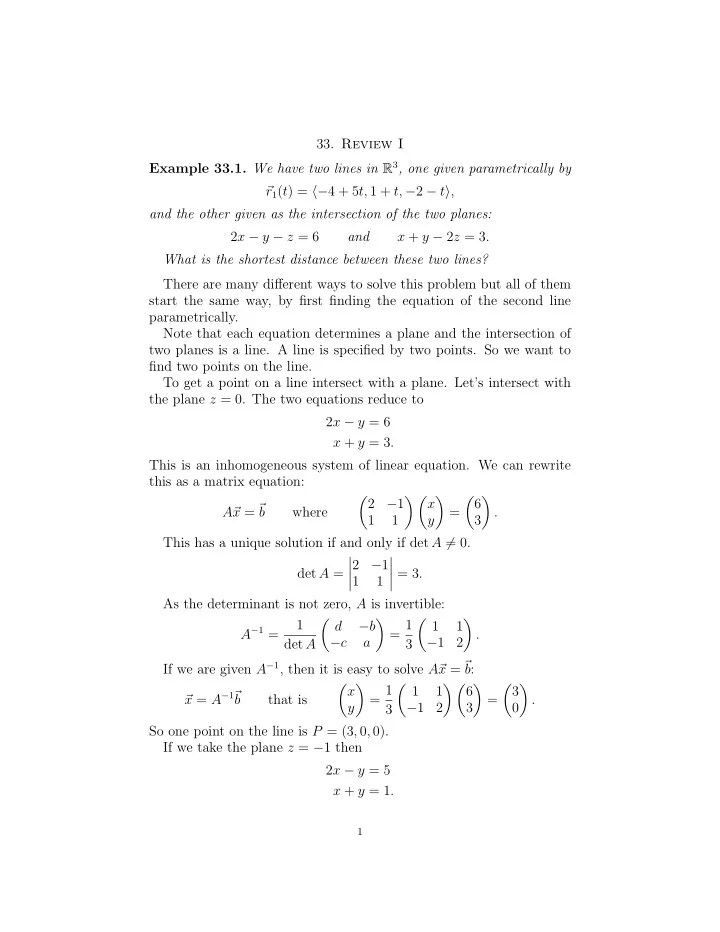
Example 33.1. We have two lines in R3, one given parametrically by
- r1(t) = −4 + 5t, 1 + t, −2 − t,
and the other given as the intersection of the two planes: 2x − y − z = 6 and x + y − 2z = 3. What is the shortest distance between these two lines? There are many different ways to solve this problem but all of them start the same way, by first finding the equation of the second line parametrically. Note that each equation determines a plane and the intersection of two planes is a line. A line is specified by two points. So we want to find two points on the line. To get a point on a line intersect with a plane. Let’s intersect with the plane z = 0. The two equations reduce to 2x − y = 6 x + y = 3. This is an inhomogeneous system of linear equation. We can rewrite this as a matrix equation: A x = b where
- 2
−1 1 1 x y
- =
- 6
3
- .
This has a unique solution if and only if det A = 0. det A =
- 2
−1 1 1
- = 3.
As the determinant is not zero, A is invertible: A−1 = 1 det A
- d
−b −c a
- = 1
3
- 1
1 −1 2
- .
If we are given A−1, then it is easy to solve A x = b:
- x = A−1
b that is
- x
y
- = 1
3
- 1
1 −1 2 6 3
- =
- 3
- .