f x , y is F u ,v = i2 xu yv dx dy f - - PDF document

f x y is f u v i2 xu yv dx dy f x y e
SMART_READER_LITE
LIVE PREVIEW

f x , y is F u ,v = i2 xu yv dx dy f - - PDF document

2-D Reconstruction Hannes Hofmann 2-D Reconstruction MB-JASS 2006, 19 29 March 2006 Computer Tomography systems use X-rays to acquire images from the inside of the human body. Out of the projection images the original object is


slide-1
SLIDE 1

2-D Reconstruction Hannes Hofmann

2-D Reconstruction

MB-JASS 2006, 19 – 29 March 2006 Computer Tomography systems use X-rays to acquire images from the inside of the human body. Out of the projection images the original object is reconstructed. This talk is about the theory in the simplyfied case of parallel projections.

Parallel Projections

When X-rays travel through an object they are attenuated and a detector measures the resulting

  • intensity. Different materials have different attenuation coefficients  .

X-ray attenuation occurs exponentially: I =I 0∗exp−∫xds Where I 0 is the original intensity, and x is the attenuation coefficient at position x along the ray path.

Radon Transform

The set of line integrals along the direction  in distance t from the origin is called Radon Transform after Johann Radon (1917). pt =∫−∞

∞ ∫−∞ ∞

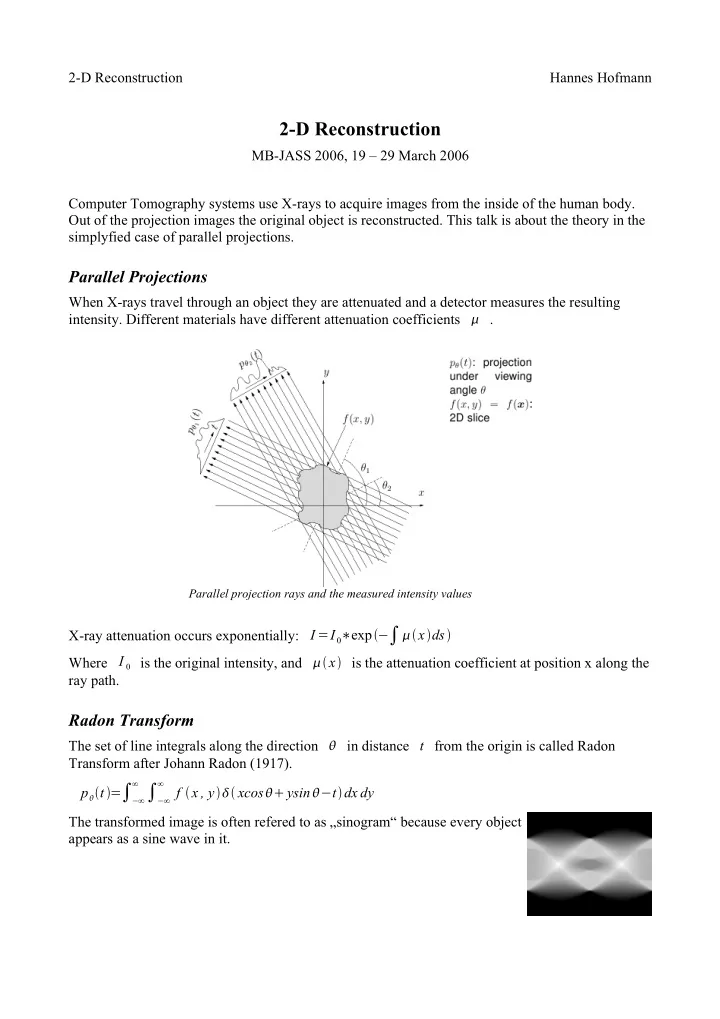
f x , y xcosysin −tdx dy The transformed image is often refered to as „sinogram“ because every object appears as a sine wave in it.

Parallel projection rays and the measured intensity values

slide-2
SLIDE 2

2-D Reconstruction Hannes Hofmann

Fourier Slice Theorem

The projection of the object f x , y in y-direction is defined by the integral p=0x=∫

−∞ ∞

f x , ydy Moreover the Fourier transform of f x , y is F u ,v=∫−∞

∞ ∫ −∞ ∞

f x , ye

−i2 xuyv dx dy

A slice su through the transformed in angle =0 is su=F u,0=∫

−∞ ∞ ∫−∞ ∞

f x , ye

−i2 xudx dy

=∫

−∞ ∞

[∫

−∞ ∞

f x , ydy]e

−i2  xudx

=∫

−∞ ∞

p=0te

−i2tu dt

which in turn is the Fourier transform of the projection p=0x (A formal derivation for arbitrary angles can be found e.g. in Kak & Slaney) pt  t f x , y  F u ,v  Pw That means that it would be possible to perfectly reconstruct any object if we had an infinite number of projections. Just find the inverse Radon transform and apply it. Unfortunately the data of that patient would be of no use as he would be dead.

slide-3
SLIDE 3

2-D Reconstruction Hannes Hofmann

FST – Regridding

pt  t f x , y  F u ,v Pw In practice we have only a limited number of projections. The projection data lies on circles (dots in the right half) and has to be interpolated into a Carthesian coordinate system. For higher frequency regions (i.e. regions with more details) the sampling density decreases and thus the interpolation result gets worse.

Unfiltered Backprojection

As expected the reconstruction using the original projection data results in an unsharp and blurred image.

Unfiltered backprojection using 180 projections

slide-4
SLIDE 4

2-D Reconstruction Hannes Hofmann

Filtering

The common approach to counteract the consequenses of the Fourier Slice Theorem is to apply a weighting to the projection data.

Filtered Backprojection

The interpolation step required by regridding can be avoided if we switch the coordinate system in the frequency domain to the polar coordinate system. Therefore in the formula for the inverse Fourier transform f x , y=∫

−∞

∞∫

−∞

∞ F u ,ve

i2uxvy dudv

we have to substitude u=wcos v=wsin and du dv=w dwd  f x , y=∫0

2∫0 ∞

F w ,e

i2xcosysinw dwd 

This can be split into two f x , y=∫0

∫0 ∞

F w ,e

i2 xcos ysinwdwd 

∫0

∫0 ∞

Fw ,e

i2 xcosysin wdw d 

and with the 180° symmetry of the Fourier transformed F u ,=F −u , the equation can be expressed as f x , y=∫0

[∫

−∞ ∞

F w ,∣w∣e

i2 wt dw] d 

where t is t=xcos ysin

Ideal case Fourier Slice Theorem The ideal is approximated by a weightening (highpass)

slide-5
SLIDE 5

2-D Reconstruction Hannes Hofmann We now make use of the FST by substituting the Fourier transform of the projection for the two- dimensional Fourier transform f x , y=∫0

[∫−∞

Pw∣w∣e

i2 wt dw]d 

Which may be written as f x , y=∫0

Qt d  Qt=∫

−∞ ∞

Pw∣w∣e

i2 wt dw

Q is the filtered projection with filter function ∣w∣

Ramp Filter

A highpass filter emphasizes the high frequencies so they contribute more to the reconstruction result. Unfortunately the ramp filter also emphasizes noise, so other filters are more common today. For example the Shepp-Logan kernel which puts a little lower emphasis on very high frequencies.

Results: Filtered Backprojection

Filtered backprojection using 180 projections

slide-6
SLIDE 6

2-D Reconstruction Hannes Hofmann

Different kernels

The opportunity to choose different filters gives doctors the choice to use the one that fits best for what they want to see.

References

  • A. C. Kak and Malcolm Slaney, Principles of Computerized Tomographic Imaging. Society of

Industrial and Applied Mathematics, 2001

  • S. Horbelt, M. Liebling, M. Unser: Filter design for filtered back-projection guided by the

interpolation model, Proceedings of the SPIE International Symposium on Medical Imaging: Image Processing (MI'02), San Diego CA, USA, February 24-28, 2002, vol. 4684, Part II, pp. 806-813. http://en.wikipedia.org/wiki/Radon_transform http://en.wikipedia.org/wiki/Projection-slice_theorem

  • J. Hornegger, D. Paulus: Slides to Medical Image Processing
  • B. Heismann: Slides to Medical Imaging

http://homepages.inf.ed.ac.uk/rbf/CVonline/LOCAL_COPIES/AV0405/HAYDEN/Slice_Reconstru ction.html http://www.mssl.ucl.ac.uk/www_solar/moses/moses-web/Pages/fourier-slice-theorem.jpg http://www.eng.warwick.ac.uk/~espbc/courses/undergrad/lec13/filtered_backprojection.htm

A soft kernel gives images with less noise and smoother areas, but in turn lower resolution. On the other side images get a higher resolution and more noise with a sharp kernel.