5. How could these responses be enhanced or strengthened to - - PDF document

5 how could these responses be enhanced or strengthened
SMART_READER_LITE
LIVE PREVIEW

5. How could these responses be enhanced or strengthened to - - PDF document

Links between the changing environment, livelihood and the world of work Coastal Erosion in Thailand The succeeding pages present for your examination and discussion an actual, on-going initiative on green jobs. A facilitator will be provided to


slide-1
SLIDE 1

1

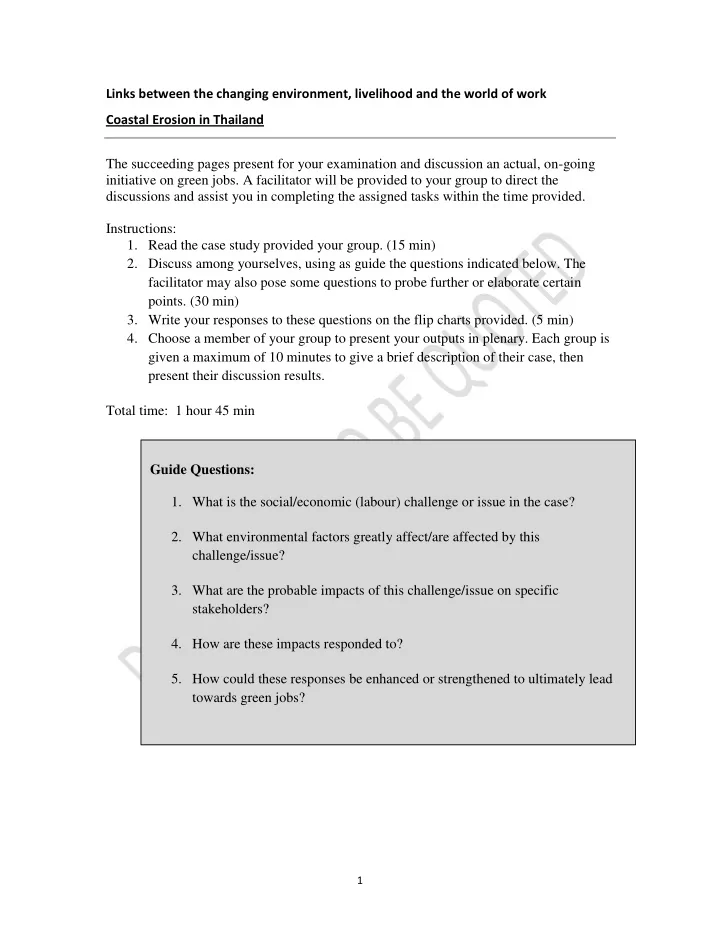
Links between the changing environment, livelihood and the world of work Coastal Erosion in Thailand The succeeding pages present for your examination and discussion an actual, on-going initiative on green jobs. A facilitator will be provided to your group to direct the discussions and assist you in completing the assigned tasks within the time provided. Instructions:

  • 1. Read the case study provided your group. (15 min)
  • 2. Discuss among yourselves, using as guide the questions indicated below. The

facilitator may also pose some questions to probe further or elaborate certain

  • points. (30 min)
  • 3. Write your responses to these questions on the flip charts provided. (5 min)
  • 4. Choose a member of your group to present your outputs in plenary. Each group is

given a maximum of 10 minutes to give a brief description of their case, then present their discussion results. Total time: 1 hour 45 min Guide Questions:

  • 1. What is the social/economic (labour) challenge or issue in the case?
  • 2. What environmental factors greatly affect/are affected by this

challenge/issue?

  • 3. What are the probable impacts of this challenge/issue on specific

stakeholders?

  • 4. How are these impacts responded to?
  • 5. How could these responses be enhanced or strengthened to ultimately lead

towards green jobs?

slide-2
SLIDE 2

2

Introduction Thailand is littoral country with the coastal zone including the Gulf of Thailand Coast and the Andaman sea Coast. They are economic important areas where 23 provinces are located with approximately 12 millions of population living in the areas (DMR). The length of the coastline of Thailand is approximately 2,637 km. The Gulf of Thailand coastline covers 17 provinces with total length is approximately 1,700 km, while the Andaman sea coastline covers 6 provinces with total length is approximately 937 km. During the last two decades, an over exploitation of resources, population growth, intensified development of tourism, aquaculture, and industries caused evidences of environmental degradation in resources of the areas that lead to coastal problem (DMR). The most striking example among the coastal problems is the landuse on sandy shores, particularly during the property boom in the early 1990.In tourist areas , tall hotel and condominium buildings are constructed close to the water’s edge, obstructing public

slide-3
SLIDE 3

3

access to theshore. Moreover, naturally accumulated sand and dunes that once protected the inland area have been removed to improve the view, and facilitate road construction along the coastline, resulting in accelerating erosion, land subsidence and

  • flooding. These problems not only damaged the physical structure, but also lead to

conflict among different groups of interest within local communities. Challenges from coastal erosion In the past, the coastlines have been changed mainly by natural processes. However, with the economic development since 1970’s, the dramatic changes were related to the maintenance of the waterway to the Bangkok Port and many local small fishing ports. The coastal erosion is closely related to the process of industrialization and the modernization of the society, which experienced a big change during 1980’s. We can

  • utline these events as (Siripong, 2010):
  • 1952-1974

invasion of coastal land especially the Inner Gulf of Thailand.

  • 1965

Maintenance of river mouth of Chao Phraya.

  • 1970’s

Maintenance of other river mouths.

  • 1977

Constructions of Bhumipol & Sirikit Dams.

  • 1982

Aquaculture boom, cutting mangrove, severe erosion further.

  • Since 1985

new industrial ports, aquaculture practices

  • 1988

Laem Chabang Port construction of deep-sea port.

  • 1990

Erosion on many coasts from resort constructions and tourism activities. Coastal erosion in the Gulf of Thailand coastline is about 376 km (14.26 % of total shoreline of Thailand). There were around 22% for severe coastal erosion with rate of more than 5 meters/year along coastline of the gulf of Thailand. The inner coast, the severe erosion has been found in Bang Khun Tien district, Bangkok, the erosion length is approximately 45 kilometers. In the Eastern part of the Gulf of Thailand, the severe erosion has occurred in areas of Rayong and Chantaburi provinces , the coastal erosion length is approximately 18 kilometer (Sirirup, no year). For Bang Khun Tien, the degree

  • f erosion is more severe around the mouth of the canal. From an analysis of aerial

photographs taken between 1952 and 1991, the rate of erosion was approximately 7-12 meters per year at the beginning, increasing to 33.1 meters per year in the period 1987- 1991 (Ittaro, 2001). Human activities particularly land-use change and mangrove loss have caused the higher rate and more permanent coastal erosion on more than 80% of the total coastal line. Moreover, the constructions of major dams in the upperland have prevented the sediment to the sea and worsened erosion. The ineffective coastal protections such as sea wall, breakwater, sand sausage and groyne also accelerate the erosion rate (Siripong, 2010).

slide-4
SLIDE 4

4

The impacts of coastal erosion, together with a relative rise in sea level owing to land subsidence as a result of excess groundwater extraction in the flat and low-lying areas of the Gulf of Thailand, which includes Bangkok, are expected to be significant. Coastal erosion involves not only a loss of land, but also of roads, electricity systems, land devoted to aquaculture, and farmland (Jarungrattanapong and Manasboonphempool, 2008). Responses Based on recorded data from National Disaster Warning Center of Thailand, it was found that occurrence of coastal erosion is more frequent and severe in many areas. In recent year, coastal erosion is becoming a major problem of Thailand. There are varied types of coastal defense projects, both hard and soft solutions, proposed by government sectors. Hard solution applies coastal structures, called as “structural method”, to protect the

  • beaches. Breakwater, groin, seawall and headland are typically used in shoreline
  • protection. Hard solutions are generally appropriate for chronic and severe erosion
  • sites. These measures are fully effective to the project areas, but cause erosion to

adjacent areas. Soft solutions are suitable for coastal resource restoration zones where the wave action is quite low. Beach nourishment and mangrove afforestation are generally used as soft solution. Coastal problems could be solved by appropriate technologies and management approaches. The main cause of failure in achieving the solution to solve coastal problem in Thailand is an overlapping responsibilities among the relevant government agencies. Currently, the Ministry of Natural Resources and Environment is working (MONRE) on solutions to coastal erosion and is preparing to set up a study center as part of its effort to tackle the problem in a sustainable manner. In case of Bang Khun Tien community, the main economic activities of which are shrimp and blood cockle farming, have been directly affected by coastal erosion. It was found

Integration frame The cabinet’s resolutions on 20th April 2010 regarding the budget integration to prevent and solve the coastal erosion problems along 23 provinces under the 2011- 2016 budget of 19,580.8 million Baht are implemented into 933 projects which can be identified to 4 plans as follows;

  • Design and analysis report management regarding the impact of environment and

construction plan; 325 projects under the budget of 15,492.5 million Baht.

  • Investment of global warming impact prevention and management plan;112

projects under the budget of 2,010 million Baht.

  • Dilapidated area and ecosystem restoration plan; 328 projects under the budget
  • f 1,664 million Baht
  • Promoting knowledge and cooperation plan; 258 projects under the budget of

414.3 million Baht. Source: DMCR, 2011

slide-5
SLIDE 5

5

that the households had applied autonomous adaptation for preventing coastal erosion/flooding. The household adaptation methods can be categorized into three types: (1) protection strategies, which consist of stone breakwaters, bamboo revetments, and the heightening of dikes, (2) retreat, for which farmers need to rebuild a new water-gate, and (3) accommodation, by rebuilding/renovating their houses in

  • rder to avoid the impacts of coastal erosion or flooding. The annual adaptation cost

from above activity is approximately THB107,587 or USD3,130 per household, an amount which accounts for 23 percent of the annual household income. Furthermore, a number of aquaculture farms are inundated, indicating that they have lost their asset. The average inundated area is approximately 5.7 rais or 0.9 hectare per household, which accounts for 8 percent of the household aquaculture area. Villagers in Samut Sakhon with some support from government agency such DMCR also erected Bamboo poles along the two kilometer shoreline to tackle the coastal erosion problem, after it caused the loss of almost 7,500 rais or 2,500 hectare of land. The project has proven successful after one year, with sediment deposits behind the bamboo wall forming new land more than one meter from the shoreline. For long-term and efficiency solution, local government e.g. TAOs in each coastal area who has the authority to take care of coastal erosion in the area, the strategies for coastal erosion protection in each area is planned independently. The protective structures to be effective, they should be designed for the whole upper Gulf of Thailand. Therefore, solution of this problem demands collective decisions by the national government in dealing with these issues. References DMCR (2011) Prevention of Coastal Erosion in Thailand. Marine and Coastal Resource Journal, Volume 1 (March 2011). DMR (no year) Status of Coastal Geo-Environment in Thailand. Available: http://www.dmr.go.th/ewtadmin/ewt/dmr_web/main.php?filename=coastal_En Ittaro I. (2001) Shoreline Change at Bang Khun Tien. Master’s Thesis, Faculty of Engineering, Chulalongkorn University, Bangkok. Jarungrattanapong R. and Manasboonphempool A. (2008) Adaptation Strategies for Coastal Erosion/Flooding: A Case Study of Two Communities in Bang Khun Thian District,

  • Bangkok. TDRI Quarterly Review (March 2008).

Jarupongsakul T. (2006) Coastal Erosion in Thailand: Causes and Management. Research Paper, Department of Geology, Chulalongkorn University.

slide-6
SLIDE 6

6

Siripong A. (2010) Detect the Coastaline Changes in Thailand by Remote Sensing. International Archives of the Photogrammetry, Remote Sensing and Spatial Information Science, Volume 38 (Part 8). Sirisup S. (no year) Simulation of Coastal Changes in Thailand. Large Scale Simulation Research Laboratory, National Electronics and Computer Technology Center (NECTEC).