61A Lecture 26 Project 1, 2, & 3 composition revisions due - - PDF document

61a lecture 26
SMART_READER_LITE
LIVE PREVIEW

61A Lecture 26 Project 1, 2, & 3 composition revisions due - - PDF document

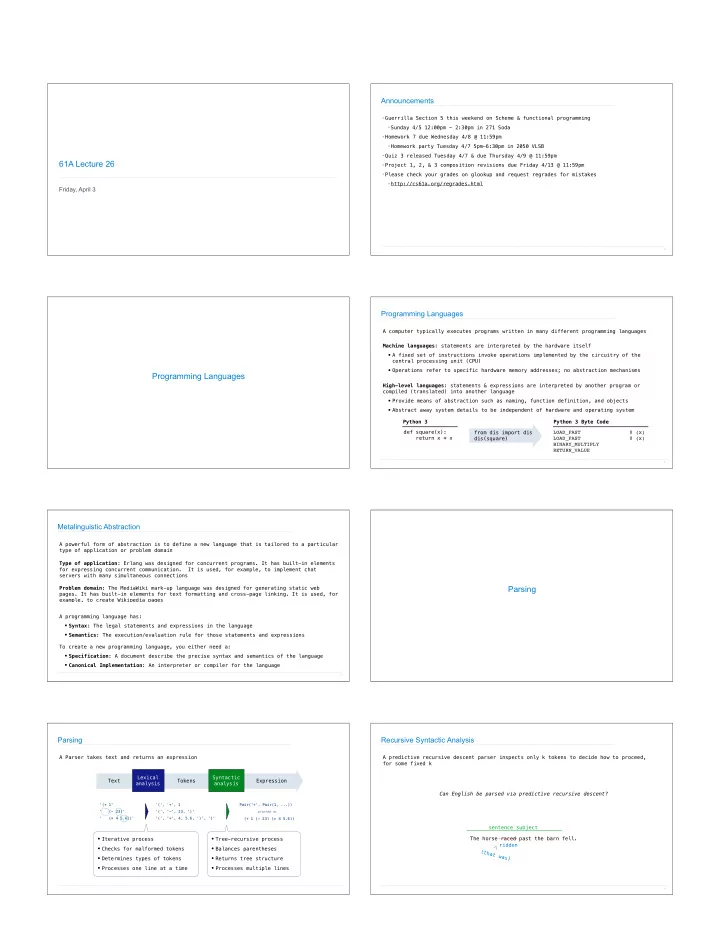
Announcements Guerrilla Section 5 this weekend on Scheme & functional programming Sunday 4/5 12:00pm - 2:30pm in 271 Soda Homework 7 due Wednesday 4/8 @ 11:59pm Homework party Tuesday 4/7 5pm-6:30pm in 2050 VLSB Quiz 3


slide-1
SLIDE 1

61A Lecture 26

Friday, April 3

Announcements

  • Guerrilla Section 5 this weekend on Scheme & functional programming
§Sunday 4/5 12:00pm - 2:30pm in 271 Soda
  • Homework 7 due Wednesday 4/8 @ 11:59pm
§Homework party Tuesday 4/7 5pm-6:30pm in 2050 VLSB
  • Quiz 3 released Tuesday 4/7 & due Thursday 4/9 @ 11:59pm
  • Project 1, 2, & 3 composition revisions due Friday 4/13 @ 11:59pm
  • Please check your grades on glookup and request regrades for mistakes
§http://cs61a.org/regrades.html 2

Programming Languages

Programming Languages

A computer typically executes programs written in many different programming languages

4

Machine languages: statements are interpreted by the hardware itself

  • A fixed set of instructions invoke operations implemented by the circuitry of the

central processing unit (CPU)

  • Operations refer to specific hardware memory addresses; no abstraction mechanisms

High-level languages: statements & expressions are interpreted by another program or compiled (translated) into another language

  • Provide means of abstraction such as naming, function definition, and objects
  • Abstract away system details to be independent of hardware and operating system

from dis import dis dis(square) def square(x): return x * x Python 3 LOAD_FAST 0 (x) LOAD_FAST 0 (x) BINARY_MULTIPLY RETURN_VALUE Python 3 Byte Code

Metalinguistic Abstraction

A powerful form of abstraction is to define a new language that is tailored to a particular type of application or problem domain

5

Type of application: Erlang was designed for concurrent programs. It has built-in elements for expressing concurrent communication. It is used, for example, to implement chat servers with many simultaneous connections Problem domain: The MediaWiki mark-up language was designed for generating static web

  • pages. It has built-in elements for text formatting and cross-page linking. It is used, for

example, to create Wikipedia pages A programming language has:

  • Syntax: The legal statements and expressions in the language
  • Semantics: The execution/evaluation rule for those statements and expressions

To create a new programming language, you either need a:

  • Specification: A document describe the precise syntax and semantics of the language
  • Canonical Implementation: An interpreter or compiler for the language

Parsing

Parsing

A Parser takes text and returns an expression

7 '(+ 1' ' (- 23)' ' (* 4 5.6))'

Text Expression Lexical analysis Tokens Syntactic analysis

'(', '+', 1 '(', '-', 23, ')' '(', '*', 4, 5.6, ')', ')' Pair('+', Pair(1, ...)) (+ 1 (- 23) (* 4 5.6)) printed as
  • Iterative process
  • Checks for malformed tokens
  • Determines types of tokens
  • Processes one line at a time
  • Tree-recursive process
  • Balances parentheses
  • Returns tree structure
  • Processes multiple lines

Recursive Syntactic Analysis

A predictive recursive descent parser inspects only k tokens to decide how to proceed, for some fixed k Can English be parsed via predictive recursive descent? The horse raced past the barn fell. ridden (that was) sentence subject

8
slide-2
SLIDE 2

Reading Scheme Lists

A Scheme list is written as elements in parentheses: (<element_0> <element_1> ... <element_n>) Each <element> can be a combination or primitive (+ (* 3 (+ (* 2 4) (+ 3 5))) (+ (- 10 7) 6)) The task of parsing a language involves coercing a string representation of an expression to the expression itself Parsers must validate that expressions are well-formed (Demo) http://composingprograms.com/examples/scalc/scheme_reader.py.html

9

A Scheme list

Syntactic Analysis

Syntactic analysis identifies the hierarchical structure of an expression, which may be nested Each call to scheme_read consumes the input tokens for exactly one expression Base case: symbols and numbers Recursive call: scheme_read sub-expressions and combine them

10

'(', '+', 1, '(', '-', 23, ')', '(', '*', 4, 5.6, ')', ')' (Demo)

Calculator

(Demo)

The Pair Class

The Pair class represents Scheme pairs and lists. A list is a pair whose second element is either a list or nil.

12

>>> s = Pair(1, Pair(2, Pair(3, nil))) >>> print(s) (1 2 3) >>> len(s) 3 >>> print(Pair(1, 2)) (1 . 2) >>> print(Pair(1, Pair(2, 3))) (1 2 . 3) >>> len(Pair(1, Pair(2, 3))) Traceback (most recent call last): ... TypeError: length attempted on improper list class Pair: """A Pair has two instance attributes: first and second.

  • For a Pair to be a well-formed list,

second is either a well-formed list or nil. Some methods only apply to well-formed lists. """ def __init__(self, first, second): self.first = first self.second = second Scheme expressions are represented as Scheme lists! Source code is data (Demo)

Calculator Syntax

The Calculator language has primitive expressions and call expressions. (That's it!) A primitive expression is a number: 2, -4, 5.6 A call expression is a combination that begins with an operator (+, -, *, /) followed by 0

  • r more expressions: (+ 1 2 3), (/ 3 (+ 4 5))
13

Expressions are represented as Scheme lists (Pair instances) that encode tree structures. (* 3 
 (+ 4 5)
 (* 6 7 8)) Expression * 3 + 4 5 * 6 8 7 Expression Tree

second first * second first 3 second first second first nil second first + second first 4 second first 5 nil second first * second first 6 second first 7 second first 8 nil

Representation as Pairs http://xuanji.appspot.com/js-scheme-stk/index.html

Calculator Semantics

The value of a calculator expression is defined recursively. Primitive: A number evaluates to itself. Call: A call expression evaluates to its argument values combined by an operator. +: Sum of the arguments *: Product of the arguments

  • : If one argument, negate it. If more than one, subtract the rest from the first.

/: If one argument, invert it. If more than one, divide the rest from the first.

14

(* 3 
 (+ 4 5)
 (* 6 7 8)) Expression * 3 + 4 5 * 6 8 7 Expression Tree 9 336 9072

Evaluation

The Eval Function

The eval function computes the value of an expression, which is always a number. It is a generic function that dispatches on the type of the expression (primitive or call).

16

def calc_eval(exp): if type(exp) in (int, float): return exp elif isinstance(exp, Pair): arguments = exp.second.map(calc_eval) return calc_apply(exp.first, arguments) else: raise TypeError A number evaluates... A call expression evaluates... to its argument values to itself '+', '-', '*', '/' A Scheme list

  • f numbers

Recursive call returns a number for each operand combined by an operator Implementation Language Semantics

slide-3
SLIDE 3

Applying Built-in Operators

The apply function applies some operation to a (Scheme) list of argument values. In calculator, all operations are named by built-in operators: +, -, *, /

17

def calc_apply(operator, args): if operator == '+': return reduce(add, args, 0) elif operator == '-': ... elif operator == '*': ... elif operator == '/': ... else: raise TypeError Sum of the arguments +: Implementation Language Semantics ...

  • :

... (Demo)

Interactive Interpreters

Read-Eval-Print Loop

The user interface for many programming languages is an interactive interpreter. 1. Print a prompt 2. Read text input from the user 3. Parse the text input into an expression 4. Evaluate the expression 5. If any errors occur, report those errors, otherwise 6. Print the value of the expression and repeat

19

(Demo)

Raising Exceptions

Exceptions are raised within lexical analysis, syntactic analysis, eval, and apply. Example exceptions

  • Lexical analysis: The token 2.3.4 raises ValueError("invalid numeral")
  • Syntactic analysis: An extra ) raises SyntaxError("unexpected token")
  • Eval: An empty combination raises TypeError("() is not a number or call expression")
  • Apply: No arguments to - raises TypeError("- requires at least 1 argument")
20

(Demo)

Handling Exceptions

An interactive interpreter prints information about each error A well-designed interactive interpreter should not halt completely on an error, so that the user has an opportunity to try again in the current environment

21

(Demo)