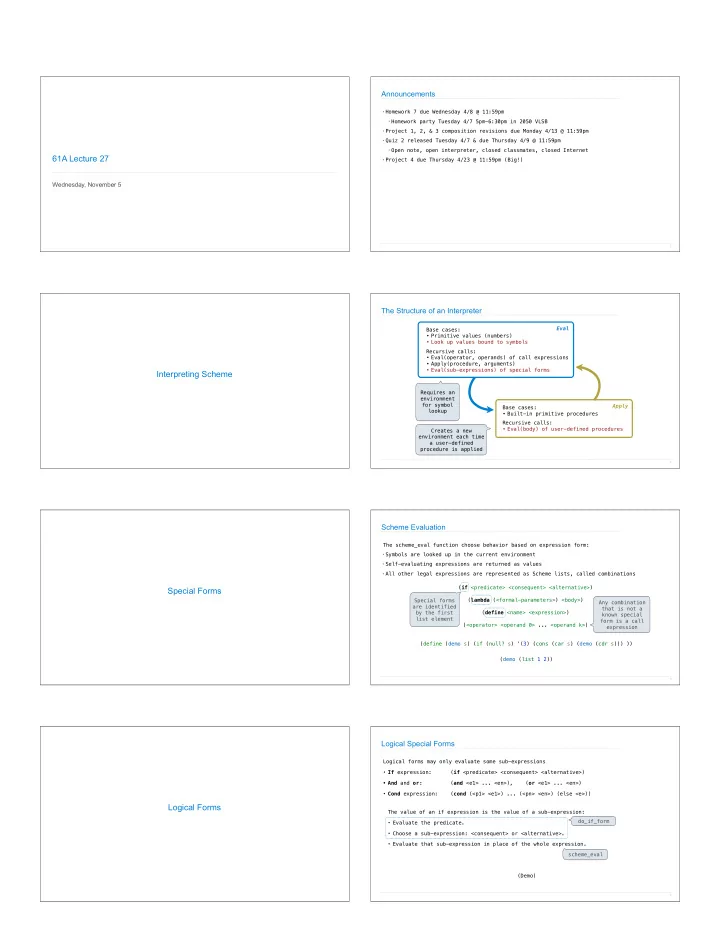
61A Lecture 27 Project 4 due Thursday 4/23 @ 11:59pm (Big!) - - PDF document

61a lecture 27
SMART_READER_LITE
LIVE PREVIEW

61A Lecture 27 Project 4 due Thursday 4/23 @ 11:59pm (Big!) - - PDF document

Announcements Homework 7 due Wednesday 4/8 @ 11:59pm Homework party Tuesday 4/7 5pm-6:30pm in 2050 VLSB Project 1, 2, & 3 composition revisions due Monday 4/13 @ 11:59pm Quiz 2 released Tuesday 4/7 & due Thursday 4/9 @


slide-1
SLIDE 1

61A Lecture 27

Wednesday, November 5

Announcements

  • Homework 7 due Wednesday 4/8 @ 11:59pm
§Homework party Tuesday 4/7 5pm-6:30pm in 2050 VLSB
  • Project 1, 2, & 3 composition revisions due Monday 4/13 @ 11:59pm
  • Quiz 2 released Tuesday 4/7 & due Thursday 4/9 @ 11:59pm
§Open note, open interpreter, closed classmates, closed Internet
  • Project 4 due Thursday 4/23 @ 11:59pm (Big!)
2

Interpreting Scheme

The Structure of an Interpreter

4

Apply Eval Recursive calls:

  • Eval(operator, operands) of call expressions
  • Apply(procedure, arguments)
  • Eval(sub-expressions) of special forms

Base cases:

  • Primitive values (numbers)
  • Look up values bound to symbols

Base cases:

  • Built-in primitive procedures

Recursive calls:

  • Eval(body) of user-defined procedures

Requires an environment for symbol lookup Creates a new environment each time a user-defined procedure is applied

Special Forms

Scheme Evaluation

The scheme_eval function choose behavior based on expression form:

  • Symbols are looked up in the current environment
  • Self-evaluating expressions are returned as values
  • All other legal expressions are represented as Scheme lists, called combinations

(if <predicate> <consequent> <alternative>) (define <name> <expression>) (lambda (<formal-parameters>) <body>) (<operator> <operand 0> ... <operand k>) Special forms are identified by the first list element Any combination that is not a known special form is a call expression (define (demo s) (if (null? s) '(3) (cons (car s) (demo (cdr s))) )) (demo (list 1 2))

6

Logical Forms

Logical Special Forms

Logical forms may only evaluate some sub-expressions

  • If expression: (if <predicate> <consequent> <alternative>)
  • And and or: (and <e1> ... <en>), (or <e1> ... <en>)
  • Cond expression: (cond (<p1> <e1>) ... (<pn> <en>) (else <e>))

The value of an if expression is the value of a sub-expression:

  • Evaluate the predicate.
  • Choose a sub-expression: <consequent> or <alternative>.
  • Evaluate that sub-expression in place of the whole expression.

do_if_form scheme_eval (Demo)

8
slide-2
SLIDE 2

Quotation

Quotation

The quote special form evaluates to the quoted expression, which is not evaluated (quote <expression>) The <expression> itself is the value of the whole quote expression '<expression> is shorthand for (quote <expression>) The scheme_read parser converts shorthand ' to a combination that starts with quote

10

(Demo) (quote (+ 1 2)) (+ 1 2) evaluates to the 
 three-element Scheme list (quote (1 2)) '(1 2) is equivalent to

Lambda Expressions

Lambda Expressions

Lambda expressions evaluate to user-defined procedures (lambda (<formal-parameters>) <body>) (lambda (x) (* x x)) class LambdaProcedure: def __init__(self, formals, body, env): self.formals = formals self.body = body self.env = env

12

A scheme list of symbols A scheme expression A Frame instance

Frames and Environments

A frame represents an environment by having a parent frame Frames are Python instances with methods lookup and define In Project 4, Frames do not hold return values

g: Global frame y z 3 5 f1: [parent=g] x z 2 4 13

(Demo)

Define Expressions

Define Expressions

Define binds a symbol to a value in the first frame of the current environment. (define <name> <expression>) (define (<name> <formal parameters>) <body>) (define <name> (lambda (<formal parameters>) <body>)) Procedure definition is shorthand of define with a lambda expression

  • 1. Evaluate the <expression>
  • 2. Bind <name> to its value in the current frame

(define x (+ 1 2))

15

Applying User-Defined Procedures

To apply a user-defined procedure, create a new frame in which formal parameters are bound to argument values, whose parent is the env attribute of the procedure Evaluate the body of the procedure in the environment that starts with this new frame (define (demo s) (if (null? s) '(3) (cons (car s) (demo (cdr s))))) (demo (list 1 2))

1 Pair 2 Pair nil [parent=g] s [parent=g] s [parent=g] s g: Global frame demo LambdaProcedure instance [parent=g] 16
slide-3
SLIDE 3

Eval/Apply in Lisp 1.5

17