7/30/2020 NYC YCHA A MOLD D TRAINING TR INING Building Scien - - PDF document

7 30 2020
SMART_READER_LITE
LIVE PREVIEW

7/30/2020 NYC YCHA A MOLD D TRAINING TR INING Building Scien - - PDF document

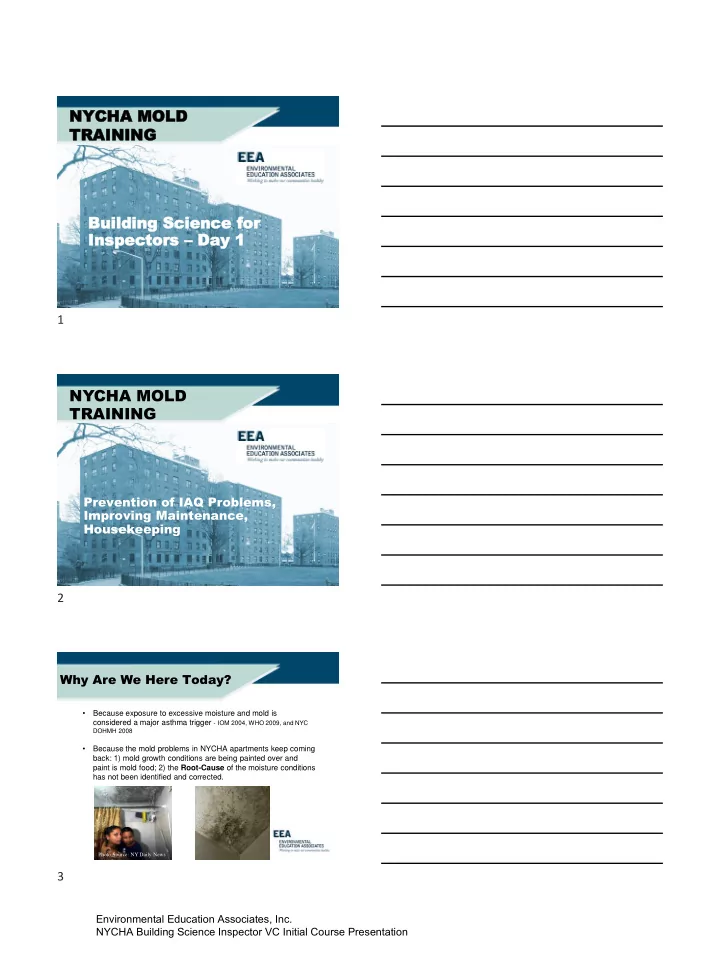
7/30/2020 NYC YCHA A MOLD D TRAINING TR INING Building Scien Bu Science fo for Inspe In spectors s Da Day y 1 1 NYCHA MOLD TRAINING Prevention of IAQ Problems, Improving Maintenance, Housekeeping 2 Why Are We Here Today?


slide-1
SLIDE 1

7/30/2020 1 Bu Building Scien Science fo for In Inspe spectors s – Da Day y 1 NYC YCHA A MOLD D TR TRAINING INING

Prevention of IAQ Problems, Improving Maintenance, Housekeeping

NYCHA MOLD TRAINING

Why Are We Here Today?

  • Because exposure to excessive moisture and mold is

considered a major asthma trigger - IOM 2004, WHO 2009, and NYC

DOHMH 2008

  • Because the mold problems in NYCHA apartments keep coming

back: 1) mold growth conditions are being painted over and paint is mold food; 2) the Root-Cause of the moisture conditions has not been identified and corrected.

Photo Source: NY Daily News

1 2 3

Environmental Education Associates, Inc. NYCHA Building Science Inspector VC Initial Course Presentation
slide-2
SLIDE 2

7/30/2020 2

  • >400,000 low-income residents
  • Childhood asthma at epidemic levels

(21.8%)

  • In 2013, with help from LSAFHS and

NRDC, NYCHA residents with asthma file class action lawsuit against NYCHA (Baez case). Residents prevail. Consent decree requires NYCHA to promptly and effectively identify and remediate mold and correct underlying moisture root causes.

  • NYCHA violates consent decree – court

appoints Special Master

Mold and the Asthma Epidemic in NYCHA Housing

Prevalence, Health Inequity, and Opportunity

Health Inequity – Asthma in Low- Income Housing

NYC Public Housing 22% asthma prevalence Typical NYC Apartment 12% asthma prevalence Private NYC Housing 7% asthma prevalence Over 24 million Americans have current asthma (7.8% of US population)1, CT 9.3%2 Over 6 million American children have asthma (8.4% of US population)1, CT 10.5%2 Wide health disparities in childhood asthma by housing type in NYC3

1 Center for Disease Control and Prevention. https://www.cdc.gov/asthma/mostrecentdata.html 2 State of Connecticut Department of Public Health. A Collaborative Approach for Addressing Asthma in Connecticut, 2009-2014. 3 Northridge, Jennifer et al. “The Role of Housing Type and Housing Quality in Urban Children with Asthma.” Journal of

Urban Health: Bulletin of the New York Academy of Medicine 87.2 (2010): 211-224. PMC. Web. July 2016.

Asth Asthma ma Preva valence Da Data

Northridge, et al. The role of housing type and housing quality in urban children with asthma. Journal

  • f Urban Health, 2010; vol 87, no. 2.

4 5 6

Environmental Education Associates, Inc. NYCHA Building Science Inspector VC Initial Course Presentation

slide-3
SLIDE 3

7/30/2020 3

Where Does Mold Grow in NYCHA?

  • The paint on plaster, concrete, and sheetrock walls/ceilings
  • The paper covering of sheetrock walls/ceilings (front/back and

top/bottom sides)

  • The covering of pipe-wrap insulation in wall cavities
  • Bathroom tile grout and caulking
  • Kitchen and bathroom cabinetry
  • Wood framing materials in wall cavities

Preventing Mold In NYCHA

  • Mold growth is always associated with excessive

moisture problems.

  • How do we prevent or control excessive moisture

and what are the Root-Causes of excessive moisture?

Root-Causes of Excessive Moisture in NYCHA

  • 1. Shower Vapor Condensation
  • 2. Plumbing Pipe Condensation
  • 3. Toilet Bowl/Tank Condensation
  • 4. Perimeter Wall Condensation
  • 5. Plumbing Leaks/Flooding
  • 6. Roof Leaks
  • 7. Façade Leaks
  • 8. Resident related

7 8 9

Environmental Education Associates, Inc. NYCHA Building Science Inspector VC Initial Course Presentation

slide-4
SLIDE 4

7/30/2020 4

Understanding Condensation

  • Why does

condensation form on the

  • utside of a cold

drink in the summer?

  • Dew point!

What is Dew Point?

Psychometric Chart

Warm air can hold more moisture than cold air. The dew point is reached when the air is cooled to the point

  • f saturation (100%

Relative Humidity). When this occurs we call it condensation

75° F 50% 55°F

Relative Humidity

  • The amount of moisture in the air at a

given temperature, as compared with the amount of moisture the air could hold before reaching saturation at that temperature

10 11 12

Environmental Education Associates, Inc. NYCHA Building Science Inspector VC Initial Course Presentation

slide-5
SLIDE 5

7/30/2020 5 Tempe emperatur ure

  • As temperature changes, so does

the amount of evaporation and moisture, or humidity, in the air.

  • Humidity increases as

temperatures cool and air approaches its dew points.

  • The dew point is the temperature

at which the atmosphere becomes saturated, and knowing it is critical to being able to measure humidity.

Humidity

  • Ideal relative humidity (R.H.) should be between 40% - 60%
  • Avoid extremes of R.H. (< 20% and > 80%)
  • Extremely low R.H. causes:

– eyes, noses & throats to dry; – produces irritations & soreness; – increases susceptibility to infection; – increases problems associated with static electricity.

  • High R.H. causes:

– high moisture; – promotes growth of fungi and mold

Cold Weather Condensation

  • Can occur when warm

moist interior air contacts cooler surfaces such as windows.

  • Condensation forms

when the surface temperature is below the dew point temperature for the interior air

13 14 15

Environmental Education Associates, Inc. NYCHA Building Science Inspector VC Initial Course Presentation

slide-6
SLIDE 6

7/30/2020 6

Warm Weather Condensation

  • Can occur when warm

moist interior air contacts cooler surfaces such as cold water pipes.

  • Toilet tanks containing cold

water often causes condensation

  • Hot showers can cause

condensation on “warm” surfaces

Shower Vapor Condensation

How do we Control Condensation?

  • Assure that bathrooms are equipped with adequate exhaust ventilation.
  • Clean/uncover bathroom exhaust grills and horizontals.
  • Repair rooftop exhaust fans: belts, motors, seating, timers.
  • Clean and assure proper function of backflow dampers.
  • How can residents help control condensation (see Controlling Mold in

Your Apartment document):

  • Monitor exhaust ventilation function (tissue trick) and condition of exhaust grill.

Notify building maintenance staff when repairs and/or cleaning is needed.

  • Discontinue the use of shower racks/clothes lines above bathtubs.
  • Try to limit the length of shower time. Open bathroom windows and doors after

showering.

  • In the summertime, lower humidity levels in your apartment by using an air-

conditioner.

  • Improve general ventilation in the apartment by keeping windows open slightly at

all times.

16 17 18

Environmental Education Associates, Inc. NYCHA Building Science Inspector VC Initial Course Presentation

slide-7
SLIDE 7

7/30/2020 7

Controlling Shower Vapor Condensation

  • Exhaust Grills

Covered or dirty grilles Loose or Broken Belts Broken timers Motor Problems Improper Seating of Housing Controlling Shower Vapor Condensation

  • Roof Fans

Controlling Shower Vapor Condensation

  • Backflow Dampers

19 20 21

Environmental Education Associates, Inc. NYCHA Building Science Inspector VC Initial Course Presentation

slide-8
SLIDE 8

7/30/2020 8

Root-Causes of Excessive Moisture in NYCHA

  • 1. Shower Vapor Condensation
  • 2. Plumbing Pipe Condensation
  • 3. Toilet Bowl/Tank Condensation
  • 4. Perimeter Wall Condensation
  • 5. Plumbing Leaks/Flooding
  • 6. Roof Leaks
  • 7. Façade Leaks
  • 8. Resident related

Condensation on Cold Water Pipes In Wall Cavities

Missing insulation on cold water riser Damaged insulation on cold water riser Missing insulation on cold water supply t

Conducting Wall-Breaks to Locate the Root-Cause of Excessive Moisture

  • When should you conduct a wall-break?
  • What should you be looking for?
  • How large of an opening should you make and when should you use a

borescope?

  • Dust control during wall-breaks

– Standard Procedure Lead Safety for Renovation, Repair, and Painting (SP 040:18:2)

  • Lead-based paint
  • Asbestos pipe wrap insulation
  • Look carefully, consider suspect ACM to be ACM.

See detailed discussion in Wall Break section on slides 127-136

22 23 24

Environmental Education Associates, Inc. NYCHA Building Science Inspector VC Initial Course Presentation

slide-9
SLIDE 9

7/30/2020 9

What’s Wrong with this Wall-Break?

What Should Have Been Done Differently?

Toilet Condensation

  • In Apartment

Toilet Condensation

  • From Above

25 26 27

Environmental Education Associates, Inc. NYCHA Building Science Inspector VC Initial Course Presentation

slide-10
SLIDE 10

7/30/2020 10

Perimeter Wall Condensation

???

Root-Causes of Excessive Moisture in NYCHA

  • 1. Shower Vapor Condensation
  • 2. Plumbing Pipe Condensation
  • 3. Toilet Bowl/Tank Condensation
  • 4. Perimeter Wall Condensation
  • 5. Plumbing Leaks/Flooding
  • 6. Roof Leaks
  • 7. Façade Leaks
  • 8. Resident related

Moisture Movement Rule #1

  • Liquid water will naturally tend to flow

laterally and vertically downward

  • It will follow the path of least resistance

28 29 30

Environmental Education Associates, Inc. NYCHA Building Science Inspector VC Initial Course Presentation

slide-11
SLIDE 11

7/30/2020 11

Plumbing Leaks/Flooding

Roof Leaks

Moisture Movement Rule #2

  • Moisture will enter into porous materials

due to capillary action

  • A solid piece of wood will draw water up

to 350-375 ft. ( height of the tallest tree)

  • A column of concrete placed in water

will draw moisture up to 10 KM or 6 miles.

31 32 33

Environmental Education Associates, Inc. NYCHA Building Science Inspector VC Initial Course Presentation

slide-12
SLIDE 12

7/30/2020 12 Moisture in Buildings

  • Capillary Action - The movement
  • f a liquid along the surface of a

solid caused by the greater attraction of the liquid's molecules to the surface of the solid than to each other. The liquid's molecules adhere to the solid surface and also to each other, so that each molecule pulls the next one along. Water moves through the roots of trees or into the pores of a sponge

  • r towel by capillary action.

Moisture in Buildings

  • Responsible for movement
  • f groundwater through

footing (footers) into concrete wall

  • Ring of dampness around

base of foundation wall

  • Perimeter drains help keep

water away from footers

Moisture in Buildings

  • Moisture can be drawn into an opening
  • f 3/16” or less
  • If two materials without capillary pores

are placed close enough together, they create a capillary pore that can draw moisture.

  • How close ?

34 35 36

Environmental Education Associates, Inc. NYCHA Building Science Inspector VC Initial Course Presentation

slide-13
SLIDE 13

7/30/2020 13 Moisture in Buildings

  • Answer 3/16 “ or less
  • l l the distance between these two lines

Moisture in Buildings

  • Materials like overlapping siding can

create capillary gaps

  • Capillary rise in wood siding
  • Film of water on surface of siding
  • Water film draws up between laps of

siding by capillary suction

  • Building paper
  • Sheathing

Façade Leaks 37 38 39

Environmental Education Associates, Inc. NYCHA Building Science Inspector VC Initial Course Presentation

slide-14
SLIDE 14

7/30/2020 14 Moisture Movement #3

  • Moisture moves through building

materials by vapor diffusion

  • Vapor diffusion is the movement of

moisture in a vapor state as a result of a vapor pressure difference (concentration gradient)

Moisture in Buildings

  • Permeance factor is a measure of

water flow through materials

  • Permeance factors (perms) specify the

vapor flow in grains of moisture per hour, through one square foot of material surface, at one inch of mercury (1” Hg) of vapor pressure

Moisture in Buildings

Q: How much water can be collected over an entire heating season in most cold climates?

40 41 42

Environmental Education Associates, Inc. NYCHA Building Science Inspector VC Initial Course Presentation

slide-15
SLIDE 15

7/30/2020 15 Moisture in Buildings

A: One-third quart of water can be collected by diffusion through a gypsum board without a vapor diffusion retarder. Whereas 30 quarts of water can be collected through air leakage.

Moisture Movement Rule #4

Moisture moves from hot to cold

– Moisture can move through building materials by diffusion or through a hole by air transport

Moisture Movement Rule #5

  • Moisture moves from an area of higher

air pressure to an area of lower air pressure

  • (air transport)

43 44 45

Environmental Education Associates, Inc. NYCHA Building Science Inspector VC Initial Course Presentation

slide-16
SLIDE 16

7/30/2020 16 Moisture in Buildings

Stack effect

  • Stack effect is caused by warm air rising within a

structure

  • As warm air rises, it creates a higher air pressure at

the ceiling area and forces air out of the building

  • As the air leaves, or exfiltrates, it is displaced with
  • utside air that is drawn into the building from the

floor area (infiltrates)

  • Stack effect can result in up to .5 ACH or 150 cfm in
  • ne home

Prevention & Control Measures

  • Inspection, Testing & Maintenance
  • Avoid development of contamination
  • Safe operating procedures
  • Improved Maintenance
  • Housekeeping

NYCHA MOLD TRAINING Understanding Building Systems

46 47 48

Environmental Education Associates, Inc. NYCHA Building Science Inspector VC Initial Course Presentation

slide-17
SLIDE 17

7/30/2020 17

Building Construction

Residential Properties are built according to:

  • Design Objectives
  • Building Code
  • Housing Code
  • Permitting Requirements

NYCHA Developments

  • Multi-story
  • Similar construction plans
  • Similar construction materials
  • Similar moisture problems

– Poor ventilation – Condensation – Leaks

  • Similar capital needs

Construction Documents

  • Specifications
  • Drawings
  • Addenda
  • Change Orders
  • Submittals
  • Shop drawings
  • As built drawings

49 50 51

Environmental Education Associates, Inc. NYCHA Building Science Inspector VC Initial Course Presentation

slide-18
SLIDE 18

7/30/2020 18

  • Physical Layout
  • Building Plans
  • Architectural Plans
  • Structural Plans
  • Mechanical Plans
  • Plumbing Plans
  • Electrical Plans
  • HVAC Plans

Understanding Building Systems

Understanding Building Systems: Building Plans

  • Floor plans are basis for mechanical,

plumbing & electrical drawings

  • Include elevations (vertical)
  • Details (Isolated areas of construction)
  • Sections (Cut vertically)
  • Notes (General or specific)
  • Schedules (Info regarding building)

Architectural Plans

52 53 54

Environmental Education Associates, Inc. NYCHA Building Science Inspector VC Initial Course Presentation

slide-19
SLIDE 19

7/30/2020 19

Understanding Building Systems: Structural Plans

  • Details of floors, framework and

foundations

  • Structural beams, columns and slabs
  • Wood framing
  • Drywall/gypsum or Plaster
  • Concrete versus steel beams

Structural Plans

Understanding Building Systems: Mechanical Plans

  • Based on building floor plans
  • HVAC schematic or system design/diagram

to indicate the HVAC system operation.

  • Ductwork routing and piping systems.
  • Details, notes, schedules, sections and

elevations.

  • Boilers, radiators and air handling units.

55 56 57

Environmental Education Associates, Inc. NYCHA Building Science Inspector VC Initial Course Presentation

slide-20
SLIDE 20

7/30/2020 20 Mechanical Plans

Understanding Building Systems: Plumbing Plans

  • Location of tanks, pipes & drains for supply

& return fluids, waste & pressure equalizer pipes

  • Locates remediation/clean-up water supply

sources

  • Quantities of materials in inaccessible areas
  • Used to estimate quantities of potential mold

contamination on building materials or surfaces

Plumbing Drawings

58 59 60

Environmental Education Associates, Inc. NYCHA Building Science Inspector VC Initial Course Presentation

slide-21
SLIDE 21

7/30/2020 21

Understanding Building Systems: Electrical Plans

  • Based on floor, power & lighting plans
  • Includes Notes, schedules & details
  • Calculations for load requirements
  • Location of panels, switches, receptacles,

etc.

  • ID’s paper insulation, cable wrap &

cementitious panels

  • ID’s temporary electric service needs

Electrical Plans Ventilation & HVAC NYCHA MOLD TRAINING

61 62 63

Environmental Education Associates, Inc. NYCHA Building Science Inspector VC Initial Course Presentation

slide-22
SLIDE 22

7/30/2020 22 HVAC

  • Heating
  • Ventilation
  • Air Conditioning
  • Temperature Control
  • Cooling
  • Heating
  • Humidity Control
  • Humidification
  • Dehumidification
  • Air Quality Control
  • Ventilation
  • Cleaning

HVAC Systems Primary Functions

Air Movement

  • Too little air flow causes

stuffy and uncomfortable environment;

  • Too much causes draught

& excessive cold.

  • Internal partitioning &

clutter creates “dead spaces”.

64 65 66

Environmental Education Associates, Inc. NYCHA Building Science Inspector VC Initial Course Presentation

slide-23
SLIDE 23

7/30/2020 23

NYCHA & & Venti tilati tion - Guiding Question stions

  • Why is ventilation

important?

  • How is it achieved in

NYCHA buildings (and

  • thers)?
  • What are the most

common problems?

  • What are some best

practices for resolving these problems?

Purpo urpose se of

  • f Exh

xhau aust st Venti tilati tion

To remove pollutants at their source:

– Kitchens; Cooking grease, water vapor, gas, CO – Bathrooms; Moisture = Mold

  • To provide adequate fresh

air to a space

  • Required by NYC Building

Code

Ventilation

  • Natural Ventilation

– Operable window

  • Central Exhaust Rooftop Fans

– Vertical shafts – Horizontal takeoffs – Wall or ceiling grilles

  • In-line fans

– Small fan in the duct – Most energy efficient

  • Continuous vs. Intermittent

67 68 69

Environmental Education Associates, Inc. NYCHA Building Science Inspector VC Initial Course Presentation

slide-24
SLIDE 24

7/30/2020 24

Eva valuati ting The Venti tilati tion Sys ystem tem

  • Does the building have a ventilation system?
  • Is the system on all the time?
  • Is the system continuous or does it go on and
  • ff during the day?
  • Does each room have a vent?
  • Are the vents supplying or removing air?

Ventilation Ce Central Exh Exhaust st

  • 65% of NYCHA homes have

mechanical ventilation in bathrooms

  • Approximately 114,000 units
  • In the process of updating

these numbers for more accuracy

Examp mples s of f Exhaust st Venti tilati tion

70 71 72

Environmental Education Associates, Inc. NYCHA Building Science Inspector VC Initial Course Presentation

slide-25
SLIDE 25

7/30/2020 25 Steps for Initial Inspection

  • 1. Generate inspection work order

Maximo will generate a roof fan IN (Inspection Work Order) for each building to the craft of SUPT (Property Maintenance Supervisor). This work order will be a paper ticket and will transition to the handheld in the future. On the Inspection Tab, there will be a series

  • f tasks listed with questions.

Ventilation Systems

Grill & duct uild up is common and fungal growth can attach to that

  • debris. While we do not remove registers and air vents we must

ensure that we visually verify that debris and dust has not accumulated in the ducting and providing a growth platform for mold.

Functioning Roof Fan

73 74 75

Environmental Education Associates, Inc. NYCHA Building Science Inspector VC Initial Course Presentation

slide-26
SLIDE 26

7/30/2020 26

  • 2. Override fan timers

NYCHA’s new policy is that roof fans must be operating 24 hours a day. The PMS must override the fan timers to ensure fans are operating continuously.

  • a. On the inspection work order, Task 10, Question 1 asks whether the fan

timers have been overridden to allow them to operate on continuously. This is a mandatory question in the inspection work order.

  • b. The PMS is required to locate and bypass the existing roof fan timer(s)

by removing the Off Pin and then tripping the Override or Bypass Switch (see supplemental section). Timers can be in a basement or a roof top distribution room.

  • c. After the timers are bypassed, the PMS must secure the timer cover.

The PMS should also attach a sign to indicate that the timer has been

  • bypassed. (Staff may create their own sign or use the one attached to this

notice.)

Steps for Initial Inspection Steps for Initial Inspection

  • 4. Ensure fans are operational

The PMS must physically inspect each roof fan and confirm airflow from base of fan housing. The results must be recorded in the Inspection work order.

  • a. Task 20, Question 2 will ask whether a specific fan is
  • perational. If the fan is not operational and requires repairs,

staff should enter an “unsatisfactory” result in Maximo. This will automatically create a child work order for each inoperative roof fan. This should be repeated for each of the roof fans on the building.

Steps for Initial Inspection

  • 5. Repair roof fans that are not operating properly
  • a. Information on roof fan repairs is provided in Section

Y below.

  • b. Staff may need to use a vendor for repairs.
  • c. Once the roof fan has been repaired and is
  • perational, the PMS should enter a CAT

(Corrective Action Taken) in Maximo to create a Closed Child Work Order.

76 77 78

Environmental Education Associates, Inc. NYCHA Building Science Inspector VC Initial Course Presentation

slide-27
SLIDE 27

7/30/2020 27 Fan Maintenance and Repair - Note!

The predominant fans installed throughout the NYCHA portfolio were manufactured by Greenheck and are Direct (model NYD) or Belt Drive driven (model NYB). For complete manufacturer’s maintenance recommendations and troubleshooting, please refer to Greenheck fan info in the Appendix.

Fan Drives

Dir irect ect D Driv ive e Belt elt Driv iven en ??? Fan Maintenance and Repair – Critical Items

To determine fan model number if manufacturer name plate is illegible or missing:

  • 1. Review Development Blueprints or QWEB for

Heating and Ventilation Plans (see examples below). Instructions for accessing QWEB are attached with this guidance.

  • 2. Refer to the Greenheck Catalog sheet which lists the

fan Curb Dimensions. See Table 1 on page 2, column A, which will narrow your choices.

79 80 81

Environmental Education Associates, Inc. NYCHA Building Science Inspector VC Initial Course Presentation

slide-28
SLIDE 28

7/30/2020 28

Fan Maintenance and Repair – Critical Items

To determine Motor HP and RPM:

  • 1. Motor is to be sized correctly for Horse

Power and RPM as per original specifications.

  • 2. Review Development Blueprints or QWEB for

Heating and Ventilation Plans.

  • 3. Refer to Greenheck Catalog Performance

Data (pages 3-4 of the Greenheck catalog – see Appendix).

Fan Maintenance and Repair – Critical Items

Below are the steps you should follow to ensure that fans are operating correctly.

  • 1. All bolts must be installed by connecting the base plate

to fan housing. This will decrease vibration/noise issues. Rubber isolators (double studded) that are worn out must be replaced, as this will also cause vibration/noise issues.

  • 2. Individual fan disconnect switch must be equipped with

the correct size fuse.

  • 3. Belts must be properly installed and tensioned.

Fan Maintenance and Repair – Critical Items

  • 4. Impeller to Inlet Cone (venturi) must have correct overlap

and must be centered properly (See fan Info Sheet Figure 2).

  • 5. Belt Driven Models- Impeller Shaft bearings must be

properly greased.

  • a. Pulleys must be properly aligned.
  • 6. All roof fans are equipped with a Backdraft Damper which

must operate freely.

  • a. Clean using a HEPA vacuum if excessively dirty.
  • b. Only use a Dry Lubricant (graphite or molybdenum

disulfide based product) on the Pivot points.

82 83 84

Environmental Education Associates, Inc. NYCHA Building Science Inspector VC Initial Course Presentation

slide-29
SLIDE 29

7/30/2020 29

Process Detail for Ongoing Monthly Inspection

  • Maximo will generate a monthly inspection work
  • rder for roof fans. Developments will be required to

do the inspections monthly and to repair any defective roof fans within 21 days by utilizing either in-house staff or a vendor.

  • Staff should follow the same steps as the initial

inspection described above, although once the timer has been bypassed, staff do not have to adjust it again unless there is a problem.

Solutions: Next Level Stuff

  • Remote fan power monitoring to

see functionality of rooftop equipment and diagnose problems from your desk.

  • Remote monitoring sensors to

track IAQ (temperature, humidity, etc.) and predict mold growth.

  • Both currently being piloted at

NYCHA through Tech Pilot Program!

Air Conditioning

  • NYCHA residential units

do not have central air conditioning

  • Window units account for

efforts to cool spaces

85 86 87

Environmental Education Associates, Inc. NYCHA Building Science Inspector VC Initial Course Presentation

slide-30
SLIDE 30

7/30/2020 30 Problem - Air Conditioning

  • Leaking or poorly

installed AC units can result in water damage and mold contamination in the unit and on adjacent building materials

Solution – Air Conditioning

  • Install according to the

manufacturers instructions

  • Remove obstructions to

drainage

  • Clean with an anti-microbial

cleaner

  • Change filters on a regular

basis

Break

  • Done for now

88 89 90

Environmental Education Associates, Inc. NYCHA Building Science Inspector VC Initial Course Presentation

slide-31
SLIDE 31

7/30/2020 31

NYCHA MOLD TRAINING

IWM APP REVIEW

Handheld informer Work Management Training – Mold Inspection Page 92 December 2018

MOLD/MILDEW WO Workflow

NO Mold was Found…

Complete Evaluation of Conditions Select Mold Inspection Work Order Begin Again or End No Condition Found Archive Results & Close WO NO QA WO is Generated Handheld informer Work Management Training – Mold Inspection Page 93 December 2018

MOLD/MILDEW WO Workflow - (Continued)

Mold is Found …Doing the Work (Part 1)…

Complete General Evaluation Select Mold Inspection Work Order Mold Condition Found Complete Evaluation of Conditions Select Remediation method Complete Identification & Causes

91 92 93

Environmental Education Associates, Inc. NYCHA Building Science Inspector VC Initial Course Presentation

slide-32
SLIDE 32

7/30/2020 32

Handheld informer Work Management Training – Mold Inspection Page 94 December 2018 Archive Results & Close WO

MOLD/MILDEW WO Workflow - (Continued)

Mold is Found …Doing the Work (Part 2)…

Complete Follow Up WOs Generate Follow Up Work Orders Generate Verification Inspection WO Complete Inspection on Verification WO

Close Completed Verified WO Handheld informer Work Management Training – Mold Inspection Page 95 December 2018

Work Order Workflow

Doing the work…

Ad Hoc (Optional) Materials Used (Optional) Enter Work Log Enter Signatures Communication Log Handheld informer Work Management Training – Mold Inspection Page 96 December 2018

Work Order Workflow

Stop Timer Begin Again or End

Ending the work…

  • Edit or Add Labor

Maximo Generate Child Work Orders Check Related Work Orders in Maximo

Submit Work Order

94 95 96

Environmental Education Associates, Inc. NYCHA Building Science Inspector VC Initial Course Presentation

slide-33
SLIDE 33

7/30/2020 33

Handheld informer Work Management Training – Mold Inspection Page 97 December 2018

View Work Order Details

The WO List screen shows a detailed summary about each WO. Priority Development WO Number Address Room/Location Failure Class Problem Code Location String Reported By Date Owner Group WO Type Craft

H G F E D C B A I J K B E F G I A C J K H D L L

Handheld informer Work Management Training – Mold Inspection Page 98 December 2018

NYCHA Locations Explained

  • Developments
  • Buildings
  • Stair Halls
  • Floors
  • Apartments

Examples of NYCHA Locations:

  • Rooms (bedroom, bathroom, etc.)
  • Heating Plumbing Line
  • Grounds
  • Elevators
  • Community Centers

Handheld informer Work Management Training – Mold Inspection Page 99 December 2018

Launch the iWM Application

Tap on the Work Management Application to access the Log In screen.

1 1

97 98 99

Environmental Education Associates, Inc. NYCHA Building Science Inspector VC Initial Course Presentation

slide-34
SLIDE 34

7/30/2020 34

Handheld informer Work Management Training – Mold Inspection Page 100 December 2018

Log In To iWM Application

Enter User Name and Password Tap LOGIN * It is the same User Name and Password as Maximo, and Your Computer. NOTE: Make sure you are in an area that has good cell service.

2 2 1 1

Handheld informer Work Management Training – Mold Inspection Page 101 December 2018

Menu

Show My Work Orders: Shows

  • pen WOs assigned to the user

who is logged-in. Show Assigned Work Orders: Shows Open WOs that are assigned to other users in the user’s area (Development or Borough) Show Unassigned Work Orders: Shows Open WOs that are not assigned to any person. Show Court Work Orders Today: Shows Open WOs where resident has an appointment for today. Show Reinspection Work Orders: Shows all automatically generated WOs as a result of the completed QA Mold Inspection.

1 2 3 4 1 2 3 4 5 5

Handheld informer Work Management Training – Mold Inspection Page 102 December 2018

Viewing Work Orders - Types

Work Orders can be filtered and sorted by Work Order type, there is no default. Show All Work Types displays all open Work Orders for the Development. Show CM / DM Work Orders displays all Corrective Maintenance and Deferred MaintenanceWork Orders. Show Inspection Work Orders displays all the InspectionWork Orders.

1 2 1 2 3 3

100 101 102

Environmental Education Associates, Inc. NYCHA Building Science Inspector VC Initial Course Presentation

slide-35
SLIDE 35

7/30/2020 35

Handheld informer Work Management Training – Mold Inspection Page 103 December 2018

How to View Work Orders - Sorting

The Menu is displayed. There are five

  • ptions in which to sort your Work

Orders: Sort by Priority defaults Work Orders based upon Priority level, with highest priorities first. Sort by Work Order Number sorts the Work Orders is a descending order. Sort By Development Name sorts the Work Orders by Development name in descending order. Sort by Scheduled Start sorts Work Orders based on the Date and Time the work is scheduled to begin. Sort by Reported Date sorts Work Orders based on the Dates the complaint was made.

1 2 1 4 3 5 2 4 5 3

Handheld informer Work Management Training – Mold Inspection Page 104 December 2018

Viewing Work Orders

All of the WOs that you’ll always see are in the user’s area/location (Borough Wide Development / Managed BY). Tap the Menu Button to go to the Menu in order to sort the list of Unassigned Work Orders in a different way.

1 1

Handheld informer Work Management Training – Mold Inspection Page 105 December 2018

How To Search For Work Orders

You can search for Work Orders by tapping on the small magnifying glass The default search criteria is ALL where you can use the keyboard and type a Work Order number to search for. Use the keyboard and start typing the first few numbers

  • f a WO and the system

displays all the Work Orders that start or begin with these numbers.

1 2 3 3 2 1

103 104 105

Environmental Education Associates, Inc. NYCHA Building Science Inspector VC Initial Course Presentation

slide-36
SLIDE 36

7/30/2020 36

Handheld informer Work Management Training – Mold Inspection Page 106 December 2018

How To Search For Work Orders

To search for more criteria, tap on  the down arrow and a list displays with all available search options. You can search by ALL, Work Order Number, Failure Code, Craft, Sub Work Type, Location, Owner Group, Development, and Address. Select the search option you wish to explore and type a new search criteria. Tap on Failure Code and use the keyboard and start typing for this example, door. The system displays all the WOs with this criteria.

1 2 2 3 4 4 3 1

Handheld informer Work Management Training – Mold Inspection Page 107 December 2018

How To Search For Work Orders – ONLY Supervisors

Tap Show Assigned Work Orders from the Menu screen. To search for a particular worker assignment, tap on the down arrow  and a list displays with all available search options. Select Assigned To search option from the criteria list. Type the worker name on the keyboard, then tap DONE on the

  • keyboard. The system displays all the

Work Orders assigned to this worker. NOTE: The Assigned To option ONLY appears when Show Assigned Worker Orders is selected. You can

  • nly search for one name at a time.

1 2 1 2 3 4 3 4

Handheld informer Work Management Training – Mold Inspection Page 108 December 2018

Viewing Related Work Orders

Related Work Order - An open Work Order for the same apartment and non- apartment locations display.

1 1

106 107 108

Environmental Education Associates, Inc. NYCHA Building Science Inspector VC Initial Course Presentation

slide-37
SLIDE 37

7/30/2020 37

Handheld informer Work Management Training – Mold Inspection Page 109 December 2018

Viewing Related Work Orders – (Continued)

After viewing the Related Work Order listing, tap the device back arrow the Work Order Details screen redisplay.

1 1

Handheld informer Work Management Training – Mold Inspection Page 110 December 2018

Mold Work Orders Process - Inspection

The first Parent Work Order appears in:

  • Show Unassigned Work Orders
  • Show CM /DM Work Orders

NOTE: If the Work Order is assigned to a worker it will appear in Show Assigned Work Orders or Show My Work Orders.

1 1

Handheld informer Work Management Training – Mold Inspection Page 111 December 2018

Mold Work Orders Process - QA

The first QA Work Order appears in:

  • Show Unassigned Work Orders
  • Show Inspection Work Orders

NOTE: The QA Work Order is automatically generated in Maximo 25-days, and the new Target Start Date will be set to 30 days after the last Child Work Order is closed (or 25-days after the mold inspection gets closed if no children are created). The Target Finish Date is set to 15 days after the Target Start Date. If either Target Start Date or Target Finish Date fall on a weekend or a holiday, then next business day.

1 1

109 110 111

Environmental Education Associates, Inc. NYCHA Building Science Inspector VC Initial Course Presentation

slide-38
SLIDE 38

7/30/2020 38

Handheld informer Work Management Training – Mold Inspection Page 112 December 2018

Mold Re-Inspection Work Orders Process

The first Re-Inspection Work Order appears in:

  • Show Reinspection Work Orders
  • Show CM / DM Work Orders

NOTE: Maximo creates the Re- Inspection Work Order immediately and the person who submits the QA Work Order, should see the Reinspection Work Order on his device and right there and then complete and submit Re-Inspection results.

1 1

Handheld informer Work Management Training – Mold Inspection Page 113 December 2018

QA: MOLD/MILDEW WO Workflow

NO Mold was Found…

Complete Evaluation of Conditions Select Mold Inspection Work Order Begin Again or End No Condition Found Archive Results & Close WO NO QA WO is Generated

QA

Handheld informer Work Management Training – Mold Inspection Page 114 December 2018 Wait 25Days After Verify ALL Items on WO Begin Again

  • r End

Create a NEW Re-Inspection WO Complete and Close ALL Child WOs

Found A Condition Submit WO QA WO is Generated

QA and Re-Inspection Work Order Workflow

More Issues QA FAILS NO Issues PASSED New or More Issues FOUNDED

Mold was Found…

112 113 114

Environmental Education Associates, Inc. NYCHA Building Science Inspector VC Initial Course Presentation

slide-39
SLIDE 39

7/30/2020 39

Handheld informer Work Management Training – Mold Inspection Page 115 December 2018

Create a NEW CHILD WO

NO Condition FOUND Submit WO

QA WO is Generated

Different Paths for QA …

New or More Issues FOUNDED AUTO generate Re-Inspection WO More Issues QA FAILS NO Issues PASSED Improper Work QA FAILS

Handheld informer Work Management Training – Mold Inspection Page 116 December 2018

Mold Work Orders Process - QA

The first QA Work Order appears in:

  • Show Unassigned Work Orders
  • Show Inspection Work Orders

NOTE: The QA Work Order is automatically generated in Maximo 25-days, and the new Target Start Date will be set to 30 days after the last Child Work Order is closed (or 25-days after the mold inspection gets closed if no children are created). The Target Finish Date is set to 15 days after the Target Start Date. If either Target Start Date or Target Finish Date fall on a weekend or a holiday, then next business day.

1 1

Handheld informer Work Management Training – Mold Inspection Page 117 December 2018 Wait 25Days After Found A Issue Create NEW WO Begin Again

  • r End

Complete and Close ALL Child WOs QA WO is Generated Create a NEW Re-Inspection WO

Re-Inspection Work Order Cycle Workflow

NO Issues PASSED New or More Issues FOUNDED

Mold was Found…

Wait 25 Days After Complete and Close ALL Child WOs

More Issues YES

115 116 117

Environmental Education Associates, Inc. NYCHA Building Science Inspector VC Initial Course Presentation

slide-40
SLIDE 40

7/30/2020 40

Handheld informer Work Management Training – Mold Inspection Page 118 December 2018

Re-Inspection Work Order

The Re-Inspection Work Order is autogenerated if you answer YES to one of the first 3 questions on the QA (Evaluation of Conditions). It’s a new parent WO that is auto- related to the QA (and the first

  • riginal inspection).

The Re-Inspection Work Order appears in Show Reinspection Work Orders and Show CM/DM Work Orders.

1 1

Practical Exercises & Simulation

Building uilding Science cience - Ins nspect pector

  • r

118 119

Environmental Education Associates, Inc. NYCHA Building Science Inspector VC Initial Course Presentation

slide-41
SLIDE 41

7/30/2020 1 Bu Building Scien Science fo for In Inspe spectors s – Da Day y 2 NYC YCHA A MOLD D TR TRAINING INING

Work Area Preparation

NYCHA MOLD TRAINING

SP 040:18:2 , Lead Safety for RRP – Site Prep

In apartments, discuss the following with the resident:

  • Extent of containment needed
  • How the containment area will be prepared
  • Advise residents not to enter the containment area until after

clean-up

  • Direct residents not to allow children to enter any area in which

plastic sheeting is being used or stored due to the risk of suffocation

1 2 3

Environmental Education Associates, Inc. NYCHA Building Science Inspector VC Initial Course Presentation

slide-42
SLIDE 42

7/30/2020 2

Ove verview of rview of Containme tainment

  • The goal of containment is to

limit the spread of mold throughout the building in

  • rder to minimize the

exposure of remediators and building occupants to mold.

  • The larger the contaminated

area, and the greater the possibility that someone will be exposed to mold, the greater the need for containment.

Preparing the Work Area

  • Pre-cleaning
  • Remove objects
  • Installation of critical barriers / Isolation

Barriers

  • Plasticizing Surfaces
  • Installing doorway flap

EPA Guidelines f s for Containme tainment

Two types of containment are described in EPA's mold remediation guidance:

  • Limited- Limited containment is generally used for

areas involving between 10 and 100 square feet of mold contamination.

  • Full containment- is used when areas larger than

100 square feet are to be remediated or in cases where it is likely that mold could be spread throughout the building during remediation

4 5 6

Environmental Education Associates, Inc. NYCHA Building Science Inspector VC Initial Course Presentation

slide-43
SLIDE 43

7/30/2020 3

Limite Limited C d Cont

  • ntainment

ainment

  • A single layer of 6-mil fire-retardant polyethylene

sheeting enclosing the moldy area.

  • Access to the contained area is through a slit entry

covered by a flap on the outside of the containment area.

  • containment is generally recommended for areas

involving 10 to 100 square feet of mold contamination.

Limite Limited C d Cont

  • ntainment

ainment

  • In small areas, the

polyethylene sheeting can be secured to the floor and ceiling with duct tape. In other areas, a frame of aluminum or wooden studs can be built to hold the polyethylene sheeting.

7 8 9

Environmental Education Associates, Inc. NYCHA Building Science Inspector VC Initial Course Presentation

slide-44
SLIDE 44

7/30/2020 4

  • All supply and air vents, doors, and pipe

chases in the containment area must be sealed with polyethylene sheeting to minimize the spread of mold and mold spores to other areas of the building. Stairs should also be sealed if a riser is missing or open.

Limite Limited C d Cont

  • ntainment

ainment

Installation of Critical Barriers Wo Work Ar Area Pre Prep

  • Pre-clean and install critical barriers
  • Barriers are constructed to seal off all
  • penings and penetrations to the work

area

  • Barriers to be constructed of 6 ml fire-

retardant poly sealed with duct tape

10 11 12

Environmental Education Associates, Inc. NYCHA Building Science Inspector VC Initial Course Presentation

slide-45
SLIDE 45

7/30/2020 5

Warning Signs

  • Shall be displayed at

all accessible entrances to remediation areas

  • Should be in the

language of the local population

  • Should only be

removed after final clean

  • Pre-clean and

remove all movable objects using a HEPA- filtered vacuum and or wet cleaning

Pre Preparing the Wo Work Ar Area

SP 040:18:2 , Lead Safety for RRP – Site Prep

  • Secure the apartment and/or work area

against unauthorized entry.

  • Move all objects out of the room, if

possible.

13 14 15

Environmental Education Associates, Inc. NYCHA Building Science Inspector VC Initial Course Presentation

slide-46
SLIDE 46

7/30/2020 6 Preparing the Work Area

SP 040:18:2 , Lead Safety for RRP – Site Prep

  • Cover all items which were not moved

from the work area with one layer of disposable polyethylene sheeting. The sheeting must be taped together with duct tape, and taped to the floors or bottom of the walls or baseboards, to form a continuous barrier to the penetration of dust.

Installation of Floor Poly

16 17 18

Environmental Education Associates, Inc. NYCHA Building Science Inspector VC Initial Course Presentation

slide-47
SLIDE 47

7/30/2020 7

Work Area Prep

  • If you are working in a

development with known lead- based paint or lead components polyethylene sheets should cover all horizontal surfaces in the room where the repairs occur.

  • The entrance door should also

be covered and weighted at the base to prevent dust from entering other rooms.

Installation of Wall Poly Wo Work Ar Area Pre Prep

  • Regulated abatement area must be

cleaned (HEPA vac and/or wet methods)

– Methods that raise dust are prohibited

  • Pre-cleaning intended for preparation

work only!

– No disturbance of visible mold until containment is established

19 20 21

Environmental Education Associates, Inc. NYCHA Building Science Inspector VC Initial Course Presentation

slide-48
SLIDE 48

7/30/2020 8 Installation of Critical Barriers Non-Movab vable It Items ms

  • Items which can’t be moved must be cleaned,

covered and sealed with a layer of 6 ml poly to protect them from damage and contamination

Clean Up

  • Once the temporary wall closure is complete,

use a HEPA-filter vacuum to remove dust, then wet wipe the work area using a clean rag or moistened towel to remove any remaining dust.

  • If you suspect lead is present, use a clean rag
  • r moistened towel with lead-specific

detergent to wipe down the work area.

22 23 24

Environmental Education Associates, Inc. NYCHA Building Science Inspector VC Initial Course Presentation

slide-49
SLIDE 49

7/30/2020 9 Work Area Prep

The time invested in prepping the work area is easily regained during the clean- up phase. Mold Remediation – Containment Barrier

Work Area Prep

  • Hands – On: Prepare an enclosure fro

containing mold contamination

NYCHA MOLD TRAINING

Wall Breaks

25 26 27

Environmental Education Associates, Inc. NYCHA Building Science Inspector VC Initial Course Presentation

slide-50
SLIDE 50

7/30/2020 10 Wall Breaks

www.environmentaleducation.com

  • When opening a wall to perform or prepare for repairs, staff must take

the necessary precautions to protect residents and staff from mold, asbestos, and lead.

  • This guidance details the steps staff must take before, during, and

after the wall break. Instructions on temporary wall closures are also included in this guidance; temporary wall closures are an important customer service practice that must be implemented until permanent repairs can be completed.

  • Maintenance workers, bricklayers, carpenters, plumbers, plasterers and

roofers are responsible for performing repairs that require wall breaks, and are responsible for following the below guidance.

Asbestos Pipe Insulation

ACM Pipe insulation

  • Asbestos containing

thermal system insulation (TSI) may be present in wall cavities.

  • Avoid disturbing and

contact Tech Services if TSI is disturbed or must be disturbed

Work Area Prep

After determining that a wall break must be performed, staff must immediately obtain the necessary supplies before proceeding with repairs. Supplies include, but are not limited to:

  • 6 mil polyethylene sheets
  • duct tape
  • a spray bottle
  • a sheet of pre-cut Masonite

28 29 30

Environmental Education Associates, Inc. NYCHA Building Science Inspector VC Initial Course Presentation

slide-51
SLIDE 51

7/30/2020 11

Precautions while preforming repairs; Temporary Wall Closure

  • Where possible, score painted walls with a utility knife or use a

pry bar or chisel to open a glazed wall. Sawing and drilling should be avoided, if possible, as they produce significantly more dust and make containment and clean up more difficult.

  • The wall opening should measure 1’ by 1’ when done for

exploratory purposes (e.g., locating a leak), 2’ by 2’ for smaller repairs, and 4’ by 4’ for larger repairs.

  • By opening the wall according to these standard sizes, staff can

quickly and easily create a temporary closure using pre-cut

  • Masonite. Developments should maintain a stock of Masonite

cut in these sizes to fit the standard wall opening.

Precautions while preforming repairs; Temporary Wall Closure

  • Staff must make a temporary closure over the
  • pening so that residents are not left with an open

wall until final repairs can be completed. Staff should place a pre-cut Masonite sheet over the opening and screw in to secure it. The edges should be covered with duct tape to seal it.

Precautions while preforming repairs; Temporary Wall Closure

  • When the wall opening is performed on a tub wall,

staff must waterproof the temporary Masonite

  • closure. Use a new piece of polyethylene sheeting to

cover the affected wall from the side and top edges to the tub ledge and extend 12 inches past the corner

  • nto the adjacent wall, securing all edges with duct

tape.

  • Carefully cut an opening for the tub spout and shower

controls, and tape down edges as thoroughly as possible.

31 32 33

Environmental Education Associates, Inc. NYCHA Building Science Inspector VC Initial Course Presentation

slide-52
SLIDE 52

7/30/2020 12

Precautions while preforming repairs; Temporary Wall Closure – Note!

  • Staff are required to detail that a wall opening

has been performed on a tub wall in the notes section of the work order. The subsequent permanent repairs must be expedited in order to prevent potential damage to apartments

  • below. To do so, staff must also notify the

development supervisor(s), who will inform the Planning Unit that the follow-up work

  • rder must be prioritized.

NYCHA MOLD TRAINING Cleaning Exhaust Vents Common Problems: Exhaust Grill

Closed Dirty

Not sealed

34 35 36

Environmental Education Associates, Inc. NYCHA Building Science Inspector VC Initial Course Presentation

slide-53
SLIDE 53

7/30/2020 13 Co Commo mmon Pro Problems: ms: Du Duct Sha Shaft ft

Bl Blocked Di Dirty

Commo mmon Pr Problems ms Imba Imbalance

Over-ventilation – Wastes energy Under-ventilation – Leads to poor IAQ and possible mold

Solut Solutions: s: Ve Ventilation Up Upgrades! s!

  • Clean duct

shafts/branches

  • Clean or replace

exhaust grilles

37 38 39

Environmental Education Associates, Inc. NYCHA Building Science Inspector VC Initial Course Presentation

slide-54
SLIDE 54

7/30/2020 14

Instructions for Cleaning Horizontal Vent Ductwork

www.environmentaleducation.com When cleaning horizontal vent ductwork from inside the apartment, employees: (1) Remove the face of the grill to the vertical shaft and HEPA-vacuum the grill and the interior and exterior of the horizontal vent ductwork. (2) Must use caution when cleaning the fire damper inside the ductwork.

NYCHA MOLD TRAINING Pipe Insulation Background

www.environmentaleducation.com

  • When performing repairs that require a wall break and/or repairs

to water/ fire system piping or heat supply lines, NYCHA has the

  • pportunity to quickly and efficiently retrofit piping with insulation

in accordance with New York City code.1

  • This Interim Guidance provides information on how to inspect

and install insulation when a wall break has been performed in the course of completing a repair.

  • Maintenance workers, bricklayers, carpenters, plumbers,

plasterers and roofers are responsible for conducting repairs that require wall breaks and/or repairs to water piping. Thus, maintenance workers and the aforementioned trades will be responsible for following the below guidance.

40 41 42

Environmental Education Associates, Inc. NYCHA Building Science Inspector VC Initial Course Presentation

slide-55
SLIDE 55

7/30/2020 15 Process Details

For repairs requiring a wall containing pipes to be

  • pened, maintenance and applicable skilled trades staff

are instructed to inspect pipes, valves and fittings exposed for the presence of insulation.

  • apartment repairs - staff must inspect all domestic water pipes

for insulation

  • public space - staff must inspect water/ fire system piping or

heat supply lines affected by the repair

  • All new piping (other than waste, vent piping and heat return

lines) must be insulated and any repairs that require removal of insulation must include replacing the removed insulation

Asbestos Pipe Insulation

ACM Pipe insulation

  • Asbestos containing

thermal system insulation (TSI) may be present in wall cavities.

  • Inspector should

inspect all risers, t’s and fittings both in the area and distal from the wall

  • pening

Process Details

  • If there is no insulation present, staff must

install insulation on all pipes, valves and fittings exposed and accessible as a result of the wall break.

  • Where possible, one-inch thick insulation

should be installed. If pipe spacing prevents

  • ne-inch insulation to be installed, half-inch

thick insulation should be installed.

43 44 45

Environmental Education Associates, Inc. NYCHA Building Science Inspector VC Initial Course Presentation

slide-56
SLIDE 56

7/30/2020 16 Process Details

  • Owens Corning ASJ Max insulation of both sizes and related

materials (or other manufactured insulation approved by Supply Chain Operations) will be available in the development storeroom for maintenance and skilled trades staff to install on water pipes of various sizes.

  • The full list of insulation and related materials is included in

Appendix A.

  • Should they not be available in the development storeroom at

the time of the appointment, staff should make a temporary closure to the wall opening using Masonite until the material is

  • btained at which point work may resume. (Please follow Interim

Guidance for Wall Breaks)

Process Details

  • Maintenance workers and applicable skilled trades staff

are responsible for fully inspecting the pipes exposed and accessible after the wall is opened.

  • Should they find these pipes lack insulation, they must

install the insulation during the course of the repair. Staff should consult the manufacturer’s installation instructions for additional information.

  • Staff issued with a handheld device must take a photo of

the installed insulation once they have completed the installation, select the appropriate insulation remedy codes and attach the photo to the work order in Maximo.

Process Details

  • If staff finds that insulation is ripped, damaged or

unsecured, staff should remove what remains of the

  • ld insulation, and then install insulation around all

pipes, valves and fittings that are exposed and accessible as a result of the repair.

  • In the event staff suspects existing insulation may

contain asbestos, they are to report it to the development and follow the existing process for testing and abatement. Once insulation has been tested and/or abated, staff should resume installation as outlined above.

46 47 48

Environmental Education Associates, Inc. NYCHA Building Science Inspector VC Initial Course Presentation

slide-57
SLIDE 57

7/30/2020 17 Process Details

  • Superintendents, assistant superintendents, and skilled trades

supervisors are responsible for ensuring that maintenance and skilled trades staff have properly inspected pipes and installed insulation and adhered to policy and procedure outlined in this interim guidance.

  • Superintendents and supervisors should review the work orders

where insulation has been installed and view the attached photos to evaluate the installation.

  • Additionally, superintendents and development staff are

responsible for ensuring that an adequate supply of insulation is in stock, monitoring the supply, and ordering additional insulation, when necessary.

Toilet Supply Line

  • Condensation on

uninsulated toilet supply line can lead to moisture on walls and floors

Cleanup & Quality Assurance NYCHA MOLD TRAINING

49 50 51

Environmental Education Associates, Inc. NYCHA Building Science Inspector VC Initial Course Presentation

slide-58
SLIDE 58

7/30/2020 18 Clea Cleanup Method

  • Method 1: Wet vacuum (in the case of porous materials, some mold

spores/fragments will remain in the material but will not grow if the material is completely dried). Steam cleaning may be an alternative for carpets and some upholstered furniture.

  • Method 2: Damp-wipe surfaces with plain water or with water and

detergent solution (except wood – use wood floor cleaner); scrub as needed.

  • Method 3: High-efficiency particulate air (HEPA) vacuum after the

material has been thoroughly dried. Dispose of the contents of the HEPA vacuum in well-sealed plastic bags.

  • Method 4: Discard – Remove water-damaged materials and seal in

plastic bags while inside of containment, if present. Dispose of as normal waste. HEPA vacuum area after it is dried.

Cleaning Methods

  • HEPA vacuum surfaces
  • Damp-wipe & dry
  • HEPA vacuum surfaces again
  • Discard in plastic as C&D waste
  • HEPA vacuum entire work area

52 53 54

Environmental Education Associates, Inc. NYCHA Building Science Inspector VC Initial Course Presentation

slide-59
SLIDE 59

7/30/2020 19 Fungicides/ Fungistats

  • Sodium Tetraborate
  • Quaternary Ammonium Compounds
  • Other Disinfectants
  • NYCHA Products

Sodium Tetraborate:

  • Advantages

– Cheap – Effective – All natural – Readily available

55 56 57

Environmental Education Associates, Inc. NYCHA Building Science Inspector VC Initial Course Presentation

slide-60
SLIDE 60

7/30/2020 20

Quaternary Ammonium Compounds

  • Advantages

– Excellent Cleaner – Effective in organic soil – Mildewstatic properties – Safe

  • Disadvantages

– Need to keep using until the mold’s food source or water is eliminated

Other Disinfectants

  • Advantages
  • Effective mildewstat
  • Low toxicity
  • Readily available
  • Inexpensive
  • Disadvantages
  • Not a fungicide
  • Dilution factors
  • Not commercial

Fosters 40-80

  • Use as a disinfectant,

sanitizer, cleaner, fungicide, deodorizer, virucide and germicide.

  • Kills a large variety of

microbes within minutes.

  • Contains surfactants to help

clean and remove residue.

  • Designed for use in water

damage restoration situations.

58 59 60

Environmental Education Associates, Inc. NYCHA Building Science Inspector VC Initial Course Presentation

slide-61
SLIDE 61

7/30/2020 21

NYCHA Products

  • Micro Bio- Wash

Cleaner

Follow Manufacturer’s Directions

  • Use the right dilution
  • Use the right application
  • Change solution when recommended
  • Avoid cross-contamination

61 62 63

Environmental Education Associates, Inc. NYCHA Building Science Inspector VC Initial Course Presentation

slide-62
SLIDE 62

7/30/2020 22

64 65 66

Environmental Education Associates, Inc. NYCHA Building Science Inspector VC Initial Course Presentation

slide-63
SLIDE 63

7/30/2020 23

67 68 69

Environmental Education Associates, Inc. NYCHA Building Science Inspector VC Initial Course Presentation

slide-64
SLIDE 64

7/30/2020 24 Cleaning Methods

  • You can clean without disinfecting
  • You can NOT disinfect without cleaning

Mold Resistant Paint

  • Applied after surfaces

are cleaned, disinfected & dry

  • Apply per manufacturers

instructions

Anti-microbial coatings

  • Used to treat building materials prone to

mold growth

  • Applied to framing and drywall, among
  • ther substrates during new

construction or after remediation

  • Long term protection against mold and

mildew growth.

70 71 72

Environmental Education Associates, Inc. NYCHA Building Science Inspector VC Initial Course Presentation

slide-65
SLIDE 65

7/30/2020 25

NYCHA Products

  • Fosters 40-50

Anti-Microbial Coating

Disposal

  • Removal of Containment

Materials

– 6 mil Contractor bags – Goose-neck sealed – Decontaminated – Taken directly to secure container

Review

  • Quality Assurance

73 74 75

Environmental Education Associates, Inc. NYCHA Building Science Inspector VC Initial Course Presentation

slide-66
SLIDE 66

7/30/2020 26

Quality Assurance Inspections

www.environmentaleducation.com

  • Maximo automatically generates a quality

assurance inspection work order twenty-five (25) days after the last child work order is closed for all apartments where a mold, water damage, or moisture (i.e. a wet measurement) condition was identified during the inspection. The target start date is automatically populated as 30 days after the last child work order closed and the target end date is populated as 45 days after the last child work

  • rder closed.
  • Once the quality assurance inspection work order is

generated, property management staff contacts the resident and schedules the quality assurance inspection to take place between 30-45 days after the last child work order is closed. See Section VIII.A.3 for the process to schedule appointments.

Quality Assurance Inspections

Inspecting for Mold, Water Damage, and Moisture

The Inspector:

– Visually inspects for mold any wall, floor, ceiling, or component identified in the initial inspection as having mold and records the results in the handheld device. – Visually inspects for water damage any wall, floor, ceiling, or component identified in the initial inspection as having water damage and records the results in the handheld device. – Uses the moisture meter to measure for subsurface moisture any, wall, floor, ceiling, or component that measured wet during the initial inspection and records the results in the handheld device.

Quality Assurance Inspections

If all work was satisfactorily completed:

  • The inspector completes the quality assurance inspection by taking

photo(s) of the inspection area free of mold, water damage, and/or moisture and uploading the photo(s) into Maximo.

76 77 78

Environmental Education Associates, Inc. NYCHA Building Science Inspector VC Initial Course Presentation

slide-67
SLIDE 67

7/30/2020 27

Quality Assurance Inspections

If any work was not satisfactorily completed: The inspector:

  • Immediately creates a child work order in Maximo.
  • Takes and uploads a photograph of the unsatisfactory

work into Maximo if the work is visible in the apartment.

  • Closes the existing quality assurance inspection work
  • rder.
  • Follows up with supervisor of the staff person(s) who

performed the work to report the unsatisfactory work and ensure the work is completed.

Simulation

  • Building Sciences

Outputs, Reports, and Record Keeping

NYCHA MOLD TRAINING

79 80 81

Environmental Education Associates, Inc. NYCHA Building Science Inspector VC Initial Course Presentation

slide-68
SLIDE 68

7/30/2020 28 Outputs

NYCHA Mold Inspector

  • Mold in NYCHA apartments is remediated and

the root causes are identified and corrected within the allowable timeframes.

  • Mold recurrence is reduced

Performance Reporting

NYCHA shall centrally assign:

Staff to review reports to identify developments with:

  • High parent mold work order completion time frames.
  • High rates of unfounded mold work orders.
  • High reoccurrence rates for mold work orders.

Performance Reporting

NYCHA shall centrally assign:

Supervisory staff trained in mold inspections to:

  • Visit developments and inspect randomly selected apartments

with high rates of unfounded or reoccurring (as applicable) mold work orders.

  • Report findings on the underlying issue, i.e. a building system

and/or mold inspection and remediation process issue.

  • Provide follow up recommendations to the regional asset

manager.

82 83 84

Environmental Education Associates, Inc. NYCHA Building Science Inspector VC Initial Course Presentation

slide-69
SLIDE 69

7/30/2020 29 Performance Reporting

  • For building system issues, the supervisory staff may,

for example, recommend additional repairs.

  • For process issues, the regional asset manager

follows up with the property manager and property maintenance supervisor to address the process issue which could include providing additional training, reviewing key accountabilities, or providing progressive discipline.

Reports

  • Operations reports to be developed with the

independent data analyst

Record Keeping

  • The IT Business Solutions Technology

Department’s Maximo Team retains electronically created and stored completed work orders for at least seven (7) years

85 86 87

Environmental Education Associates, Inc. NYCHA Building Science Inspector VC Initial Course Presentation

slide-70
SLIDE 70

7/30/2020 30

Building Sciences

  • Questions, Comments & Discussion

Knowledge Assessment

  • Thanks for your participation!
  • Questions & comments

– training@environmentaleducation.com – 888436 8338

Have a great day!

88 89

Environmental Education Associates, Inc. NYCHA Building Science Inspector VC Initial Course Presentation