7. Generative grammar 7.1 Language as a subset of the free monoid - - PowerPoint PPT Presentation

7 generative grammar
SMART_READER_LITE
LIVE PREVIEW

7. Generative grammar 7.1 Language as a subset of the free monoid - - PowerPoint PPT Presentation

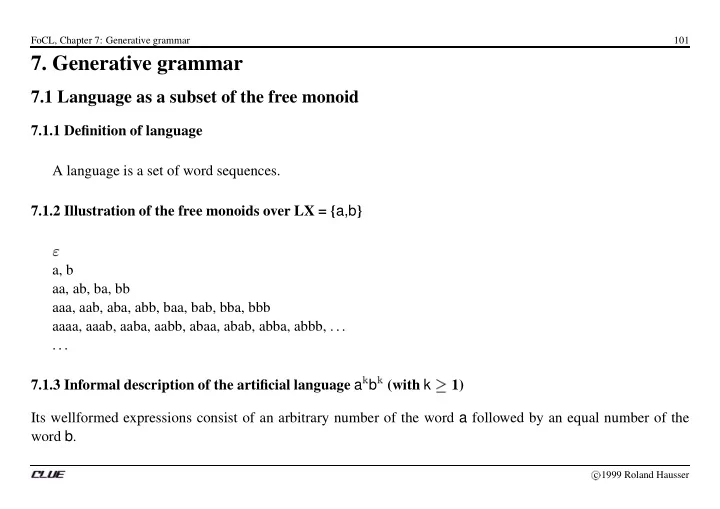
FoCL, Chapter 7: Generative grammar 101 7. Generative grammar 7.1 Language as a subset of the free monoid 7.1.1 Definition of language A language is a set of word sequences. 7.1.2 Illustration of the free monoids over LX = { a,b } " a, b


slide-1
SLIDE 1

FoCL, Chapter 7: Generative grammar 101

  • 7. Generative grammar

7.1 Language as a subset of the free monoid

7.1.1 Definition of language A language is a set of word sequences. 7.1.2 Illustration of the free monoids over LX = {a,b}

"

a, b aa, ab, ba, bb aaa, aab, aba, abb, baa, bab, bba, bbb aaaa, aaab, aaba, aabb, abaa, abab, abba, abbb, . . . . . . 7.1.3 Informal description of the artificial language a

kb k (with k 1)

Its wellformed expressions consist of an arbitrary number of the word a followed by an equal number of the word b.

c

1999 Roland Hausser
slide-2
SLIDE 2

FoCL, Chapter 7: Generative grammar 102

7.1.4 Wellformed expressions of a

kb k

a b, a a b b, a a a b b b, a a a a b b b b, etc., 7.1.5 Illformed expressions of a

kb k

a, b, b a, b b a a, a b a b, etc., 7.1.6 PS-grammar for a

kb k

S

! a S b

S

! a b

A formal grammar may be viewed as a filter which selects the wellformed expressions of its language from the free monoid over the language’s lexicon. 7.1.7 Elementary formalisms of generative grammar

  • 1. Categorial or C-grammar
  • 2. Phrase-structure or PS-grammar
  • 3. Left-associative or LA-grammar

c

1999 Roland Hausser
slide-3
SLIDE 3

FoCL, Chapter 7: Generative grammar 103

7.1.8 Algebraic definition The algebraic definition of a generative grammar explicitly enumerates the basic components of the sys- tem, defining them and the structural relations between them using only notions of set theory. 7.1.9 Derived formalisms of PS-grammar Syntactic Structures, Generative Semantics, Standard Theory (ST), Extended Standard Theory (EST), Re- vised Extended Standard Theory (REST), Government and Binding (GB), Barriers, Generalized Phrase Structure Grammar (GPSG), Lexical Functional Grammar (LFG), Head-driven Phrase Structure Gram- mar (HPSG) 7.1.10 Derived formalisms of C-grammar Montague grammar (MG), Functional Unification Grammar (FUG), Categorial Unification Grammar (CUG), Combinatory Categorial Grammar (CCG), Unification-based Categorial Grammar (UCG)

c

1999 Roland Hausser
slide-4
SLIDE 4

FoCL, Chapter 7: Generative grammar 104

7.1.11 Examples of semi-formal grammars Dependency grammar (Tesnière 1959), systemic grammar (Halliday 1985), stratification grammar (Lamb ??)

7.2 Methodological reasons for generative grammar

7.2.1 Grammatically well-formed expression the little dogs have slept earlier 7.2.2 Grammatically ill-formed expression * earlier slept have dogs little the

c

1999 Roland Hausser
slide-5
SLIDE 5

FoCL, Chapter 7: Generative grammar 105

7.2.3 Methodological consequences of generative grammar

Empirical: formation of explicit hypotheses

A formal rule system constitutes an explicit hypothesis about which input expressions are well-formed and which are not. This is an essential precondition for incremental improvements of the empirical description.

Mathematical: determining formal properties

A formal rule system is required for determining mathematical properties such as decidability, complexity, and generative capacity. These in turn determine whether the formalism is suitable for empirical description and computational realization.

Computational: declarative specification for parsers

A formal rule system may be used as a declarative specification of the parser, characterizing its necessary properties in contrast to accidental properties stemming from the choice of the programming environment,

  • etc. A parser in turn provides the automatic language analysis needed for the verification of the individual

grammars.

c

1999 Roland Hausser
slide-6
SLIDE 6

FoCL, Chapter 7: Generative grammar 106

7.3 Adequacy of generative grammars

7.3.1 Desiderata of generative grammar for natural language The generative analysis of natural language should be simultaneously

defined mathematically as a formal theory of low complexity, designed functionally as a component of natural communication, and realized methodologically as an efficiently implemented computer program in which the properties of formal

language theory and of natural language analysis are represented in a modular and transparent manner.

c

1999 Roland Hausser
slide-7
SLIDE 7

FoCL, Chapter 7: Generative grammar 107

7.4 Formalism of C-grammar

7.4.1 The historically first generative grammar Categorial grammar or C-grammar was invented by the Polish logicians LE ´

SNIEWSKI 1929 and AJDUKIEWICZ

1935 in order to avoid the Russell paradox in formal language analysis. C-grammar was first applied to natural language by BAR-HILLEL 1953. 7.4.2 Structure of a logical function

= ) . . . . . . . . . . . . . . . . . . . . . . . . . . . . . . . . . . . . . . . . . . . . . . . . . . . . . .
  • 3. range
  • 1. function name:
  • 2. domain
  • 4. assignment

c

1999 Roland Hausser
slide-8
SLIDE 8

FoCL, Chapter 7: Generative grammar 108

7.4.3 Algebraic definition of C-grammar A C-grammar is a quintuple

< W, C, LX, R, CE >.
  • 1. W is a finite set of word form surfaces.
  • 2. C is a set of categories such that

(a) basis u and v

C,

(b) induction if X and Y

C, then also (X=Y) and (X nY) C,

(c) closure Nothing is in C except as specified in (a) and (b).

  • 3. LX is a finite set such that LX
(W C).
  • 4. R is a set comprising the following two rule schemata:
  • (Y
=X)
  • (Y
) )
  • (X)
  • (Y
)
  • (Y
nX) )
  • (X)
  • 5. CE is a set comprising the categories of complete expressions, with CE
C.

c

1999 Roland Hausser
slide-9
SLIDE 9

FoCL, Chapter 7: Generative grammar 109

7.4.4 Recursive definition of the infinite set C Because the start elements u and v are in C so are (u =v), (v=u), (unv), and (v nu) according to the induction

  • clause. This means in turn that also ((u =v)=v), ((u=v)nu), (u=(u=v)), (v =(u=v)), etc., belong to C.

7.4.5 Definition of LX as finite set of ordered pairs Each ordered pair is built from (i) an element of W and (ii) an element of C. Which surfaces (i.e. elements of W) take which elements of C as their categories is specified in LX by explicitly listing the ordered pairs. 7.4.6 Definition of the set of rule schemata R The rule schemata use the variables

and to represent the surfaces of the functor and the argument, respec-

tively, and the variables X and Y to represent their category patterns. 7.4.7 Definition of the set of complete expressions CE Depending on the specific C-grammar and the specific language, this set may be finite and specified in terms of an explicit listing, or it may be infinite and characterized by patterns containing variables.

c

1999 Roland Hausser
slide-10
SLIDE 10

FoCL, Chapter 7: Generative grammar 110

7.4.8 Implicit pattern matching in combinations of bidirectional C-grammar

= )

functor word argument word a b

  • (u/v)

(u) result of composition ab result category argument category (v)

= )

ba argument word functor word result of composition b a

  • (u
nv)

(u) (v) result category argument category

c

1999 Roland Hausser
slide-11
SLIDE 11

FoCL, Chapter 7: Generative grammar 111

7.4.9 C-grammar for a

kb k

LX =

def {a (u=v ), b (u), a (v =(u=v ))}

CE =

def {(v)}

The word a has two lexical definitions with the categories (u =v) and (v=(u=v)), respectively, for reasons apparent in the following derivation tree. 7.4.10 Example of a

kb k derivation, for k = 3 . . . . . . . . . . . . . . . . . . . . . . . . . . . . . . . . . . . . . . . . . . . . . . . . . . . . . . . . . . . . . . . . . . . . . . . . . . . . . . . . . . . . . . . . . . . . . . . . . . . . . . . . . . . . . . . . . . . . . . . . . . . . . . . . . . . . . . . . . . . . . . . . . . . . . . . . . . . . . . . . . . . . . . . . . . . . . . . . . . . . . . . . . . . . . . . . . . . . . . . . . . . . . . . . . . . . . . . . . . . . . . . . . . . . . . . . . . . . . . . . . . . . . . . . . . . . . . . . . . . . . . . . . . . . . . . . . . . . . . . . . . . . . . . . . . . . . . . . . . . . . . . . . . . . . . . . . . . . . . . . . . . . . . . . . . . . . . . . . . . . . . . . . . . . . . . . . . . . . . . . . . . . . . . . . . . . . . . . . . . . . . . . . . . . . . . . . . . . . . . . . . . . . . . . . . . . . . . . . . . . . . . . . . . . . . . . . . . . . . . . . . . . . . . . . . . . . . . . . . . . . . . . . . . . . . . . . . . . . . . . . . . . . . . . . . . . . . . . . . . . . . . . . . . . . . . . . . . . . . . . . . . . . . . . . . . . . . . . . . . . . . . . . . . . . . . . . . . . . . . . . . . . . . . . . . . . . . . . . . . . . . . . . . . . . . . . . . . . . . . . . . . . . . . . . . . . . . . . . . . . . . . . . . . . . . . . . . . . . . . . . . . . . . . . . . . . . . . . . . . . . . . . . . . . . . . . . . . . . . . . . . . . . . . . . . . . . . . . . . . . . . . . . . . . . . . . . . . . . . . . . . . . . . . . . . . . . . . . . . . . . . . . . . . . . . . . . . . . . . . . . . . . . . . . . . . . . . . . . . . . . . . . . . . . . . . . . . . . . . . . . . . . . . . . . . . . . . . . . . . . . . . . . . . . . . . . . . . . . . . . . . . . . . . . . . . . . . . . . . . . . . . . . . . . . . . . . . . . . . . . . . . . . . . . . . . . . . . . . . . . . . . . . . . . . . . . . . . . . . . . . . . . . . . . . . . . . . . . . . . . . . . . . . . . . . . . . . . . . . . . . . . . . . . . . . . . . . . . . . . . . . . . . . . . . . . . . . . . . . . . . . . . . . . . . . . . . . . . . . . . . . . . . . . . . . . . . . . . . . . . . . . . . . . . . . . . . . . . . . . . . . . . . . . . . . . . . . . . . . . . . . . . . . . . . . . . . . . . . . . . . . . . . . . . . . . . . . . . . . . . . . . . . . . . . . . . . . . . . . . . . . . . . . . . . . . . . . . . . . . . . . . . . . . . . . . . . . . . . . . . . . . . . . . . . . . . . . . . . . . . . . . . . . . . . . . . . . . . . . . . . . . . . . . . . . . . . . . . . . . . . . . . . . . . . . . . . . . . . . . . . . . . . . . . . . . . . . . . . . . . . . . . . . . . . . . . . . . . . . . . . . . . . . . . . . . . . . . . . . . . . . . . . . . . . . . . . . . . . . . . . . . . . . . . . . . . . . . . . . . . . . . . . . . . . . . . . . . . . . . . . . . . . . . . . . . . . . . . . . . . . . . . . . . . . . . . . . . . . . . . . . . . . . . . . . . . . . . . . . . . . . . . . . . . . . . . . . . . . . . . . . . . . . . . . . . . . . . . . . . . . . . . . . . . . . . . . . . . . . . . . . . . . . . . . . . . . . . . . . . . . . . . . . . . . . . . . . . . . . . . . . . . . . . . . . . . . . . . . . . . . . . . . . . . . . . . . . . . . . . . . . . . . . . . . . . . . . . . . . . . . . . . . . . . . . . . . . . . . . . . . . . . . . . . . . . . . . . . . . . . . . . . . . . . . . . . . . . . . . . . . . . . . . . . . . . . . . . . . . . . . . . . . . . . . . . . . . . . . . . . . . . . . . . . . . . . . . . . . . . . . . . . . . . . . . . . . . . . . . . . . . . . . . . . . . . . . . . . . . . . . . . . . . . . . . . . . . . . . . . . . . . . . . . . . . . . . . . . . . . . . . . . . . . . . . . . . . . . . . . . . . . . . . . . . . . . . . . . . . . . . . . . . . . . . . . . . . . . . . . . . . . . . . . . . . . . . . .

a (v/(u/v)) a (v/(u/v)) a (u/v) b (u) b

. . . . . . . . . . . . . . . . . . . . . . . . . . . . . . . . . . . . . . . . . . . . . . . . . . . . . . . . . . . . . . . . . . . . . .

(u) 6 b (u) ab (v) (u/v) aab aabb (v) aaabb (u/v) aaabbb (v) 1 2 3 4 5

c

1999 Roland Hausser
slide-12
SLIDE 12

FoCL, Chapter 7: Generative grammar 112

7.5 C-grammar for natural language

7.5.1 C-grammar for a tiny fragment of English LX =

def {W (e) [ W (ent)}, where

W

(e) = {Julia, Peter, Mary, Fritz, Suzy . . . }

W

(ent) = {sleeps, laughs, sings . . . }

CE =

def {(t)}

7.5.2 Simultaneous syntactic and semantic analysis

. . . . . . . . . . . . . . . . . . . . . . . . . . . . . . . . . . . . . . . . . . . . . . . . . . . . . . . . . . . . . . . . . . . . . . . . . . . . . . . . . . . . . . . . . . . . . . . . . . . . . . . . . . . . . . . . . . . . . . . . . . . . . . . . . . . . . . . . . . . . . . . . . . . . . . . . . . . . . . . . . . . . . . . . . . . . . . . . . . . . . . . . . . . . . . . . . . . . . . . . . . . . . . . . . . . . . . . . . . .

entity {set of entities}

. . . . . . . . . . . . . . . . . . . . . . . . . . . . . . . . . . . . . . . . . . . . . . . . . . . . . . . . . . . . . . . . . . . . . . . . . . . . . . . . . . . . . . . . . . . . . . . . . . . . . . . . . . . . . . . . . . . . . . . . . . . . . . . . . . . . . . . . . . . . . . . . . . . . . . . . . . . . . . . . . . . . . . . . . . . . .

Julia Denotations (in the model

M):

sleeps (e) (e

nt)

Julia sleeps (t)

c

1999 Roland Hausser
slide-13
SLIDE 13

FoCL, Chapter 7: Generative grammar 113

7.5.3 C-analysis of a natural language sentence

. . . . . . . . . . . . . . . . . . . . . . . . . . . . . . . . . . . . . . . . . . . . . . . . . . . . . . . . . . . . . . . . . . . . . . . . . . . . . . . . . . . . . . . . . . . . . . . . . . . . . . . . . . . . . . . . . . . . . . . . . . . . . . . . . . . . . . . . . . . . . . . . . . . . . . . . . . . . . . . . . . . . . . . . . . . . . . . . . . . . . . . . . . . . . . . . . . . . . . . . . . . . . . . . . . . . . . . . . . . . . . . . . . . . . . . . . . . . . . . . . . . . . . . . . . . . . . . . . . . . . . . . . . . . . . . . . . . . . . . . . . . . . . . . . . . . . . . . . . . . . . . . . . . . . . . . . . . . . . . . . . . . . . . . . . . . . . . . . . . . . . . . . . . . . . . . . . . . . . . . . . . . . . . . . . . . . . . . . . . . . . . . . . . . . . . . . . . . . . . . . . . . . . . . . . . . . . . . . . . . . . . . . . . . . . . . . . . . . . . . . . . . . . . . . . . . . . . . . . . . . . . . . . . . . . . . . . . . . . . . . . . . . . . . . . . . . . . . . . . . . . . . . . . . . . . . . . . . . . . . . . . . . . . . . . . . . . . . . . . . . . . . . . . . . . . . . . . . . . . . . . . . . . . . . . . . . . . . . . . . . . . . . . . . . . . . . . . . . . . . . . . . . . . . . . . . . . . . . . . . . . . . . . . . . . . . . . . . . . . . . . . . . . . . . . . . . . . . . . . . . . . . . . . . . . . . . . . . . . . . . . . . . . . . . . . . . . . . . . . . . . . . . . . . . . . . . . . . . . . . . . . . . . . . . . . . . . . . . . . . . . . . . . . . . . . . . . . . . . . . . . . . . . . . . . . . . . . . . . . . . . . . . . . . . . . . . . . . . . . . . . . . . . . . . . . . . . . . . . . . . . . . . . . . . . . . . . . . . . . . . . . . . . . . . . . . . . . . . . . . . . . . . . . . . . . . . . . . . . . . . . . . . . . . . . . . . . . . . . . . . . . . . . . . . . . . . . . . . . . . . . . . . . . . . . . . . . . . . . . . . . . . . . . . . . . . . . . . . . . . . . . . . . . . . . . . . . . . . . . . . . . . . . . . . . . . . . . . . . . . . . . . . . . . . . . . . . . . . . . . . . . . . . . . . . . . . . . . . . . . . . . . . . . . . . . . . . . . . . . . . . . . . . . . . . . . . . . . . . . . . . . . . . . . . . . . . . . . . . . . . . . . . . . . . . . . . . . . . . . . . . . . . . . . . . . . . . . . . . . . . . . . . . . . . . . . . . . . . . . . . . . . . . . . . . . . . . . . . . . . . . . . . . . . . . . . . . . . . . . . . . . . . . . . . . . . . . . . . . . . . . . . . . . . . . . . . . . . . . . . . . . . . . . . . . . . . . . . . . . . . . . . . . . . . . . . . . . . . . . . . . . . . . . . . . . . . . . . . . . . . . . . . . . . . . . . . . . . . . . . . . . . . . . . . . . . . . . . . . . . . . . . . . . . . . . . . . . . . . . . . . . . . . . . . . . . . . . . . . . . . . . . . . . . . . . . . . . . . . . . . . . . . . . . . . . . . . . . . . . . . . . . . . . . . . . . . . . . . . . . . . . . . . . . . . . . . . . . . . . . . . . . . . . . . . . . . . . . . . . . . . . . . . . . . . . . . . . . . . . . . . . . . . . . . . . . . . . . . . . . . . . . . . . . . . . . . . . . . . . . . . . . . . . . . . . . . . . . . . . . . . . . . . . . . . . . . . . . . . . . . . . . . . . . . . . . . . . . . . . . . . . . . . . . . . . . . . . . . . . . . . . . . . . . . . . . . . . . . . . . . . . . . . . . . . . . . . . . . . . . . . . . . . . . . . . . . . . . . . . . . . . . . . . . . . . . . . . . . . . . . . . . . . . . . . . . . . . . . . . . . . . . . . . . . . . . . . . . . . . . . . . . . . . . . . . . . . . . . . . . . . . . . . . . . . . . . . . . . . . . . . . . . . . . . . . . . . . . . . . . . . . . . . . . . . . . . . . . . . . . . . . . . . . . . . . . . . . . . . . . . . . . . . . . . . . . . . . . . . . . . . . . . . . . . . . . . . . . . . . . . . . . . . . . . . . . . . . . . . . . . . . . . . . . . . . . . . . . . . . . . . . . . . . . . . . . . . . . . . . . . . . . . . . . . . . . . . . . . . . . . . . . . . . . . . . . . . . . . . . . . . . . . . . . . . . . . . . . . . . . . . . . . . . . . . . . . . . . . . . . . . . . . . . . . . . . . . . . . . . . . . . . . . . . . . . . . . . . . . . . . . . . . . . . . . . . . . . . . . . . . . . . . . . . . . . . . . . . . . . . . . . . . . . . . . . . . . . . . . . . . . . . . . . . . . . . . . . . . . . . . . . . . . . . . . . . . . . . . . . . . . . . . . . . . . . . . . . . . . . . . . . . . . . . . . . . . . . . . . . . . . . . . . . . . . . . . . . . . . . . . . . . . . . . . . . . . . . . . . . . . . . . . . . . . . . . . . . . . . . . . . . . . . . . . . . . . . . . . . . . . . . . . . . . . . . . . . . . . . . . . . . . . . . . . . . . . . . . . . . . . . . . . . . . . . . . . . . . . . . . . . . . . . . . . . . . . . . . . . . . . . . . . . . . . . . . . . . . . . . . . . . . . . . . . . . . . . . . . . . . . . . . . . . . . . . . . . . . . . . . . . . . . . . . . . . . . . . . . . . . . . . . . . . . . . . . . . . . . . . . . . . . . . . . . . . . . . . . . . . . . . . . . . . . . . . . . . . . . . . . . . . . . . . . . . . . . . . . . . . . . . . . . . . . . . . . . . . . . . . . . . . . . . . . . . . . . . . . . . . . . . . . . . . . . . . . . . . . . . . . . . . . . . . . . . . . . . . . . . . . . . . . . . . . . . . . . . . . . . . . . . . . . . . . . . . . . . . . . . . . . . . . . . . . . . . . . . . . . . . . . . .

((e/t)/e) ((e/t)/(e/t)) ((e/t)/(e/t)) (e/t)

. . . . . . . . . . . . . . . . . . . . . . . . . . . . . . . . . . . . . . . . . . . . . . . . . . . . . . . . . . . . . . . . . . . . . . . . . . . . . . . . . . . . . . . . . . . . . . . . . . . . . . . . . . . . . . . . . . . . . . . . . . . . . . . . . . . . . . . . . . . . . . . . . . . . . . . . . . . . . . . . . . . . . . . . . . . . . . . . . . . . .

(e

nt)

The small black dogs sleep black black dogs small (e/t) small black dogs (e/t) the the small black dogs (e) sleep (t) dogs

c

1999 Roland Hausser
slide-14
SLIDE 14

FoCL, Chapter 7: Generative grammar 114

7.5.4 C-grammar for example 7.5.3 LX =

def {W (e) [ W (ent) [ W (e=t) [ W ((e=t)=(e=t)) [ W ((e=t)=t) }, where

W

(e) = {Julia, Peter, Mary, Fritz, Suzy . . . }

W

(ent) = {sleeps, laughs, sings . . . }

W

(e=t) = {dog, dogs, cat, cats, table, tables . . . }

W

((e=t)=(e=t)) = {small, black . . . }

W

((e=t)=t) = {a, the, every . . . }

CE =

def {(t)}

7.5.5 Empirical disadvantages of C-grammar for natural language

Deriving expressions relative to a C-grammar has the character of problem solving. The handling of alternative word orders and agreement phenomena requires an extremely high degree of

lexical ambiguities.

c

1999 Roland Hausser