70: Discrete Math and Probability. Instructor/Admin CS70: Lecture - - PowerPoint PPT Presentation

70 discrete math and probability instructor admin cs70
SMART_READER_LITE
LIVE PREVIEW

70: Discrete Math and Probability. Instructor/Admin CS70: Lecture - - PowerPoint PPT Presentation

70: Discrete Math and Probability. Instructor/Admin CS70: Lecture 1. Outline. Instructor: Satish Rao. 17th year at Berkeley. Programming Computers Superpower! Today: Note 1. Note 0 is background. Do read/skim it. PhD: Long time ago, far


slide-1
SLIDE 1

70: Discrete Math and Probability.

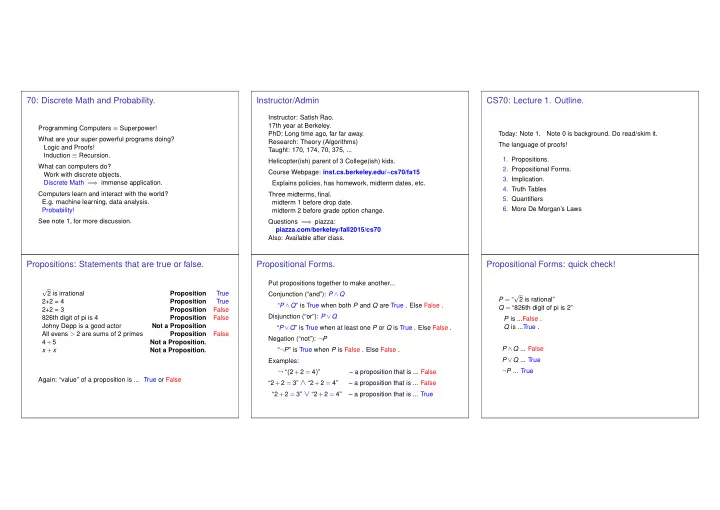
Programming Computers ≡ Superpower! What are your super powerful programs doing? Logic and Proofs! Induction ≡ Recursion. What can computers do? Work with discrete objects. Discrete Math = ⇒ immense application. Computers learn and interact with the world? E.g. machine learning, data analysis. Probability! See note 1, for more discussion.

Instructor/Admin

Instructor: Satish Rao. 17th year at Berkeley. PhD: Long time ago, far far away. Research: Theory (Algorithms) Taught: 170, 174, 70, 375, ... Helicopter(ish) parent of 3 College(ish) kids. Course Webpage: inst.cs.berkeley.edu/~cs70/fa15 Explains policies, has homework, midterm dates, etc. Three midterms, final. midterm 1 before drop date. midterm 2 before grade option change. Questions = ⇒ piazza: piazza.com/berkeley/fall2015/cs70 Also: Available after class.

CS70: Lecture 1. Outline.

Today: Note 1. Note 0 is background. Do read/skim it. The language of proofs!

  • 1. Propositions.
  • 2. Propositional Forms.
  • 3. Implication.
  • 4. Truth Tables
  • 5. Quantifiers
  • 6. More De Morgan’s Laws

Propositions: Statements that are true or false.

√ 2 is irrational Proposition True 2+2 = 4 Proposition True 2+2 = 3 Proposition False 826th digit of pi is 4 Proposition False Johny Depp is a good actor Not a Proposition All evens > 2 are sums of 2 primes Proposition False 4+5 Not a Proposition. x +x Not a Proposition. Again: “value” of a proposition is ... True or False

Propositional Forms.

Put propositions together to make another... Conjunction (“and”): P ∧Q “P ∧Q” is True when both P and Q are True . Else False . Disjunction (“or”): P ∨Q “P ∨Q” is True when at least one P or Q is True . Else False . Negation (“not”): ¬P “¬P” is True when P is False . Else False . Examples:

¬ “(2+2 = 4)”

– a proposition that is ... False “2+2 = 3” ∧ “2+2 = 4” – a proposition that is ... False “2+2 = 3” ∨ “2+2 = 4” – a proposition that is ... True

Propositional Forms: quick check!

P = “ √ 2 is rational” Q = “826th digit of pi is 2” P is ...False . Q is ...True . P ∧Q ... False P ∨Q ... True ¬P ... True

slide-2
SLIDE 2

Put them together..

Propositions: P1 - Person 1 rides the bus. P2 - Person 2 rides the bus. .... But we can’t have either of the follwing happen; That either person 1 or person 2 ride the bus and person 3 or 4 ride the

  • bus. Or that person 2 or person 3 ride the bus and that either

person 4 ride the bus or person 5 doesn’t. Propositional Form: ¬(((P1 ∨P2)∧(P3 ∨P4))∨((P2 ∨P3)∧(P4 ∨¬P5))) Who can ride the bus? What combinatations of people can ride the bus? This seems ...complicated. We need a way to keep track!

Truth Tables for Propositional Forms.

P Q P ∧Q T T T T F F F T F F F F P Q P ∨Q T T T T F T F T T F F F One use for truth tables: Logical Equivalence of propositional forms! Example: ¬(P ∧Q) logically equivalent to ¬P ∨¬Q ...because the two propositional forms have the same... ....Truth Table! P Q ¬(P ∨Q) ¬P ∧¬Q T T F F T F F F F T F F F F T T DeMorgan’s Law’s for Negation: distribute and flip! ¬(P ∧Q) ≡ ¬P ∨¬Q ¬(P ∨Q) ≡ ¬P ∧¬Q

Implication.

P = ⇒ Q interpreted as If P, then Q. True Statements: P, P = ⇒ Q. Conclude: Q is true. Example: Statement: If you stand in the rain, then you’ll get wet. P = “you stand in the rain” Q = “you will get wet” Statement: “Stand in the rain” Can conclude: “you’ll get wet.”

Non-Consequences/consequences of Implication

The statement “P = ⇒ Q”

  • nly is False if P is True and Q is False .

False implies nothing P False means Q can be True or False Anything implies true. P can be True or False when Q is True If chemical plant pollutes river, fish die. If fish die, did chemical plant polluted river? Not necessarily. P = ⇒ Q and Q are True does not mean P is True Instead we have: P = ⇒ Q and P are True does mean Q is True . Be careful out there! Some Fun: use propositional formulas to describe implication? ((P = ⇒ Q)∧P) = ⇒ Q.

Implication and English.

P = ⇒ Q

◮ If P, then Q. ◮ Q if P. ◮ P only if Q. ◮ P is sufficient for Q. ◮ Q is necessary for P.

Truth Table: implication.

P Q P = ⇒ Q T T T T F F F T T F F T P Q ¬P ∨Q T T T T F F F T T F F T ¬P ∨Q ≡ P = ⇒ Q. These two propositional forms are logically equivalent!

slide-3
SLIDE 3

Contrapositive, Converse

◮ Contrapositive of P =

⇒ Q is ¬Q = ⇒ ¬P.

◮ If the plant pollutes, fish die. ◮ If the fish don’t die, the plant does not pollute.

(contrapositive)

◮ If you stand in the rain, you get wet. ◮ If you did not stand in the rain, you did not get wet.

(not contrapositive!) converse!

◮ If you did not get wet, you did not stand in the rain.

(contrapositive.)

Logically equivalent! Notation: ≡. P = ⇒ Q ≡ ¬P ∨Q ≡ ¬(¬Q)∨¬P ≡ ¬Q = ⇒ ¬P.

◮ Converse of P =

⇒ Q is Q = ⇒ P. If fish die the plant pollutes. Not logically equivalent!

◮ Definition: If P =

⇒ Q and Q = ⇒ P is P if and only if Q

  • r P ⇐

⇒ Q. (Logically Equivalent: ⇐ ⇒ . )

Variables.

Propositions?

◮ ∑n i=1 i = n(n+1) 2

.

◮ x > 2 ◮ n is even and the sum of two primes

  • No. They have a free variable.

We call them predicates, e.g., Q(x) = “x is even” Same as boolean valued functions from 61A or 61AS!

◮ P(n) = “∑n i=1 i = n(n+1) 2

.”

◮ R(x) = “x > 2” ◮ G(n) = “n is even and the sum of two primes”

Next: Statements about boolean valued functions!!

Quantifiers..

There exists quantifier: (∃x ∈ S)(P(x)) means ”P(x) is true for some x in S” For example: (∃x ∈ N)(x = x2) Equivalent to “(0 = 0)∨(1 = 1)∨(2 = 4)∨...” Much shorter to use a quantifier! For all quantifier; (∀x ∈ S) (P(x)). means “For all x in S P(x) is True .” Examples: “Adding 1 makes a bigger number.” ∀(x ∈ N) (x +1 > x) ”the square of a number is always non-negative” (∀x ∈ N)(x2 >= 0) Wait! What is N?

Quantifiers: universes.

Proposition: “For all natural numbers n, ∑n

i=1 i = n(n+1) 2

.” Proposition has universe: “the natural numbers”. Universe examples include..

◮ N = {0,1,...} (natural numbers). ◮ Z = {...,−1,0,...} (integers) ◮ Z + (positive integers) ◮ See note 0 for more!

More for all quantifiers examples.

◮ ”doubling a number always makes it larger”

(∀x ∈ N) (2x > x) False Consider x = 0 Can fix statement... (∀x ∈ N) (2x >= x) True

◮ ”Square of any natural number greater than 5 is greater

than 25.” (∀x ∈ N)(x > 5 = ⇒ x2 > 25). Idea alert: Restrict domain using implication. Note that we may omit universe if clear from context.

Quantifiers..not commutative.

◮ In English: ”there is a natural number that is the square of

every natural number”, i.e the square of every natural number is the same number! (∃y ∈ N) (∀x ∈ N) (y = x2) False

◮ In English: ”the square of every natural number is a natural

number”... (∀x ∈ N)(∃y ∈ N) (y = x2) True

slide-4
SLIDE 4

Quantifiers....negation...DeMorgan again.

Consider ¬(∀x ∈ S)(P(x)), English: there is an x in S where P(x) does not hold. That is, ¬(∀x ∈ S)(P(x)) ⇐ ⇒ ∃(x ∈ S)(¬P(x)). What we do in this course! We consider claims. Claim: (∀x) P(x) “For all inputs x the program works.” For False , find x, where ¬P(x). Counterexample. Bad input. Case that illustrates bug. For True : prove claim. Next lectures...

Negation of exists.

Consider ¬(∃x ∈ S)(P(x)) English: means that for all x in S , P(x) does not hold. That is, ¬(∃x ∈ S)(P(x)) ⇐ ⇒ ∀(x ∈ S)¬P(x).

Which Theorem?

Theorem: (∀n ∈ N) ¬(∃a,b,c ∈ N) (n > 3 = ⇒ an +bn = cn) Which Theorem? Fermat’s Last Theorem! Remember Special Triangles: for n = 2, we have 3,4,5 and 5,7, 12 and ... 1637: Proof doesn’t fit in the margins. 1993: Wiles ...(based in part on Ribet’s Theorem) DeMorgan Restatement: Theorem: ¬(∃n ∈ N) (∃a,b,c ∈ N) (n > 3 = ⇒ an +bn = cn)

Summary.

Propositions are statements that are true or false. Proprositional forms use ∧,∨,¬. Propositional forms correspond by truth tables. Logical equivalence of forms means same truth tables. Implication: P = ⇒ Q ⇐ ⇒ P ∨Q. Contrapositive: ¬Q = ⇒ ¬P Converse: Q = ⇒ P Predicates: Statements with “free” variables. Quantifiers: ∀x P(x), ∃y Q(y) Now can state theorems! And disprove false ones! DeMorgans Laws: “Flip and Distribute negation” ¬(P ∨Q) ⇐ ⇒ (¬P ∧¬Q) ¬∀x P(x) ⇐ ⇒ ∃x ¬P(x). Next Time: proofs!