CS70: Discrete Math and Probability 6 More graphs 1 2 u and v are - - PowerPoint PPT Presentation

cs70 discrete math and probability
SMART_READER_LITE
LIVE PREVIEW

CS70: Discrete Math and Probability 6 More graphs 1 2 u and v are - - PowerPoint PPT Presentation

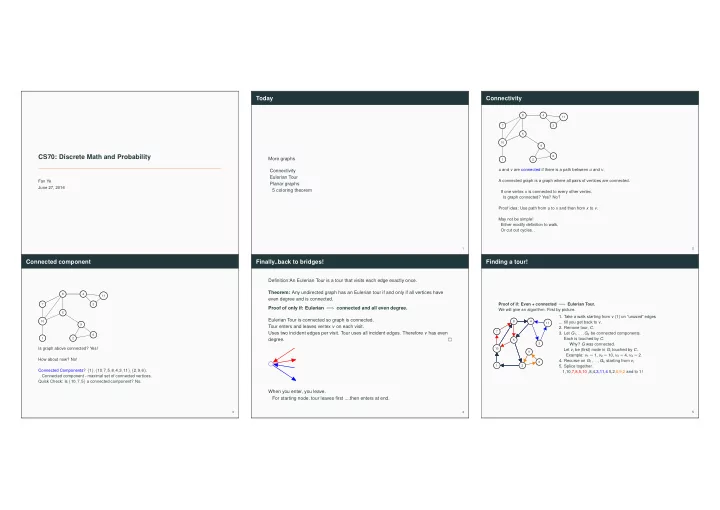
Today Connectivity 8 4 11 7 3 5 10 9 CS70: Discrete Math and Probability 6 More graphs 1 2 u and v are connected if there is a path between u and v . Connectivity Eulerian Tour Fan Ye A connected graph is a graph where all pairs of


slide-1
SLIDE 1

CS70: Discrete Math and Probability

Fan Ye June 27, 2016

Today

More graphs Connectivity Eulerian Tour Planar graphs 5 coloring theorem

1

Connectivity

1 2 3 4 5 6 7 8 9 10 11

u and v are connected if there is a path between u and v. A connected graph is a graph where all pairs of vertices are connected. If one vertex x is connected to every other vertex. Is graph connected? Yes? No? Proof idea: Use path from u to x and then from x to v. May not be simple! Either modify definition to walk. Or cut out cycles. .

2

Connected component

1 2 3 4 5 6 7 8 9 10 11

Is graph above connected? Yes! How about now? No! Connected Components? {1},{10,7,5,8,4,3,11},{2,9,6}. Connected component - maximal set of connected vertices. Quick Check: Is {10,7,5} a connected component? No.

3

Finally..back to bridges!

Definition:An Eulerian Tour is a tour that visits each edge exactly once. Theorem: Any undirected graph has an Eulerian tour if and only if all vertices have even degree and is connected. Proof of only if: Eulerian = ⇒ connected and all even degree. Eulerian Tour is connected so graph is connected. Tour enters and leaves vertex v on each visit. Uses two incident edges per visit. Tour uses all incident edges. Therefore v has even degree. When you enter, you leave. For starting node, tour leaves first ....then enters at end.

4

Finding a tour!

Proof of if: Even + connected = ⇒ Eulerian Tour. We will give an algorithm. First by picture.

1 2 3 4 5 6 7 8 9 10 11
  • 1. Take a walk starting from v (1) on “unused” edges

... till you get back to v.

  • 2. Remove tour, C.
  • 3. Let G1,...,Gk be connected components.

Each is touched by C. Why? G was connected. Let vi be (first) node in Gi touched by C. Example: v1 = 1, v2 = 10, v3 = 4, v4 = 2.

  • 4. Recurse on G1,...,Gk starting from vi
  • 5. Splice together.

1,10,7,8,5,10 ,8,4,3,11,4 5,2,6,9,2 and to 1!

5
slide-2
SLIDE 2

Finding a tour: in general.

  • 1. Take a walk from arbitrary node v, until you get back to v.

Claim: Do get back to v! Proof of Claim: Even degree. If enter, can leave except for v.

  • 2. Remove cycle, C, from G.

Resulting graph may be disconnected. (Removed edges!) Let components be G1,...,Gk. Let vi be first vertex of C that is in Gi. Why is there a vi in C? G was connected = ⇒ a vertex in Gi must be incident to a removed edge in C. Claim: Each vertex in each Gi has even degree and is connected. Prf: Tour C has even incidences to any vertex v.

  • 3. Find tour Ti of Gi starting/ending at vi. Induction.
  • 4. Splice Ti into C where vi first appears in C.

Visits every edge once: Visits edges in C exactly once. By induction for all edges in each Gi.

6

Planar graphs.

A graph that can be drawn in the plane without edge crossings. Planar? Yes for Triangle. Four node complete? Yes. Five node complete or K5? No! Why? Later. Two to three nodes, bipartite? Yes. Three to three nodes, complete/bipartite or K3,3. No. Why? Later.

7

Euler’s Formula.

Faces: connected regions of the plane. How many faces for triangle? 2 complete on four vertices or K4? 4 bipartite, complete two/three or K2,3? 3 v is number of vertices, e is number of edges, f is number of faces. Euler’s Formula: Connected planar graph has v +f = e +2. Triangle: 3+2 = 3+2! K4: 4+4 = 6+2! K2,3: 5+3 = 6+2! Examples = 3! Proven! Not!!!!

8

Euler and Polyhedron.

Greeks knew formula for polyhedron. . Faces? 6. Edges? 12. Vertices? 8. Euler: Connected planar graph: v +f = e +2. 8+6 = 12+2. Greeks couldn’t prove it. Induction? Remove vertice for polyhedron? Polyhedron without holes ≡ Planar graphs. Surround by sphere. Project from point inside polytope onto sphere. Sphere ≡ Plane! Topologically. Euler proved formula thousands of years later!

9

Euler and planarity of K5 and K3,3

Euler: v +f = e +2 for connected planar graph. Each face is adjacent to at least three edges. face-edge adjacencies. ≥ 3f Each edge is adjacent to exactly two faces. face-edge adjacencies. = 2e = ⇒ 3f ≤ 2e Euler: v + 2

3 e ≥ e +2 =

⇒ e ≤ 3v −6 K5 Edges? 4+3+2+1 = 10. Vertices? 5. 10 ≤ 3(5)−6 = 9. = ⇒ K5 is not planar. K3,3? Edges? 9. Vertices. 6. 9 ≤ 3(6)−6? Sure! But no cycles that are triangles. Face is of length ≥ 4. .... 4f ≤ 2e. Euler: v + 1

2 e ≥ e +2 =

⇒ e ≤ 2v −4 9 ≤ 2(6)−4. = ⇒ K3,3 is not planar!

10

Tree.

A tree is a connected acyclic graph. To tree or not to tree!

  • Yes. No. Yes. No. No.

Faces?

  • 1. 2. 1. 1. 2.

Vertices/Edges. Notice: e = v −1 for tree. One face for trees! Euler works for trees: v +f = e +2. v +1 = v −1+2

11
slide-3
SLIDE 3

Euler’s formula.

Euler: Connected planar graph has v +f = e +2. Proof sketch: Induction on e. Base: e = 0, v = f = 1. p(0) (base case) holds Induction Step: If it is a tree. Done. If not a tree. Find a cycle. Remove edge. f1

Outer face.

. . . Joins two faces. New graph: v-vertices. e −1 edges. f −1 faces. Planar. v +(f −1) = (e −1)+2 by induction hypothesis for a smaller graph with e −1 edges. Therefore v +f = e +2.

12

Graph Coloring.

Given G = (V,E), a coloring of a G assigns colors to vertices V where for each edge the endpoints have different colors. Notice that the last one, has one three colors. Fewer colors than number of vertices. Fewer colors than max degree node. Interesting things to do. Algorithm!

13

Planar graphs and maps.

Planar graph coloring ≡ map coloring. Four color theorem is about planar graphs!

14

Six color theorem.

Theorem: Every planar graph can be colored with six colors. Proof: Recall: e ≤ 3v −6 for any planar graph. From Euler’s Formula. Total degree: 2e Average degree: ≤ 2e

v ≤ 2(3v−6) v

≤ 6− 12

v .

There exists a vertex with degree < 6 or at most 5. Remove vertex v of degree at most 5. Inductively color remaining graph. Color is available for v since only five neighbors... and only five colors are used.

15

Five color theorem

Theorem: Every planar graph can be colored with five colors. Preliminary Observation: Connected components of vertices with two colors in a legal coloring can switch colors. Proof: Again with the degree 5 vertex. Again recurse. ······ . . . m Assume neighbors are colored all differently. Otherwise done. Switch green to blue in component.

  • Done. Unless blue-green path to blue.

Switch red to orange in its component.

  • Done. Unless red-orange path to red.
  • Planar. =

⇒ paths intersect at a vertex! What color is it? Must be blue or green to be on that path. Must be red or orange to be on that path. Contradiction. Can recolor one of the neighbors. And recolor “center” vertex.

16

Four Color Theorem

Theorem: Any planar graph can be colored with four colors. Proof: Not Today!

17