8/1/2018 ADDING THE EARLY START DENVER MODEL INTO PART C SERVICE - - PDF document

8 1 2018
SMART_READER_LITE
LIVE PREVIEW

8/1/2018 ADDING THE EARLY START DENVER MODEL INTO PART C SERVICE - - PDF document

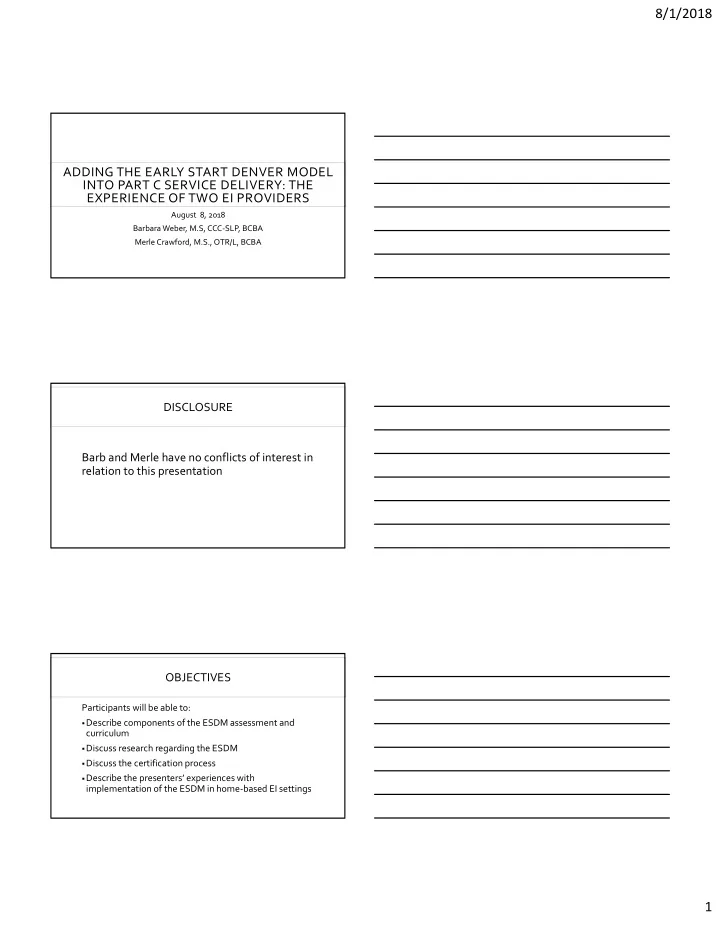
8/1/2018 ADDING THE EARLY START DENVER MODEL INTO PART C SERVICE DELIVERY: THE EXPERIENCE OF TWO EI PROVIDERS August 8, 2018 Barbara Weber, M.S, CCC-SLP, BCBA Merle Crawford, M.S., OTR/L, BCBA DISCLOSURE Barb and Merle have no conflicts of


slide-1
SLIDE 1

8/1/2018 1

ADDING THE EARLY START DENVER MODEL INTO PART C SERVICE DELIVERY: THE EXPERIENCE OF TWO EI PROVIDERS

August 8, 2018 Barbara Weber, M.S, CCC-SLP, BCBA Merle Crawford, M.S., OTR/L, BCBA

DISCLOSURE Barb and Merle have no conflicts of interest in relation to this presentation OBJECTIVES

Participants will be able to:

  • Describe components of the ESDM assessment and

curriculum

  • Discuss research regarding the ESDM
  • Discuss the certification process
  • Describe the presenters’ experiences with

implementation of the ESDM in home-based EI settings

slide-2
SLIDE 2

8/1/2018 2

REFERENCES/RESOURCES

Rogers, S. J., & Dawson, G. (2010). Early Start Denver Model for young children with autism: Promoting language, learning, and engagement. New York: Guilford Press. Rogers, S. J., Dawson, G., & Vismara, L. A. (2012). An early start for your child with autism: Using everyday activities to help kids connect, communicate, and learn. New York: Guilford Press

WHAT IS THE ESDM?

A comprehensive early intervention approach that is: Evidence-based Play-based and routines-based A blend of behavioral and developmental approaches Can be implemented in a variety of settings Targets all developmental areas Appropriate for children 12-60 months

FOUNDATIONS OF THE ESDM

The Denver Model Rogers’ and Pennington’s Model of Interpersonal Development in Autism The Social Motivation Hypothesis of Autism Pivotal Response Training (PRT)

slide-3
SLIDE 3

8/1/2018 3

SENSORY SOCIAL ROUTINES TEACHING STRATEGIES

Blend of ABA/PRT, Denver Model Positive affect Play as a framework for intervention Intensive teaching Positive behavior approaches Family involvement

RESEARCH STUDIES

Waddington, H., van der Meer, L., & Sigafoos, J. (2016). Effectiveness of the Early Start Denver Model: A systematic review. Review Journal of Autism and Developmental Disorders, 3(2), 93-106.  12 studies/15 articles; methodological limitations in 8 that reduce certainty of evidence  “promising treatment for young children with, or at risk, for an ASD diagnosis”  “Given the generally promising results, the ESDM can be recommended as a practical approach to delivering a sensible early intervention program to children with, or at risk for, an ASD diagnosis. Still, more research is needed on all aspects

  • f this model, particularly independent replications of the findings.”
slide-4
SLIDE 4

8/1/2018 4

RESEARCH STUDIES, CONTINUED

Baril, E. M., & Humphreys, B. P. (2017). An evaluation of the research evidence on the Early Start Denver Model. Journal of Early Intervention, 39(4), 321-338.  10 met criteria: ESDM was primary intervention, targeted and reported child

  • utcomes, children ≤60 months, published in scholarly peer-reviewed journal in

English  “…promise as an evidence-based practice…..preliminary evidence to support the implementation of the ESDM.”  “…through rigorous ESDM training, family members as well as teams of professionals in community-based settings have successfully met criteria for fidelity

  • f implementation.”

 “…the extent to which child improvements are due to the ESDM intervention alone is not fully known.” Additional replications needed

CERTIFICATION PROCESS

Introductory workshop Advanced workshop Supervision

ASSESSMENT: CURRICULUM CHECKLIST

 Level 1: 12-18 months  Level 2: 18-24 months  Level 3: 24-36 months  Level 4: 36-48 months Areas include Receptive Communication, Expressive Communication, Joint Attention, Social Skills, Imitation, Cognition, Play, Fine Motor, Gross Motor, Behavior, Personal Independence

slide-5
SLIDE 5

8/1/2018 5

SHORT-TERM OBJECTIVES LEARNING STEPS

Behavioral objective format 2-3 from each domain on checklist based from parent priorities, data from ESDM Curriculum Checklist, input from

  • ther professionals

Functional Twelve week time frame Based on task analysis and chaining Incorporate prompt fading Build on increasing frequency, accuracy, and

  • r complexity of a skill

INTERVENTION

Joint Activity Routines:

  • pening/set-up theme/activity

elaboration/expansion end/transition Adult and child have shared control and “co-construct” the activity. Unwanted behaviors are addressed as needed.

ACTIVE LISTENING NARRATION HELPING/ JOINING IN IMITATION

JOINT ACTIVITY ROUTINE PROCESS

slide-6
SLIDE 6

8/1/2018 6

DATA COLLECTION: CHILD PROGRESS Daily data sheets Data taken every 15 minutes DATA COLLECTION: FIDELITY OF TREATMENT

 Management of Child Attention  ABC Format: Quality of Behavioral Teaching  Instructional Techniques Application  Adult Ability to Modulate Child Affect and Arousal  Management of Unwanted Behaviors  Quality of Dyadic Engagement  Adult Optimizes Child Motivation for Participating in the Activity

FIDELITY, CONTINUED

 Adult Use Positive Affect  Adult Sensitivity and Responsivity to Child Communicative Cues  Multiple and Varied Communicative Opportunities Occur in the Activity  Appropriateness of Adult Language for Child’s Language Level  Joint Activity Structure and Elaboration  Transitions Between Activities

slide-7
SLIDE 7

8/1/2018 7

IMPLEMENTATION

ESDM IN ACTION

ASSESSMENT COLLABORATION

Discuss ESDM with families as a treatment option If family would like to use the ESDM, discuss with

  • ther providers on team

When providers would like to be involved in goal selection they collaborate on assessment and determination of objectives

slide-8
SLIDE 8

8/1/2018 8

JOINT ACTIVITY: AVERY PLAYING WITH TOYS

  • Objectives:
  • During play with toys when an adult models an action, Avery will imitate

the action within 5 seconds , 4/5 opportunities, across 3 activities and 2 people for 3 consecutive sessions.

  • During play with toys when an adult models a sound or word and pauses

expectantly, Avery will approximate it 4/5 opportunities, across 3 activities and 2 people for 3 consecutive sessions.

  • Watch for: being a play partner, active listening, imitation, joining in,

managing unwanted behaviors

JOINT ACTIVITY ROUTINE: PLAYING WITH TOYS

 Video Segment 1: Attends briefly to another person with eye contact; Responds to preferred objects; Responds to activities via gaze, reach, smiles and movements  Video Segment 2: Imitates motor action; Combines vocalization and gaze; Asks for help  Video Segment 3: Follows verbal directions; Carries out single action with a prop on a doll or animal  Watch for: Following child’s lead, narrating, helping/joining in, elaborating/expanding

JOINT ACTIVITY: GROSS MOTOR

Objective: When given a ball and told to kick it, Tony will independently kick the ball 4/5 x, in 2 settings, for 2 different people, for 3 consecutive sessions. Watch for incorporating sibling into session, coaching mother, generalizing skills, transition

slide-9
SLIDE 9

8/1/2018 9

COACHING PARENTS AND SIBLINGS

Watch for:

  • Positioning that facilitates optimal engagement of the

child and parent/siblings

  • Strategies used to help parent/siblings be play partners,

use prompts, and provide opportunities for practice

  • Use of reflective questions and statements
  • Variety of routines: snack and play

WHAT WE LIKE ABOUT THE ESDM

Evidence based curriculum for children with autism Supports collaboration across providers within a pre- determined curriculum Data collection is systematic Caregiver capacity is expanded by using ESDM strategies Capitalizes on motivation and care giver priorities

WHAT WE HAVE DISCOVERED ABOUT THE ESDM

 Many competing reinforcers exist in home settings  Homes not organized like clinics  Materials for teaching may be absent or unavailable  Families may not have ESDM objectives as their weekly priority  Managing unwanted behavior may be frequent priority  Transfer of play partner skills to caregivers may take many sessions  Siblings may be present during sessions and need to play an active role when appropriate

slide-10
SLIDE 10

8/1/2018 10

PARENT VOICES QUESTIONS?

Thanks so much for coming! Barb: bswslp@aol.com Merle: mjcotr@gmail.com