A brief review outcome, and response to treatment, and associated - - PDF document

a brief review
SMART_READER_LITE
LIVE PREVIEW

A brief review outcome, and response to treatment, and associated - - PDF document

8/30/2013 Working Definition of a Clinical Disorder: a constellation of symptoms that significantly impairs an individuals ability to function, and is characterized by a particular symptom picture with a specifiable onset, course, duration, A


slide-1
SLIDE 1

8/30/2013 1

A brief review

Definition of a clinical disorder Sensitivity Specificity PPP NPP

Working Definition of a Clinical Disorder:

a constellation of symptoms that significantly impairs an individual’s ability to function, and is characterized by a particular symptom picture with a specifiable onset, course, duration,

  • utcome, and response to treatment, and associated familial,

psychosocial, and biological correlates. Sensitivity – the proportion of children with a particular disorder who exhibit a specific symptom Specificity – the proportion of children without a particular disorder who do not exhibit a specific symptom PPP – the proportion of children with a specific symptom who meet diagnostic criteria for a specific disorder NPP – the proportion of children without a specific symptom who do not meet diagnostic criteria for a specific disorder Pathognomonic: a symptom that is highly characteristic for diagnosing a specific disorder 2-way pathognomonic – a symptom that if present, signals a high likelihood

  • f having the disorder, and whose absence, signals the

unlikelihood of the disorder being present. Importance of Base Rate

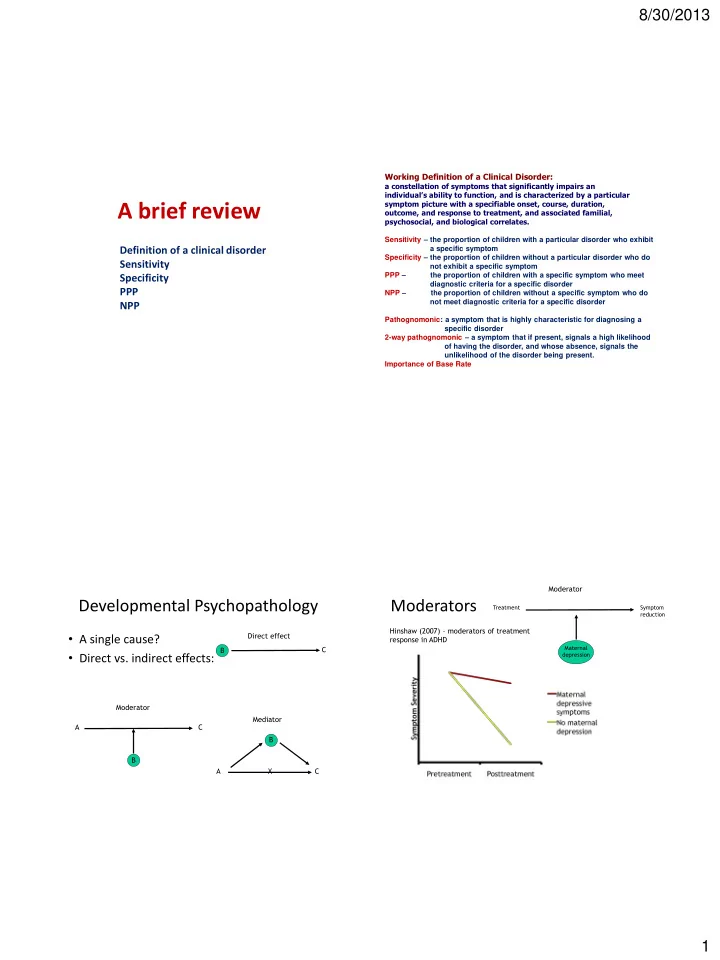
Developmental Psychopathology

  • A single cause?
  • Direct vs. indirect effects:

A C B Moderator A B C Mediator X C B Direct effect

Moderators

Treatment Symptom reduction Maternal depression

Moderator Hinshaw (2007) – moderators of treatment response in ADHD

slide-2
SLIDE 2

8/30/2013 2

Historical Influences

  • Early explanations of psychopathology

– Adult focused – Demonology – Somatogenesis

  • Nineteenth Century

– Classification-Kraeplin – Study of youth still lagged – Some childhood disorders identified

  • Mental retardation received attention

– Progress made on conceptualization of etiology Basic Classical Conditioning Learning

No conditioning required UCS: Food [unconditioned Stimulus] UCR: Salivation [unconditioned response becomes a conditioned response] Neutral Stimulus: Bell [becomes a CS or conditioned stimulus after pairing Paired temporally Conditioning required Outcome of Conditioning Decrease Behavior Increase Behavior Response Cost (remove stimulus) Positive Reinforcement (add stimulus) Positive Stimulus Punishment (add stimulus) Negative Reinforcement (remove stimulus) Negative Stimulus Schematic of Operant Conditioning Relationships Positive Reinforcement – a positively viewed stimulus follows a particular behavior and strengthens or increases the behavior. Negative Reinforcement – a negatively viewed stimulus is removed or avoided and strengthens or increases the behavior (e.g., carrying an umbrella); 2 primary types: avoidance and escape behavior. Punishment – a negatively viewed stimulus is presented or occurs following a behavior and weakens or reduces future occurrences of the behavior (e.g., spanking). Response Cost – a positive stimulus is removed and strengthens or increases a particular behavior. Extinction – behavior is no longer followed by reinforcement and decreases and eventually ceases in frequency.

slide-3
SLIDE 3

8/30/2013 3

  • S-d’s – discriminative stimuli that indicate the

likely occurrence of reinforcement.

  • S-delta’s – stimuli that indicate the unlikely
  • ccurrence of

reinforcement.

Psychological assessment The process of gathering data about children and families in order to reach valid conclusions about their current functioning and future well being Purposes 1. To screen children for possible problems 2. To arrive at a diagnosis 3. To identify & treat a specific behavior problem 4. To monitor the progress of treatment Four Pillars of Psychological Assessment Sattler (2001) Clinical interviews Informal data gathering Observations Norm-referenced tests Multimethod assessment 1. Clinical interviews 2. Structured observations 3. Norm-referenced tests Multiinformant assessment 1. Parents 2. Teachers/daycare providers 3. Child

slide-4
SLIDE 4

8/30/2013 4

Clinical interviews Clinical interviews: Psychosocial history

  • presenting problem
  • family background
  • child’s developmental/medical history
  • child’s academic history
  • child’s social history
  • child’s behavioral history
  • child’s psychiatric history

Paternal G-parents Maternal G-parents Father Mother Paternal Siblings Maternal Siblings

Children

Father Father Mother Mother Psychological/psychiatric hx including DSM disorders, LD, suicide, hospitalizations; also age

  • f siblings and children.

Clinical interviews Mental status examination Overt behavior General appearance Posture, eye contact, body movements, activity level Behavior toward clinician & caregivers Emotions Mood Affect Appropriateness Cognitions Thought content Thought process Intelligence Attention Memory Orientation to person, place, & time Insight Judgment Observations Methods of observation Observations during clinical interview Analogue tasks Naturalistic observations (e.g., playground, classroom)

slide-5
SLIDE 5

8/30/2013 5

Observations Functional analysis of behavior Antecedents Child does not understand assignment, cannot read directions, does not know what to do Behavior Child leaves seat, talks with classmates, disrupts teacher Consequences Child is positively reinforced by teacher’s attention and classmate’s giggles; child is negatively reinforced by avoiding the assignment How might you intervene to reduce the child’s problem behavior? Norm-referenced tests Norm-referenced testing Involves the administration of a standardized measure of children’s behavior that allows comparisons of that child to other individuals her age All norm-referenced tests are administered, scored, and interpreted in a standardized format, that is, each administration of the test involves the same item content, the same administration procedure, and the same method of scoring and interpretation Standardization permits comparison of an individual child with other children in the norm group Standard score A raw score that has been changed to a different scale with a designated mean and standard deviation

The standard normal distribution. Approximately 68% of people earn scores within one standard deviation from the mean. Approximately 95% of people earn scores within two standard deviations from the mean. Raw scores can be transformed into standard scores to make them easier to understand.

The WISC-IV: Verbal Comprehension reflects knowledge gained through formal and informal educational experiences and reflects the application of verbal skills to new

  • situations. Everyday tasks that require verbal comprehension include providing

factual information, defining words, and understanding verbal analogies.

slide-6
SLIDE 6

8/30/2013 6

The WISC-IV: Perceptual Reasoning reflects the ability to organize and interpret visually presented material and to engage in visual-spatial problem solving. Everyday tasks that require perceptual reasoning include solving puzzles and mazes, manipulating geometric shapes, and understanding patterns. The WISC-IV: Working Memory reflects the ability to attend to information, retain and manipulate information in memory, and apply information when necessary. Everyday tasks that require working memory include remembering someone’s telephone number and solving arithmetic problems in one’s head.

What is Working Memory?

– Working memory is a limited capacity system that enables individuals to store briefly and process information (Baddeley, 2007).

http://usablealgebra.landmark.edu/wp-content/uploads/2008/12/working-memory-2.gif

WM Capacity

Academic achievement Computer programming Reasoning/organizational ability Literacy Long-term memory retrieval Bridge & chess playing Following directions Writing; Note taking Reduced proactive interference General fluid intelligence Complex learning Lexical-semantic abilities

slide-7
SLIDE 7

8/30/2013 7

Spoken Output Visuospatial Analysis Visuospatial STS Right hemisphere Visuospatial output buffer Right premotor cortex Rehearsal Process Motor Output

Visuospatial task Phonological task Central Executive Input Process Visuospatial buffer/rehearsal loop Phonological buffer/rehearsal loop

Shared Variance

Input Process

Auditory Input Phonological Analysis Phonological STS Inferior parietal lobe Phonological output buffer Broca’s area-premotor cortex Rehearsal Process Central Executive Visual analysis & STS Orthographic to phonological recoding Visual Input Visual Input

Domain General

Alan Baddeley’s (2007) WM Model The WISC-IV: Processing Speed reflects the capacity to visually scan and process nonverbal information quickly and accurately. Tasks that require processing speed include scanning a supermarket aisle for a specific product, or activities that require matching and sorting.

Academic achievement domains: Domain Examples Reading Basic Reading Skills recognizing letters, reading words, reading fluency, sounding out phonemes Reading Comprehension understanding the meaning of sentences and paragraphs Mathematics Math Calculation Skills math skills ranging from arithmetic to geometry, math fluency Math Reasoning formulating and solving story problems Written Language Basic Writing Skills spelling, editing grammar and punctuation Written Expression writing sentences and paragraphs Oral Language Listening Comprehension understanding directions, answering questions about stories Oral Expression recalling verbal stories, telling the names of

  • bjects

Adaptive functioning in young children Domain Example Conceptual Skills Communication Follows simple commands, such as “Come here.” Uses complete sentences. Functional Academics Knows colors. Counts from 1 to 20. Self-Direction Follows simple rules, such as “No yelling indoors.” Controls temper when parent takes a toy away. Social Skills Leisure Asks to be read a favorite book. Waits turn during games and activities. Social Shares toys with others. Offers to help others. Practical Skills Community Use Looks both ways before crossing street. Finds restrooms in public places. Home Living Gets own snacks from pantry. Places dirty clothes in laundry basket/hamper. Health and Safety Avoids hot stove. Buckles seatbelt or car seat. Carries scissors appropriately. Self-Care Washes hands with soap. Uses bathroom without help. Cuts meals into bite-size pieces.

slide-8
SLIDE 8

8/30/2013 8

Behavior rating scales Externalizing Problems reflect children’s disruptive behavior. Externalizing symptoms include hyperactivity, aggression, and conduct problems. Internalizing Problems reflect disturbance in children’s emotional functioning. Internalizing symptoms include anxiety, depression, and somatic complaints. School Problems reflect academic difficulties, including low motivation, inattention, and learning problems. This scale is only completed by teachers. Adaptive Skills reflect behavioral and social-emotional competence, appropriate social and daily-living skills, and general prosocial behavior. Rorschach Inkblot Test Based on the projective hypothesis, the notion that people who take the test “project” or impose structure and organization on the inkblots in order to perceive them in meaningful ways Individuals with social, emotional, or cognitive disturbance will show difficulty in the perceptual-cognitive process required to make sense of the inkblots John Exner (2003) developed a standardized method for administering, scoring, and interpreting the Rorschach known as the Comprehensive System Evaluating psychological tests Reliability The consistency of psychological test scores

  • Test-retest reliability
  • Internal consistency

Validity The degree to which its users can have confidence in the inferences made from the test’s results for a specific purpose

  • Content validity
  • Construct validity (convergent & discriminant validity)
  • Criterion-related validity (concurrent & predictive validity)

Diagnosis

Advantages Parsimony Professional communication Prediction Treatment planning To obtain social services To help parents To facilitate scientific discovery Limitations Loss of detailed information Focuses exclusively on individuals Normality is sometimes arbitrary High cormorbidity Subjective & value-laden criteria Stigma

slide-9
SLIDE 9

8/30/2013 9

DSM-IV-TR Multiaxial Diagnosis: Axis I Clinical Disorders & Other Conditions that May Be a Focus of Clinical Attention Axis II Personality Disorders & Mental Retardation Axis III General Medical Conditions Axis IV Psychosocial and Environmental Problems Axis V Global Assessment of Functioning