A Categorization of Violations based on the Key-Factors and Plausible - - PDF document

a categorization of violations based on the key factors
SMART_READER_LITE
LIVE PREVIEW

A Categorization of Violations based on the Key-Factors and Plausible - - PDF document

Transactions of the Korean Nuclear Society Virtual Spring Meeting July 9-10, 2020 A Categorization of Violations based on the Key-Factors and Plausible Countermeasures in Human Error Investigations of Nuclear Events Lee Yong-Hee I&C and


slide-1
SLIDE 1

Transactions of the Korean Nuclear Society Virtual Spring Meeting July 9-10, 2020

A Categorization of Violations based on the Key-Factors and Plausible Countermeasures in Human Error Investigations of Nuclear Events

Lee Yong-Hee I&C and Human Factors Division, Korea Atomic Energy Research Institute (KAERI) Daedeok-daero 989-111, Daejon, Korea, 34050 * yhlee@kaeri.re.kr

  • 1. BACKGROUND

High-reliability era is demanding a different level

  • f safety due to the demanding of expected

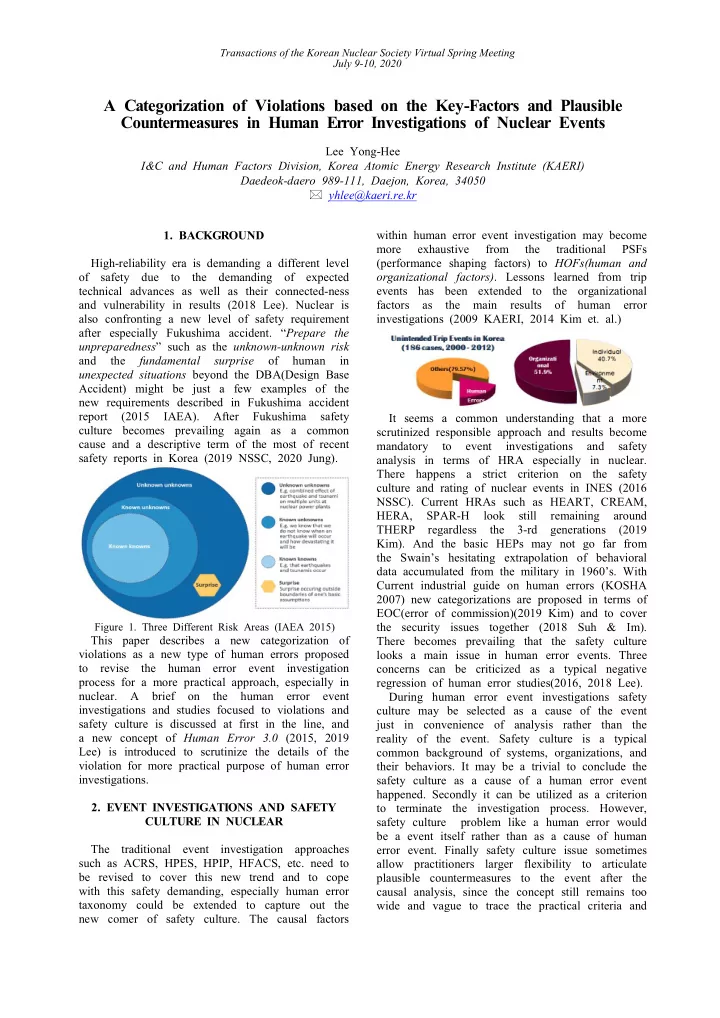
technical advances as well as their connected-ness and vulnerability in results (2018 Lee). Nuclear is also confronting a new level of safety requirement after especially Fukushima accident. “Prepare the unpreparedness” such as the unknown-unknown risk and the fundamental surprise

  • f

human in unexpected situations beyond the DBA(Design Base Accident) might be just a few examples of the new requirements described in Fukushima accident report (2015 IAEA). After Fukushima safety culture becomes prevailing again as a common cause and a descriptive term of the most of recent safety reports in Korea (2019 NSSC, 2020 Jung).

Figure 1. Three Different Risk Areas (IAEA 2015)

This paper describes a new categorization of violations as a new type of human errors proposed to revise the human error event investigation process for a more practical approach, especially in nuclear. A brief

  • n

the human error event investigations and studies focused to violations and safety culture is discussed at first in the line, and a new concept of Human Error 3.0 (2015, 2019 Lee) is introduced to scrutinize the details of the violation for more practical purpose of human error investigations.

  • 2. EVENT INVESTIGATIONS AND SAFETY

CULTURE IN NUCLEAR The traditional event investigation approaches such as ACRS, HPES, HPIP, HFACS, etc. need to be revised to cover this new trend and to cope with this safety demanding, especially human error taxonomy could be extended to capture out the new comer of safety culture. The causal factors within human error event investigation may become more exhaustive from the traditional PSFs (performance shaping factors) to HOFs(human and

  • rganizational factors). Lessons learned from trip

events has been extended to the organizational factors as the main results

  • f

human error investigations (2009 KAERI, 2014 Kim et. al.) It seems a common understanding that a more scrutinized responsible approach and results become mandatory to event investigations and safety analysis in terms of HRA especially in nuclear. There happens a strict criterion on the safety culture and rating of nuclear events in INES (2016 NSSC). Current HRAs such as HEART, CREAM, HERA, SPAR-H look still remaining around THERP regardless the 3-rd generations (2019 Kim). And the basic HEPs may not go far from the Swain’s hesitating extrapolation of behavioral data accumulated from the military in 1960’s. With Current industrial guide on human errors (KOSHA 2007) new categorizations are proposed in terms of EOC(error of commission)(2019 Kim) and to cover the security issues together (2018 Suh & Im). There becomes prevailing that the safety culture looks a main issue in human error events. Three concerns can be criticized as a typical negative regression of human error studies(2016, 2018 Lee). During human error event investigations safety culture may be selected as a cause of the event just in convenience of analysis rather than the reality of the event. Safety culture is a typical common background of systems, organizations, and their behaviors. It may be a trivial to conclude the safety culture as a cause of a human error event

  • happened. Secondly it can be utilized as a criterion

to terminate the investigation process. However, safety culture problem like a human error would be a event itself rather than as a cause of human error event. Finally safety culture issue sometimes allow practitioners larger flexibility to articulate plausible countermeasures to the event after the causal analysis, since the concept still remains too wide and vague to trace the practical criteria and

slide-2
SLIDE 2

Transactions of the Korean Nuclear Society Virtual Spring Meeting July 9-10, 2020

monitor the status/changes in detail. There have been many trials to study the safety culture in mainly nuclear in Korea such as system dynamics simulation (2013 Lee et al.), 7-S model (2015 Park), BPM based monitoring (2015, 2018 Lee), competence-focused approach(2016 Jang & Lee), managerial model (2016 KINS), after IAEA’s self-assessment model(2012 IAEA) and 5 attribution model in aviation(2006 Govaarts, Reason). Although human error researchers such as Embey, Kirwan, Reason, etc. have excluded some part

  • f

human errors by introducing the psychological criteria of intention, however, safety culture may not separated from human errors including violations and even up to sabotages. New approach to human error investigation at first is required to cope with the demanding issue of safety culture in Korean nuclear.

  • 3. VIOLATION INVESTIGATIONS

The traditional human error investigations have adopted a classification on human failures to be included in event structures. Many classifications and taxonomy on human behaviors have been developed from the early stage of human factors research in time-and-motion study of the 1-st Industrial Revolution era. Following criteria can be adopted to discriminate the different characteristics

  • f human errors.
  • types of human behavior and/or system function
  • causes of failure
  • consequences to the human such as injury
  • PSFs and Error Shaping/Influencing Factors
  • psychological modes, status, and cognitive level
  • counter-measures

Reason’s taxonomy shows a typical classification

  • f human errors in a perspective of psychology.

Figure 2. Types of Human Errors (by Reason)

It utilizes an interpretation of internal process of memory, attention control and others. Intention especially discriminate the violations and sabotage from more typical slip, lapse, and mistakes. There are further considerations on violations in human error investigations including safety culture issue since various new types of human errors are raised from the human error studies as examples.

  • routine/permitted violations(1998 Hudson et al)
  • mannerism/negligence/avoidance (2014 Lee)
  • optimized/convenience violations(2015 Jung et al)
  • temporal/exceptional violations(2016 Kang et al)
  • test violation, after-event violation (2016 Lee)
  • asked/induced violations (2016 Yoon, 2019 Lee)

Failure to have a appropriate formation of intention and good intentions also should be separated from the faulty and bad intentions (2011 Lee). Algorithms for substitution test were proposed to discriminate the so-called ‘honest error’ from the blamable violations by Reason and Govaarts in aviation (2006 Govaarts).

Figure 3. Substitution Test on Violations in Aviation Events (Proposed by Reason and HERA-JANUS, part)

They are articulated for the clearer line of acceptable and unacceptable behavior in ‘Just’ culture in practice. However they were established

  • n the believe that a “no-blame” culture per se is

neither feasible nor desirable withstanding

  • f

questioning attitude required. They are focused to promote the reporting more actively, however just to provide a culpability to the judical system. Recent studies to human errors in Korean nuclear include a proposal to the house model of violation with 10 keys and 152 factors after a revisit to the nuclear events (2016 Kang et al).

Figure 4. Violation Errors and Influencing Structures (Kang, et.al. 2015)

slide-3
SLIDE 3

Transactions of the Korean Nuclear Society Virtual Spring Meeting July 9-10, 2020 Figure 5. Classification of Influencing Factors of the Violations in Nuclear Events (Kang, et. al. 2015)

A few details to scrutinized violations for judical system can be summarized as followings.

  • intention of consequences
  • perception of rule-breaking
  • availability of information and prior experiences
  • 4. CATEGORIZATIONS OF VIOLATIONS IN

EVENT INVESTIGATIONS Main categorization of violations is to give a more details

  • n

the causes

  • f

them. The

  • bjectivity may be vague and strongly dependent
  • n

the judical investigations rather than any technical one. Further categorization of violations can be applied by incorporating the followings. keys sub-factors intention consequence (negatives) loss/damage punishment value gain (positives) gain interest, fun etc. personal value convenience

  • thers

mis-captured (selected in domain tasks) perceptio n rule rule itself/details rule purpose intended rule-breaking meaning of rule-breaking availability physical informational manage ment intervention self peer supervisory E&T education-class, case, mt’l training – OJT and etc. PJB etc. experiences job-related personal

  • thers
  • rganization

(selected in domain org.)

  • thers

(selected on purpose) A few postulations on violations are suggested. Firstly, most violations turned out to be influenced externally (sometimes induced) by detectable surrounding factors, and might be manageable by technical efforts to them. It can also be suggested that external technical interventions to violations are to be feasible like the others human errors (2016 Lee). New perspective of Human Error 3.0 changes the main focus of investigations from the factual causes to the practical countermeasures (2016, 2018, 2019 Lee). It can be differentiated from Human error 1.0 & 2.0 since it comes more from unknowns rather than known limitations of human and the surroundings in a system. It suggests an

  • pen

attitude to the scope

  • f

investigations from the causality to the plausibility

  • f influencing factors in order to select a more

practical and effective countermeasure to the human errors in the future. Proposed categorization approach to investigation can be articulated to most

  • f violations in practice with the prior studies on

the types of violations and the factors in house

  • model. Additional technical barriers, avoidable and

escapable means, tolerances, bypasses and endurances to stop the propagation of errors can be selected as a basis to the countermeasures.

  • 5. DISCUSSIONS AND CONCLUSIONS

Very small portion of human errors are solely deliberate and wilful in a system. They are induced by overall system and the situation-and

  • atmosphere,

and to be described as a just non-compliance at first, and concluded eventually into a criminal activity, abuse, a rule-breaking, and culpability and

  • thers.

However violations in nuclear events tend to be burst into the blaming process rather than technical understanding for lessons learned. Generally speaking human errors in a high-reliability system they are very rare and expensive to reveal the internal limitations if

  • system. And violations may be more informative

than other human errors. So the proposed approach to violations should be further developed with countermeasures available and recommendable in a

  • system. It also can be considered during the

following technical activities in nuclear(2019 Lee). Ÿ Safety culture issues such as Organized Irresponsibility and behavior-based safety(BBS) Ÿ Security including human credibility and accountability to the insider threat for example Ÿ Human factors safety verifications(2018 Lee) : For human factors safety verification on the designs

  • f

new and existing nuclear installations, plausible violations in an unexpected situation should be investigated more precisely until getting the safety enough. And stress test for the further unexpected extreme events such as beyond DBAs

slide-4
SLIDE 4

Transactions of the Korean Nuclear Society Virtual Spring Meeting July 9-10, 2020

ACKNOWLEDGMENT This paper is supported by the Nuclear Safety Research Program grant funded by Nuclear Security and Safety Commission(NSSC) and KOFONS(2003010). REFERENCES

  • 1. Govaarts, C., Establishment of ‘Just Culture’

Principles in ATM Safety Data Reporting & Assessment, EAM2/GUI6, Eurocontrol, 2006

  • 2. Hudson, P. et. al., Bending the Rules: Managing

Violation in the Workplace, Society

  • f

Petroleum Eng. Int. Conf. on Health, Safety &

  • Env. in Oil & Gas Exploration, 1998
  • 3. IAEA, Fukushima Accident Report, 2015
  • 4. Jung, D.Y., et al., A new Definition of

Violation based on Accident/Failure Analyses in NPPs, ESK-2015 Spring, 2015

  • 5. Jung, Y.H. et al., Current Status of Just Culture

in Aviation and Its Applications to Nuclear Power Plants(in Korean), KINS/RR-2011, 2020

  • 6. KAERI, Lessons Learned from the Trip Cases

in Korean NPPs, 2007, 2009

  • 7. Kang, B. et. al., Conceptual Models of

Violation Errors in a NPP, J. Korean Society of Safety, 31(1), pp.126-131, 2016

  • 8. Kim, KY. A Study of Risk Communication

Under Energy Transition Government, KNS2019Spring, 2019

  • 9. Kim, J.H., Development of A Methodology for

Analyzing Human Errors Causing Multi-Unit Initiating Events, 2019

  • 10. Kim, J.H. et al., Development of Multi-Unit

Human Reliability Analysis Methodology based

  • n SPAR-H, 2019
  • 11. Kim, S.K. and Kim, J.Y., Implementation of Mixed

Reality Techniques for maximizing reality and fidelity of experiments of NPP MCR operators., ESK-2018 Spring, 2018.

  • 12. KINS, Regulatory Review Guideline: 15.6

Application of HFE to Severe Accidents and B-DBA, KINS/RG-N15.06, Rev.0, 2017

  • 13. KOSHA, Guideline for Human Error Analysis,

KOSHA code P-11, 2007.

  • 14. Lee, Y.H., A State of the Art Report on the

Current Human Error Studies: What and How to Cope with, JESK30(1) pp.1-8, 2011

  • 15. Lee, Y.H., Human Error 3.0 Concept for High-

Reliability Era, Proc. ESK-2015-Fall, 2015

  • 16. Lee, Y.H., Human Factors Engineering

Approach to Safety Culture, Proc. ESK-2016 Fall, 2016

  • 17. Lee, Y.H., New Classification of Human Errors

in High Reliability Era, Proc. ESK-2018 Spring, 2018

  • 18. Lee, Y.H., An Introduction of Human Error

3.0 Concept to Cope with the Safety Culture Issue in Nuclear, KNS-2018 Fall, 2018

  • 19. Lee, Y. H., How to Consider the Unexpected

Situations for the Human Factors Verification and Validation, Proc. ESK-2018 Spring, 2018

  • 20. Lee, Y. H., A Study on the Technical Status, Issues,

and Approach to HFE V&V of Nuclear Installations in Severe Accidents, KNS-2018 Fall, 2018

  • 21. Lee, Y.H., An Application of Human Error 3.0

Concept to Cope with the Organized Irresponsibility, ESK-2019 Spring, 2019

  • 22. Lee, Y. H., Human Error Research Trends

Toward 21-st Century Nuclear Technology, Nuclear I&C 2019 Winter Workshop, 2019

  • 23. Lee, Y.H., A Revisit to the Technical Issues

and Approaches For the Investigation of Human Error Events, KNS 2019 Fall, 2019

  • 24. Lee, Y.H., How to Treat Violation Errors

during Human Error Investigations in Nuclear Events, KNS 2019 Fall, 2019

  • 25. Rasmussen, J., Concept of Human Error: Is it

Useful for the Design of Safety Systems? Safety Science Monitor,3(1), 1999

  • 26. Reason, J., Human Error, Cambridge University

Press, 1990.

  • 27. Shorrock, S.T. & Kirwan, B., Development

and application of a human error identification tool for air traffic control, Applied Ergonomics, 33, 2000

  • 28. Suh, Y. and Im, M. Experimental measurement
  • f Human Errors using psycho-physiological

signals, ESK2018 Fall, 2018

  • 29. Wickens, C.D., Engineering Psychology and

Human Performance,2nd ed. HarperCollins Pub., 1992