A distributed approximation scheme for sleep scheduling in sensor - - PowerPoint PPT Presentation

a distributed approximation scheme for sleep scheduling
SMART_READER_LITE
LIVE PREVIEW

A distributed approximation scheme for sleep scheduling in sensor - - PowerPoint PPT Presentation

A distributed approximation scheme for sleep scheduling in sensor networks Patrik Flor een, Petteri Kaski, Jukka Suomela HIIT, University of Helsinki, Finland SECON 19 June 2007 A sensor network Battery-powered sensor devices


slide-1
SLIDE 1

A distributed approximation scheme for sleep scheduling in sensor networks

Patrik Flor´ een, Petteri Kaski, Jukka Suomela

HIIT, University of Helsinki, Finland
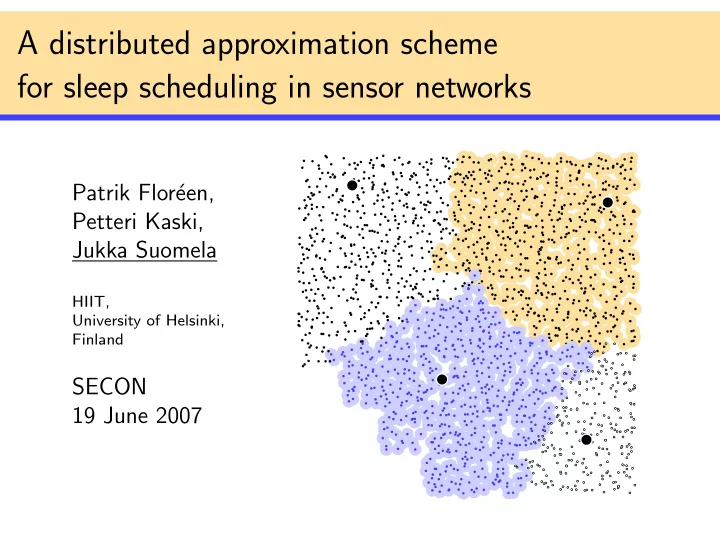
SECON 19 June 2007

slide-2
SLIDE 2

A sensor network

Battery-powered sensor devices Maximise the lifetime by letting each node sleep occasionally

2 / 18

slide-3
SLIDE 3

Pairwise redundancy relations

Two sensors close to each other may be pairwise redundant If v is active then u can be asleep and vice versa

Detecting pairwise redundancy: e.g., Koushanfar et al. (2006)

v u

3 / 18

slide-4
SLIDE 4

Redundancy graph for the sensor network

All pairwise redundancy relations

4 / 18

slide-5
SLIDE 5

A dominating set in the redundancy graph

If v1 is active then its neighbours can be asleep v1

5 / 18

slide-6
SLIDE 6

A dominating set in the redundancy graph

If v2 is active then its neighbours can be asleep v1 v2

6 / 18

slide-7
SLIDE 7

A dominating set in the redundancy graph

If v3 is active then its neighbours can be asleep v1 v2 v3

7 / 18

slide-8
SLIDE 8

A dominating set in the redundancy graph

If nodes {v1, v2, v3} are active then all other nodes can be asleep

  • D = {v1, v2, v3} is

a dominating set in this redundancy graph Task: find multiple dominating sets and apply them one after another v1 v2 v3

8 / 18

slide-9
SLIDE 9

Fractional domatic partition

1 2 units 1 2 units 1 2 units 1 2 units 1 2 units 5 2 time units

Each node active for 1 time unit Achieved lifetime:

9 / 18

slide-10
SLIDE 10

Towards the distributed algorithm

Optimal sleep scheduling =

  • ptimal fractional domatic partition

◮ Hard to optimise and hard to

approximate in general graphs

◮ Centralised solutions are not

practical in large networks Plan:

◮ Identify the features of

typical redundancy graphs

◮ Exploit the features to design a

distributed approximation scheme

1 2 units 1 2 units

· · ·

10 / 18

slide-11
SLIDE 11

Features of a typical redundancy graph

Communication graph

  • 1. Density of nodes
  • 2. Length of edges
  • 3. Geometric

spanner Redundancy graph

◮ Any subgraph

Given these assumptions, there exists a distributed approximation scheme

11 / 18

slide-12
SLIDE 12

The distributed approximation scheme

Idea 1:

  • 1. Partition the graph into small cells
  • 2. Solve the scheduling problem

locally in each cell

◮ Nodes near a cell boundary

help in domination

◮ Local optimum at least

as good as global optimum

  • 3. Merge the local solutions

Problem:

◮ Nodes near a cell boundary

work suboptimally

12 / 18

slide-13
SLIDE 13

The distributed approximation scheme

Idea 2: shifting strategy

(e.g., Hochbaum & Maass 1985)

  • 1. Form several partitions
  • 2. Make sure no node is near

a cell boundary too often

  • 3. Construct a schedule for each

partition and interleave Works fine if the nodes know their coordinates Can we form the partitions without using any coordinates ?

13 / 18

slide-14
SLIDE 14

The distributed approximation scheme

Install anchor nodes

Or use a distributed algorithm to find suitable anchors: e.g., any maximal independent set in a power graph of the communication graph

Not too sparse, not too dense 1 bit of information: “I am an anchor”

14 / 18

slide-15
SLIDE 15

The distributed approximation scheme

Finding one partition is now easy: Voronoi cells for anchors

◮ Metric: hop counts in communication graph

How do we get more partitions? No global consensus

  • n left/right,

north/south

15 / 18

slide-16
SLIDE 16

The distributed approximation scheme

Assumption: locally unique identifiers for anchors

◮ MAC addresses ◮ Random numbers

Shift borders towards those anchors with larger identifiers

Key lemma

No node is near a cell boundary too often

16 / 18

slide-17
SLIDE 17

The distributed approximation scheme

A constant number of partitions suffices Cell size is bounded

Main result

For any ǫ > 0, with suitable anchor placement, sleep scheduling can be approximated within 1 + ǫ in constant time per node

17 / 18

slide-18
SLIDE 18

Summary

◮ Sleep scheduling in sensor networks

= fractional domatic partition

◮ Formalise the features which make

the problem easier to approximate

◮ Anchors suffice, coordinates are

not needed

◮ A distributed approximation

scheme, constant effort per node

◮ Demonstrates theoretical feasibility

– more work needed to make the constants practical

http://www.hiit.fi/ada/geru jukka.suomela@cs.helsinki.fi 1 2 units 1 2 units

· · ·

18 / 18