A Gender Focused Analysis of Learning Processes of Smallholders - - PowerPoint PPT Presentation

a gender focused analysis of learning processes of
SMART_READER_LITE
LIVE PREVIEW

A Gender Focused Analysis of Learning Processes of Smallholders - - PowerPoint PPT Presentation

A Gender Focused Analysis of Learning Processes of Smallholders within a Development Program in Nepal Katharina Zangerle 1 , Lorenz Probst 1 , Romana Roschinsky 1 , Maria Wurzinger 1 , Manindra Malla 2 , Chintan Manandhar 2 1 University of Natural


slide-1
SLIDE 1

A Gender Focused Analysis of Learning Processes of Smallholders within a Development Program in Nepal

Katharina Zangerle1, Lorenz Probst1, Romana Roschinsky1, Maria Wurzinger1, Manindra Malla2, Chintan Manandhar2

1 University of Natural Resources and Life Sciences (BOKU),

Centre for Development Research (CDR), Austria

2 Caritas Nepal, Nepal

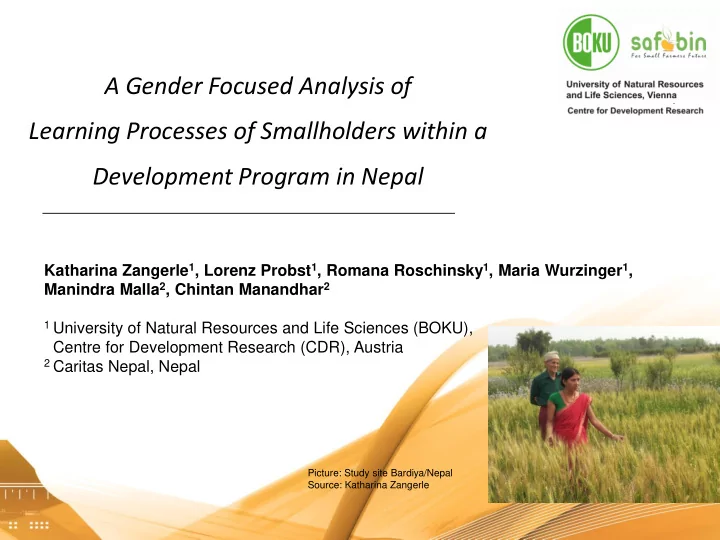
Picture: Study site Bardiya/Nepal Source: Katharina Zangerle

slide-2
SLIDE 2

SAF-BIN key facts:

Strengthening Adaptive Farming in Bangladesh, India & Nepal

  • Research and development program
  • Duration: 5 years; since 2011
  • Objective: Promote local food and nutritional security through adaptive small

scale farming in the context of climate change (SAF-BIN 2011)

Katharina Zangerle

2

slide-3
SLIDE 3

SAF-BIN in Nepal & Study Sites

Katharina Zangerle

3

  • SAF-BIN in Nepal:

4 districts, 28 villages, 3-4 farmers groups/ village, about 15 persons/ group

  • Study Sites:

Mixed farming systems, subsistence- oriented

Bardiya: Mid western plains

Kaski: Mid- hills

Kaski Bardiya

Surkhet Nawalparasi

slide-4
SLIDE 4

Research Questions

Katharina Zangerle

4

 In which ways do the activities within SAF-BIN allow learning?  Which learning outcomes are realized?  In which way do these learning outcomes differ between men and women?

slide-5
SLIDE 5
  • Transformative Learning Theory

 Critical reflection, Dialogue, Individual experience are essential for learning  Instrumental learning ....... gaining technical skills and knowledge  Communicative learning … communication skills (Mezirow et al. 2009)

  • Gender perspectives

 Theory of practical and strategic gender needs (Moser 1993)  Intersectionalities (Crenshaw 2004)

Theoretical approach

Katharina Zangerle

5

slide-6
SLIDE 6

Methodology – Qualitative design

  • 2-months field study

 Problem-centered interviews with SHFs (#22) and project staff (#11)  Observation: living context and learning activities (group meetings, field trials)  Field-work diary, records, photographs, transcription with software f5

  • Analysis

 Descriptive statistics  Content Analysis and Comprehensive Structural Analysis (Lueger 2010) with software Atlas.ti

Katharina Zangerle

6

slide-7
SLIDE 7

Results I: Gender distribution

& learning activities

Katharina Zangerle

7

 Different age classes, ethnicities, marital status

Bardiya Kaski Female Male Female Male Group 1 13 2 14 1 Group 2 8 7 13 2 Group 3 13 2 13 3

  • Group meetings
  • Design of plots
  • Monitoring of field trials
  • Interpretation of results

 These activities allow transformative learning through the participative character and supportive project staff

slide-8
SLIDE 8

Results II:

Instrumental learning outcomes

Topic Learning outcomes Notable gender outcome Climate Change Knowledge about global and regional Climate Change (CC), CC adaption, links between CC and farming

  • Cultivation

practices/ Inputs Use of different crop varieties/ Line sowing instead of broadcasting/ Application of organic fertilizers/ mulching Especially men Management IPM/ Water management/ Farm management Especially men Health Nutrients (application: cooking, kitchen gardening), Potential impacts of chemical pesticides and fertilizers on health Especially women learned about health issues Farming as business Sell vegetables at market, diversification and professionalization

Katharina Zangerle

8

slide-9
SLIDE 9

Results III:

Communicative learning outcomes

Topic Learning outcomes Notable gender outcome Planning Defining problems and short-term and long-term objectives Especially women Management Organization skills e.g. assign functions of group members

  • Communication Presentation skills and techniques,

networking, decision making, self- confidence Especially women (except for decision making!) Analytical capacities Analytical and methodological awareness

  • Concepts

Concepts e.g. sustainability, empowerment, leadership, gender equality, capacity building Especially women

9

Katharina Zangerle

slide-10
SLIDE 10

Conclusions

 Participative and regular activities & skilled facilitators support learning  SAF-BIN can be a platform for transformative learning  Men are more likely to achieve technical learning outcomes and women are more likely to achieve communicative learning outcomes  Chances for learning and empowerment: e.g. adressing issues like postharvest handling of crops, animal husbandry, management of crisis, women in higher positions, motivating women for technical topics  Further research: Which processes lead to inequalities?

Katharina Zangerle

10

slide-11
SLIDE 11

11

A Gender Focused Analysis of Learning Processes of Smallholders within a Development Program in Nepal

Katharina Zangerle1, Lorenz Probst1, Romana Roschinsky1, Maria Wurzinger1, Manindra Malla2, Chintan Manandhar2

1 University of Natural Resources and Life Sciences (BOKU),

Centre for Development Research (CDR), Austria

2 Caritas Nepal, Nepal

Picture: Study site Bardiya/Nepal Source: Katharina Zangerle

European Commission

This research has been produced with the financial assistance of the European Union. The contents of this document are the sole responsibility of Caritas Austria and its partners and can under no circumstances be regarded as reflecting the position of the European Union.

slide-12
SLIDE 12

Katharina Zangerle

12

Crenshaw, K. (2004): Intersectionality: The Double Bind of Race and Gender. Perspectives Magazine. (online): http://www.americanbar.org/content/dam/aba/publishing/perspectives_magazine/women_perspectives_Spring20 04CrenshawPSP.authcheckdam.pdf. [Abgerufen: 13.06.2015]. Duggan, L., Nisonoff, L., Visvanathan, N., Wiegersma, N. (2006): The Women, Gender and Development

  • Reader. Sixth impression. Malaysia: Forum.

Farming First (2013): The female facts of farming. (online) http://www.farmingfirst.org/portal/gender/. [Abgerufen: 25.01.2013]. Giro (2009): Food and Agriculture Organization of the United Nations (FAO) (2014): Fact Sheet Nepal. Women in Agriculture, Environment and Rural Production. (online) ftp://ftp.fao.org/sd/sdw/sdww/Nep.pdf [25.07.2014]. Lueger, M. (2010): Interpretative Sozialforschung: die Methoden. Wien : Facultas.WUV. Mezirow, J., Taylor, E.W. & Associates (2009): Transformative Learning in Practice. Insights from Community, Workplace and Higher Education. San Francisco: Jossey-Bass. SAF-BIN (2011): Strengthening Adaptive Farming in Bangladesh, India & Nepal (online) http://www.safbin.org/home. [Abgerufen: 30.10.2013].

References