A Multidisciplinary Approach A Multidisciplinary Approach to - - PDF document

a multidisciplinary approach a multidisciplinary approach
SMART_READER_LITE
LIVE PREVIEW

A Multidisciplinary Approach A Multidisciplinary Approach to - - PDF document

8/15/2012 Hawaii Conservation Conference Hawaiian Archipelago August 2012 A Multidisciplinary Approach A Multidisciplinary Approach to Restoration and to Restoration and Sustainability of Midway Sustainability of Midway Atoll's Shallow


slide-1
SLIDE 1

8/15/2012 1

Donald C. Potts Donald C. Potts1, Kristin M. McCully , Kristin M. McCully1*, *, Wendy A. Wendy A. Cover Cover1,2

1,2, Anne B. Warner

, Anne B. Warner1

1University of California, Santa Cruz

University of California, Santa Cruz

2Fagatele Bay National Marine Sanctuary, American Samoa

Fagatele Bay National Marine Sanctuary, American Samoa *Corresponding author: mccully@biology.ucsc.edu *Corresponding author: mccully@biology.ucsc.edu

A Multidisciplinary Approach to Restoration and Sustainability of Midway Atoll's Shallow Reef Habitats A Multidisciplinary Approach to Restoration and Sustainability of Midway Atoll's Shallow Reef Habitats

Hawaii Conservation Conference August 2012

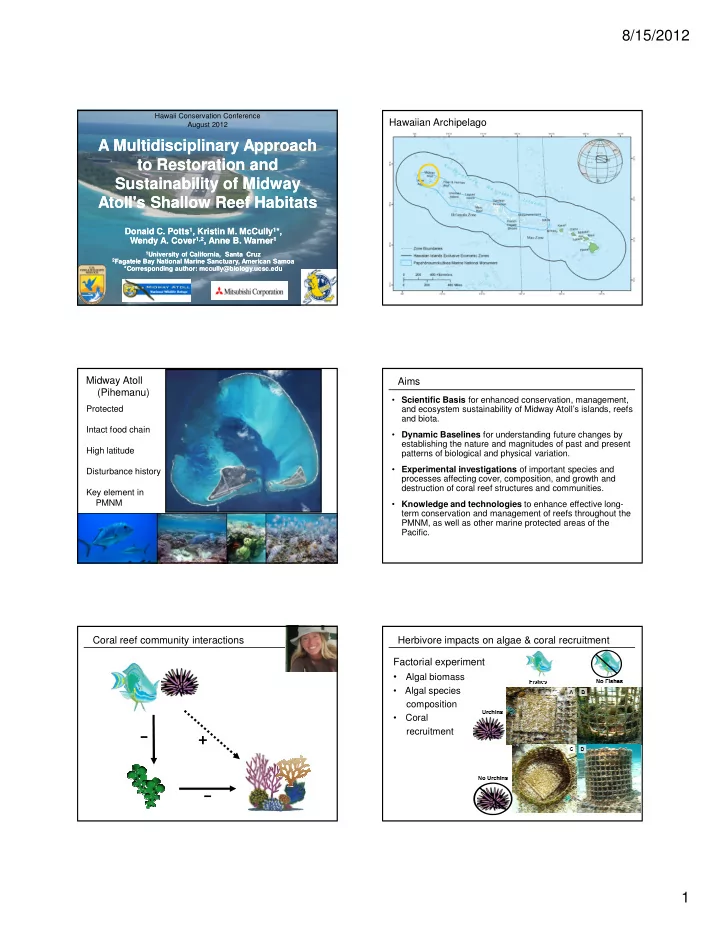
Hawaiian Archipelago Midway Atoll (Pihemanu)

Protected Intact food chain High latitude Disturbance history Key element in PMNM

Aims

  • Scientific Basis for enhanced conservation, management,

and ecosystem sustainability of Midway Atoll’s islands, reefs and biota.

  • Dynamic Baselines for understanding future changes by

establishing the nature and magnitudes of past and present patterns of biological and physical variation.

  • Experimental investigations of important species and

processes affecting cover, composition, and growth and destruction of coral reef structures and communities.

  • Knowledge and technologies to enhance effective long-

term conservation and management of reefs throughout the PMNM, as well as other marine protected areas of the Pacific.

Coral reef community interactions Herbivore impacts on algae & coral recruitment Factorial experiment

  • Algal biomass
  • Algal species

composition

  • Coral

recruitment

slide-2
SLIDE 2

8/15/2012 2

Fish grazing prevented macroalgal growth Fish grazing increased coral recruitment Coral reef community interactions Coral reef community interactions

?

urchins present: urchins removed:

Bioerosion of corals by urchins

n = 10 n = 10

Porites Montipora Rock-boring urchin (Echinometra mathaei) 6 - 34/m2

Urchins damaged coral tissue & skeleton

slide-3
SLIDE 3

8/15/2012 3

Coral reef community interactions Conclusions & implications for conservation

  • Fishes are the dominant herbivores on Midway
  • Fish grazing indirectly promotes coral recruitment
  • Particularly important to protect fish herbivores
  • Urchins can directly damage corals through bioerosion
  • May be able to promote coral cover by reducing urchin

abundance

Restoration of Porites compressa patch reefs Methods

Transplant Sites Source

All coral recruits were Pocillopora sp.

  • 10 tiles at source site and at 2

transplant sites

  • No significant difference between sites
  • Very low recruitment compared to

previous Midway recruitment studies – mean 2.7 recruits per tile

  • All coral recruits were Pocillopora sp.
  • No natural recovery possible via

recruitment of Porites compressa

Most transplants survived 10 months

0% 20% 40% 60% 80% 100% RB1 RB2 RB3 RB4 RB5 Percent Survival Site

Shallow (1-2 m) Deep Shallow (1-2 m) Deep (3-4 m)

Near Island Far from Island More analysis coming soon!

slide-4
SLIDE 4

8/15/2012 4

Black-lipped pearl oysters are rare & hard to restore Talk in this session at: 11:50 am Much more analysis in progress

USFWS

Sediment & rubble collections Reef cores Reef accretion/erosion Coral reproduction

Conclusions & implications for conservation

  • Particularly important to protect fish herbivores
  • May be able to promote coral cover by reducing urchin

abundance

  • Restoring Porites compressa reefs by transplantation

holds great promise

  • May be very difficult to restore pearl oyster beds
  • More information coming soon!

THANK YOU! Info & photos at: http://bio.research.ucsc.edu/people/potts/midway/