A Path to NIST Calibrated Stars over the Dome of the Sky April 18, - - PowerPoint PPT Presentation

a path to nist calibrated stars
SMART_READER_LITE
LIVE PREVIEW

A Path to NIST Calibrated Stars over the Dome of the Sky April 18, - - PowerPoint PPT Presentation

A Path to NIST Calibrated Stars over the Dome of the Sky April 18, 2012 Peter C. Zimmer, John T. McGraw, Dan Zirzow & Jeff Karle UNM Keith Lykke, Claire Cramer & John Woodward NIST Astronomical Photometry: Extinction Record It is


slide-1
SLIDE 1

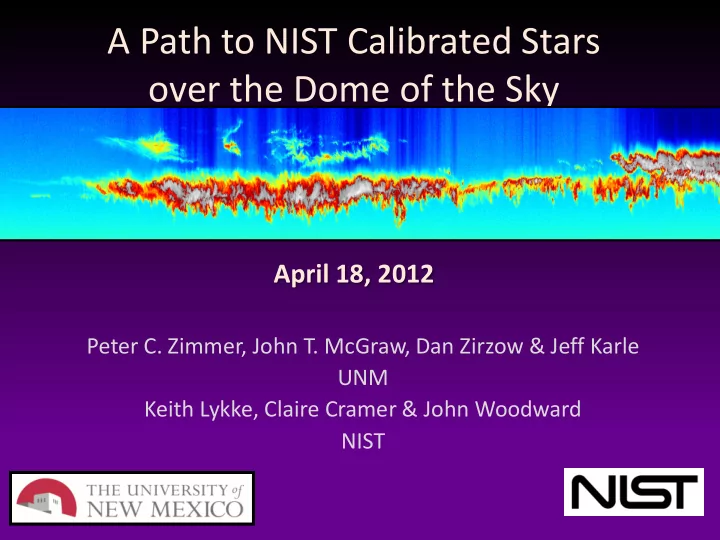
A Path to NIST Calibrated Stars

  • ver the Dome of the Sky

April 18, 2012

Peter C. Zimmer, John T. McGraw, Dan Zirzow & Jeff Karle UNM Keith Lykke, Claire Cramer & John Woodward NIST

slide-2
SLIDE 2

Astronomical Photometry: Extinction Record

“It is impractical to determine the extinction thoroughly and accomplish anything else.”

  • Stebbins and Whitford (1945)*
slide-3
SLIDE 3

Astronomical Photometry: Extinction Record

“It is impractical to determine the extinction thoroughly and accomplish anything else.”

  • Stebbins and Whitford (1945)*

Not a warning, a measurement philosophy!

slide-4
SLIDE 4

NIST Stars

Spectral irradiance calibration (W/m2/nm) of bright stars (V<5.5) to NIST standards Initially dozens, ultimately ~100 objects

  • Vega, Sirius, 109 Vir, ~20 targets from NGSL
  • Please contribute your favorite star!

Initially < 1% accuracy per nm from 400-1000nm Biggest known obstacle: Atmospheric T

slide-5
SLIDE 5

Applications of Absolute Standard Stars

Instruments that can be calibrated using standard stars: Upper Left: NOAA GOES-R Satellite Far Left: SBIRS Ballistic missile launch detection satellite Left: Wide Field InfraRed Space Telescope (WFIRST)

– calibrating Earth-observing spacecraft, including weather and climate – calibrating ground- and space-based telescopes – SSA sensor test and calibration, – characterization of low Earth

  • rbit objects

– Missile defense sensors – Geospatial intelligence sensors

slide-6
SLIDE 6

Atmospheric Transmission: Two Categories, Two Instruments

Slowly varying with wavelength

  • Clouds – rapid temporal and angular variability
  • Aerosols – confusion with O3 absorption

Measurement Solution: Calibrated LIDAR

Rapidly varying with wavelength

  • H2O absorption – significant temporal variability
  • O2 absorption – stable and easily modeled

Instrumental Solution: Calibrated Spectrophotometry

slide-7
SLIDE 7
  • AESoP Key Parameters

– Free spectral range

  • Shortpass (2nd order): 320 nm– 550nm
  • Longpass: 525nm – 1050nm

– Spectral resolution 0.6 nm, R = 1100 at 650nm – Pixel resolution 0.28nm at 650nm

  • For bright stars, a large aperture is not

required

  • AESoP is an objective spectrophotometer

– 106mm Takahashi refractor – Paramount ME eq. mount – 90 l/mm transmission grating mounted behind entrance aperture – 100mm diam. Invar aperture

Measured area: 7827.17 +/- 0.01 mm2

  • No optical elements other than an order

separating filter) after the telescope

  • bjective lenses
  • Sci-In photometric shutter
  • Photometric precision is fundamentally

limited by scintillation

Astronomical Extinction Spectrophotometer (AESoP)

slide-8
SLIDE 8

AESoP Calibration

AESoP CAL

CAL – the irradiance transfer standard Nearly identical to AESoP but:

– No grating or order blocking filter – Fabry lens makes pupil image on CCD – CCD read out in TDI mode (see poster) – Easily removable from mount – Calibrated at NIST

Proof of concept detector achieved NEP < 100 aW/√Hz at 550nm New detector expected < 20 aW/√Hz

Sample CAL data

slide-9
SLIDE 9

AESoP Calibration

In calibration mode:

  • Trailer roof closed
  • AESoP and CAL both pointed at collimator mirror

– Fiber at collimator focal point is fed by a monochromator

  • AESoP and CAL illuminated one wavelength at a time to transfer

irradiance calibration from CAL to AESoP

  • System can translate vertically to assess illumination variations
  • CAL only observes this or horizon calibrator

– CAL is otherwise closed to protect optics

AESoP & CAL Collimator Fiber Source

slide-10
SLIDE 10

Atmospheric Transmission: Two Categories, Two Instruments

Slowly varying with wavelength

  • Clouds – rapid temporal and angular variability
  • Aerosols – confusion with O3 absorption

Measurement Solution: Calibrated LIDAR

Rapidly varying with wavelength

  • H2O absorption – significant temporal variability
  • O2 absorption – stable and easily modeled

Instrumental Solution: Calibrated Spectrophotometry

slide-11
SLIDE 11

Sensitive to: Rayeigh scattering Mie scattering Molecular and aerosol absorption Time-gated return yields range

Basics of LIDAR

        

   

r P M P M

dr P M

e r r P r r A N r N

' ) ( 2 2

) ( 4 ) ( ) ( 8 3 2 ) (

    

     

LIght Detection and Ranging – laser analog to radar

slide-12
SLIDE 12

The Stratosphere

slide-13
SLIDE 13

Target the Stratosphere

Troposhere Stratoposhere Weather Volcanic Aerosols Gravity Waves

(Brunt-Vaisala, not Einstein)

Mesoposhere Target Here

slide-14
SLIDE 14

Facility Lidar for Astronomical Monitoring

  • f Extinction (FLAME)

FLAME simultaneously transmits 3W at 1064nm, 2W at 532nm and 1.5W at 355nm 6 ns pulses at 1500Hz emitted from 200mm diameter transmitters Return below 10km collected with three 75mm refractive short range receivers Return from high altitude are collected with 500mm long range receiver Long range photons split with dichroics and sent to individual photomultipliers DESIGN GOAL: > 1 x 10⁶ photons/minute from above 30km

slide-15
SLIDE 15

Calibrating FLAME

Transmitter:

  • Calibrated telescopes (one for each

wavelength) in trailer

  • FLAME transmits at these to

establish link to power meter

  • Current design testing off-axis mirror
  • vs. Fresnel lens
  • Photodiode inside an integrating

sphere for detectors Receivers:

  • CAL with laser-line filter for FLAME

calibrated at each laser wavelength

  • Use bright stars and twilight sky for

calibration source

        

   

r P M P M

dr P M

e r r P r r A N r N

' ) ( 2 2

) ( 4 ) ( ) ( 8 3 2 ) (

    

     

Scattering:

  • From sonde profile
slide-16
SLIDE 16

Observe Star Irradiance Calibration Best ATM Model Best Stellar SED

ATM Data Astrophysics

X Sub-1%? Add to Catalog Why? Yes No Adjust ATM model Adjust Stellar SED Reject

Making and Maintaining Absolute Standard Stars

LIDAR

slide-17
SLIDE 17

Observe Star NIST Calibration Best ATM Model

Known Stellar Spectrum

ATM Data X Sub-1%? Add to ATM Database Why? Yes No Adjust ATM model Reject

Monitoring Transmission for Larger Science Telescope

slide-18
SLIDE 18

Lidar plus Thermal IR Imaging

Off-the-shelf uncooled bolometer arrays have the potential to detect the thermal radiance of clouds with τ < 0.01 Lidar can measure cloud transparency very well, but only in beam Thermal IR can measure radiance over wide field Establish radiance->transparency relationship at beam to enable correction of wide-angle transparency variations

slide-19
SLIDE 19

Summary

  • Bright stars absolutely calibrated to NIST spectral irradiance

(W/m2/nm) can aid calibration of a wide variety of sensors

  • Atmospheric transmission is the critical limitation
  • Directly measure the air between the telescope and star
  • Production of these will begin this summer using:
  • Calibrated spectrophotometry
  • Calibrated lidar
  • Combinations of complementary instruments can constrain

atmospheric transmission at an observatory site

  • Atmospheric metadata stream is a natural byproduct
  • Valuable dataset to more than just astronomers
slide-20
SLIDE 20

Why so high?

Calipso average aerosol to molecular backscatter

  • Aug. 2008
slide-21
SLIDE 21

Why not higher?

Gravity wave amplitude > 0.1% above 35km Radiosonde returns tend to end around 35km

  • Balloons pop

(Lu et al. 2008)