
SLIDE 1
A Plan of Materials Irradiation Facility at J-PARC for Development - - PowerPoint PPT Presentation
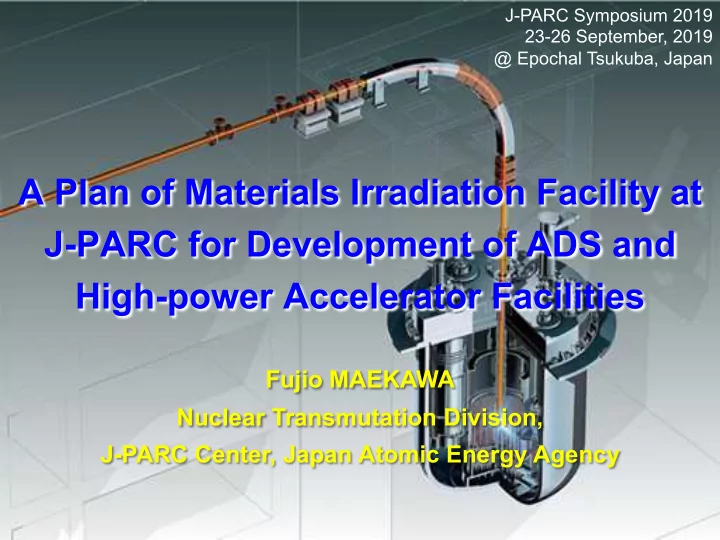
J-PARC Symposium 2019 23-26 September, 2019 @ Epochal Tsukuba, Japan A Plan of Materials Irradiation Facility at J-PARC for Development of ADS and High-power Accelerator Facilities Fujio MAEKAWA Nuclear Transmutation Division, J-PARC Center,
Spent fuel Reprocessing FPMA MA (Np, Am, Cm) PGM (Ru, Rh, Pd) Heat generator (Sr, Cs) Remaining elements UPu Geological disposal Transmutation by ADS and/or FR Utilization and/or disposal Geological disposal after cooling and/or utilization Geological disposal Partitioning Conventional scheme P&T technology
MA: Minor Actinides FP: Fission Products PGM: Platinum Group Metal FR: Fast Reactor ADS: Accelerator Driven System
Recycle
Conventional geological disposal
Effective utilization of geological disposal space
P-T technology introduced Long-term storage added
02 03 04 05 06 07 08 09
HLW (U&Pu recycling) P-T Technology Spent Fuel Elapsed time after reprocessing (years) Potential Toxicity (Sv)
Reduction of long-term toxicity
Spent fuel (1t) High-level waste MA transmutation Natural uranium (9t)
10 100 1k 10k 100k 1M 10M 109 108 107 106 105 104 103 102 100,000 y 5,000 y 300 y
Spallation target (LBE) MA-fueled LBE-cooled subcritical core proton Spallation target (Pb-Bi: LBE) Spallation neutrons MA Fission neutrons Stable & Short-lived nuclei
Nuclear transmutation by ADS Utilize chain fission reactions in a sub-critical core
è High safety is expected.
è MA from 10 LWRs can be transmuted.
Pb-Bi eutectic (LBE)
(60%MA + 40%Pu) Mono-nitride
(=250 kg: MA from 10 units of LWR)
Reactor structure ü Beam window ü Spallation target ü LBE handling Accelerator ü SC Linac ü High power ü High Reliability ü Beam control MA-loaded subcritical core ü Nuclear design ü Reactor physics Fuel cycle ü Partitioning ü MA-bearing Fuel fabrication ü Dry reprocessing
Transmutation Experimental Facility Materials & Life Science Experimental Facility Hadron Experimental Facility Neutrino Experimental Facility 500 m LINAC
(330m)
3 GeV Synchrotron
(25Hz,1MW)
50 GeV Synchrotron
(0.75MW)
400 MeV 3 GeV 30 GeV
250kW 10W
Purpose : Reactor Physics CategoryCritical Assembly Proton Power400MeV-10W Thermal Output up to 500W
Purpose : Material Irradiation Category : Radiation Application Proton Power400MeV-250kW Target MaterialLead-Bismuth
J A E AJ-PARC 核変換実験施設 技術設計書
̶ ADS ターゲッ ト試験施設 (TEF-T) ̶ T e c h n i c a l D e s i g n R e pJ
A R C 核 変 換 物 理 実 験 施 設 ( T E F
) 安 全 設 計 書
Safety Design Report on J-PARC Transmutation Physics Experimental Facility (TEF-P)(JAEA-Technology 2017-003, 539 pages)
(JAEA-Technology 2017-033, 383 pages)
to TEF-P
250 kW 250 kW Laser charge exchange From LINAC TEF-P LBE target Hot-cell for Target exchange & PIE specimen prep. Multi-purpose hall Proton beam transport line LINAC 2F 1F B1F B2F B3F 3GeV RCS Mechanical room for beam transport
Target trolley & LBE circulation system N-S 42 m Service entrance 32 m high
W-E 110 m Target vessel LBE circulation system Target trolley LBE target system Vacuum vessel
J-PARC Transmutation Experimental Facility
250kW-beam
Demonstration test facility (in case when it will not be possible to utilize MYRRHA)
Previous program
J-PARC’s facility 1.Development of simulation models to predict materials’ irradiation and corrosion effects 2.Development of design system for ADS plants 3.Data taking for V&V using existing facilities 4.Proton irradiation facility at J-PARC
Experimental ADS⇒MYRRHA ~2.4MW-beam, 50~100MWth
Demonstration of ADS technology and materials irradiation
Basic experiment with LBE loops and critical assemblies Commercial ADS Plant
Large components handling room Irradiated components handling room Irradiated components storage room Target station In-cell crane Power manipulator Target trolley TP+8.9m TP+15.3m Multi-purpose use room to TEF-P Linac side LBE target Laser charge exchange 250kW 10W L-TEF BT tunnel
Hold the concept of TEF-T’s multi-purpose use 1. Neutron irradiation 2. High-energy neutron beam port 3. Use of a small fraction of the proton beam (ex. ISOL)
PIE specimens To JAEA’s Hot-labo.
Hot-labo.
PIE specimens
MLF HD NU
PIE specimens
accelerator development for ADS
Pb-Bi Sample specimens SUST91
Linac’s pulse
500 μs 50 mA
60 mA 600 μs
Linac’s pulse PBW Water or He cooling
Irradiation samples (Accelerators)
Proton beam
Irradiation samples (fusion & fission)
1 10 100 0.1 1 10 100 10k 1k He production (appm) Displacement damage (dpa)
ITER
Fusion demo, IFMIF J-PARC MLF (yearly) J-PARC TEF (yearly) ADS (2 years)
High-energy contribution only High-energy + fission
LWR
H i g h
n e r g y a c c e l e r a t
f a c i l i t i e s H e / d p a : ~ 1
ADS (2 years) 10~15
F R c l a d d i n g
−40 −20 20 10 20 30 40 z [cm] r [cm]
1010 1011 1012 1013 1014 Flux (1/cm2/sec)
LBE target
A B C D Neutron flux
−40 −20 20 10 20 30 40 z [cm] r [cm]
10−1 100 101 102 103 appm He/year
LBE target
He production
−40 −20 20 10 20 30 40 z [cm] r [cm]
1010 1011 1012 1013 1014 Flux (1/cm2/sec)
LBE target
Proton flux
−40 −20 20 10 20 30 40 z [cm] r [cm]
10−3 10−2 10−1 100 101 DPA/year
LBE target
DPA
10 1 0.1 0.01
1 MeV ↓ 100 MeV ↓
C D B A
400-MeV proton beam
−40 −20 20 10 20 30 40 z [cm] r [cm]
10−1 100 101 appm He/dpa
He/dpa = 10 He/DPA = ~100
3
400-MeV proton beam
LBE target 5 8
He/dpa = 1
13
Irradiation under the fission and fusion environments is also possible although the flux is not very intense.
n
IMMORTAL
n
Demonstration of TEF-T target operation
n
Succeeded LBE circulation tests at the max. temp. (500 C)
n
System transient experiment and analysis to be performed
n
OLLOCHI
n
To obtain material corrosion data
n
2 of 3 test sections with individual heater were completed
n
Third test section will be installed within next fiscal year, i.e. in- situ loading section.
Oxygen-controlled LBE Loop for Corrosion tests in High temperature Integrated Multi-functional Mockup for TEF-T Real-scale Target Loop Remote handling cutting and welding Oxygen concentration sensors Thermal-hydraulics design Ultra-sonic flow sensors for LBE
Beam profile image
l We are acquiring nuclear data needed for designing the J-PARC facilities and ADS by using the J-PARC’s proton and neutron beams.
l The peak current density
was reduced by ~30 % by introducing the nonlinear beam optics with octupole magnets. l This is effective to prolong the target life and to reduce the peak heat density. w/o nonlinear optics with nonlinear optics Nuclide production cross section Displacement cross section l We are developing proton beam monitors which are durable against high-intensity proton beams