M = is written this way: 20. What is the concentration of a 1650 - - PDF document

m
SMART_READER_LITE
LIVE PREVIEW

M = is written this way: 20. What is the concentration of a 1650 - - PDF document

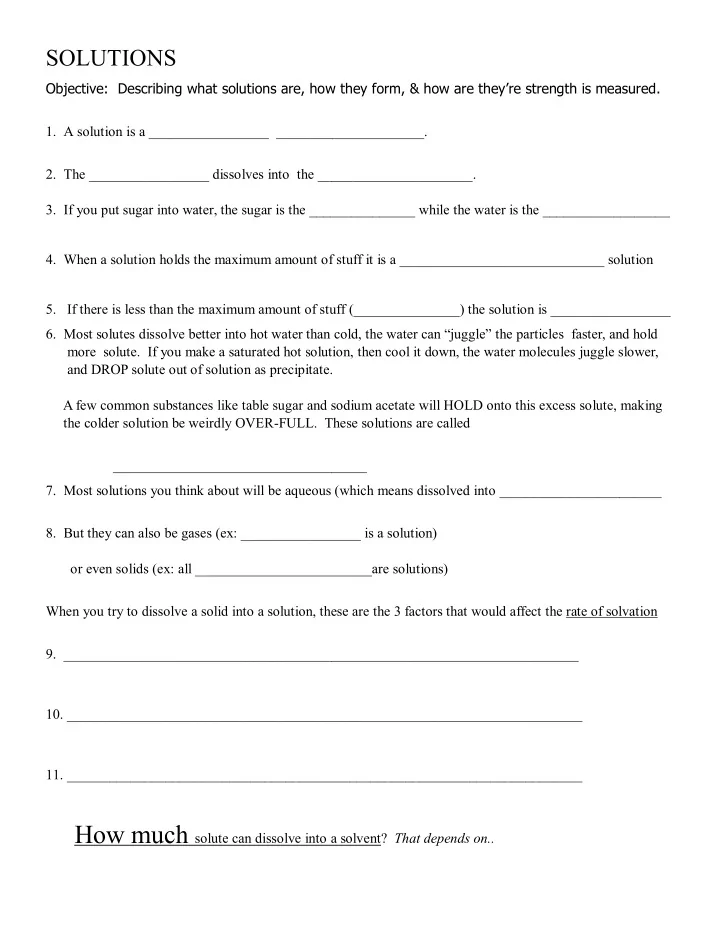
SOLUTIONS Objective: Describing what solutions are, how they form, & how are theyre strength is measured. 1. A solution is a _________________ _____________________. 2. The _________________ dissolves into the ______________________.


slide-1
SLIDE 1

SOLUTIONS

Objective: Describing what solutions are, how they form, & how are they’re strength is measured.

  • 1. A solution is a _________________ _____________________.
  • 2. The _________________ dissolves into the ______________________.
  • 3. If you put sugar into water, the sugar is the _______________ while the water is the __________________
  • 4. When a solution holds the maximum amount of stuff it is a _____________________________ solution
  • 5. If there is less than the maximum amount of stuff (_______________) the solution is _________________
  • 6. Most solutes dissolve better into hot water than cold, the water can “juggle” the particles faster, and hold

more solute. If you make a saturated hot solution, then cool it down, the water molecules juggle slower, and DROP solute out of solution as precipitate. A few common substances like table sugar and sodium acetate will HOLD onto this excess solute, making the colder solution be weirdly OVER-FULL. These solutions are called ____________________________________

  • 7. Most solutions you think about will be aqueous (which means dissolved into _______________________
  • 8. But they can also be gases (ex: _________________ is a solution)
  • r even solids (ex: all _________________________are solutions)

When you try to dissolve a solid into a solution, these are the 3 factors that would affect the rate of solvation

  • 9. _________________________________________________________________________
  • 10. _________________________________________________________________________
  • 11. _________________________________________________________________________

How much solute can dissolve into a solvent? That depends on..

slide-2
SLIDE 2

How much solute can dissolve into a solvent?

  • 12. _________________________________________________________________________
  • 14. _________________________________________________________________________
  • 15. _________________________________________________________________________
  • 16. How does Wegman’s get carbon dioxide into water to make seltzer?
  • 17. Concentration or STRENGTH of a solution can be measure by…
  • 18. Molarity is
  • 19. The formula for molarity

is written this way: CO2 NON POLAR H2O POLAR

M =

slide-3
SLIDE 3
  • 20. What is the concentration of a 1650 mL salt water solution containing 125 g NaCl?

You must SUBSTITUTE PROPERLY!!! Figure out MOLES and LITERS, then write molarity formula again.

  • 22. If you add 43.5 g NaCl to enough water to form a 648 mL solution, what is it’s concentration?

Write formula, then substitute.

  • 21. SAY

21. WRITE 21. THINK

M = M = =

SAY WRITE THINK

slide-4
SLIDE 4
  • 23. You put 74.0 g KCl solid into a flask. You fill the flask to 1600. mL, what is the molarity of this solution?

Start with the formula, or you know what might happen!

  • 24. Calculate the molarity of a 750 mL KCl(AQ) solution containing 148 grams KCl.

_____________________________________________________________________________

Let’s totally change gears now. We have a table called the SOLUBILITY CURVES at STP. Reference Table G This table shows all at once, 10 different SOLUTES ability to dissolve into 100 mL of water, at ALL temperatures. It’s confusing, unless you LOOK AT ONE CURVE AT A TIME. Take it out now. Let’s FIX it first. Change the Y-AXIS to read Solubility (grams of solute in 100 mL water) (water 1.00 g/mL so 1 gram water = 1 mL) Think, then do this problem.

  • 25. How many grams of sodium nitrate are in a 325 mL aqueous solution that is saturated at 10°C?

Set up the ratio, TEMP, solute/water fraction, graph data, and unknown. Do the math

  • 26. Calculate the MOLARITY of this NaNO3 (AQ). Get moles and liters, then write the formula.

M =

slide-5
SLIDE 5

Solutions Vocabulary to Memorize by Tomorrow (fill in at home from slides)

  • 27. Solute
  • 28. Solvent
  • 29. Saturated
  • 30. Unsaturated
  • 31. Supersaturated
  • 32. Table G
  • 33. Molarity
  • 34. Molarity Formula:
  • 35. What units go into this formula (only)

————————————————————————————————————————————

  • 36. Calculate the molarity of a solution containing 259 g KCl in a solution with total volume of 750. mL
  • 37. How many grams of sodium chloride are in an 885 mL aqueous solution that is saturated at 90°C?
  • 38. What is the molarity of this saturated solution of NaCl(AQ) ? (start with the formula!)

M =

slide-6
SLIDE 6
  • 39. THINK: If you had two salty water solutions, say:

One 10 mL saturated NaCl(AQ) and a 500 Liters saturated NaCl(AQ) solution. How would they both taste? How would they both conduct electricity? Would they be “the same”?

  • 40. How many grams of NaCl are required to form a 2.50 L of 0.900 M NaCl(AQ)?
  • 41. Calculate the mass of KOH needed to make a 3.20 Liter solution of KOH(AQ) with a 1.20 M concentration.
  • 42. The WRONG WAY to mix up 1.0 Liters of 1.00 M NaCl(AQ) is to put the _______________ into a beaker,

and to then add the __________________

  • 43. The RIGHT WAY to make this solution would be to start with the ___________________ ,and then

add in the ___________________________. If we do this WRONG WAY, our solution will have a slightly higher ___________________________. 

  • 44. How would you mix up a 2.50 M KNO3(AQ) of 5.65 liters? (the diagram of a beaker might help you)
slide-7
SLIDE 7

If you have no solution and you need to make one, use that molarity formula, figure out how many grams of solute you need, and then fill up the beaker with water to the proper total volume. What if you have some carefully measured solution on the shelf in the lab? You can use that to make another solution, you can DILUTE it. A formula helps you figure out how much “STOCK SOLUTION” you need to use, and then fill with water to dilute to perfect volume. Stock solution is literally, what you have in the stock room. Stock refers to what you have, not something

  • special. You might have 2.0 M NaCl(AQ) in stock, or not. What ever you do have, that’s your stock. OK?

THINK: Using a 2.50M KNO3(AQ) how would you make 1.64 Liters of 1.15 M KNO3(AQ) ?

  • 45. We need the DILUTION FORMULA written as: _________________________________
  • 46. M1 means
  • 47. V1 means
  • 48. M2 means
  • 49. V2 means
  • 50. Using a 2.50M KNO3(AQ) how would you make 1.64 Liters of 1.15 M KNO3(AQ) ?

M1V1 = M2V2

  • 51. How do you prepare a 135 mL NaCl(AQ) solution of 1.00 molarity from a stock solution of 5.50 M?

M1V1 = M2V2

slide-8
SLIDE 8
  • 52. Using the stock solution of 12.0 M HCl, how do you make up 2.00 L of 2.25 M HCl solution?

—————————————————————————————————————————

  • 53. Another way to measure concentration of solutions that are VERY WEAK is by using something called…
  • 54. The formula is
  • 55. You put 1502 grams NaCl into a pool of 312,000 L of water. What’s the concentration of this in PPM?
  • 56. PPM is used when molarity is silly small, but you need a measurement that you can easily grasp.
  • 57. Sometimes low concentration environmental _______________ are measured this way.

We’ll do another problem in PPM later, see if you can remember this formula. —————————————————————————————————————-

  • 58. There are three properties of water called COLLIGATIVE PROPERTIES.
  • 59. They are

60. 61. 62.

  • 63. The reason for all of these colligative properties is: __________________________________________

PPM =

slide-9
SLIDE 9
  • 64. Water has a normal boiling point of _______K. 65. Water has a normal freezing point of _______K.
  • 66. Water has vapor pressure AT 20⁰C of ABOUT __________________ (how did you know this?)
  • 67. Water boils when it all has enough energy to break up all of the ______________________ ___________

that hold it together as a liquid.

  • 68. If we add NaCl, this salt will ____________________ or it will _______________________ in the water.
  • 69. That looks like this: _________________ → ____________ + ____________
  • 70. In solution, the H2O molecules are _________________ to each other, by _________________________ ,

and they are attracted to the ions as well, also by hydrogen bonding.

  • 71. This will create more __________________________________ which will INCREASE the boiling point.

Mathematically, the BOILING POINT ELEVATION for water is: _______________________________________________________________ Fill in this chart… Formula Kinds of particles* Total moles of particles ex 1.0 M NaCl(AQ)

1 mole Na+1 and 1 mole Cl-1

2

73 2.0 M NaCl(AQ)

____ moles Na+1 and ____ moles Cl-1

74 3.0 M NaCl(AQ)

____ moles Na+1 and ____ moles Cl-1

75 2.0 M CaCl2(AQ)

____ moles Ca+2 and ____ moles Cl-1

76 3.0 M CaCl2(AQ)

____ moles Ca+2 and ____ moles Cl-1

77 2.50 M NaCl(AQ)

____ moles Ca+2 and ____ moles Cl-1

78 1.25 M NaCl(AQ)

____ moles Na+1 and ____ moles Cl-1

slide-10
SLIDE 10

—————————————————————————————————

  • 85. Calculate the temperature that a 1.00 liter, 2.00 M NaCl(AQ) solution will boil in Kelvin temperature.

Remember, each mole of particles will elevate the BP by 0.50 K/mole of particles per liter.

  • 86. Calculate the Kelvin BP of a 1.00 Liter, 3.00 M CaCl2(AQ).
  • 87. The freezing point is ____________________________ when you put particles into solution. That’s

because the particles “get in the way” of the water molecules forming into their neat hexagons. It takes a lower temperature to lock the water molecules into place with those ions in the way.

  • 88. The FREEZING POINT DEPRESSION for water is:
  • 89. For every mole of particles in a liter of solution, the freezing point will drop or decrease by…_________K

Formula Kinds of particles* Total moles of particles 79 1.75 M NaCl(AQ) _____ moles Na+1 & _____ moles Cl-1 80 2.25 M CaCl2(AQ) _____ moles Ca+2 & _____ moles Cl-1 81 3.0 M Al(OH)3(AQ) _____ moles Al+3 & ____ moles OH-1 82 1.0 M NH3(AQ) 83 2.50 M C12H22O11(AQ) 84 1.0 M AgCl

slide-11
SLIDE 11
  • 90. Calculate the temperature that a 1.00 liter, 2.00 M NaCl(AQ) solution will freeze in Kelvin.
  • 91. Calculate the FP in Kelvin of a 1.00 Liter, 3.00 M CaCl2(AQ).
  • 92. Express the concentration of the following solution in parts per million: 98.0 g of lithium chromate

(Li2CrO4) is dissolved into an aqueous solution with total volume of 57,800 liters. —————————————————————————————————————————

  • 93. Vapor Pressure is
  • 94. And vapor pressure has units of ________ and you can find it on TABLE H
  • 95. When solutions have lots of ions in solution, the Vapor pressure will be LOWER because...

We can rank the vapor pressure of these solutions from lowest to highest by comparing the number of moles of particles per liter in each. Rank these 1.0 liter aqueous solutions by vapor pressure. Aqueous solution Number of moles of particles per liter Vapor Pressure Rank 96 1.00 M NaCl 97 1.00 M CaCl2 98 1.00 M NBr3 99 1.00 M Al(OH)3

slide-12
SLIDE 12

Next we will examine the dissociation of ionic compounds into water. We’ll count ions!

  • 105. What is the freezing point of a 1.00 liter solution of 1.00 M Tin (IV) nitrate?

Round to NEAREST WHOLE KELVIN

  • 106. In a solution labeled 2.46 M KCl(AQ) that is 2.00 Liters in volume,

how many grams of KCl are in this solution?

  • 107. According to an article in the New England Journal of Medicine, mercury toxicity begins at 0.100 PPM.

If a crazy person dropped 125 grams of mercury into the school pool, that is 102,900 liters, would you be able to safely swim in there? (1 pound = 454 grams) Compound Write the Formula What ions are formed when this is put into water 100 Sodium carbonate 101 Ammonium sulfide 102 Aluminum nitrate 103 Lead (IV) acetate 104 Silver chloride

slide-13
SLIDE 13
  • 108. What is the molarity of a solution where 148 g KCl is dissolved into a solution of 5000. mL?
  • 109. How do you prepare a 25.5 mL 0.850 Molar NaOH(AQ), if you start with a stock solution of 6.40 M?
  • 110. You dissolve 2.25 moles of KBr into water forming a 1.00 liter solution. What is this solution’s boiling

point, and freezing point, IN KELVIN? (don’t worry about the SF in this problem, please)

  • 111. You have two 1.0 liter glasses of solution of equal volume in the same room (same temp and pressure).

One solution is a 3.50 M NaCl(AQ) , the other is a 3.00 M Ca(NO3)2(AQ). Which one would evaporate dry first, and why? 1.0 Liter 1.0 Liter 3.50 M NaCl(AQ) 3.00 M Ca(NO3)2(AQ)

slide-14
SLIDE 14
  • 112. If you have a 2.40 M HCl AQ) stock solution, how do you make

a 50.0 mL of 3.00 M HCl(AQ) solution from it?

  • 112. These ions of CaCl2(AQ) are surrounded by water molecules. Properly orient the water around the ions.
  • 113. You prepare a 235 mL saturated solution of ammonium chloride at 20.°C. You go to lunch and come

back in an hour. The room temperature has warmed up this solution by 5.0°C . How would you best describe this solution at 25.0 centigrade?

  • A. Saturated at 25.°C B. Supersaturated at 25.°C
  • C. Unsaturated at 25.°C D. Still saturated at 20.°C
  • 114. If you have lots of sulfur solid floating on your pond (or lots of water strider bugs), and you wanted to

clear the surface, you could add some soap. Explain this.

slide-15
SLIDE 15
  • 115. Oil floats on water. Explain these things: why oil floats on water, and why it does not sink.

Then explain why it does not just mix up in the water.

  • 116. Using a 1.00 M stock of sugar water, tell how to make up a 26.0 mL solution of 0.350 M sugar water?

Read the BASICS again. Hand in all Solutions HW assignments. Hand in the CO2 in Soda Lab. Hand in the Solutions Lab. Get ready to crush the Solutions Celebration of Knowledge.