_______________________ Solutions PackArbuiso Chem Solutions are - - PDF document

solutions pack arbuiso chem
SMART_READER_LITE
LIVE PREVIEW

_______________________ Solutions PackArbuiso Chem Solutions are - - PDF document

_______________________ Solutions PackArbuiso Chem Solutions are mixtures. They can be homogeneous (like salty water) or they can be heterogeneous (like choco- late milk that has settled). They usually are aqueous, but they can be dissolved


slide-1
SLIDE 1

_______________________ Solutions Pack—Arbuiso Chem

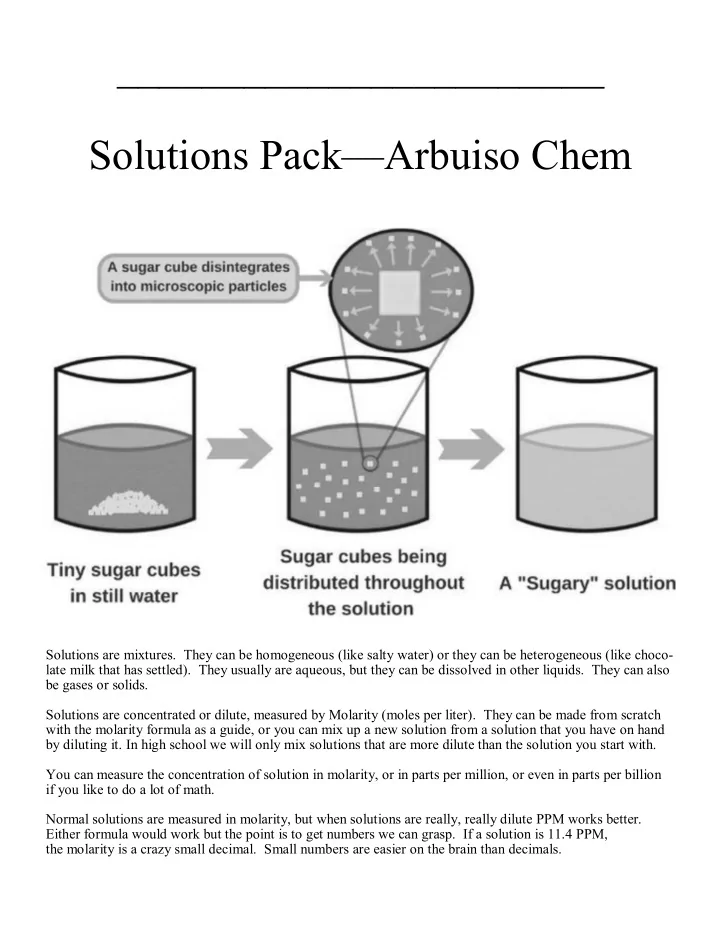
Solutions are mixtures. They can be homogeneous (like salty water) or they can be heterogeneous (like choco- late milk that has settled). They usually are aqueous, but they can be dissolved in other liquids. They can also be gases or solids. Solutions are concentrated or dilute, measured by Molarity (moles per liter). They can be made from scratch with the molarity formula as a guide, or you can mix up a new solution from a solution that you have on hand by diluting it. In high school we will only mix solutions that are more dilute than the solution you start with. You can measure the concentration of solution in molarity, or in parts per million, or even in parts per billion if you like to do a lot of math. Normal solutions are measured in molarity, but when solutions are really, really dilute PPM works better. Either formula would work but the point is to get numbers we can grasp. If a solution is 11.4 PPM, the molarity is a crazy small decimal. Small numbers are easier on the brain than decimals.

slide-2
SLIDE 2

Solutions BASICS

In this section of chemistry we’ll be examining solutions, how they form, how to measure their strength, their properties, and how to dilute them exactly to get new solutions of lesser concentration and volume. Then we’ll study about changing Colligative properties of water with dissolving particles into it. We’ll examine the concept of parts per million for very un-concentrated solutions, finally, we’ll do the math with this. Solutions are homogeneous mixtures containing a solute in a solvent. We most often think of them as wet, with water as the solvent. Other liquids can be solutes as well. Gases can mix homogeneously which makes a gaseous solution, and we could even melt metals or other solids and stir them together. When they cool, tech- nically speaking they are solid solutions (like steel). For now we’ll stick to the “wet” solutions. Solutions can be saturated, holding as much solute in a given volume of solvent as possible. At some point there is just no more room in the solvent and added solute cannot be held, so it falls to the bottom of the container. Although a saturated solution is “maxed out”, excess solute continues to dissolve into solution while solute falls out of solution – a dynamic equilibrium is formed. The rate of dissolving is equal to the rate of precipitation. It’s a “full” solution, but it’s not stuck, rather it’s constantly changing while the amount of solute is constant. An unsaturated solution has room to hold more solute. You can add as much solute as you want, and the solution will allow it to dissolve until it reaches the saturation level. A supersaturated solution is one that is more highly concentrated than is normally possible under given conditions of temperature and pressure. Usually you heat up the solvent, saturate it with solute, then cool it to a lower temperature which would not normally be able to contain that amount of solute. If you add some “seed” crystals of solute to this super saturated solution, the excess will collapse out onto these seeds, forming larger crystals. This photo shows the crystallization

  • f excess solute after the seeding.

When these bonds form, energy is released.

slide-3
SLIDE 3

Formation of Solutions…

When a crystal of sugar (or other polar compound) is put into the polar solvent water, the crystal is “attacked” by the water molecules. The water molecules surround the sugar molecules, carrying them off molecules of the crystal into solution. Of course, molecules are too small to see, so the visible crystal is soon invisible to the eye as it’s broken into billions

  • f molecules too small to see. At some point the solvent

cannot hold a single molecule more, so as more sugar dissolves, some other sugar molecules will precipitate out

  • f solution at the same rate.

Like dissolves like is our solution mantra; polar solvents such as water can only dissolve polar molecular compounds,

  • r most ionic compounds.

Non-polar compounds can not mix with polar solvents. At right is oil sitting atop water. The polar water cannot mix with the nonpolar oil. The oil floats because it’s less dense. It doesn’t mix because: Like Dissolves Like is always true. Polar water can’t dissolve NONPOLAR oil.

When ionic compounds are put into a polar solvent like water, they (usually) are dissociated or ionized into ions. The water molecules surround them as shown below. Solubility exceptions exist on table F! In the picture below, note how the positive hydrogen side of the water molecules surround the negative chloride anions. The oxygen, with their negative charge, surround the positive sodium cations.

The solvent will dissolve solute until saturated, then the dynamic equilibrium will form.

Remember what an electrolyte is? It’s a solution that can conduct electricity. Solutions with ions dissolved can conduct electricity, but solutions with dissolved molecules like sugar cannot

  • conduct. The more ions, the better the conduction.

The less ions, the weaker the conduction. Acids are special chemical compounds in aqueous solutions that appear to be molecular compounds like sugar (no metals), which they are, but they do form ions (we’ll learn about acids and bases soon enough).

slide-4
SLIDE 4

The CONCENTRATION of solutions.

One of the coolest concepts in chemistry is MOLARITY, the measure of how concentrated a solution is. Molarity can best be described as the molar concentration of a solution, expressed as the number of moles

  • f solute/ liter of solution. The formula is:

The formula is set up as moles divided by LITERS of solution but any volume of a solution can be made, and its CONCENTRATION will be measured by this formula. For example… A 1.0 Molar aqueous solution of HCl could be made by putting 1.0 moles HCl into 1.0 Liters of H2O. Or, the same strength or concentration solution could be made with 0.25 moles HCl and 250 mL water. In fact, an infinite number of combinations of moles to volume exist to make the same concentration. These three tubes represent 3 different solutions of the SAME compound, but at different concentrations. The darkest one, on the left, would have the HIGHEST MOLARITY or greatest concentration. The one on the far right the LOWEST MOLARITY or least concentration.

THINKING PROBLEM:

What is the concentration of an aqueous solution of KCl containing 370 grams KCl dissolved into 2.5 liters water?

Using the formula above for molarity, we figure this way…

Molarity = number of moles of solute Liters of solution

Molarity = #moles KCl liters of solution 370 g KCl X 1 mole KCl = 5.0 moles KCl 74 grams KCl M = 5.0 moles KCl 2.5 Liters M = 2.0 molar solution

slide-5
SLIDE 5

Making a solution from Scratch.

How do you prepare a 1.00 M of NaCl(AQ) solution of 3.00 Liters in volume? Start with the molarity formula, putting in the data you have, solving for moles of so- lute (here that’s the NaCl).

So to make this solu- tion, put 174 grams of NaCl into a large beak- er, then fill it up to 3.00 Liters of total volume with water. NOTE: do not think for one moment that you can put 174 grams of salt into 3.00 Liters of wa- ter! That salt has a small but real volume, and this solution is NOT CORRECT. Do not ever make such a silly mistake! Finish your work with the water filling up to the line! Always solute in, THEN water up to the total volume. How do you make a 1.75 M CuCl2(AQ) of 245 mL? (start with molarity formula) So, to make this solution, put 57.5 grams of copper (II) chloride into a beaker, then fill with water up to the 245 mL mark. DO NOT PUT 57.5 g CuCl2 into 245 ml Water!

#moles solute

liters of solution

Molarity =

1.00 M = 1 # moles NaCl 3.00 Liters = 3.00 moles NaCl 3.00 moles NaCl 1 58 grams NaCl 1 moles NaCl

X =

174 g NaCl 1.75 M = 1 # moles CuCl2 0.245 Liters = 0.429 moles CuCl2 0.429 moles CuCl2 1 134 grams CuCl2 1 moles CuCl2

X = 57.5 grams CuCl2

slide-6
SLIDE 6

The Molar Dilution Formula

Another formula that we can use is called the dilution formula. We can start out with a concentrated stock solution of known volume and molarity, and use it to make a new solution with a new volume and concentration.

How much of the strong solution is needed to create a new solution as stated?

To do a problem like this we substitute in what we know, and calculate our answer. So… For example, assume you have a lot of a concentrated CuSO4(AQ), of 2.0 Molar strength. How would you dilute this to create a 500. mL CuSO4 solution of only 1.0 Molarity? How much of the strong solution is needed? We’ll write at the formula, then we’ll do the math. This means you will need to add 250 mL of the stronger, original stock solution into a flask, and add enough water to dilute it and fill up to 500. mL solution.

Another example:

You have a 5.00 M stock NaCl solution. You want to prepare a 375. mL salt water solution of 0.755 M

  • concentration. When you start with a stock solution, you need to dilute it, with the dilution formula:

That means, you need 56.6 mL of the concentrated stock salt water solution and you need to dilute it then with enough water to reach the 375 mL mark, which is about 318.4 mL (disregarding SF).

The Molar Dilution formula is: M1V1 = M2V2 M1V1 = M2V2

(2.0 M) (V1) = (1.0 M)(500. mL) V1 = 250 mL stock solution

250 mL of stock first... Add ~ 250 mL water second

M1V1 = M2V2 (5.00 M) (V1) = (0.755 M)(375 mL) V1 = (0.755 M)(375 mL) 5.00 M V1 = 56.6 mL of stock solution

56.6 mL of stock first... Add ~ 318.4 mL water next

slide-7
SLIDE 7

Example 2: Now we’ll do a second dilution: How do you prepare a solution of 0.30 M and 500. mL total volume from the original 2.0 M stock solution?

75.0 mL of 2.0M CuSO4(AQ) + ENOUGH water to fill up to 500. mL to make the 500. mL 0.30M CuSO4(AQ) Note: to make a solution from scratch you use the molarity formula. To make a solution from an existing stock solution, use the dilution formula. No matter, always draw a picture of an empty beaker, and “show making the solution” so you can see clearly what you are doing.

M1V1 = M2V2

(2.0 M) (V1) = (0.30 M)(500. mL) V1 = (0.30 M)(500. mL) 2.0 M V1 = 75.0 mL

These three tubes represent the CuSO4 solutions we just made. First is the 2.0 M stock solution. Second is the 1.0 M diluted solution. Third is the final weakest 0.4 M CuSO4(AQ). All made of the same CuSO4, but of different concentrations or strengths. Aqueous solutions of CuSO4 would be shades of blue, the darkness of solution would depend upon the concentration or molarity of the solutions.

75.0 mL of stock first... Add ~ 425 mL water next

slide-8
SLIDE 8

Colligative Properties of Solutions

These are physical properties that can change depending upon how much solute is dissolved into a liter of the

  • solution. They include boiling point, freezing point, & vapor pressure. These three different properties get

adjusted by the solute mixed into the water. If you dissolve particles (ions or polar molecules) into water, you change all of these properties. The more particles in solution, the greater the properties change. First we need to examine what happens when substances dissolve into water. Molecular compounds, like sugar, dissolve into water, they do not form ions. They are not ionic. When soluble ionic compounds dissolve, the compound ionizes, or it dissociates into ions this way: So when things dissolve into water, depending upon what the substance is, the change of colligative properties is not always the same. 1 mole of substance does not always equal one mole of particles. ———————————————————

BOILING POINT ELEVATION

The water boils when it can overcome both the air pressure pressing down on the surface, and the internal hydrogen bonding holding the molecules together. At normal pressure the boiling point of pure water is 373 Kelvin. When polar molecules or ions are dissolved into the water, the water molecules are ALSO attracted to the particles. This creates MORE INTERNAL ATTRACTION, which means it will take more energy to make the water boil (blow apart from itself into the gas phase). The actual boiling point elevation for water is 0.50 K per mole of particles per liter of solution. For every mole of particles, the boiling point goes up by 0.50 Kelvin.

FREEZING POINT DEPRESSION

The freezing point is also very affected by dissolved particles. The difference is that the freezing point requires colder temperatures to freeze around the annoying, cluttered ions or molecules that are “in the way”

  • f the hydrogen bonding. Water only freezes when the hydrogen bonding is stronger than the kinetic energy

that the particles have (the temperature more or less is the KE). The freezing point depression for water is that each mole of particles depresses the freezing point by 1.86 Kelvin (that’s a lot!). Problems follow, read the math slowly and follow along…. NaCl NaCl(S) → Na+1

(AQ) + Cl-1 (AQ)

1 mole NaCl → 2 moles of ions CaCl2 CaCl2 → Ca+2

(AQ) + Cl-1 (AQ) + Cl-1 (AQ)

1 mole CaCl2 → 3 moles of ions AlCl3 AlCl3 → Al+3

(AQ) + Cl-1 (AQ) + Cl-1 (AQ) + Cl-1 (AQ)

1 mole AlCl3 → 4 moles of ions C6H12O6 C6H12O6(S) → C6H12O6(AQ) 1 mole C6H12O6 → 1 mole of molecules AgCl AgCl → no moles of ions, it’s insoluble! 1 mole AgCl = zero particles.
slide-9
SLIDE 9

Example 1. What is the boiling point of a 1.0 Molar NaCl solution of one liter? Start boiling point Boiling point elevation New boiling point 373 K + (2 x 0.50 K) = 373 + 1 = 374 K

Here we had to INCREASE THE boiling point, so we ADD the BP elevation to the normal BP of 373 Kelvin.

Example 2. What is the boiling point of a 1.0 Molar CaCl2 solution of one liter? Start boiling point Boiling point elevation New boiling point 373 K + (3 x 0.50 K) = 373 + 1.5 = 374.5 K

In this example, the salt has 3 ions per FU, so when it does ionize in water, one mole provides 3 moles of ions, and therefore a bigger affect on the BP.

Example 3. What is the boiling point of a 2.0 Molar CaCl2 solution of one liter? Start boiling point Boiling point elevation New boiling point 373 K + (6 x 0.50 K) = 373 + 3 = 376 K

Did you see that one? Each mole of calcium chloride forms 3 moles of ions. Here the solution contains 2 moles of calcium chloride, each forms 3 moles of ions, so 2 X 3 = 6

Example 4. What is the boiling point of a 4.0 Molar AlCl3 solution of one liter? Start boiling point Boiling point elevation New boiling point 373 K + (16 x 0.50 K) = 373 + 8 = 381 K

Did you see that one? Each mole of aluminum chloride forms 4 moles of ions. Here the solution contains 4 moles of calcium chloride, each forms 4 moles of ions, so 4 X 4 = 16

slide-10
SLIDE 10

Example 5. What is the boiling point of a 2.5 Molar CaBr2 solution of one liter? Start boiling point Boiling point elevation New boiling point 373 K + (7.5 x 0.50 K) = 373 + 3.75 = 386.75 K

Did you see that one? Each mole of calcium bromide forms 3 moles of ions. Here the solution contains 2.5 moles of calcium chloride, each forms 3 moles of ions, so 2.5 X 3 = 7.5 FREEZING POINT DEPRESSION The water molecules wish to freeze normally at 273 Kelvin. The water forms six-molecule rings, locking into place when their hydrogen bonding is stronger than the kinetic energy provided by the temperature. At 273 K the hydrogen bonding is strong enough to lock the water into the grid like lattice we call ice. When the water has ions dissolved into it, or polar molecules dissolved into it, the water molecules can’t lock together until they get colder than usual. They need to be able to “freeze out the particles, and that requires lower kinetic energy - lower temperature to happen. The salt water also has a lower freezing point, as the ions disrupt the formation of the (neat) six sided rings of solid ice. It takes COLDER temperatures, or a lower kinetic energy to solidify into ice. One mole of particles in one liter of solution drops the freezing point by 1.86 Kelvin or 1.86°C.

Example 6. What is the freezing point of a 1.0 Molar NaCl solution of one liter? Start freezing point Freezing point depression New boiling point 273 K – (2 x 1.86 K) = 273 – 3.72 = 269.28 K

Here the one mole of NaCl provides 2 moles of ions, so the FP is depressed by 2 X the 1.86 Kelvin.

Example 7. What is the freezing point of a 2.0 Molar CaCl2 solution of one liter? Start freezing point Freezing point depression New boiling point 273 K – (6 x 1.86 K) = 273 – 11.16 = 261.84 K

Did you see that? Each mole of calcium chloride forms 3 moles of ions. Here there are 2 moles, so, 2 x 3 = 6 moles of particles in solution.

slide-11
SLIDE 11

THINK #1: Why would people do better with calcium chloride than sodium chloride on their sidewalks in winter? NaCl ionizes into TWO IONS, while the CaCl2 ionoizes into THREE IONS. More moles of ions means that the sidewalk water would not freeze until a LOWER temperature, making them ice free, and safer, to a lower temperature. THINK #2: Why would adding one mole of sugar vs. one mole of table salt cause different boiling points? Moles of particles also RAISES the BOILING POINT, each mole of particles raises the boiling point by 0.50 Kelvin or 0.50°C. One mole of sugar molecules (1 mole of particles) raises the boiling point of one liter of water to 373.5 K. One mole of NaCl ionizes into 2 moles of ions, raising the boiling point to 374 K. One mole of CaCl2 ionizes into 3 moles of ions, raising the boiling point of one liter of water to 374.5 K. THINK #3: Why would there be different Vapor Pressure with different numbers of particles dissolved into solutions? This occurs for the same reason as the change in boiling point — the water sticks together well due to the many hydrogen bonds. With the addition of extra charged (or polar) particles, there are MORE attractions that have to be over come to evaporate those water molecules into the gas phase. Vapor pressure is also affect- ed by particles in solution, but we won’t do any math with this. In a sealed system, molecules of the liquid will evaporate into the space above the surface of the liquid. How much evaporation is determined by the attractiveness of the particles to each other which keeps them liquid, also by the temperature (the more Kinetic Energy means more evaporating), and also how many parti- cles are dissolved into the liquid. The more particles that are dissolved, the more attractive the liquid is to itself; the less evaporation means lower vapor pressure. Let’s imagine an NaCl salt water solution. The salt ions are now present, and although the water molecules have plenty of hydrogen bonds to each other, they also have attraction to these ions. This makes evaporation more difficult or slower.

Example 8. What is the freezing point of a 4.0 Molar AlCl3 solution of one liter? Start freezing point Freezing point depression New boiling point 273 K – (16 x 1.86 K) = 273 – 29.76 = 243.24 K

Did you see that? Each mole of aluminum chloride forms 4 moles of ions. Here there are 4 moles, so, 4 x 4 = 16 moles of particles in solution.

slide-12
SLIDE 12

VAPOR PRESSURE ADJUSTMENT

The vapor pressure is shown in table H on the reference tables. The vapor pressure is THE EXTRA PRESSURE ADDED TO A CLOSED SYSTEM BY THE EVAPORATION OF A LIQUID. Room temperature water (25°C) has a vapor pressure of about 4 kPa. That means inside that bottle at right, if the starting air pressure inside the bottle was 101.3 kPa (normal), the water evaporating will add to it by about +4 kPa. That makes the pressure in the bottle about 105.3 kPa. Water doesn’t evaporate well because of all the hydrogen bonding it has. That means water has a low vapor pressure. Adding any solute to water

  • nly increases the internal attraction, making it harder to evaporate.

In our class we will only know that any solute in water decreases the vapor pressure (makes it evaporate less well). More concentrated aqueous solutions have lower vapor pressure compared to dilute aqueous solutions.

We’ll do NO MATH for the vapor pressure in this part of chem. We will attempt to make relative decisions as to which solutions have the highest vapor pressure.

Which of the following aqueous solutions will have the highest and lowest vapor pressures?

  • A. 3.00 molar Al(NO3)3(AQ)
  • B. 5.00 molar NaCl(AQ)
  • C. 8.00 molar C6H12O6(AQ)
  • D. 15.0 molar SrSO4(AQ)

Al(NO3)3 will ionize into 4 moles of particles, so a 3.00 M solution will form 3.00 X 4 = 12 moles of ions in solution NaCl will ionize into 2 moles of particles, so a 5.00 M solution will form 5.00 X 2 = 10 moles of ions in solution C6H12O6 will NOT ionize, but will dissolve into one mole of particles, so an 8.00 M solution will form 8.00 X 1 = 8 moles of molecules in solution SrSO4 will NOT ionize, it’s ionic, but according to table F, this stuff is insoluble in water. So, the strontium sulfate will form NO particles in water to measure. Strontium sulfate will have the highest vapor pressure (the same as water’s) while the lowest VP will be with the solution with the MOST particles dissolved into solution, which is aluminum nitrate. 105.3 kPa 101.3 kPa

  • utside

the bottle

slide-13
SLIDE 13

PARTS PER MILLION

Some solutions are so very dilute that the molarity becomes a super small decimal that our brains can’t make easy sense of. For example, when you add just 1.0 moles of NaCl into a swimming pool sized 43,000 Liter solution, the molarity works this way: This number is accurate, but 581 hundred millionths molar is just outside normal thinking zones. Another way to do concentration is parts per million. PPM =

PPM =

x 1,000,000 = 1.35 PPM salt

1.35 PPM is a number you can more easily wrap your head around, although it is exactly equivalent to the silly small molarity of 0.00000581 M.

Example 9

If there is 0.125 grams of mercury dissolved into 101. liters of sea water, concentration is parts per million?

PPM = PPM =

= 1.24 parts per million

This means: 1.24 parts Hg per million parts water Molarity = moles of solute Liters of solution Molarity = 0.250 moles NaCl 43,000 Liters M = 0.00000581 M

  • r it’s

5.81 x 10⁻⁶ Molar NaCl solution which is silly small

Grams solute Grams solution 58 g NaCl 43,000,000 g H2O x 1,000,000 Grams solute Grams solution x 1,000,000 0.125 g Hg 101,000 g waterH2O x 1,000,000

slide-14
SLIDE 14

Example 10 From an old regents exam was this problem… What is the concentration of a solution in PPM, if 0.02 grams Na3PO4 is dissolved into 1000 grams water?

  • A. 20 PPM B. 2 PPM C. 0.2 PPM D. 0.02 PPM

ANSWER PPM = grams of solute X 1,000,000 grams of solution PPM = 0.02 g Na3PO4 X 1,000,000 = 20 parts per million (choice A) 1000 g water The regents will sometimes uses just one significant figure in a problem, they are trying to get across the concept, and not the math. You always pick the BEST possible choice. SF count, but the regents breaks that rule often.

Bits and Pieces To make a proper solution, of perfect volume, there is only one way to proceed. First get a special flask with a line that shows exactly a particular volume (often 1.00 L). Put the solute in first. Then fill with pure water up to the line. This is the ONLY WAY to make a perfect solution. You can’t just add solute into the solvent, it will affect the volume (in a small but measurable way). When an ionic compound (NaCl, KCl, etc.) is dissolved into water it forms an ionic solution. It has free ions floating in the water. This is a homogeneous mixture. The more ions in solution, the better electrical conduction that occurs, which is a stronger electrolyte. With fewer ions means a lesser electrical conduction, or a weaker electrolyte. If you melt an ionic compound like NaCl(L) or CuBr(L) it will be super-duper hot. It will also be able to conduct electricity because the ions are loose, almost like in an aqueous solution. This is weird, it would be way too hot to handle in most colleges and impossible in high school, but it would conduct. Ionic compounds that do not ionize in water are NOT electrolytes, but they can conduct electricity is their liquid or melted states. Electrolytes are solutions with ions in them (soluble ionic compounds), and they can conduct

  • electricity. Electrolytes are always able to conduct electricity. The more ions in solution, the

better the electricity flows. Ionic compounds in the solid form CANNOT conduct electricity because there are no loose ions, and no loose electrons (as with metals and metallic bonds). Solid ionic compounds are called electrolytes only if they are soluble in water. Electrolytes can be solutions that conduct, or (strangely enough) solids that would form soluble ionic solutions. Insoluble ionic compounds like AgCl, or molecular compounds are never electrolytes, and cannot conduct electricity.

slide-15
SLIDE 15

SOLUTIONS

Objective: Describing what solutions are, how they form, & how are they’re strength is measured.

  • 1. A solution is a _________________ _____________________.
  • 2. The _________________ dissolves into the ______________________.
  • 3. If you put sugar into water, the sugar is the _______________ while the water is the __________________
  • 4. When a solution holds the maximum amount of stuff it is a _____________________________ solution
  • 5. If there is less than the maximum amount of stuff (_______________) the solution is _________________
  • 6. Most solutes dissolve better into hot water than cold, the water can “juggle” the particles faster, and hold

more solute. If you make a saturated hot solution, then cool it down, the water molecules juggle slower, and DROP solute out of solution as precipitate. A few common substances like table sugar and sodium acetate will HOLD onto this excess solute, making the colder solution be weirdly OVER-FULL. These solutions are called ____________________________________

  • 7. Most solutions you think about will be aqueous (which means dissolved into _______________________
  • 8. But they can also be gases (ex: _________________ is a solution)
  • r even solids (ex: all _________________________are solutions)

When you try to dissolve a solid into a solution, these are the 3 factors that would affect the rate of solvation

  • 9. _________________________________________________________________________
  • 10. _________________________________________________________________________
  • 11. _________________________________________________________________________

How much solute can dissolve into a solvent? That depends on..

slide-16
SLIDE 16

How much solute can dissolve into a solvent?

  • 12. _________________________________________________________________________
  • 14. _________________________________________________________________________
  • 15. _________________________________________________________________________
  • 16. How does Wegman’s get carbon dioxide into water to make seltzer?
  • 17. Concentration or STRENGTH of a solution can be measure by…
  • 18. Molarity is
  • 19. The formula for molarity

is written this way: CO2 NON POLAR H2O POLAR

M =

slide-17
SLIDE 17
  • 20. What is the concentration of a 1650 mL salt water solution containing 125 g NaCl?

You must SUBSTITUTE PROPERLY!!! Figure out MOLES and LITERS, then write molarity formula again.

  • 22. If you add 43.5 g NaCl to enough water to form a 648 mL solution, what is it’s concentration?

Write formula, then substitute.

  • 21. SAY

21. WRITE 21. THINK

M = M = =

SAY WRITE THINK

slide-18
SLIDE 18
  • 23. You put 74.0 g KCl solid into a flask. You fill the flask to 1600. mL, what is the molarity of this solution?

Start with the formula, or you know what might happen!

  • 24. Calculate the molarity of a 750 mL KCl(AQ) solution containing 148 grams KCl.

_____________________________________________________________________________

Let’s totally change gears now. We have a table called the SOLUBILITY CURVES at STP. Reference Table G This table shows all at once, 10 different SOLUTES ability to dissolve into 100 mL of water, at ALL temperatures. It’s confusing, unless you LOOK AT ONE CURVE AT A TIME. Take it out now. Let’s FIX it first. Change the Y-AXIS to read Solubility (grams of solute in 100 mL water) (water 1.00 g/mL so 1 gram water = 1 mL) Think, then do this problem.

  • 25. How many grams of sodium nitrate are in a 325 mL aqueous solution that is saturated at 10°C?

Set up the ratio, TEMP, solute/water fraction, graph data, and unknown. Do the math

  • 26. Calculate the MOLARITY of this NaNO3 (AQ). Get moles and liters, then write the formula.

M =

slide-19
SLIDE 19

Solutions Vocabulary to Memorize by Tomorrow (fill in at home from slides)

  • 27. Solute
  • 28. Solvent
  • 29. Saturated
  • 30. Unsaturated
  • 31. Supersaturated
  • 32. Table G
  • 33. Molarity
  • 34. Molarity Formula:
  • 35. What units go into this formula (only)

————————————————————————————————————————————

  • 36. Calculate the molarity of a solution containing 259 g KCl in a solution with total volume of 750. mL
  • 37. How many grams of sodium chloride are in an 885 mL aqueous solution that is saturated at 90°C?
  • 38. What is the molarity of this saturated solution of NaCl(AQ) ? (start with the formula!)

M =

slide-20
SLIDE 20
  • 39. THINK: If you had two salty water solutions, say:

One 10 mL saturated NaCl(AQ) and a 500 Liters saturated NaCl(AQ) solution. How would they both taste? How would they both conduct electricity? Would they be “the same”?

  • 40. How many grams of NaCl are required to form a 2.50 L of 0.900 M NaCl(AQ)?
  • 41. Calculate the mass of KOH needed to make a 3.20 Liter solution of KOH(AQ) with a 1.20 M concentration.
  • 42. The WRONG WAY to mix up 1.0 Liters of 1.00 M NaCl(AQ) is to put the _______________ into a beaker,

and to then add the __________________

  • 43. The RIGHT WAY to make this solution would be to start with the ___________________ ,and then

add in the ___________________________. If we do this WRONG WAY, our solution will have a slightly higher ___________________________. 

  • 44. How would you mix up a 2.50 M KNO3(AQ) of 5.65 liters? (the diagram of a beaker might help you)
slide-21
SLIDE 21

If you have no solution and you need to make one, use that molarity formula, figure out how many grams of solute you need, and then fill up the beaker with water to the proper total volume. What if you have some carefully measured solution on the shelf in the lab? You can use that to make another solution, you can DILUTE it. A formula helps you figure out how much “STOCK SOLUTION” you need to use, and then fill with water to dilute to perfect volume. Stock solution is literally, what you have in the stock room. Stock refers to what you have, not something

  • special. You might have 2.0 M NaCl(AQ) in stock, or not. What ever you do have, that’s your stock. OK?

THINK: Using a 2.50M KNO3(AQ) how would you make 1.64 Liters of 1.15 M KNO3(AQ) ?

  • 45. We need the DILUTION FORMULA written as: _________________________________
  • 46. M1 means
  • 47. V1 means
  • 48. M2 means
  • 49. V2 means
  • 50. Using a 2.50M KNO3(AQ) how would you make 1.64 Liters of 1.15 M KNO3(AQ) ?

M1V1 = M2V2

  • 51. How do you prepare a 135 mL NaCl(AQ) solution of 1.00 molarity from a stock solution of 5.50 M?

M1V1 = M2V2

slide-22
SLIDE 22
  • 52. Using the stock solution of 12.0 M HCl, how do you make up 2.00 L of 2.25 M HCl solution?

—————————————————————————————————————————

  • 53. Another way to measure concentration of solutions that are VERY WEAK is by using something called…
  • 54. The formula is
  • 55. You put 1502 grams NaCl into a pool of 312,000 L of water. What’s the concentration of this in PPM?
  • 56. PPM is used when molarity is silly small, but you need a measurement that you can easily grasp.
  • 57. Sometimes low concentration environmental __________________________ are measured this way.

We’ll do another problem in PPM later, see if you can remember this formula. —————————————————————————————————————-

  • 58. There are three properties of water called COLLIGATIVE PROPERTIES.
  • 59. They are

60. 61. 62.

  • 63. The reason for all of these colligative properties is: __________________________________________

PPM =

slide-23
SLIDE 23
  • 64. Water has a normal boiling point of _______K. 65. Water has a normal freezing point of _______K.
  • 66. Water has vapor pressure AT 20⁰C of ABOUT __________________ (how did you know this?)
  • 67. Water boils when it all has enough energy to break up all of the ______________________ ___________

that hold it together as a liquid.

  • 68. If we add NaCl, this salt will ____________________ or it will _______________________ in the water.
  • 69. That looks like this: _________________ → ____________ + ____________
  • 70. In solution, the H2O molecules are _________________ to each other, by _________________________ ,

and they are attracted to the ions as well, also by hydrogen bonding.

  • 71. This will create more __________________________________ which will INCREASE the boiling point.

Mathematically, the BOILING POINT ELEVATION for water is: _______________________________________________________________ Fill in this chart… Formula Kinds of particles* Total moles of particles ex 1.0 M NaCl(AQ)

1 mole Na+1 and 1 mole Cl-1

2

73 2.0 M NaCl(AQ)

____ moles Na+1 and ____ moles Cl-1

74 3.0 M NaCl(AQ)

____ moles Na+1 and ____ moles Cl-1

75 2.0 M CaCl2(AQ)

____ moles Ca+2 and ____ moles Cl-1

76 3.0 M CaCl2(AQ)

____ moles Ca+2 and ____ moles Cl-1

77 2.50 M NaCl(AQ)

____ moles Ca+2 and ____ moles Cl-1

78 1.25 M NaCl(AQ)

____ moles Na+1 and ____ moles Cl-1

slide-24
SLIDE 24

—————————————————————————————————

  • 85. Calculate the temperature that a 1.00 liter, 2.00 M NaCl(AQ) solution will boil in Kelvin temperature.

Remember, each mole of particles will elevate the BP by 0.50 K/mole of particles per liter.

  • 86. Calculate the Kelvin BP of a 1.00 Liter, 3.00 M CaCl2(AQ).
  • 87. The freezing point is ____________________________ when you put particles into solution. That’s

because the particles “get in the way” of the water molecules forming into their neat hexagons. It takes a lower temperature to lock the water molecules into place with those ions in the way.

  • 88. The FREEZING POINT DEPRESSION for water is:
  • 89. For every mole of particles in a liter of solution, the freezing point will drop or decrease by…_________K

Formula Kinds of particles* Total moles of particles 79 1.75 M NaCl(AQ) _____ moles Na+1 & _____ moles Cl-1 80 2.25 M CaCl2(AQ) _____ moles Ca+2 & _____ moles Cl-1 81 3.0 M Al(OH)3(AQ) _____ moles Al+3 & ____ moles OH-1 82 1.0 M NH3(AQ) 83 2.50 M C12H22O11(AQ) 84 1.0 M AgCl

slide-25
SLIDE 25
  • 90. Calculate the temperature that a 1.00 liter, 2.00 M NaCl(AQ) solution will freeze in Kelvin.
  • 91. Calculate the FP in Kelvin of a 1.00 Liter, 3.00 M CaCl2(AQ).
  • 92. Express the concentration of the following solution in parts per million: 98.0 g of lithium chromate

(Li2CrO4) is dissolved into an aqueous solution with total volume of 57,800 liters. —————————————————————————————————————————

  • 93. Vapor Pressure is
  • 94. And vapor pressure has units of ________ and you can find it on TABLE H
  • 95. When solutions have lots of ions in solution, the Vapor pressure will be LOWER because...

We can rank the vapor pressure of these solutions from lowest to highest by comparing the number of moles of particles per liter in each. Rank these 1.0 liter aqueous solutions by vapor pressure. Aqueous solution Number of moles of particles per liter Vapor Pressure Rank 96 1.00 M NaCl 97 1.00 M CaCl2 98 1.00 M NBr3 99 1.00 M Al(OH)3

slide-26
SLIDE 26

Compound Write the Formula What ions are formed when this is put into water 100 Sodium carbonate 101 Ammonium sulfide 102 Aluminum nitrate 103 Lead (IV) acetate 104 Silver chloride Next we will examine the dissociation of ionic compounds into water. We’ll count ions!

  • 105. What is the freezing point of a 1.00 liter solution of 1.00 M Tin (IV) nitrate?

Round to NEAREST WHOLE KELVIN

  • 106. In a solution labeled 2.46 M KCl(AQ) that is 2.00 Liters in volume,

how many grams of KCl are in this solution?

  • 107. According to an article in the New England Journal of Medicine, mercury toxicity begins at 0.100 PPM.

If a crazy person dropped 125 grams of mercury into the school pool, that is 102,900 liters, would you be able to safely swim in there? (1 pound = 454 grams)

slide-27
SLIDE 27
  • 108. What is the molarity of a solution where 148 g KCl is dissolved into a solution of 5000. mL?
  • 109. How do you prepare a 25.5 mL 0.850 Molar NaOH(AQ), if you start with a stock solution of 6.40 M?
  • 110. You dissolve 2.25 moles of KBr into water forming a 1.00 liter solution. What is this solution’s boiling

point, and freezing point, IN KELVIN? (don’t worry about the SF in this problem, please)

  • 111. You have two 1.0 liter glasses of solution of equal volume in the same room (same temp and pressure).

One solution is a 3.50 M NaCl(AQ) , the other is a 3.00 M Ca(NO3)2(AQ). Which one would evaporate dry first, and why? 1.0 Liter 1.0 Liter 3.50 M NaCl(AQ) 3.00 M Ca(NO3)2(AQ)

slide-28
SLIDE 28
  • 112. If you have a 2.40 M HCl AQ) stock solution, how do you make

a 50.0 mL of 3.00 M HCl(AQ) solution from it?

  • 112. These ions of CaCl2(AQ) are surrounded by water molecules. Properly orient the water around the ions.
  • 113. You prepare a 235 mL saturated solution of ammonium chloride at 20.°C. You go to lunch and come

back in an hour. The room temperature has warmed up this solution by 5.0°C . How would you best describe this solution at 25.0 centigrade?

  • A. Saturated at 25.°C B. Supersaturated at 25.°C
  • C. Unsaturated at 25.°C D. Still saturated at 20.°C
  • 114. If you have lots of sulfur solid floating on your pond (or lots of water strider bugs), and you wanted to

clear the surface, you could add some soap. Explain this.

slide-29
SLIDE 29
  • 115. Oil floats on water. Explain these things: why oil floats on water, and why it does not sink.

Then explain why it does not just mix up in the water.

  • 116. Using a 1.00 M stock of sugar water, tell how to make up a 26.0 mL solution of 0.350 M sugar water?

Read the BASICS again. Hand in all Solutions HW assignments. Hand in the CO2 in Soda Lab. Hand in the Solutions Lab. Get ready to crush the Solutions and Water Celebration of Knowledge.

slide-30
SLIDE 30

Solutions Homework #1 name: _________________________________________ Read the BASICS. 15 Minutes a Day for Chem Practice. Then attempt these questions.

  • 1. How much NaNO3 will saturated 250. mL at 20°C? (show work).
  • 2. If you cooled this 250. mL saturated NaNO3(AQ) from 20°C to 0°C, how many grams of solute precipitate?
  • 3. Once this solute precipitates out of solution to the bottom of the beaker it forms a dynamic equilibrium.

Explain what dynamic equilibrium means.

  • 4. In solutions chem, there’s an expression: Like Dissolves Like. That being said, how is carbon dioxide put

into seltzer and soda? Why is it when you open a soda can the soda starts to get flat right away?

  • 5. Which solution contains more solute? 200 mL HCl(AQ) at 30°C, or 100 mL of KI(AQ) at 20°C?

Show the numbers, don’t just guess.

slide-31
SLIDE 31

Solutions Homework #2 name: _________________________________________

  • 1. You mix a 100 mL saturated solution of potassium chloride at 10°C. What is the molarity of this solution?
  • 2. You dissolve 4.47 moles of KCl into 12.00 liters of water. What is the molarity of this solution?
  • 3. You dissolve 7.85 moles of KNO3 into 21.0 liters of water, what is the molarity of this solution?
  • 4. You put 1.12 grams of perfume into your bathtub to soak in. Your bathtub holds this 43.5 gallons of water

and perfume. Water weighs 8.34 pounds per gallon, while each pound has 454 grams. How many parts per million of perfume are in this water?

  • 5. A “normal” saline is NaCl(AQ) solution that you get via an IV line in the hospital if you are dehydrated.

There are 4.5 grams NaCl per 500. mL bag of solution. That matches the same salt concentration in your

  • body. What’s the molarity of this solution?
slide-32
SLIDE 32

Solutions Homework #3 name: _________________________________________

  • 1. You put 50.0 grams KClO3 into 475 mL of water at 100.0°C. How many more grams will it take to

saturate this solution?

  • 2. If you cool a 100 mL saturated KClO3(AQ) from 100°C to 80°C, how many grams of KClO3(S) precipitate out
  • f solution?
  • 3. If you have a stock solution of 2.75 M Ca(OH)2, how do you make a 1.43 M solution of 550 mL?

(show FORUMULA + work, draw a picture of a beaker)

  • 4. If you have a stock 3.64 M Mg(NO3)2, how do you make up a 0.755 M solution of 305 mL?

(show FORUMULA + work, draw a picture of the beaker)

slide-33
SLIDE 33

Solutions HW #4 name: _________________________________________

  • 1. How many parts per million of lead be present in a water tank of 253,800 liters if 1.15 kilograms
  • f lead dissolved into this water?
  • 2. What is the concentration of O2(G) in parts per million, in a solution that contains 0.008 grams of O2 dis-

solved into each 1000. grams of H2O(L)? (NYS Regents Jan 2008, #38) You must show work.

  • A. 0.8 ppm B. 8 ppm C. 80 ppm D. 800 ppm
  • 3. If a solution has 3.75 PPM arsenic and this solution is a pond with volume of 45,750 Liters, how many

grams of arsenic are present in the whole lake?

  • 4. The 3 colligative properties of water include boiling point, freezing point, and the approximate the

vapor pressures. Fill in this chart with numbers that show you know what you’re doing. ROUND TEMPERATURES to the NEAREST WHOLE NUMBER

pure water 2.00 M NBr3(AQ) 2.00 M MgF2(AQ)

boiling point in Kelvin freezing point in Kelvin vapor pressure at 25°C in kPa

slide-34
SLIDE 34

More Practice Problems for Solutions Do not write on this page - do all work on white paper. Save this for review. Answers will be provided in 30 minutes. This is a test of your ability, take it seriously. Fill in this chart (1, 2, and 3) SHOW ALL WORK, watch SF

  • 4. How do you prepare 125.0 mL of 0.625 M NaCl(AQ) from a stock solution of 3.00 molarity?

Make sure to draw a diagram to help you, and show me that you are smart.

  • 5. How do you prepare 6.75 mL of 1.14 M KCl(AQ) from a stock solution of 4.70 molarity?

Make sure to draw a diagram to help you, and show me that you are smart.

  • 6. What is the concentration in parts per million when 164 grams of mercury is mixed into a

pond of 120,150 liters?

  • 7. Benzene (C6H6) is a carcinogenic molecule when it reaches 10 PPM. In drinking water in a

city in China, scientists measured 1.43 grams in 98.75 liters of water. What is the concentration of benzene in this water? Is it safe to drink?

  • 8. You have 1.0 liter of four different solutions: CaCl2, (NH3)3PO4, KCl, and C6H12O6.

Please put them in order of lowest to highest boiling point.

  • 9. You have 5 beakers containing 400. mL each, of PURE H2O, and 1.0 M K3PO4, NaCl,

CHCl3, and MgBr2 solutions. Put them in order of highest → lowest freezing points. 10. What is the freezing point and the boiling point in centigrade of 1.00 liters of 2.00 M aluminum nitrate solution? 11. BONUS THINKING QUESTION: when 1.0 moles of urea (CH4N2O) dissolved in a

  • 250. mL aqueous solution, what is the freezing point and the boiling point?

(hint: urea is molecular) 12. What is the vapor pressure of H2O at 25°C? If you replaced that pure water with sugary water, would the vapor pressure of that solution be higher or lower? More Practice Problems Answers on Arbuiso.com on the solutions page

Solution Molarity Number of grams solute Solute formula Volume in mL

(1)

1345 g CaCl2 3260 mL 1.05 M

(2)

AgNO3 25.0 mL 5.92 M 424.0 g NH4Cl

(3)

slide-35
SLIDE 35

TOPIC INDEX - SOLUTIONS

By the end of this topic, before the Celebration of Knowledge you should be able to do this, know this, re- member this, define these words, and use these formulas at the right time. This is what you are “supposed to know”. This is a guide to help you follow, realize, and manage this whole topic. Words to be able to use in sensible sentences or define at any moment until you turn 100! Formulas you should be able to use at the right time, always with proper sig figs and unit. These formulas measure the concentration or strength of solution, or how to dilute it. Generally molarity is used to describe the concentrations of “normal” solutions, while PPM is used for very, very dilute concentrations. Both formulas can be used for any solution, but very dilute solutions have very small (decimal) molarities, while normal to concentrated solutions have very big PPM values.

solute solution solvent saturated unsaturated supersaturated dissociation ionization solvation acid solution base solution mixture polar molecules nonpolar molecules electrolyte molarity dilute aqueous alloy parts per million concentrated precipitate like dissolves like stock solution colligative properties boiling point elevation freezing point depression vapor pressure rate of solvation dynamic equilibrium Molarity formula MOLARITY = Dilution formula (M1)(V1) = (M2)(V2) (molarity)(volume) of stock solution = (molarity)(volume) of new solution Parts Per Million Formula PPM = MOLES OF SOLUTE LITERS OF SOLUTION Grams Solute Grams Solution X 1,000,000 =

slide-36
SLIDE 36

The in high school, the 3 colligative properties are boiling point, freezing point, and vapor pressure. We will only do math on the first two, but vapor pressure is still part of the discussion. For every mole of particles (polar molecules, or of individual moles of ions) the BP increases for a liter of wa- ter by 0.50°C. That constant will be given to you when ever you need it, but you need to be able to use it. For every mole of particles the FP is depressed by 1.86°C. That constant will also be given to you. Vapor pressure is also depressed by solutes, because the solute and water attract, it makes it harder for the water to escape into the gas phase via evaporation. Factors that affect the RATE of SOLVATION include temperature, particle size, and agitation. Generally, hotter solvents dissolve solutes faster because the solvent “hits” the solute faster and breaks it down faster. Smaller particles dissolve faster since they all have to become atomic/molecular/ionic sized, the smaller that they start out, the faster (and less waiting around for solvent) is. Finally, calm solutions dissolve slower than agitated ones, due to increased kinetic energy (this reason is similar to increasing the temperature). Steps to making a solution. This seems relatively silly to say, but there is a RIGHT way and a commonly thought of WRONG WAY. The right way is to put the solute into a beaker that you can measure in, and FILL UP to the proper volume

  • f solution. The volume of solution is solute + solvent = proper solution size.

If you start with the volume of water, THEN ADD the solute, you will end up with a slightly higher volume than you want, this is WRONG. Solute is FIRST. Sometimes you start with a little water, much less than the total, mix in the proper mass of solute, then fill with

  • water. NO MATTER WHAT, the last ingredient must be more pure water, filling to the proper solution size.

If you are using stock solution, pour sufficient stock solution into a measuring beaker, then FILL WITH PURE WATER to the proper volume. Always end with pure water. Never start with the full volume of water and try to add solute (solid or aqueous). That’s the wrong way, and you will be tempted to do this, just don’t! 1 mole NH3 = 1 mole of particles this does not form ions but it dissolves because it’s polar 1 mole NaCl has 2 moles of particles

  • ne mole of Na+1

and one mole of Cl-1 ions 1 mole CaCl2 = 3 moles of particles

  • ne mole Ca+2

and two moles of Cl-1 1 mole AlCl3 = 4 moles particles

  • ne mole Al+3

and three moles of Cl-1 1 mole CaCO3 yields ZERO moles of particles! Check Table F - this is not aqueous, it does not dissociate in H2O 1 mole Cr(NO3)6 = 7 moles particles

  • ne mole Cr+6

and six moles of NO3

  • 1

On Arbuiso.com there are 50 practice problems with answers. Guess who should try them? Hint: not me!