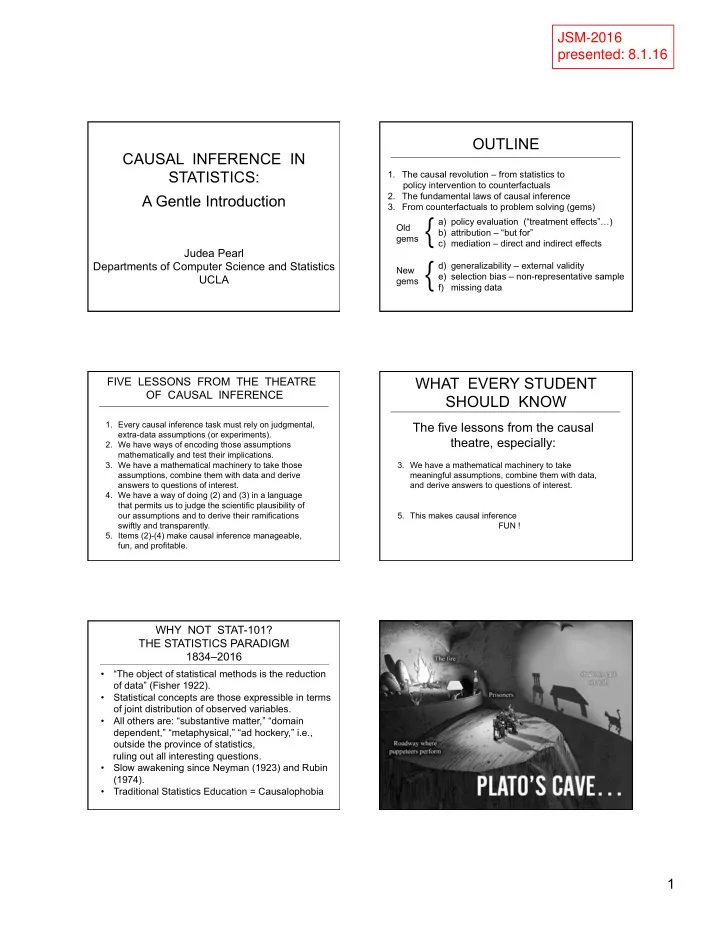

SLIDE 1
1
CAUSAL INFERENCE IN STATISTICS: A Gentle Introduction
Judea Pearl Departments of Computer Science and Statistics UCLA
- 1. The causal revolution – from statistics to
policy intervention to counterfactuals
- 2. The fundamental laws of causal inference
- 3. From counterfactuals to problem solving (gems)
a) policy evaluation (“treatment effects”…) b) attribution – “but for” c) mediation – direct and indirect effects d) generalizability – external validity e) selection bias – non-representative sample f) missing data
OUTLINE
{
Old gems New gems {
FIVE LESSONS FROM THE THEATRE OF CAUSAL INFERENCE
- 1. Every causal inference task must rely on judgmental,
extra-data assumptions (or experiments).
- 2. We have ways of encoding those assumptions
mathematically and test their implications.
- 3. We have a mathematical machinery to take those
assumptions, combine them with data and derive answers to questions of interest.
- 4. We have a way of doing (2) and (3) in a language
that permits us to judge the scientific plausibility of
- ur assumptions and to derive their ramifications
swiftly and transparently.
- 5. Items (2)-(4) make causal inference manageable,
fun, and profitable.
WHAT EVERY STUDENT SHOULD KNOW
The five lessons from the causal theatre, especially:
- 3. We have a mathematical machinery to take
meaningful assumptions, combine them with data, and derive answers to questions of interest.
- 5. This makes causal inference
FUN !
- “The object of statistical methods is the reduction
- f data” (Fisher 1922).
- Statistical concepts are those expressible in terms
- f joint distribution of observed variables.
- All others are: “substantive matter,” “domain
dependent,” “metaphysical,” “ad hockery,” i.e.,
- utside the province of statistics,
ruling out all interesting questions.
- Slow awakening since Neyman (1923) and Rubin
(1974).
- Traditional Statistics Education = Causalophobia